
The best way to clean windows is a mild soap wash, a squeegee, and dry edges. Wash the glass with a few drops of dish soap in water, pull the water off with a squeegee in overlapping passes, wipe the blade after every pass, and detail the edges with a dry cloth. That sequence, done in shade, beats any spray and wipe routine on full panes, and it works the same inside and outside.
Most streaks come from three faults: too much soap, solution left to dry on the glass, and a dirty squeegee blade dragged across a clean pane. Fix those three and the brand of cleaner stops mattering. The rest of this guide covers the cases where the standard method changes: screens, high glass, tint, plastic, car windows, hard water, mold, paint, cold weather, and new construction.
At a glance
| Job | Method | What changes |
|---|---|---|
| Full house panes | Soap wash plus squeegee | Work in shade, wipe the blade after every pass |
| Small panes and touch-ups | Spray cleaner plus two cloths | One cloth to wash, one dry cloth to buff |
| Outside glass | Hose rinse, wash, squeegee | Frames and screens first, never a pressure washer |
| High and second-story glass | Water-fed pole from the ground | Ladder only on firm, level ground; hire above that |
| Screens | Remove, wash, dry fully | Label each screen so it goes back to its own window |
| Tinted or coated glass | Ammonia-free cleaner, soft cloth | No ammonia, no abrasives, no razor blades |
| Plastic and plexiglass | Mild soap and lukewarm water | No ammonia, alcohol, or solvents of any kind |
| Car windows | Spray cleaner, two cloths, alcohol mix for film | Tint rule applies; keep spray off the dash |
| Hard water spots | Vinegar soak, then rinse and dry | Etched haze needs a pro polisher, not more acid |
| Fog between panes | No cleaning fixes it | Failed seal; the glass unit needs replacement |
What is the best way to clean windows without streaks?
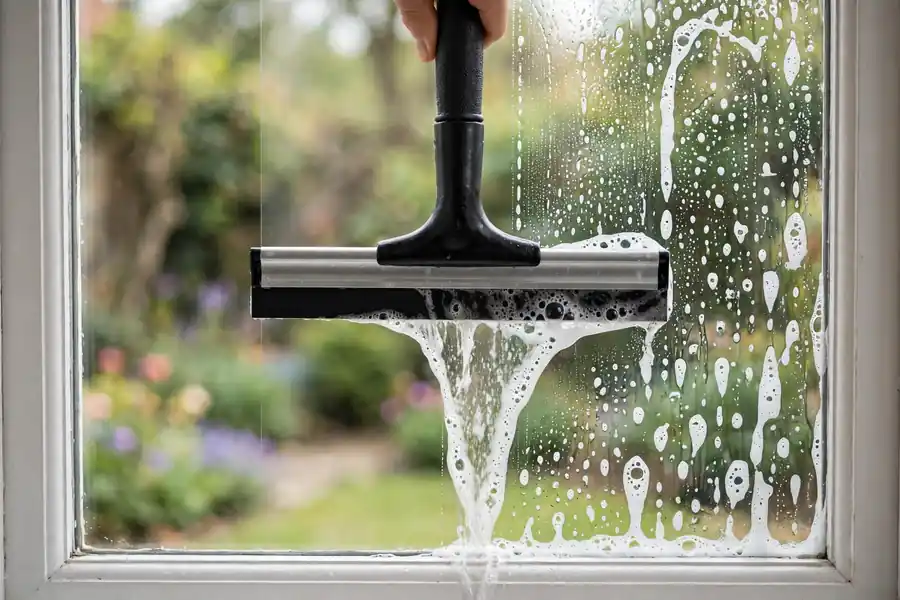
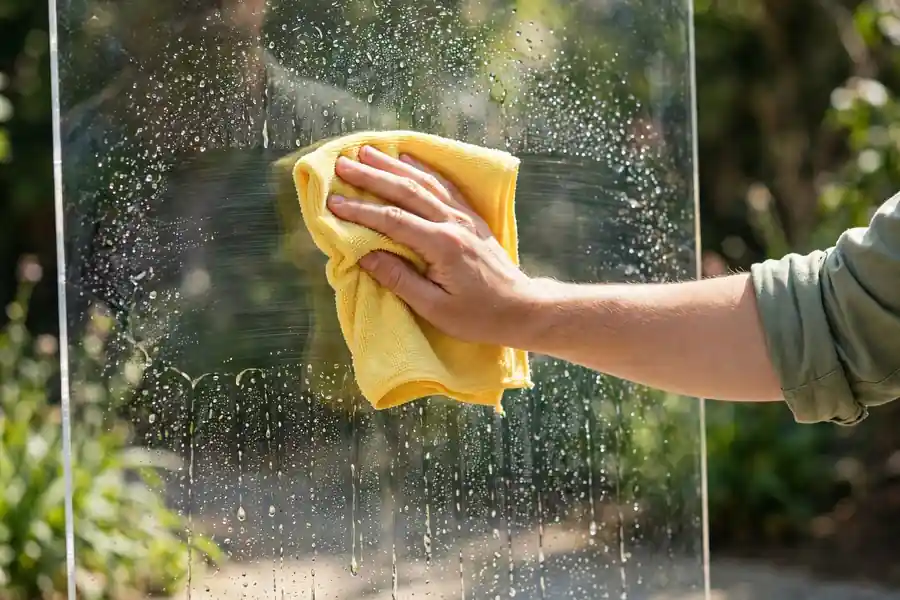
A squeegee removes dirty water instead of spreading it around, and that is the whole difference. Start with a dry edge: wipe a strip about one inch wide down one side of the pane with a dry microfiber cloth. Set the squeegee blade in that dry strip at the top corner, tilt it about 30 degrees so the leading edge meets the glass, and pull straight down in one smooth pass with light, even pressure. Wipe the rubber blade clean on a dry cloth after every pass, overlap the next pass by about an inch, and keep going until the pane is done. The 30 degree angle and the blade wipe come from professional guidance summarized by window trade sources read October 27, 2026, and both keep dirty water off finished glass.
On wide panes, use the S-technique instead of straight pulls. Start at the top corner and sweep the squeegee across in a smooth S shape, keeping the blade moving so water runs ahead of it in one ribbon. Unger consumer guidance, read October 27, 2026, describes the same move: tilt one edge down, pull down in a slightly diagonal direction, and finish each stroke against the frame. Detail the edges last with a dry cloth folded into quarters, and wipe the sill. Work in shade or on a cloudy day. Andersen care guidance, read October 27, 2026, says never to clean glass in direct sunlight, because solution dries on the pane before the squeegee reaches it, and that dried residue is a streak.
What tools do you need for streak-free glass?
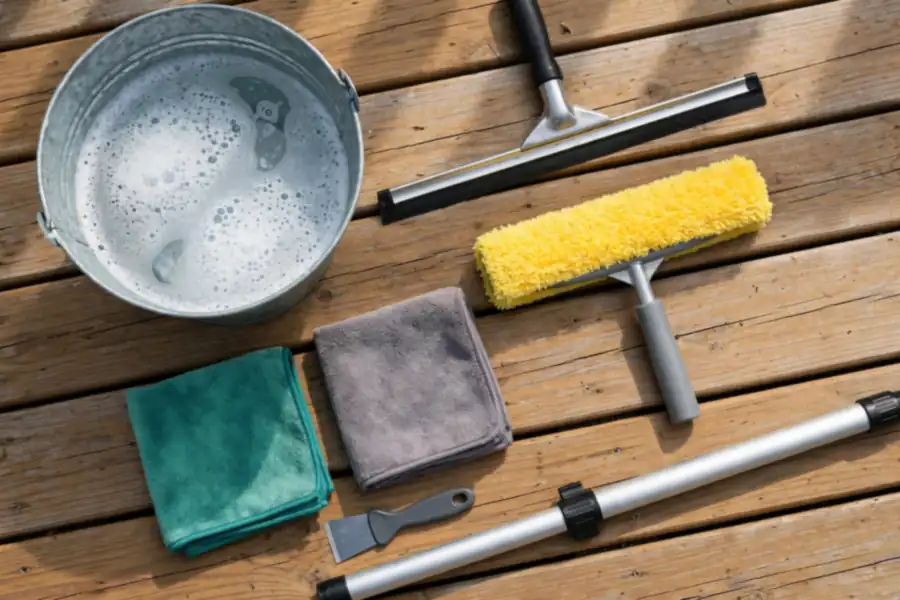
| Tool | What it does | What to avoid |
|---|---|---|
| Bucket | Holds the wash water | A bucket so small the water turns gray after two panes |
| Washer sleeve or sponge | Wets and scrubs the glass | Abrasive pads, steel wool, and gritty sponges |
| Squeegee, 10 to 14 inches | Pulls dirty water off in one pass | A nicked or dried-out blade, which chatters and leaves lines |
| Microfiber cloths, at least two | Dry edges, wipe the blade, buff | Paper towels, which shed lint, and old rags with grit |
| Detail cloth or scrim | Dries edges and corners | A damp cloth, which puts solution back on finished glass |
| Plastic scraper | Lifts paint and stickers on plain glass | Metal razor blades on coated or tinted glass |
| Extension pole | Reaches high glass from the ground | A pole used from a ladder, which doubles the fall risk |
| Garden hose with a gentle nozzle | Rinses outside glass and screens | A pressure washer, which forces water into seals |
Unger consumer guidance, read October 27, 2026, lists squeegees from 6 inches for small panes to 18 inches for large panes. A 12 inch squeegee suits most house windows. Replace the rubber when it nicks, drags, or leaves a line after wiping. A fresh blade costs little and decides the result more than any cleaner does.
Which cleaning solution fits each job?
| Solution | Use it for | Keep it away from |
|---|---|---|
| A few drops of dish soap in a gallon of water | Full panes, inside and out | Nothing; this is the default wash |
| Spray glass cleaner | Small panes, mirrors, touch-ups | Film tint, if the label says ammonia |
| Equal parts white vinegar and distilled water | Hard water spots, greasy film | Stone sills, film tint, and coated glass |
| Rubbing alcohol mixed with water | Car window film, smoke residue | Film tint and plastic; test a corner first |
| Plain distilled water rinse | Final rinse in hard water areas | No restriction |
Too much soap is the most common fault in a home wash. A few drops is enough to break the surface tension so the squeegee glides. A bucket full of suds leaves a film that no buffing removes, and it forces a second rinse. Rinse the washer sleeve often, and change the bucket water when it turns gray. For the final rinse on outside glass in a hard water area, distilled water leaves no minerals behind. A summary of the International Window Cleaning Association field guide, read October 27, 2026, sets 20 parts per million total dissolved solids or less for a spot-free final rinse; that figure is summary-basis and was not opened on an IWCA page directly.
Read the label before using any spray cleaner. Windex Original label directions, read October 27, 2026, say to spray and wipe, to work top to bottom, and to clean on a cloudy day so the sun does not dry the formula early. S.C. Johnson label text for its foaming glass cleaner, read October 27, 2026, says it is not recommended for film-tinted windows, vinyl surfaces, painted surfaces, or dashboards, because damage may occur. That warning decides the tint section below.
How do you clean windows without a squeegee?
Use two cloths and a spray cleaner, and keep the work small. Spray the glass lightly, wash with a damp microfiber cloth, then buff dry at once with a second, dry microfiber cloth before the cleaner dries. Work top to bottom so drips fall onto wet glass, not finished glass. Change to a dry section of the buffing cloth often. This method suits mirrors, small panes, French door lights, and touch-ups between full washes. It fails on large panes because the cleaner dries in patches before the buffing cloth reaches it, and each patch dries into a streak.
Newspaper is the old standby, and the honest verdict is mixed. Dry newspaper buffs glass to a shine because the paper is dense and lint-free, and many cleaners used it for years. The risk is ink transfer on some papers, and modern newsprint is thinner and weaker than the stock the trick came from. Glass Doctor guidance, read October 27, 2026, advises against newspaper because newsprint can smear on the glass. Microfiber does the same job with no ink risk, so newspaper is a fallback, not a first choice. Never use newspaper on tint or plastic, where ink and grit both cause damage that does not wipe off.
How do you clean outside windows?
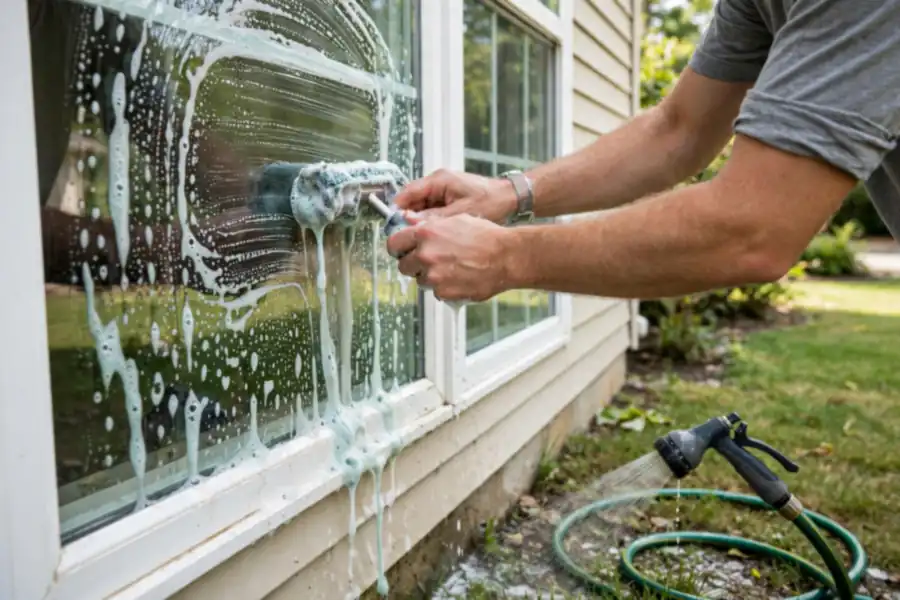
Start from the outside, and start with everything that is not glass. Hose the pane down on a gentle setting to float off grit, because grit dragged across dry glass scratches it. Wash the frames and sills with the same soap water before touching the glass, so dirty frame water cannot run onto a finished pane. Take the screens out first and wash them separately, as described below. Then wash the glass with the sleeve, squeegee it off, and detail the edges. Rinse the sill last and wipe it dry.
A hose-end sprayer that attaches to a garden hose can rinse second-story glass from the ground, and Windex sells one for that purpose, with label directions, read October 27, 2026, to rinse, spray, wait about 15 seconds without letting suds dry, and rinse again. Treat that as a rinse aid for light soil, not a substitute for a wash on dirty glass. Never use a pressure washer on windows. Trade and maker sources agree that high-pressure water breaks the seals of insulated glass units, drives water into frames and wall cavities, and can crack panes. The fog that appears between panes after pressure washing is a broken seal, and no cleaning fixes it.
How do you clean second-story and high windows safely?
Clean every window you can reach from the ground with a water-fed pole, and treat a ladder as the last resort, not the default. A pole with a washer and squeegee head reaches most second-story glass from firm ground, and it keeps both feet on the ground while the glass gets the same wash and squeegee sequence. Work the pole in short sections so solution does not dry before the squeegee pass.
If a ladder is the only way, follow the ladder rules in OSHA standard 29 CFR 1926.1053, read in summaries October 27, 2026. Set an extension ladder at a 4 to 1 angle, meaning the base sits one foot out from the wall for every 4 feet of height. Extend the side rails at least 3 feet above the landing. Keep three points of contact at all times, two hands and a foot or two feet and a hand. Face the ladder, keep your body between the rails, and never stand on the top rung or the top cap. Inspect the ladder before use, set it on firm, level ground, and secure it against slipping. Never lean out of a window to reach outside glass, never work from a ladder in wind or on wet ground, and never set a ladder where a door can swing into it.
Hire a pro when the glass sits above the second story, when the ground slopes or is soft, when power lines run near the work, or when the window opens over a drop. A pro brings poles, pure water systems, and insurance for the fall risk, and the cost of that visit is small against a fall from 18 feet. Local pros exist in most areas; get two quotes and confirm insurance before anyone climbs.

How do you clean window screens?
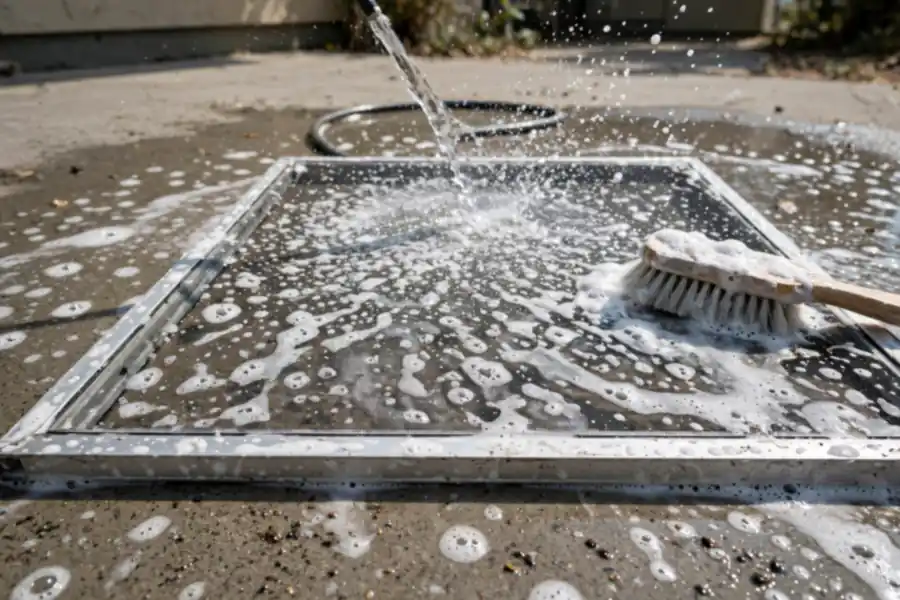
Take the screens out, label each one, and wash them flat. Andersen screen guidance, read October 27, 2026, describes the pro method: hose the screen down, scrub both sides lightly with a washer sleeve dipped in mild soap water, tap each side lightly to shake the solution off, hose it off, and let it air dry. Andersen's guide uses 2 to 3 gallons of water with a 10-second squeeze of dish soap for the wash; that figure comes from a maker page excerpt and is summary-basis. A quarter cup of dish soap in a gallon of warm water is the same idea at home scale. Use a soft brush, never a stiff one, and press lightly. Mesh stretches and tears under hard pressure, and a stretched screen never sits flat again.
Label each screen with painter's tape showing the room and position before it comes off. Houses settle, and screens that look identical often fit only their own window. Check the mesh for holes and the spline, the rubber cord that holds the mesh in its channel, for looseness while the screen is out. A torn screen lets in the insects the screen exists to stop. Let screens dry fully before reinstalling, because a wet screen holds moisture against the frame. Screens that cannot come out get the same wash in place with a spray bottle for rinsing, and the window stays open until the screen is dry.
How do you remove hard water spots from glass?
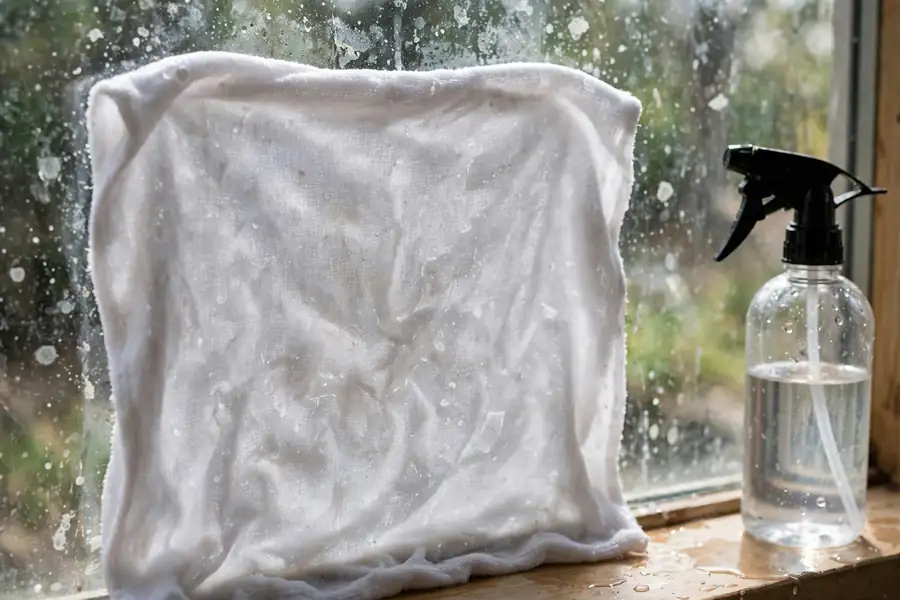
Soak the spots in acid, then rinse and dry. Mix equal parts white vinegar and distilled water, soak a soft cloth in it, and hold the cloth flat against the spotted glass for 5 to 10 minutes before wiping. The soak does the work; scrubbing dry does not. Rinse with plain water and dry the pane at once. If spots survive, repeat the soak the next day instead of reaching for something harsher, because layered deposits come off in layers. Keep the vinegar off stone sills, which acid etches, and off film tint. Use distilled water for the mix, because tap water adds the same minerals back.
Test whether the haze is scale or etching before going further. After the vinegar soak and rinse, run a fingertip across the dry glass. Scale sits on top of the glass and lifts with the soak. Etching is pitting in the glass surface itself, left by minerals that sat for years in sun, and it feels rough or hazy after cleaning. No cleaner dissolves etching. Restoration pros polish etched glass with cerium oxide paste on a felt pad, and that is a hired job, not a home remedy, because a polisher in untrained hands heats and hazes the pane. Fix what keeps wetting the glass, such as a sprinkler head aimed at the window, or the spots return within weeks.
How do you clean vinyl window frames?
Wash vinyl frames with the same mild soap and water used on the glass. Pella installation instructions, read October 27, 2026, say the vinyl frame may be cleaned the same way as the glass, and that a nonabrasive cleaner such as Bon-Ami or Soft Scrub may be used for stubborn dirt. Pella warns against solvents such as mineral spirits, toluene, xylene, naphtha, or muriatic acid on vinyl, because they can dull the finish, soften the vinyl, and cause failure of the insulated unit seal. Do not use abrasives, and do not scrape vinyl. Keep the tracks clear of dirt and debris, and keep the weep holes, the small drain slots at the bottom of the frame, open and clear of obstructions, because blocked weep holes hold water in the frame and feed mold.
How do you clean tinted windows without damage?
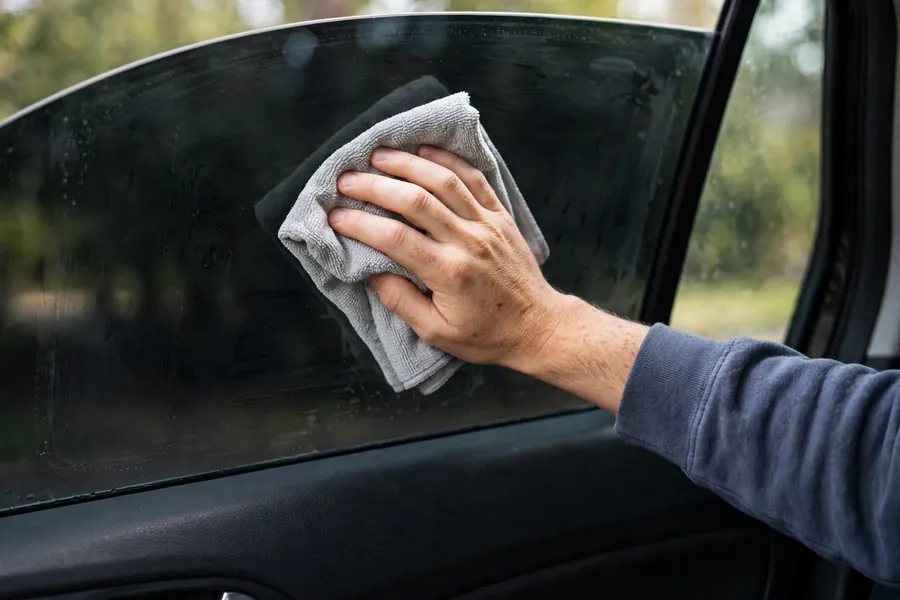
Use an ammonia-free cleaner and a soft cloth, and nothing else. Ammonia attacks the adhesive that holds aftermarket film to the glass, and over time the film bubbles, lifts at the edges, and fades. S.C. Johnson label text, read October 27, 2026, says its ammonia formula is not recommended for film-tinted windows. 3M says to wait until its Sun Control film has fully cured, about 30 days, before cleaning with an ammonia-based cleaner, so use an ammonia-free cleaner before then and follow the care sheet for the film you have, since warranty terms differ by maker. Factory tint is different: the color sits inside the glass itself during manufacture, and ammonia does not harm it. If you cannot tell which kind you have, assume film and use ammonia-free cleaner.
Wash tinted glass gently, with no abrasives and no razor blades, and dry it with a soft microfiber cloth. Do not use vinegar on film tint, and do not let any cleaner dry on the film. Clean the film side, which is the inside face on cars and most house windows, last in the room, so overspray from other cleaning cannot sit on it. If the film already bubbles or peels, cleaning will not save it; the film needs replacement by a tint installer.
How do you clean plexiglass and plastic windows?
Treat plastic as a soft surface, not as glass. Rinse grit off first with plain water, because dust and sand score acrylic the way sandpaper scores wood. Wash with a small quantity of mild soap and lukewarm water, rinse well with clean water, and dry with a microfiber cloth, a chamois, or a soft cotton cloth. Plastics supplier care guidance, read October 27, 2026, says never to use ammonia-based glass cleaners, solvents, or alcohol on acrylic, and warns against window cleaning fluids, scouring compounds, gritty cloths, lacquer thinner, benzene, and strong solvents. Ammonia clouds acrylic over time and can craze it, meaning fine cracks spread across the surface.
Never use a squeegee blade, a scraper, or a paper towel on plexiglass. Paper towels scratch, and a blade catches grit and scores a line across the pane. Wipe in straight lines, not circles, and press lightly. Fine scratches can be buffed out with a plastic polish, but deep scratches stay. Keep plastic windows out of direct sun while cleaning, and rinse before every wipe, because one grain of sand under a cloth does more damage than a year of washing.
How do you clean car windows inside and out?
Clean car glass in two passes: the outside like house glass, and the inside as a film removal job. Outside, wash with soap water, squeegee or wipe dry, and treat water spots with the vinegar soak used on house glass, keeping the vinegar off trim and wipers. Inside, the haze is a film of plasticizer from the dash, plus smoke, vape residue, and fingerprints, and it needs a cleaner that cuts film. Spray an ammonia-free glass cleaner onto the cloth, not the glass, wipe the pane, then buff with a second dry cloth. For stubborn film, wipe with a cloth dampened with rubbing alcohol mixed with water, then follow with glass cleaner and a dry buff. Keep spray off the dash, vents, and electronics, and keep the cloth off the rear defroster lines, which scratch easily.
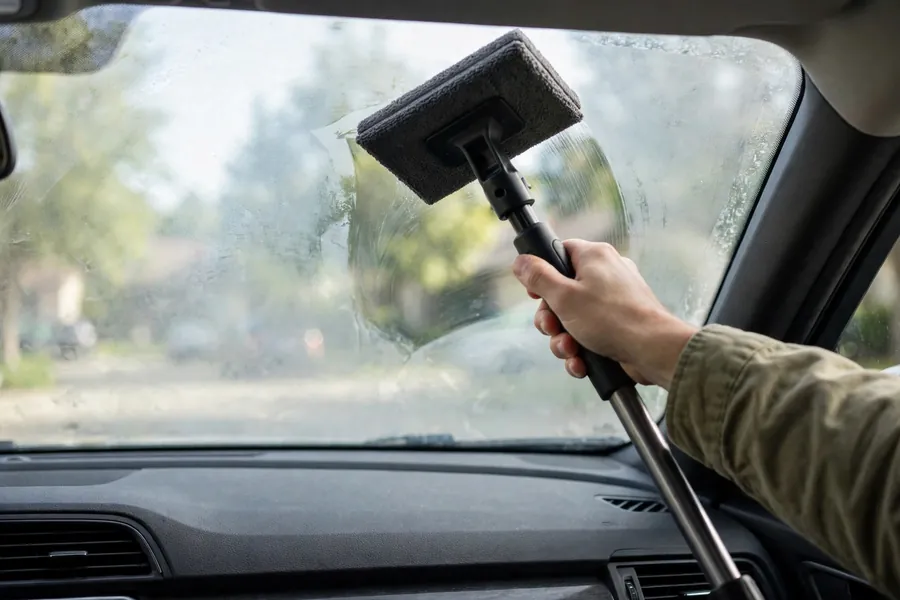
Most car tint is aftermarket film on the inside face, so use ammonia-free cleaner only, and skip the alcohol mix on tinted panes unless the tint installer approves it. Clean the inside of the windshield last, in sections, because the slope makes cleaner run down before it is wiped. A reach tool with a flat microfiber pad helps on deep windshields. Do not use a razor blade on any car window with defroster lines, antenna traces, or tint.
How do you remove paint, tape, and sticker residue from glass?
Soften the residue first, then lift it with plastic, never with a blade on coated glass. Soak the spot with warm soapy water or a vinegar-soaked cloth for 10 to 20 minutes, then push the softened residue off with a plastic scraper or the edge of a credit card. Work from the edge of the spot inward, and rinse the glass as you go so loosened adhesive does not resettle. For tape residue, the same soak works, and a cloth dampened with rubbing alcohol takes off what water leaves behind, except on tint and plastic.
Metal razor blades are the fault to avoid. Andersen care guidance, read October 27, 2026, says not to use metal razor blades to clean glass or remove paint from the glass surface, because scratching can damage the low-maintenance coating on its Low-E4 glass. On plain, uncoated glass a single-edge blade held flat on wet glass is a trade tool, but the coating on modern glass cannot be told apart by eye, so the safe rule is plastic only unless the window maker says otherwise. Mineral spirits remove stubborn adhesive on plain glass, but Pella guidance, read October 27, 2026, bars solvents on vinyl frames and warns they can damage insulated unit seals, so keep solvents off frames and off coated glass.
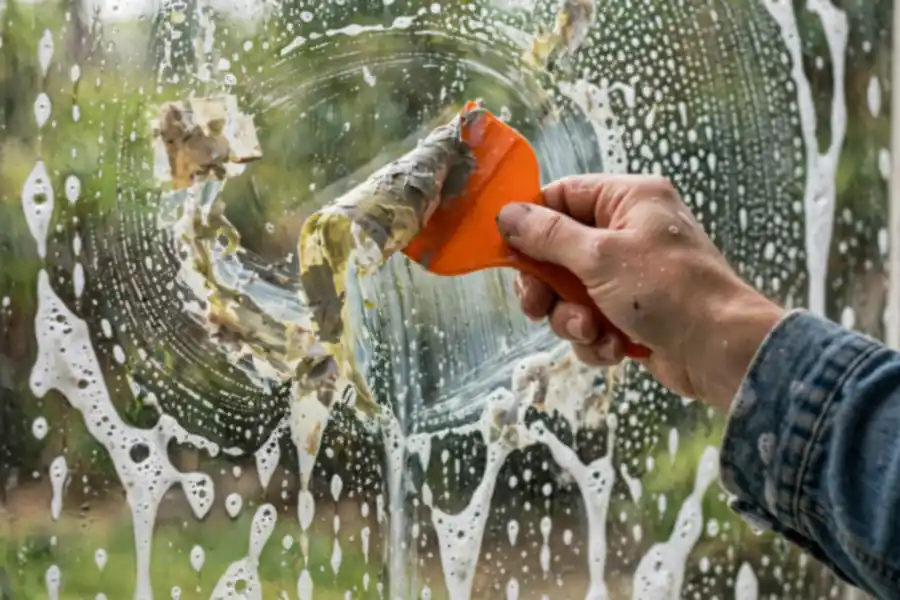
How do you clean mirrors and glass doors?
Use the same method as house glass, with a lighter hand on the solution. Spray lightly, wipe with a damp microfiber cloth, and buff dry at once. Mirrors fog and spot from the same film as windows, and the same spray cleaner works. Keep liquid out of the mirror edges and the frame seam, because moisture that gets behind a mirror attacks the silver backing and leaves black edges that never come back. Wipe the edges dry as a separate step.
Sliding glass doors need the tracks cleaned before the glass, because track dirt washes onto the pane and grinds into the rollers. Vacuum the track, wash it with soap water and a stiff brush, rinse, and dry it before washing the glass. Patio door glass is usually large, so use the S-technique with the squeegee. French door lights are small panes, so use a 6 inch squeegee or the two-cloth method, and detail each small pane separately instead of dragging the blade across the muntins, the bars between panes.
What should you do about mold around windows?
Fix the moisture first, then clean the mold. Mold around windows grows where condensation sits: on cold glass, in tracks, and on sills that stay damp. The EPA guide to mold, moisture, and your home, read in excerpts October 27, 2026, says to keep indoor humidity below 60 percent, ideally between 30 and 50 percent, and to dry wet materials within 24 to 48 hours. Wipe condensation off glass and sills when you see it, run the bath or kitchen fan during steam, and keep weep holes clear so frames drain. If a window leaks, the leak gets fixed before any cleaning, because mold returns wherever water keeps arriving.
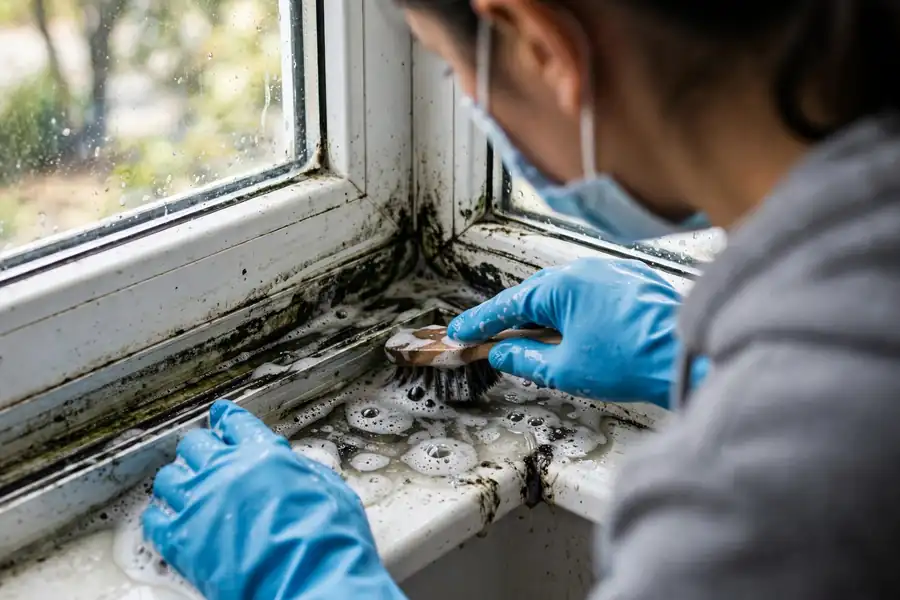
For the cleanup itself, scrub the hard surfaces with detergent and water, rinse, and dry fully. Do not paint or caulk over mold, and do not mix bleach with any other cleaner. The EPA guide says a moldy area under about 10 square feet is in most cases one a homeowner can handle, with gloves, eye protection, and a mask rated N-95 or better. Wear the same protection when scrubbing tracks, because the work stirs spores into the air. If the mold covers a larger area, sits inside a wall, or follows a leak you cannot find, hire a mold remediation pro. Black color alone says nothing about the type of mold or the risk, and no home test settles that question.
How do you clean windows in cold weather?
Use lukewarm water, work in small sections, and dry each pane before moving on. Cold glass chills the wash water fast, and solution left on a cold pane dries slowly into streaks or freezes at the edges. Lukewarm water keeps the soap working without shocking the glass. Never pour hot water on a frozen pane, because the sudden temperature change can crack glass, and never let solution freeze on the pane. Work one pane at a time, squeegee it dry, and detail the edges before starting the next.
Below freezing, the practical choice is to wait or hire. A small amount of rubbing alcohol in the wash water helps it dry before it freezes, and trade sources describe winter mixes that use alcohol for that purpose; that guidance is summary-basis and was not verified on a maker page. Inside glass can be cleaned all winter, since the room stays warm. Outside glass in hard frost, snow, or wind is a pro job with pure water gear, or a job for a milder day. Spring and fall are the easy seasons for outside glass in most climates, because the air is cool and the sun is low.
How do you clean windows after construction?
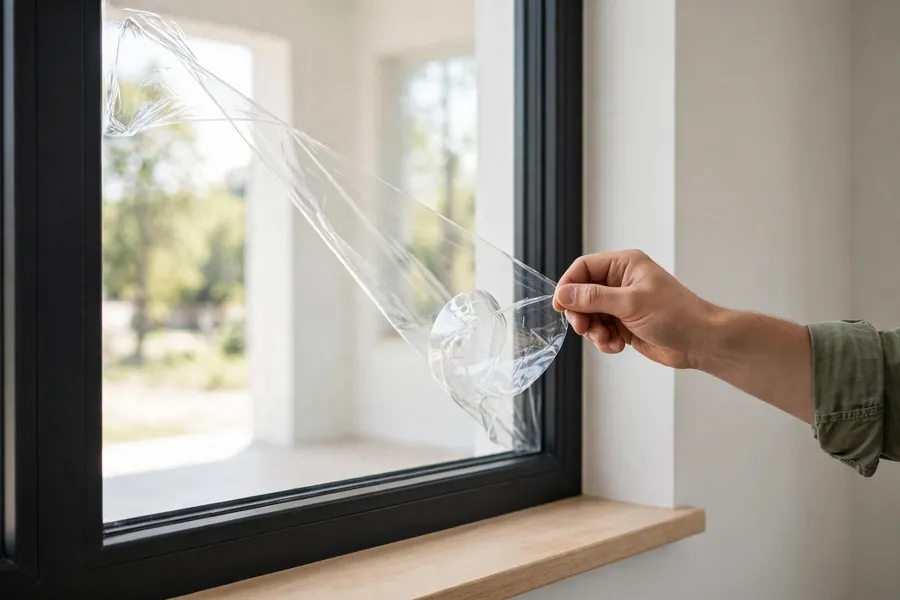
Dust first, remove the protective film by hand, and keep blades and acids off the glass. New windows ship with a protective film on the glass, and Andersen guidance, read October 27, 2026, says to remove it within 9 months of installation, in temperatures above 32 degrees Fahrenheit, by peeling it back at a corner with a fingernail or a clean plastic scraper. Never use a metal razor blade to remove the film. Vacuum dust off the glass and frames before any wet work, because construction dust holds grit that scratches glass under a cloth.
Wash with mild soap and water once the dust is off, and rinse well. Acid solutions used for cleaning masonry or concrete damage glass, fasteners, hardware, and metal flashing, according to Andersen guidance, so mask the glass before any masonry wash and rinse at once if acid touches a window. Paint, plaster, and adhesive on new glass come off with the soak and plastic scraper method. Heavy debris, etched glass, and scratched coatings after construction are pro territory. Angi cost data, updated October 8, 2026, from 25,969 verified projects, puts post-construction window cleaning at $12 to $20 per window, against $8 to $16 for both sides on a standard clean.
Why does glass stay cloudy or foggy after cleaning?
Cloudy glass after a careful clean means the problem is not dirt on the surface. Three causes cover nearly every case. The first is cleaner residue, usually too much soap or a spray left to dry, and it wipes off with a fresh wash in plain water followed by a dry buff. The second is etching from hard water, which feels rough after cleaning and does not wipe off. The third is a failed seal in a double pane window, where fog sits between the panes and cannot be wiped from either side.
A failed seal means the edge seal of the insulated glass unit has let moist air in, and the moisture condenses between the panes. Cleaning either face cannot reach it. The lasting fix is replacing the sealed glass unit inside the existing frame, which a glass company measures and orders to size. Defogging services drill a hole, vent the moisture, and fit a valve, but the seal stays broken and the insulating gas stays gone, so the fog usually returns. If the frame is sound, glass-only replacement costs less than a new window. If several windows fog at once, expect more to follow, and get the whole house assessed before replacing one at a time.
Do skylights, storm windows, and French doors need a different method?
The method stays the same, and the access and handling change. Skylights get cleaned from inside with a pole, or from the roof only by someone trained and tied off for roof work, because skylight glass is overhead and the slope sends solution running. Never stand on a skylight. Clean skylights on a cool, cloudy day, since sun heats the glass and dries solution fast. Storm windows come off, get labeled like screens, and wash flat on a soft surface with soap water and a squeegee, then dry fully before going back. A storm window left wet in its frame traps moisture against the primary window.
Double-hung windows that tilt in wash from inside: release the sash, tilt it in, support it with one hand, and wash the outside face from the room. Never let a tilted sash hang by its cords or balances. French doors and divided lights use a small squeegee or the two-cloth method, pane by pane. Sliding doors get their tracks cleaned first. None of these types needs a different cleaner, only a different way to reach the glass safely.
When should you hire a window cleaner?
Hire when height, access, or glass condition puts the job past safe home methods. The hire line sits at glass you cannot reach from the ground with a pole, glass over a sloped or soft yard, glass near power lines, skylights that need roof access, etched or coated glass that needs polishing, and any window with a failed seal. A pro also makes sense for a whole house clean once or twice a year, when the time and ladder work outweigh the visit cost. Get two quotes, confirm the quote covers screens and tracks, and confirm insurance before anyone climbs.
| Service | Angi cost data, updated October 8, 2026, from 25,969 verified projects |
|---|---|
| Interior only, per window | $4 to $8 |
| Exterior only, per window | $4 to $8 |
| Both sides, per window | $8 to $16 |
| Post-construction, per window | $12 to $20 |
| High or specialty access, per window | $15 to $40 |
| Whole house visit | $150 to $303 |
Those figures were read on the Angi page October 28, 2026, and they move with window count, size, access, and region. A house with many small divided lights costs more per window than a house with large fixed panes, and skylights cost the most. Ask what the quote includes, because screens, tracks, and hard water treatment are often separate. If a quote seems far below the bands above, ask whether screens, tracks, and insurance are included before booking.
Start with the dirtiest ground-floor window
The best way to clean windows becomes a habit once the first pane goes well, so start with the dirtiest ground-floor window and run the full sequence on it: rinse, wash, squeegee, detail the edges. Judge the result in daylight from inside the room. If the pane is clear, repeat the sequence across the house, screens first and high glass last. If the pane still shows haze, run the scale test from the hard water section before buying a stronger cleaner, because the fix for residue, etching, and a failed seal is different in each case, and only one of the three is a cleaning job at all.
Quick answers to common questions
Can you clean windows with vinegar and water?
Yes, on plain glass. Equal parts white vinegar and distilled water cuts grease and dissolves light mineral deposits. Keep the mix off stone sills, film tint, and coated glass, rinse after the soak, and dry at once. For a full wash, mild soap water and a squeegee still beats vinegar, because vinegar alone does not lift heavy soil as well.
Does newspaper clean windows without streaks?
It can, on small plain panes, because dense newsprint buffs without lint. The risk is ink transfer, and modern paper is thin enough to tear when wet. Microfiber does the same job with no ink risk, so newspaper is a fallback. Never use it on tint, plastic, or coated glass.
How often should house windows be cleaned?
Twice a year suits most homes, once in spring and once in fall. Angi says professional cleaning is recommended once or twice per year, with spring and fall as peak seasons. Homes near busy roads, trees, sprinklers, or the sea need more frequent outside washes, and kitchen windows near a range need more frequent inside washes. Screens get cleaned at the same visits, because dirty screens soil clean glass within days.
Can you use a pressure washer on windows?
No. High-pressure water breaks the seals of insulated glass units, drives water into frames and wall cavities, and can crack panes. Use a garden hose on a gentle setting for rinsing, and a washer sleeve and squeegee for the wash. A pressure washer belongs on driveways and siding, kept well away from glass.
Why do windows fog between the panes?
The edge seal of the insulated glass unit has failed, letting moist air between the panes, where it condenses into fog that cannot be wiped from either side. The lasting fix is replacing the sealed glass unit inside the existing frame. Defogging clears the view for a time but does not restore the seal or the insulating gas.