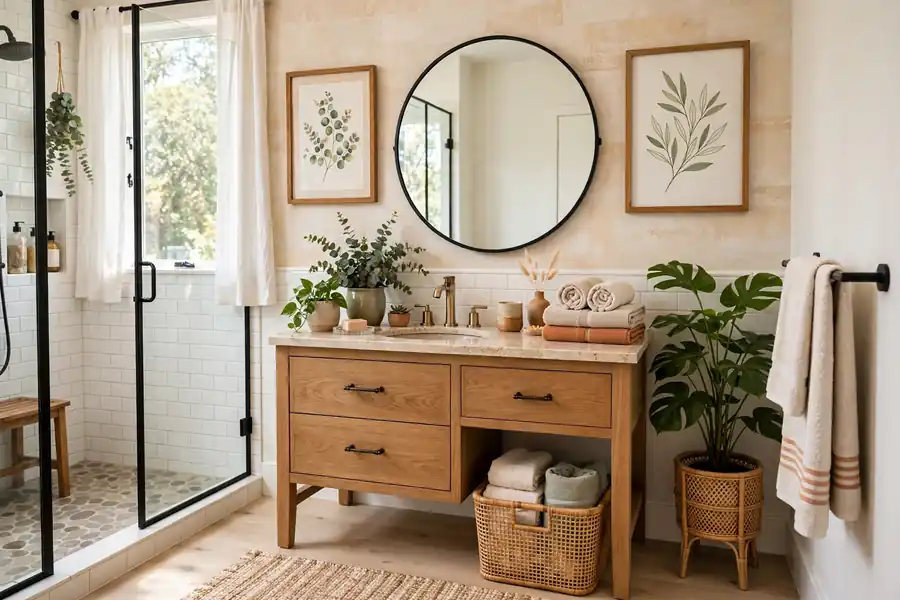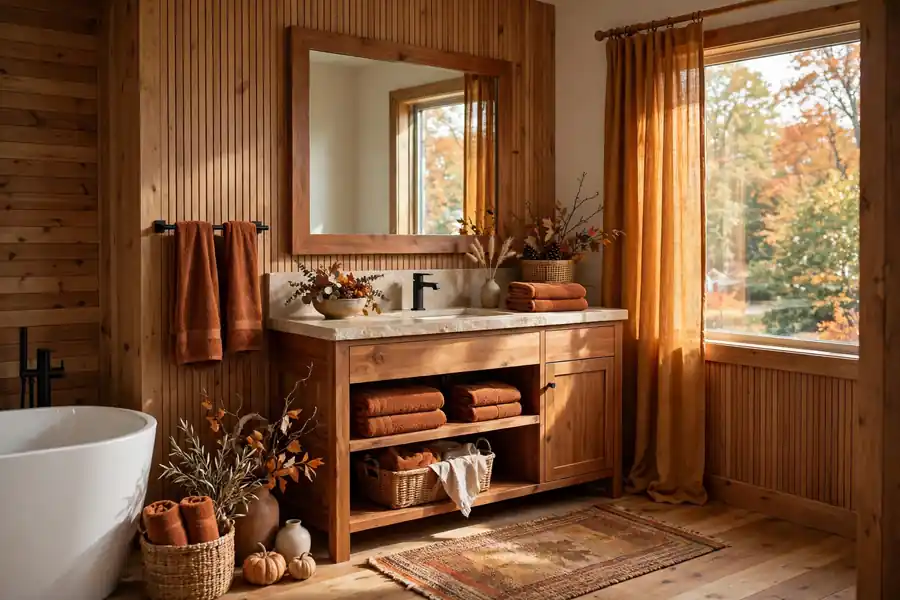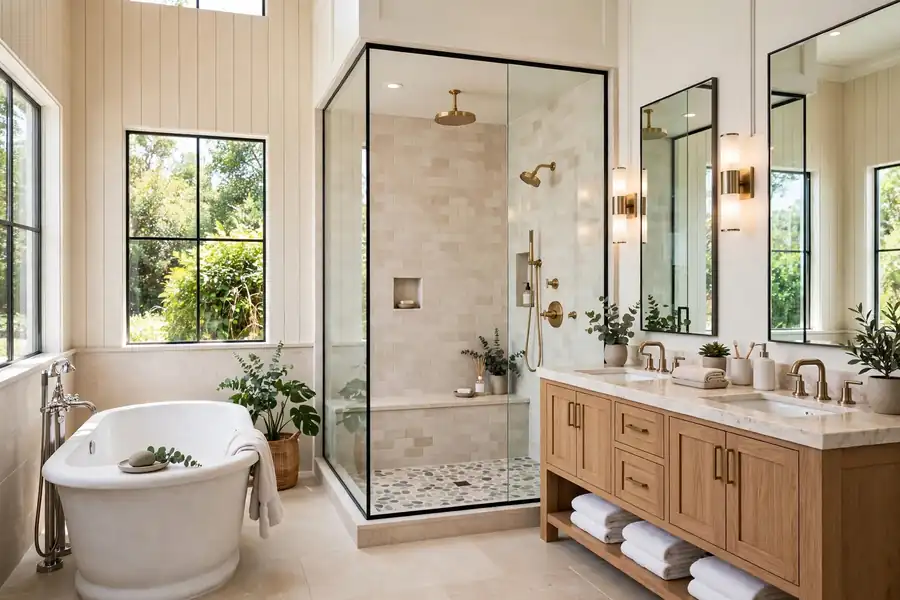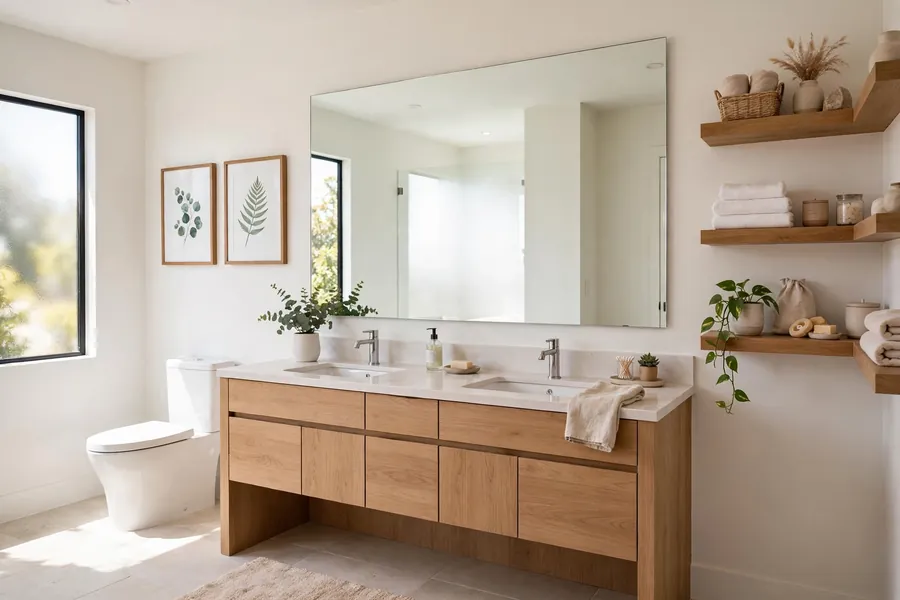
A bathroom wall stays bare for a reason. Steam, splashes, and daily temperature swings punish paper, raw wood, and weak glue, so the pieces that last are chosen for the wall they hang on, not for the catalog photo. The best bathroom wall decor starts with the driest wall in the room, uses sealed or nonporous materials, and hangs on fixings rated for the weight.
At a glance
| Decision | Rule that holds up | Where it goes wrong |
|---|---|---|
| Driest wall first | Hang art on the wall farthest from the shower | A print beside the shower fogs and warps |
| Sealed back | Tape the frame backing shut all round | Damp air enters from behind and spots the print |
| Frame material | Metal or sealed synthetic in steamy rooms | Raw wood swells, opens at the corners, and molds |
| Glazing | Acrylic over glass where feet are bare | Glass breaks on hard floors |
| Hanging | Stud or rated anchor, never a bare nail in drywall | A shelf pulls out under jars |
| Height | Center of a single piece at standing eye level | Art hung too high reads as an afterthought |
| Fan | Fan on during the shower and 20 minutes after | Steam sits in the room and feeds mold |
Why does wall decor fail in a bathroom?
Steam is the cause, and the fan is the fix. A bathroom fills with warm, wet air every time the shower runs, and that air condenses on the coldest surfaces first, which are often a mirror, a window, and the back of a frame. The U.S. Environmental Protection Agency, in "A Brief Guide to Mold, Moisture and Your Home," read October 27, 2026, states the rule plainly: keep indoor humidity below 60 percent, ideally between 30 and 50 percent, and dry wet materials within 24 to 48 hours. The guide adds that damp places stay hard to keep free of mold unless ventilation increases and cleaning happens more often.
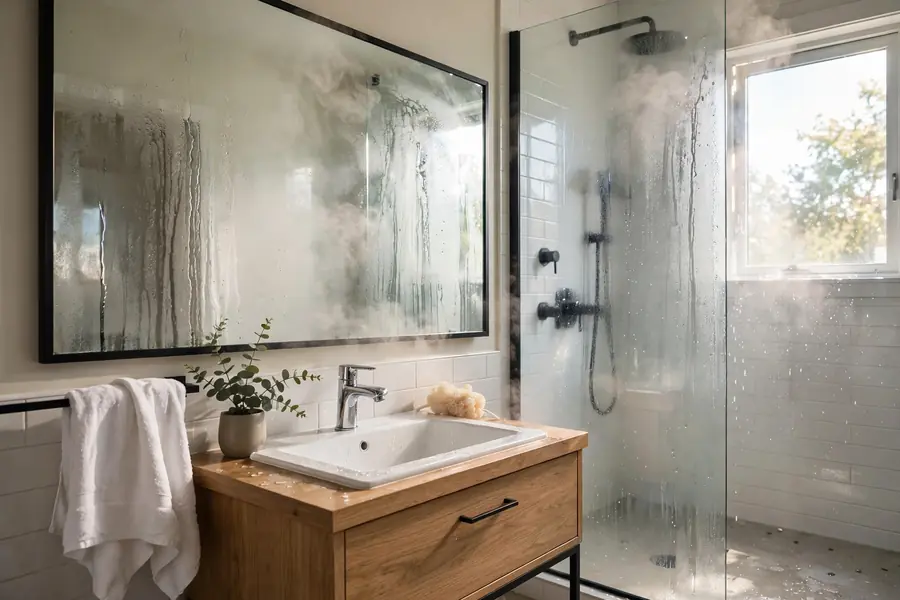
Size the fan to the room before hanging anything. The Home Ventilating Institute method calls for 1 cubic foot per minute (CFM) per square foot of floor in rooms of 50 to 100 square feet, with 50 CFM for rooms smaller than 50 square feet, and 50 CFM per fixture (toilet, shower, tub) and 100 CFM for a jetted tub in rooms larger than 100 square feet. Building code sets a lower floor at 50 CFM intermittent or 20 CFM continuous, and The Home Ventilating Institute recommends that the fan be left on for 20 minutes after use of the bathroom. A fan that meets only the code floor leaves the room damp longer.
Which bathroom wall decor survives steam best?
Metal prints, coated canvas, sealed framed prints, and glazed tile survive steam best, because none of them lets water reach a paper or wood core. A metal print is a photograph bonded to aluminum, so there is no paper to cockle and no frame joint to open. A coated canvas carries a clear protective coat over the print, which lets it be wiped with a damp cloth. A framed print survives when the frame back is sealed with tape all round, the print sits on a mount that holds it off the glazing, and the glazing is acrylic rather than glass.
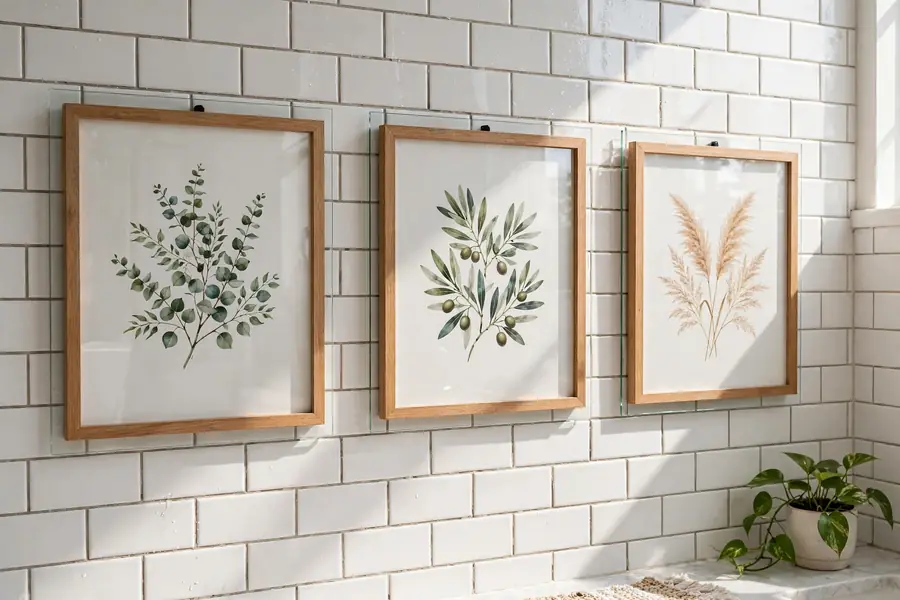
Frame material matters as much as the print inside. Aluminum and synthetic moldings cope with humidity and temperature swings without moving. Wood takes up water from humid air and gives it back as the room dries, so a wooden frame swells and shrinks with every shower. In a small bathroom with a daily shower, choose metal, and seal the back in both cases, since damp air enters from behind more often than from the front.
How should mirrors work as wall decor?
A mirror earns its place on a bathroom wall twice over: it bounces light into a room that often has one small window, and it acts as the visual anchor the wall needs. A single large mirror over the vanity is the default, and it works because the vanity already sets the width. A mirror two to six inches narrower than the vanity in total leaves room for the sconces and keeps the glass clear of the side walls. The general decor guide owns the rest of mirror selection.
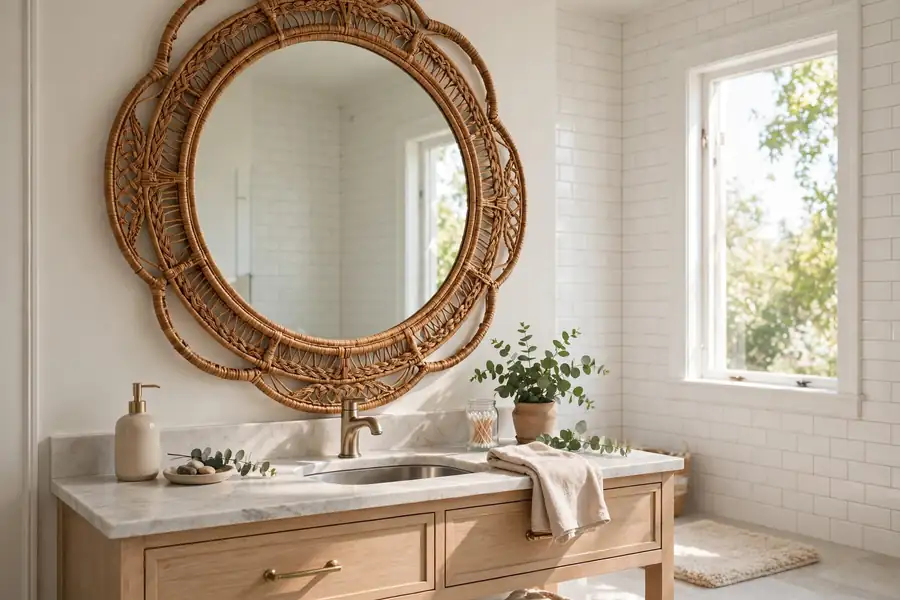
Decorative mirrors earn their keep away from the vanity. An arched mirror on the wall opposite the door gives a small room a focal point that a flat print cannot match, since it reflects the window or the brightest wall.
How do you style shelves on a bathroom wall?
A floating shelf turns a bare wall into storage and display in one move, and it suits a bathroom because it keeps jars, towels, and plants off wet counters. Shelf depth decides whether it works: six to eight inches holds rolled towels, jars, and a small plant without jutting into the walking path, while four inches suits a display ledge for two or three small objects. A shelf deeper than eight inches crowds the person at the sink, so measure the walkway first.
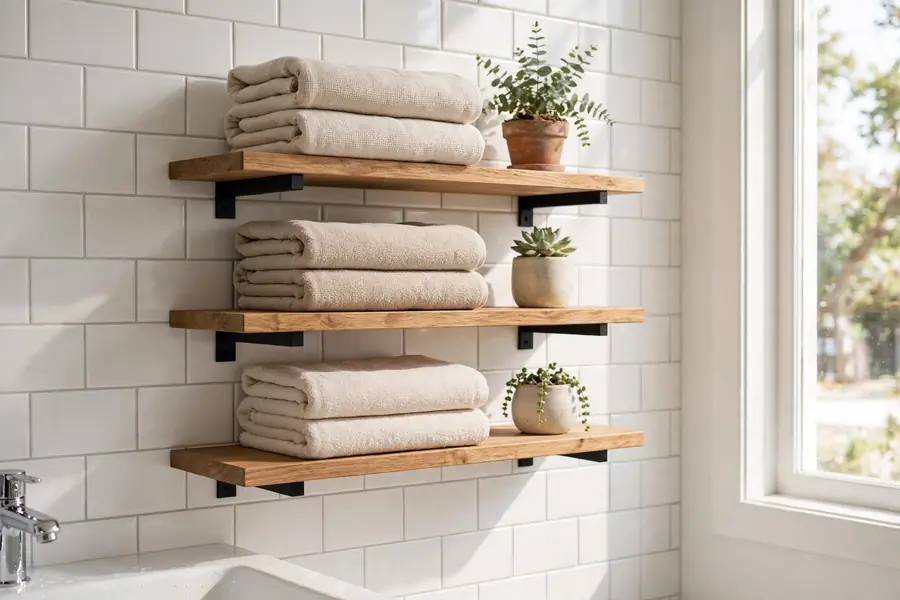
Hang shelves on studs where possible. A stud finder marks the framing, and a screw driven into solid wood carries far more load than any drywall anchor. Where no stud lines up, use a rated toggle bolt or metal molly bolt, and follow the load rating printed on the anchor package. The anchor rating must cover the shelf plus everything on it. Never hang a loaded shelf on a bare nail or a small plastic plug in drywall alone.
Do wall decals and stickers hold up in a bathroom?
Vinyl wall decals hold up well in a bathroom when they sit on a smooth, dry, fully cured painted wall away from direct spray. Vinyl is nonporous, so steam beads on it instead of soaking in, and a smooth wall gives the adhesive full contact. The same decal fails on textured paint, on fresh paint that has not cured, and on a wall inside the shower, where direct water lifts the edges within weeks. Wait at least two weeks after painting, since paint that looks dry still releases vapor as it cures, and trapped vapor pushes the decal off.
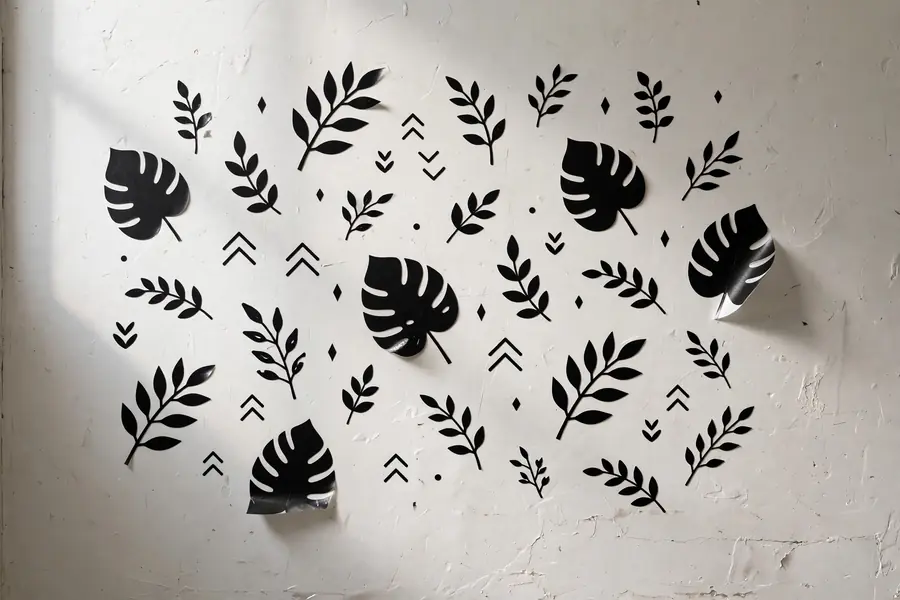
Tile, glass, and mirror take decals well and release them cleanly, which makes a decal a sound renter choice for a tiled wall. Smooth glazed tile gives the adhesive a flat grip, and the decal peels off without residue when it is warmed with a hair dryer on a low setting. Rough stone tile, matte unglazed tile, and grout lines break the seal, so a decal spanning a grout line lifts at the line first. Cut the decal to sit inside a single tile where the design allows.
Can wallpaper work as wall decor?
Vinyl and vinyl coated wallpaper work in a bathroom because the vinyl face sheds water, and peel-and-stick vinyl gives renters a wall treatment that removes without damage. Keep both out of direct spray. A wall beside the vanity or behind the door takes wallpaper well, while the wall inside a shower or directly behind a tub filler does not, since standing water finds seams and edges. Seal the edges and seams with the method the wallpaper maker states.
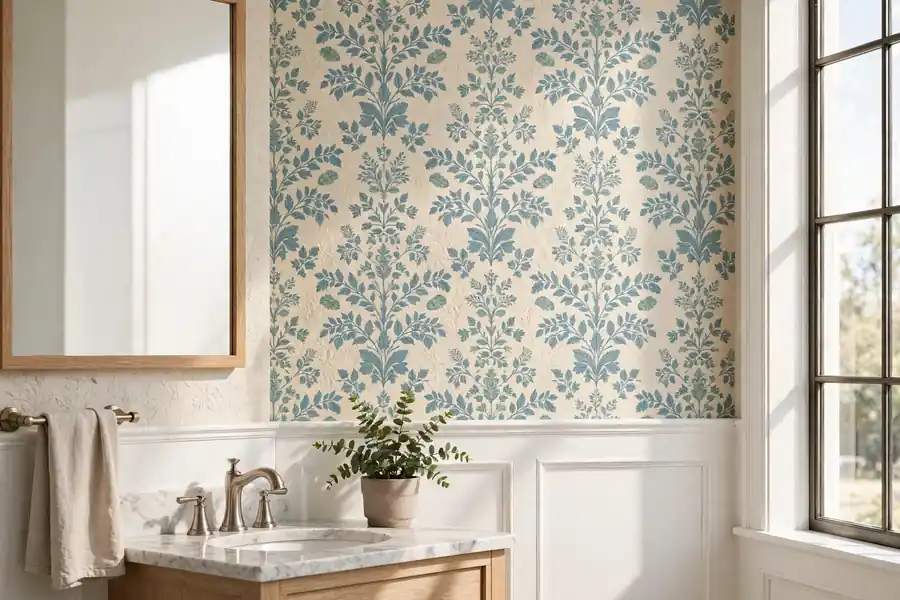
Paste and paper wallpaper without a vinyl face fails in a steamy room. The paper absorbs moisture, the paste softens, and the seams open. The same applies to grasscloth and fabric wallcoverings, which hold damp air in their fibers and grow mold behind the surface where it cannot be seen. If the room has no fan or the fan is undersized, skip wallpaper entirely until ventilation is fixed, since no wallcovering survives a room that never dries.
What about tile, wainscoting, and paneling on the wall?
A tile accent wall is the hardest wearing wall decor a bathroom can have, since glazed tile ignores steam, splashes, and cleaning chemicals alike. One tiled wall behind the vanity or the tub gives the room a focal point and a surface that wipes clean, The tile guide owns tile selection, sizes, grout, and slip ratings, and this guide states only the decor rule: one accent wall, chosen for the surface that takes the most splash, beats four tiled walls for both cost and comfort.
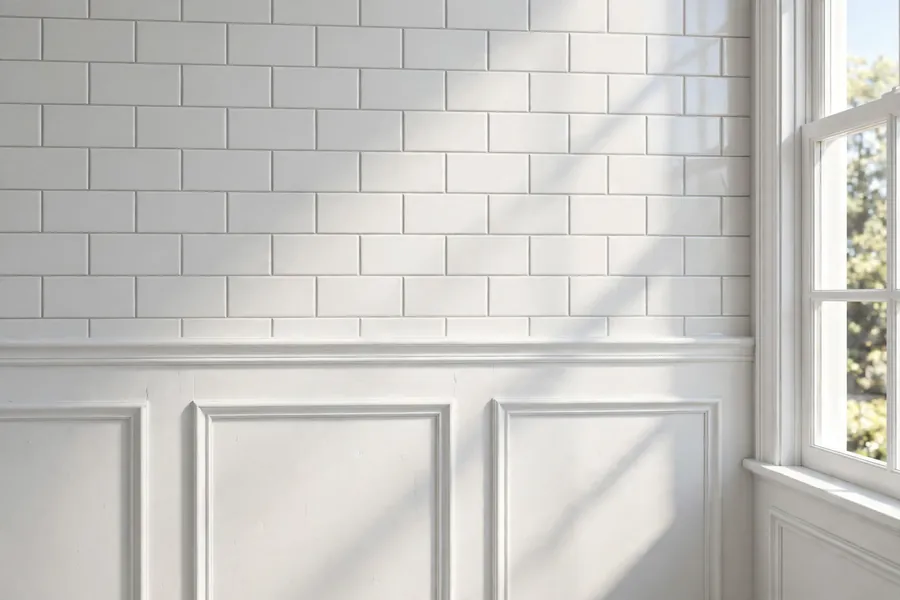
Wainscoting and beadboard add texture at the lower half of the wall and protect the drywall behind the toilet and vanity from splashes. Use a moisture resistant board (PVC beadboard or sealed wood with waterproof primer on all faces) and cap the top with a chair rail that sheds water away from the wall. Paint the beadboard with a bath rated paint, since flat paint chalks and spots under repeated wiping. Paint maker guidance summarized on October 27, 2026 describes a bath paint formulated for high humidity in a matte finish that resists moisture and mildew, and names Benjamin Moore Aura Bath and Spa as one such paint. Keep beadboard out of the shower, where tile belongs.
What signs, sayings, and funny pieces belong on the wall?
Word signs work in a bathroom when the text is short enough to read at a glance. One line of four to six words reads from the doorway; a paragraph does not. A sign above the toilet is the classic spot, and a sign on the wall opposite the mirror faces the person standing at the sink. Funny signs follow the same rule: one joke, large letters, no small print.
Which metal, wood, and three-dimensional pieces hold up?
Metal wall art holds up best of all the decorative options, since powder coated steel and aluminum ignore steam and wipe clean. A metal sunburst, a cut metal botanical, or a metal frame with a mirror center gives texture that a flat print cannot, and the open design lets air move behind it so the wall dries. Check the coating twice a year for chips, since bare steel at a chip rusts in a damp room.
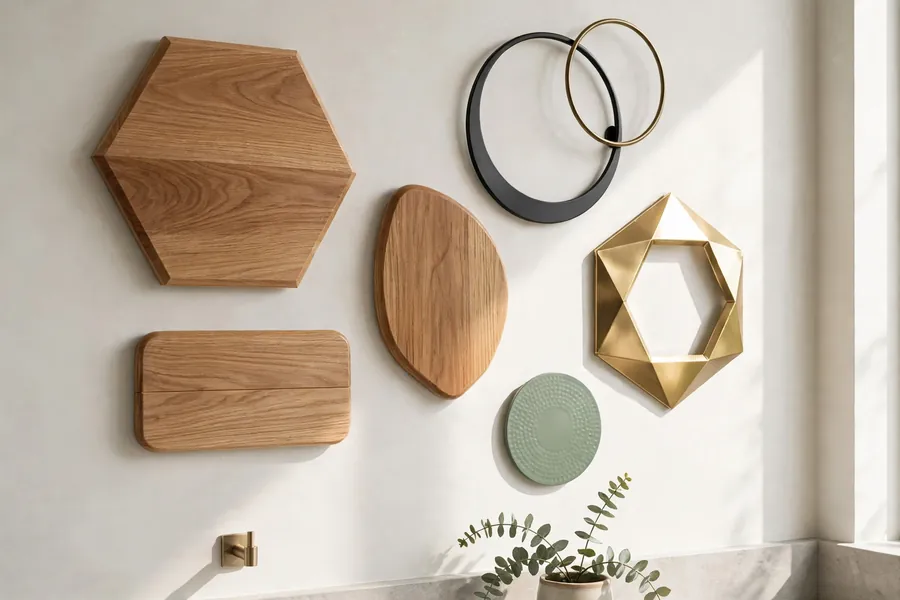
Clocks, wall planters, and wall-mounted vases each carry a special risk. A pothos in a wall planter is a sound choice, since it tolerates low light and the trailing stems soften a hard tile wall.
How do you hang things on drywall, plaster, and tile?
Find the stud first, and hang heavy pieces on it. A stud finder marks the framing behind drywall, and a screw driven into solid wood carries a shelf, a large mirror, or a heavy frame with a wide margin. Mark both edges of the stud and aim for the center. For plaster walls, drill a pilot hole first so the plaster does not crack, and use a screw long enough to reach the lath or stud behind the plaster coat.
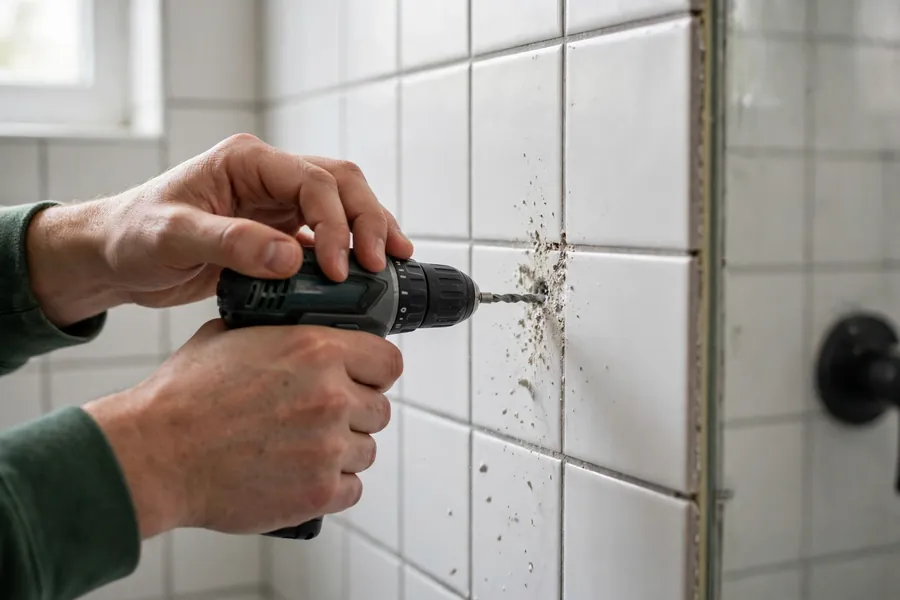
Where no stud lines up, match the anchor to the wall and the weight. Toggle bolts and metal molly bolts spread the load across a wide area of drywall and carry the heaviest loads without a stud. Plastic expansion plugs suit light frames on drywall and tile backing, and they fail when asked to carry a shelf. Never hang a loaded shelf or a large mirror on a bare nail, a small picture hook, or an unrated adhesive strip, since the failure drops the piece onto tile or into the tub.
| Wall type | Fixing that holds | What to avoid |
|---|---|---|
| Drywall on a stud | Wood screw into the stud center | A screw near the stud edge |
| Drywall, no stud | Toggle bolt or metal molly bolt, rated for the load | Bare nail, small plastic plug for heavy pieces |
| Plaster and lath | Pilot hole, screw into lath or stud | Hammering a nail, which cracks the plaster |
| Ceramic tile | Carbide bit, no hammer action, anchor seated behind the tile | Hammer action, fast speed, dry drilling |
| Porcelain or glass tile | Diamond bit, water cooling unless made for dry drilling | Carbide bit, which burns out and cracks the tile |
| No drill, renter | Adhesive strip for light frames only, on a dry wall | Heavy frames, pieces over a toilet or tub |
Drilling tile needs patience more than force. Mark the spot, cover it with painter tape so the bit does not wander, and drill with steady light pressure and no hammer action. Carbide bits suit softer ceramic tile, while diamond bits suit porcelain, glass, and natural stone, and water cooling keeps the bit and the tile from overheating, unless the diamond bit is made for dry drilling, according to tile drilling guidance summarized on October 27, 2026. Seat the anchor behind the tile face so tightening the screw does not crack the tile edge. Practice on a spare tile first when the tile is porcelain or glass.
Hang at eye level. The center of a single piece sits at standing eye level, about 57 inches from the floor, according to framing guidance summarized on October 27, 2026. A piece above a toilet sits lower, since the viewer sits, and the bottom edge clears the tank lid so the lid lifts freely. Electrical rules set a hard limit on what goes near water. The National Electrical Code, read via code summaries on October 27, 2026, requires ground fault circuit interrupter (GFCI) protection for all bathroom receptacles, and it bars receptacles inside a tub or shower and within three feet horizontally of a tub or shower and eight feet vertically above the rim. A lighted mirror, a plug-in sconce, or a lighted wall piece must sit outside that zone and on a GFCI protected outlet. Keep cords out of the splash zone, and hire a licensed electrician for any new outlet or hardwired light.
Which wall gets the decor?
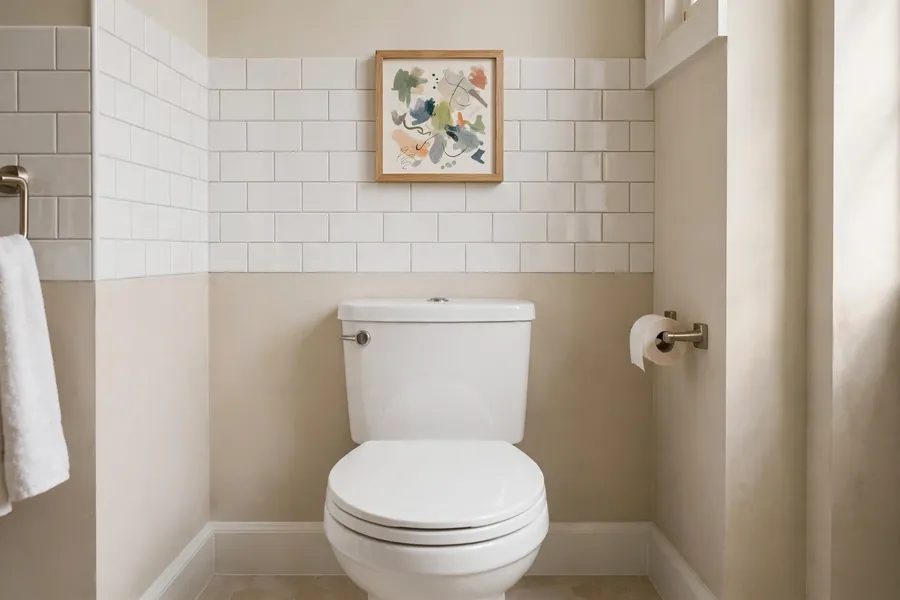
The wall above the toilet takes decor best, since it is usually the largest uninterrupted wall in a small bathroom and it faces the door. One framed print, one mirror, or one shelf grouping fills it without crowding the fixtures. Leave room between the bottom of the piece and the tank lid so the lid lifts freely, and keep the piece narrow enough that it does not overhang the tank on either side. A piece wider than the tank reads as top heavy and risks a bump every time the lid lifts.
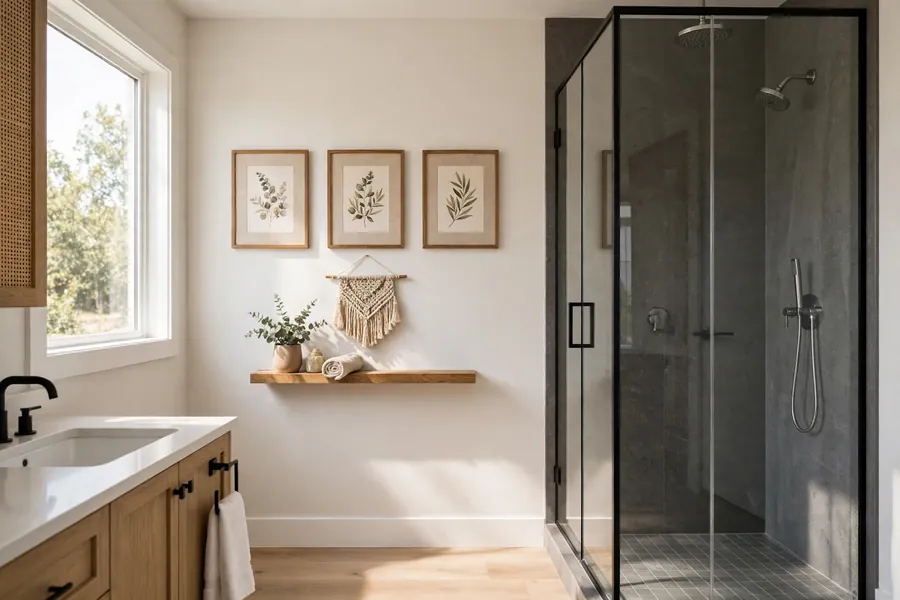
The long wall opposite the door carries the second best spot. A horizontal grouping, a long shelf, or a row of three small frames suits a long wall, since the shape of the grouping echoes the shape of the wall. The wall beside the tub suits a single piece hung high enough to clear splashes, and the wall behind the door suits nothing, since the door covers it and a swinging door knocks frames loose. Hang nothing on the wall inside the shower except tile, a niche, or a fixture made for wet areas. The wall opposite the mirror deserves a piece with color, since the mirror doubles it.
Which style fits your room?
Style is decided once, for the whole room, and the wall pieces follow it. The general decor guide owns color schemes and style detail, and the modern guide owns the modern style in full, so this table states only what each style puts on the wall.
| Style | What goes on the wall | What to skip |
|---|---|---|
| Modern | One large print or mirror, thin black frame, bare wall around it | Small scattered frames, ornate gold |
| Farmhouse and rustic | Wooden sign, galvanized metal, raw edge wood, wrought iron | Glossy chrome, bright color |
| Boho | Woven hanging, macrame, layered small frames | Single formal portrait, heavy gold |
| Coastal, beach, and nautical | Shell shapes, pale blue art, rope frames, navy and white | Dark heavy frames, gold ornate |
| Vintage and shabby chic | Old advertisement prints, brass frames, patina metal | New plastic frames, neon color |
| Minimalist | One piece only, wide empty wall, no grouping | Gallery walls, mixed frames |
| Elegant, classy, and luxury | Pair of matching prints, gold or black frames, large mirror | Funny signs, small prints |
| Spa and zen | Botanical prints, bamboo, stone texture, single print | Bold patterns, busy groupings |
| Masculine and industrial | Dark metal, black frames, pipe shelf, geometric art | Pastel florals, soft fabric |
| Country and western | Floral prints, leather detail, desert tones, primitive wood | Sleek metal, abstract art |
| Contemporary and mid-century | Oversized abstract, walnut frames, mustard and teal | Matched pairs, ornate gold |
| Glam | Mirrored frame, crystal detail, black and gold | Matte wood, rustic texture |
| Floral | Botanical prints, pressed flowers under glass | Geometric abstracts, dark metal |
| Colorful | Mixed bright frames, bold prints, playful grouping | Single muted piece, bare wall |
| Neutral | Tone on tone art, linen texture, pale wood | Bright color, black heavy frames |
| Black and white | Black and white photography, black frames, white mat | Color prints, gold frames |
| Black and gold | Black frames with gold detail, dark art | Pale wood, pastel color |
| Colors (blue, green, pink, gray, beige, brown, red, teal, purple, yellow, aqua, navy, gold, silver) | One color family per wall, matched frame | Mixed color families on one wall |
| Animal prints | One animal print, natural frame, leopard or cow in one row only | A wall of animal prints |
How does wall decor change by room type?
A small bathroom takes one focal piece and nothing else on the walls. The wall above the toilet or the wall opposite the door carries it, and the remaining walls stay bare so the room reads larger. A gallery wall in a small bathroom crowds the fixtures and makes the room feel smaller, so resist adding a second group. The small bathroom guide owns small room planning.
A half bath and powder room take bolder wall decor than a full bathroom, since steam is light and the wall stays dry. A dark print, a large mirror, or a wallpapered accent wall works here where it would fail beside a daily shower. A guest bathroom takes one welcoming piece and a small shelf with a spare towel. A primary bathroom takes a calm grouping scaled to a larger wall, with the art kept away from the shower end of the room.
Kids, girls, and boys bathrooms take wall decor at the child eye level, with shatterproof acrylic glazing and no glass. A growth chart, a playful print, or a set of animal pictures suits the room, and the pieces move up as the child grows.
What seasonal wall decor makes sense?
Seasonal wall decor in a bathroom means one swap, not a redecoration. A single framed print, a small wreath on a hook, or a seasonal towel on a wall ring changes the room for Christmas, fall, or Halloween, and the piece comes down when the season ends. Fall takes warm tones and dried stems in a wall vase, Christmas takes a small wreath and a pine sprig, and Halloween takes one playful sign. Store the seasonal pieces dry in a labeled box. The fall decor guide owns seasonal styling in full, and this paragraph states only the wall swap rule.
What DIY wall decor is worth the effort?
Framing a print yourself is the DIY job with the best return, since a well cut mat and a sealed back cost little and protect the print. Buy the frame to fit the print, cut the mat to leave an even border, tape the backing shut all round, and hang it on a rated fixing. Mounting a floating shelf is the second best job, since it needs only a stud finder, a level, and a drill, and it adds storage a bathroom always uses. Making a sign is worth it when the words are yours. A sealed wood board, stenciled letters, and a clear coat give a personal piece that no store sells, and the clear coat is the step that makes it survive steam. Skip DIY decals cut from craft vinyl on textured walls, since the edges lift, and skip DIY wallpaper made from wrapping paper, since paper without a vinyl face fails in steam. Judge each DIY piece by whether it survives the moisture rule, not by whether it looks good on day one.
How much should you spend, and in what order?
Spend in the order the room needs it, not in the order the store displays it. First, the fan and the ventilation fix, since no wall decor survives a room that never dries. Second, one focal piece for the best wall. Third, the hanging hardware, since a rated anchor costs little and a fallen mirror costs much more. Fourth, the shelf or the grouping that fills the second wall, if the room has one. Last, the seasonal swap and the small extras, since they add charm but carry no function.
Expectation bands run from lowest to highest. The lowest band covers a decal, a printable print in a ready made frame, and an adhesive hook, which suit a rental or a first try. The middle band covers a sealed framed print, a floating shelf, and a decorative mirror. The highest band covers a large mirror, a tile accent wall, and a pasted vinyl wallcovering, which suit a remodel. A room with a failing fan stays in the lowest band until ventilation is fixed.
What goes wrong most often?
| Mistake | Why it fails | Fix |
|---|---|---|
| Hanging paper art beside the shower | Steam reaches the print first | Move it to the driest wall |
| Raw wood frame in a steamy room | Wood swells and opens at the corners | Metal frame or sealed wood |
| Unsealed frame back | Damp air enters from behind | Tape the backing shut all round |
| Shelf on a bare nail | Nail pulls out under load | Stud or rated toggle bolt |
| Drilling tile with hammer action | Tile cracks from impact and heat | Slow speed, diamond or carbide bit, water cooling |
| Adhesive strip over a toilet | Steam weakens glue, fall lands hard | Screw or anchor for pieces over fixtures |
| Art hung too high | Reads as an afterthought | Center at standing eye level |
| Gallery wall in a tiny room | Crowds fixtures, room feels smaller | One focal piece only |
| Wallpaper inside the spray zone | Water finds seams and edges | Keep paper on dry walls only |
| No fan run after showers | Room never dries, mold follows | Fan on during and 20 minutes after |
Start with the driest wall, not the prettiest piece
Bathroom wall decor rewards a plain order: fix the air, pick the driest wall, choose sealed or nonporous pieces, hang them on fixings rated for the weight, and leave the rest of the walls bare. A single sealed print on the right wall outlasts a gallery wall hung in steam. The wall that dries first is the wall that takes the art, and the wall that stays damp takes tile or nothing at all.
Quick answers to common questions
Can you hang a regular framed print in a steamy bathroom?
A regular framed print with an open back and a raw wood frame fails in a steamy bathroom, since damp air enters from behind and the wood swells. Seal the back with tape all round, use a metal or sealed synthetic frame with acrylic glazing, and hang it on the driest wall away from the shower. A powder room with light steam takes a regular frame more easily, but the sealed back still helps.
What hangs on a bathroom wall without drilling holes?
Vinyl decals on smooth tile or glass, a leaning mirror on the floor against the wall, and a light frame on an adhesive strip all hang without drilling. Adhesive strips suit light frames on dry walls only, and they hold less in steam, so keep them off the wall over a toilet or tub. A tension rod shelf or a freestanding ladder shelf needs no holes and suits a rental.
How high should wall decor hang above a toilet?
Hang the bottom edge above the tank lid so the lid lifts freely, and center the piece on the wall width, not on the tank. The center of the piece sits near standing eye level where the wall allows, and the piece stays narrower than the tank so it does not overhang either side. A shelf above a toilet sits higher, with clearance over the tank so heads clear it.
Do adhesive strips hold in a steamy bathroom?
Adhesive strips hold light frames on dry walls in a bathroom with sound ventilation, and they hold less as steam and heat rise. Apply them to a dry, cool wall, press for the full time the package states, and wait the full cure time before hanging weight. For heavy frames, mirrors, shelves, or anything hung over a fixture, use a screw into a stud or a rated anchor instead.
What wall decor is safe inside a shower area?
Only tile, stone, glass, and fixtures made for wet areas are safe inside a shower, since every other material takes direct water and fails. A tile niche, a mosaic accent band, or a glass shelf rated for wet use belongs there, and no print, frame, decal, or sign does. Hang art on the wall outside the shower and let the tile carry the inside.