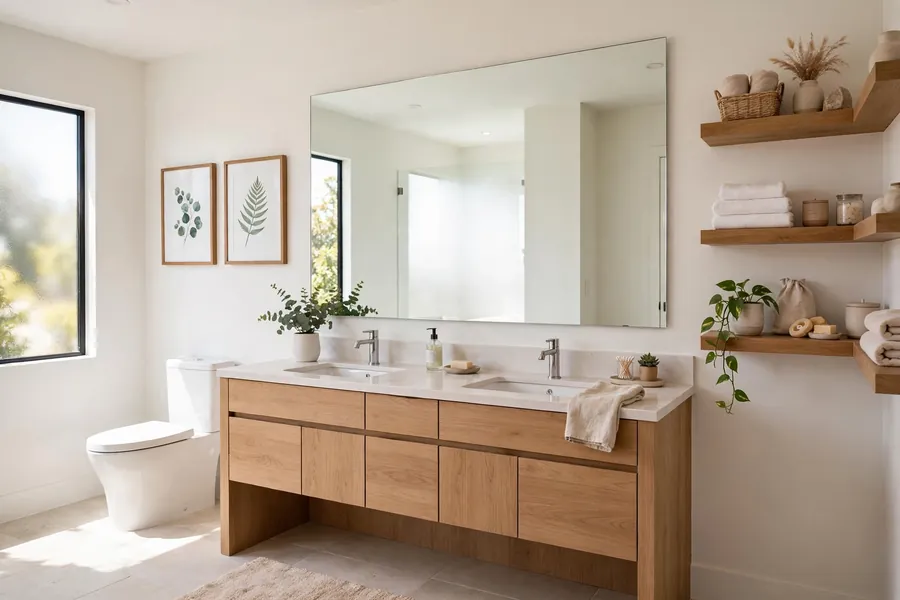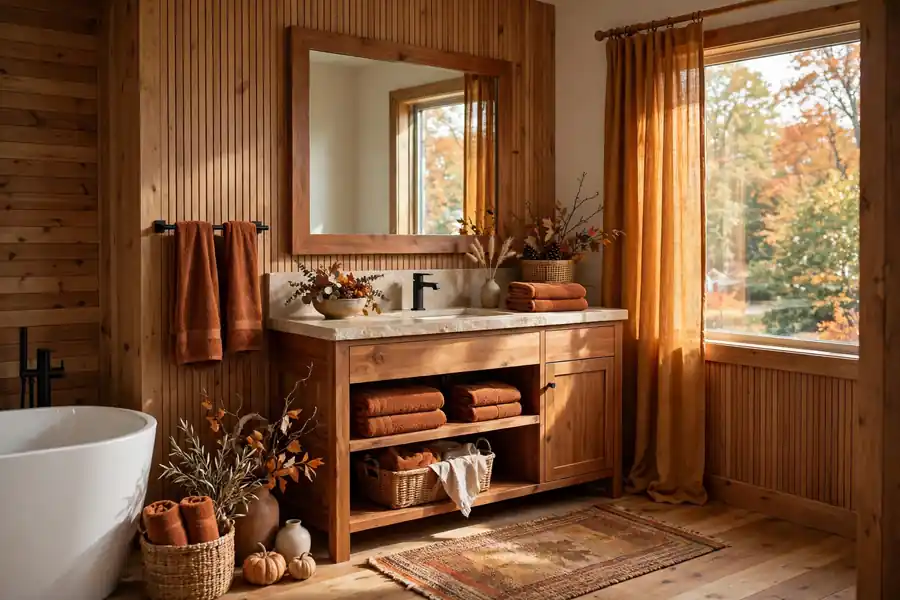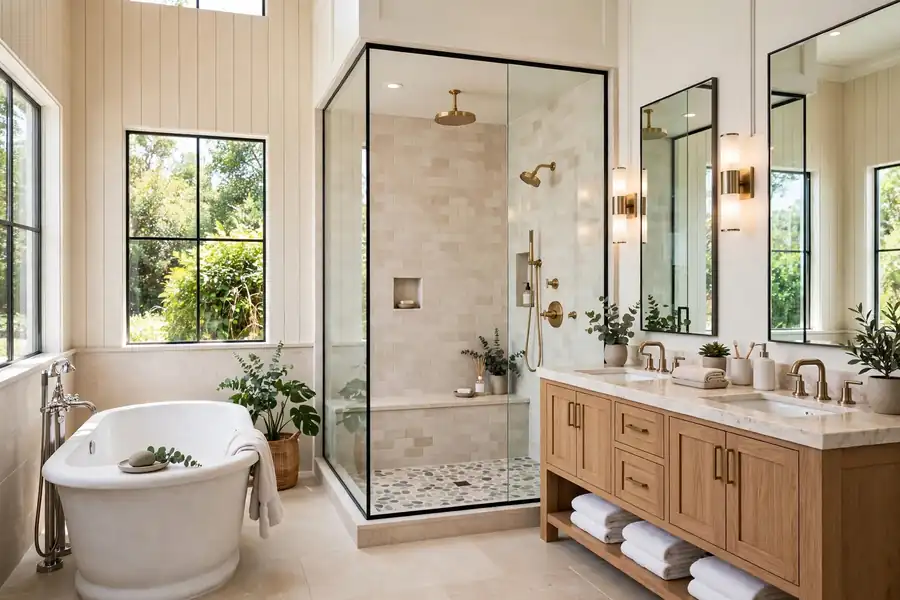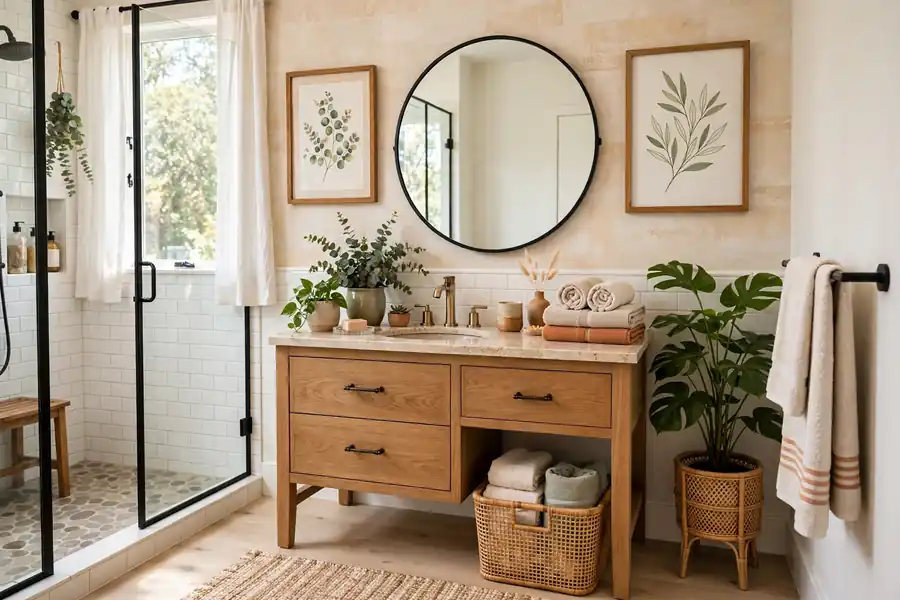
A bathroom earns its look from five decisions made in the right order: the mirror wall, the wall surfaces, the towels, the floor textiles, and one living plant. Get those five right and the room reads as planned even with plain tile and a basic vanity. The most useful bathroom decor ideas are the ones that survive steam, splashes, and daily use, so every choice below is judged first on how it holds up wet, and second on how it looks dry.
Bathroom decor at a glance
| Decision | Rule that holds up | Where it goes wrong |
|---|---|---|
| Ventilation | Fan sized to the room, run during and after showers | Decor molds because steam never leaves |
| Mirror | Width 2 to 6 inches less than the vanity | A mirror wider than the vanity crowds the sconces |
| Walls | Sealed frames, vinyl wallcovering, bath paint | Paper prints and raw wood warp and spot |
| Towels | Hung open to dry, one finish family | Folded stacks stay damp and smell |
| Floor | Non-slip mat or rug with a sound backing | A smooth rug slides on a wet floor |
| Light | Sconces at eye level, damp-rated at the vanity | Overhead-only light casts face shadows |
What makes bathroom decor last in a wet room?
Ventilation decides whether decor lasts. The Home Ventilating Institute guidance, read October 27, 2026, sizes an exhaust fan at 1 cubic foot per minute (CFM) per square foot of floor for bathrooms up to 100 square feet, and at 50 CFM per toilet, shower, or bathtub, 100 CFM for a jetted tub, for larger rooms. A 5 by 8 foot bathroom needs at least 40 CFM by that rule; the practical minimum sold is 50 CFM. Run the fan during the shower and for 20 to 30 minutes after. A fan that vents into an attic instead of outside moves moisture where it does more harm unseen, so check where the duct ends before spending on decor.
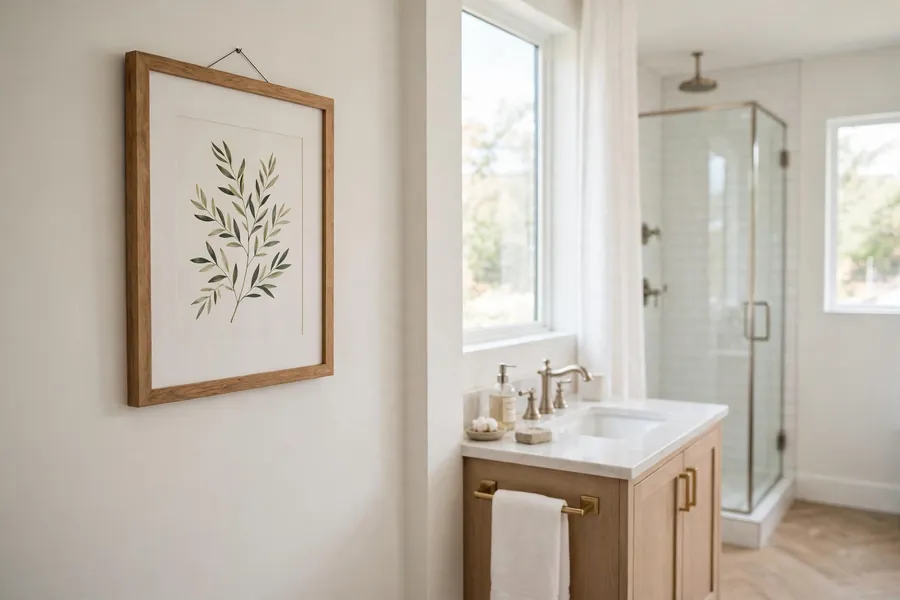
Humidity targets come from the US Environmental Protection Agency guidance, read October 27, 2026: keep indoor relative humidity below 60 percent, ideally between 30 and 50 percent, and dry wet materials fully within 24 to 48 hours. Wipe spray-caught shelves and leave the curtain partly open so both sides dry. Do not paint over mold. The EPA states plainly that moldy surfaces should not be painted or caulked over, so clean and dry the surface and fix the leak or the fan first.
Materials fail in a predictable order. Paper, untreated wood, raw iron, and unsealed stone take water first. Glass, glazed ceramic, sealed wood, powder-coated metal, vinyl, and acrylic shed it. A print behind glass with a sealed back holds up in a full bathroom.
How do you pick a bathroom color scheme?
Pick the base first, then one accent, then the metal. Three colors plus one metal finish is enough. The base covers the walls and the largest surfaces. The accent appears in towels, the shower curtain, and one wall object, and nowhere else. The metal repeats in the faucet, the mirror frame, the towel bar, and the light fixture.
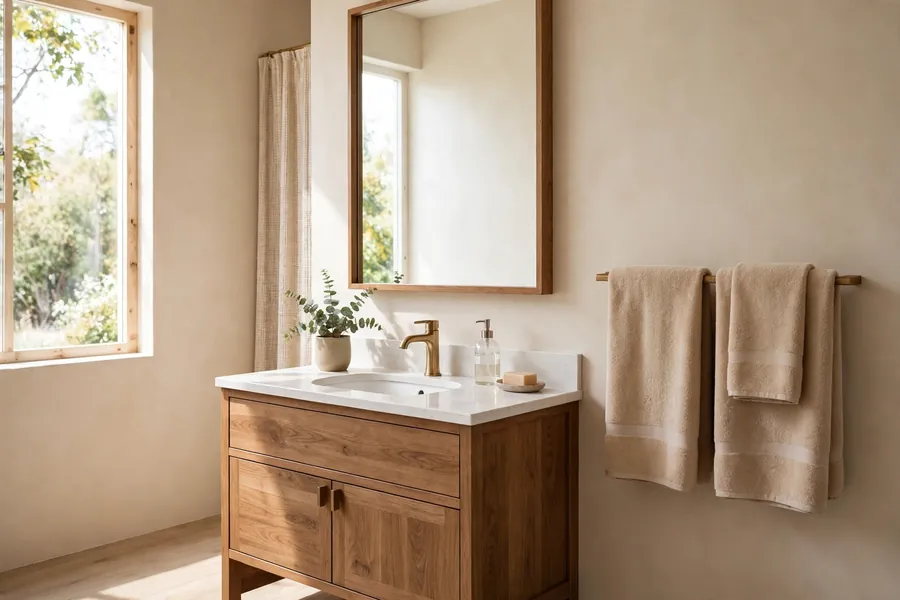
Light colors read larger because they bounce the light the room already has. That is the whole trick in a small room: pale walls, a pale floor, and a mirror that returns light do more than any single object. Dark colors need bright sconces and a light floor or light towels to keep contrast.
| Scheme | Base and accent | Where it works | Risk to watch |
|---|---|---|---|
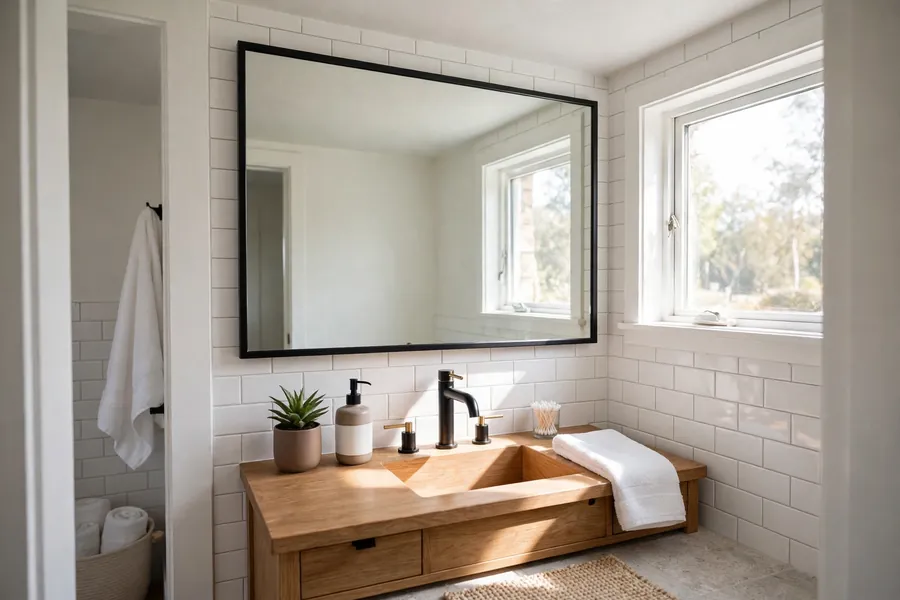
| White and warm wood | White walls, wood shelf and tray, black or brass metal | Any size, any style | Reads cold without wood or textile warmth |
| Black | Black walls or tile, white towels, brass or chrome | Large rooms, strong light | Small rooms go flat without bright sconces |
| Black and white | White tile, black floor or frame, one pattern | Small rooms, retro and modern | Pattern on every surface turns busy fast |
| White and gold | White walls, gold frame and faucet, cream towels | Primary baths, elegant and luxury | Gold on every fixture looks costumed |
| Teal | Teal walls or tile, white towels, brushed nickel | Guest baths, coastal and modern | Teal under warm light shifts green, test a swatch |
| Pink | Blush walls, white fixtures, brass metal | Powder rooms, vintage and cute | Pink with cool light reads gray, use warm light |
| Green | Sage or deep green walls, wood, black metal | Spa and farmhouse styles | Deep green needs strong light and a pale floor |
| Brown | Warm brown tile or paint, cream towels, bronze | Rustic and traditional styles | Brown with dim light reads muddy, raise light level |
Paint choice matters as much as paint color. Satin and semi-gloss finishes wipe clean and shed water better than flat paint on bathroom walls. Bath-formulated paint lines, such as Benjamin Moore Aura Bath and Spa, are made for high humidity and hold a matte look without the water sensitivity of standard matte paint, according to maker guidance summaries read October 27, 2026. Sherwin-Williams Duration Home is the comparable washable line in the same summaries. Test the color on the wall facing the mirror, under the actual vanity light.
Which styles hold together in a bathroom?
One style family per room, carried through the mirror frame, the light fixture, the faucet finish, and the textiles. Mixing two families in one sightline reads as a mistake, not as variety. Coverage is current as of October 2026.
| Style | Materials and shapes | Colors and metal | Avoid |
|---|---|---|---|
| Modern | Flat fronts, frameless glass, straight lines | White, gray, black, chrome or matte black | Ornate frames and ruffled textiles |
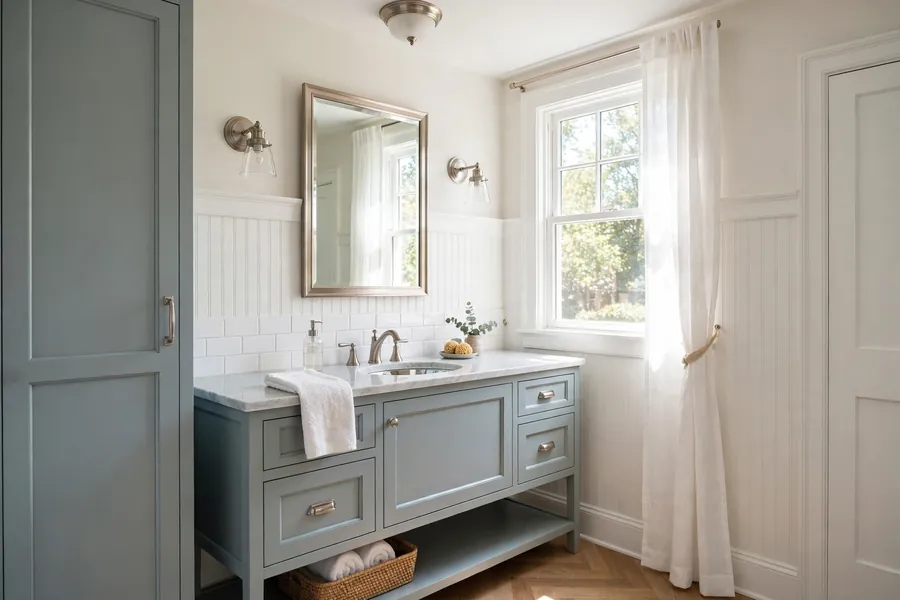
| Farmhouse | Lantern frames, shiplap or beadboard look, wood | White, cream, black, oil-rubbed bronze | Chrome and high-gloss plastic |
| Rustic | Aged wood, stone, woven baskets, heavy frames | Brown, cream, black, aged bronze | Sleek chrome and pale minimal textiles |
| Coastal | Woven shades, light wood, open glass, rope | White, sand, pale blue, brushed nickel | Dark heavy frames and black tile floors |
| Vintage and retro | Schoolhouse glass, ribbed shades, pedestal sinks | White, black, pastel, chrome or brass | Flat modern panels and matte black everywhere |
| Luxury | Stone, large mirror, layered light, full towels | White, warm gray, gold or brass | Thin towels and visible plastic storage |
| Spa | Wood, stone, plants, linen, low pattern | White, sage, sand, brushed nickel or black | Bright patterns and glossy color blocks |
| Minimalist | One mirror, one shelf, hidden storage, no clutter | White, light gray, black, matte black | Open shelves full of bottles and jars |
| Elegant | Chandelier or crystal sconces, framed mirror, drapery | White, cream, gold, soft gray | Rustic wood and woven baskets |
| Cute | Patterned curtain, scalloped edge, small prints | Pink, cream, white, brass | Dark walls and heavy stone |
| Mens | Matte black fixtures, dark tile, straight lines | Charcoal, gray, white, matte black | Frills, pastels, and busy patterns |
How do bathroom decor ideas change in a small bathroom?
A small bathroom needs fewer objects, not smaller versions of a large plan, since every object competes for wall space. Keep the mirror wall, one wall object, one plant, and the textiles, and leave the rest of the walls bare. Pale walls, a pale floor, and a large mirror do the work, with one dark accent for edge. Skip a gallery wall, a second shelf, and a floor plant in a room under 40 square feet.
A half bath or powder room is the one room where bold decor costs nothing in comfort, because nobody showers in it. Dark walls, bold wallpaper, a large pattern, and a statement mirror all suit a powder room, and the moisture rules relax to the level of hand washing. A guest bathroom keeps the scheme calm, the towels fresh, and one spare set visible. A primary bathroom takes the full plan.
Kids use the same room differently, so give them one low hook, one low shelf or step, and nothing breakable within reach. Keep medicines and cleaning products in a closed cabinet with a latch, and keep glass off low shelves. Pick washable textiles and a non-slip mat, and leave the theme to one towel color.
What goes on bathroom walls?
Art, mirrors, shelves, and wallcovering each have one moisture rule, and the wall that takes direct spray is not a decor wall at all. Keep paper, fabric, and open frames off the shower wall and the wall beside the tub. The wall over the toilet, the wall opposite the vanity, and the wall beside the door carry decor safely in most rooms.
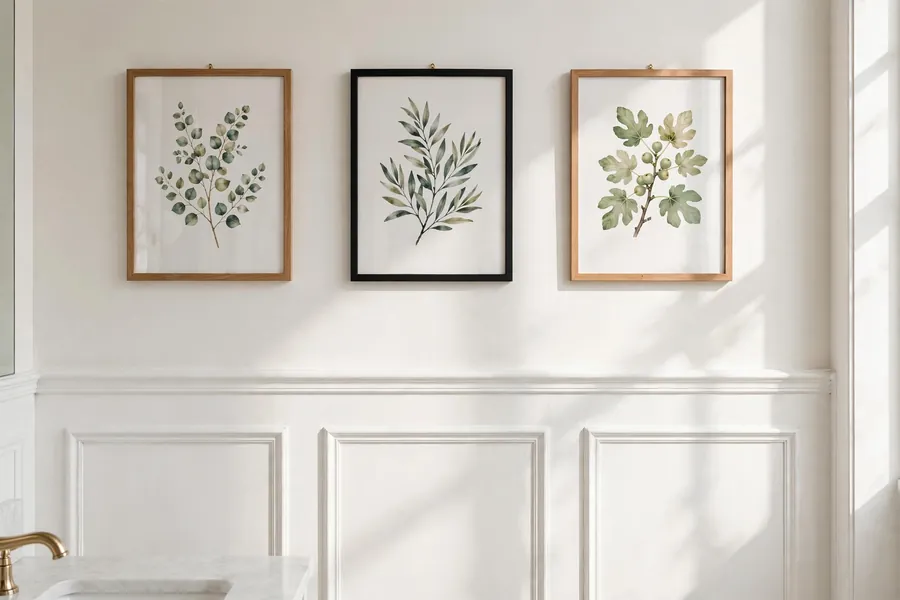
Framed art works when the frame is sealed. Use glass or acrylic over the print, a sealed back, and a frame of metal, sealed wood, or acrylic. A gallery wall over the toilet: three to five pieces, one frame finish, 2 to 3 inches apart, centered at eye level, 57 to 60 inches from the floor. Keep the bottom frame clear of the toilet tank lid so the lid opens fully.
Wallpaper belongs on dry walls, in vinyl form. Vinyl and vinyl-coated wallpapers shed steam instead of absorbing it, and peel-and-stick vinyl is the renter-friendly form, according to retailer and maker guidance summaries read October 27, 2026. Paper-only and fabric-backed wallpapers warp and lose adhesion in a full bathroom. Keep wallpaper out of the spray zone, run the fan, and seal the edges at the trim.
Wainscoting and paneling style a wall without covering it in tile. Beadboard and shiplap-look panels suit farmhouse and coastal rooms; a painted panel below a chair rail suits traditional rooms. The panel material must tolerate humidity: PVC or sealed wood panels hold up, while raw medium-density fiberboard swells at the base where splashes reach it. Paint it in satin or semi-gloss, caulk the floor joint, and keep it off the shower wall.
How do you size and hang a bathroom mirror?
Size the mirror to the vanity, then place the light to the mirror. Planning summaries read October 27, 2026 put the mirror width at the vanity width minus 2 to 6 inches total, so a 36 inch vanity takes a 30 to 34 inch mirror. A round mirror follows the same rule by diameter: 24 to 30 inches across suits a single vanity. Two sinks need one wide mirror or two mirrors, one over each sink.
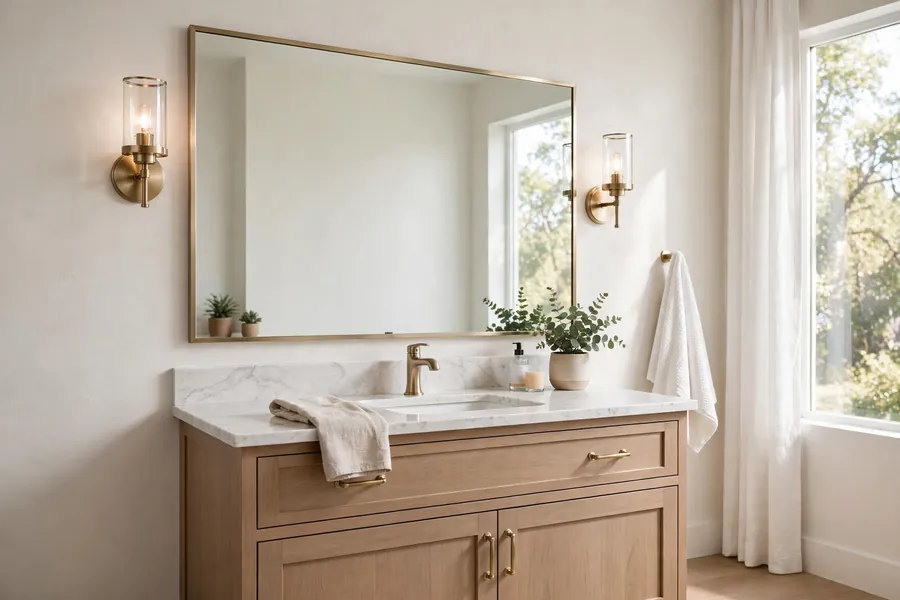
Hang it 40 to 44 inches from the floor, 4 to 6 inches above the backsplash, per the same NKBA summaries. Keep the top edge at least 3 inches below the ceiling or any overhead light. Center it over the sink, not the cabinet. Level it from the standing position before the anchors set.
A round mirror with a brass frame, a black metal arch, or a beveled frameless slab each set the room, and the rest of the wall stays quiet. A backlit mirror still needs its light at face height and matched to the other lights, or faces read two colors at once. Hang it on anchors rated for its weight in the actual wall material; a heavy mirror on a single drywall anchor will pull out.
How do you style bathroom shelves?
A shelf earns its place by holding what the counter cannot. Style in thirds: one third closed storage, one third folded towels or a plant, one third empty space. Roll towels on open shelves: a rolled towel shows its edge and dries faster.
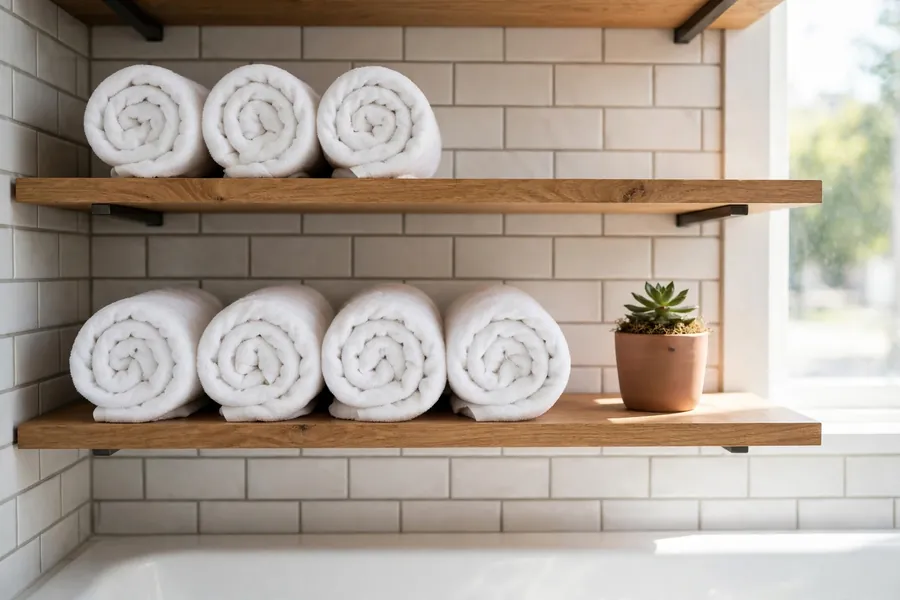
Anchor every shelf into studs or with anchors rated for tile or plaster, and read the weight limit on the shelf hardware before loading it. Heavy items sit low and near the brackets, light decor sits high and at the ends. Keep the toilet-wall shelf clear of the tank lid swing, and glass off shelves over hard floors. One shelf over the toilet and one beside the vanity is enough for most rooms.
Closed cabinets suit medicines, cleaning products, and anything that must stay dry and out of reach. Never store medicines where steam reaches them daily: heat and humidity shorten their life, and a cabinet over a steamy shower is the worst spot for them.
What belongs on the counter and the vanity?
The counter holds what hands reach for daily, and nothing else. A tray corrals the soap, the toothbrush holder, and one bottle, and the tray itself is the decor: ceramic, stone, or sealed wood, with a lip that keeps water off the counter. One tray per sink, sized to leave at least half the counter clear.
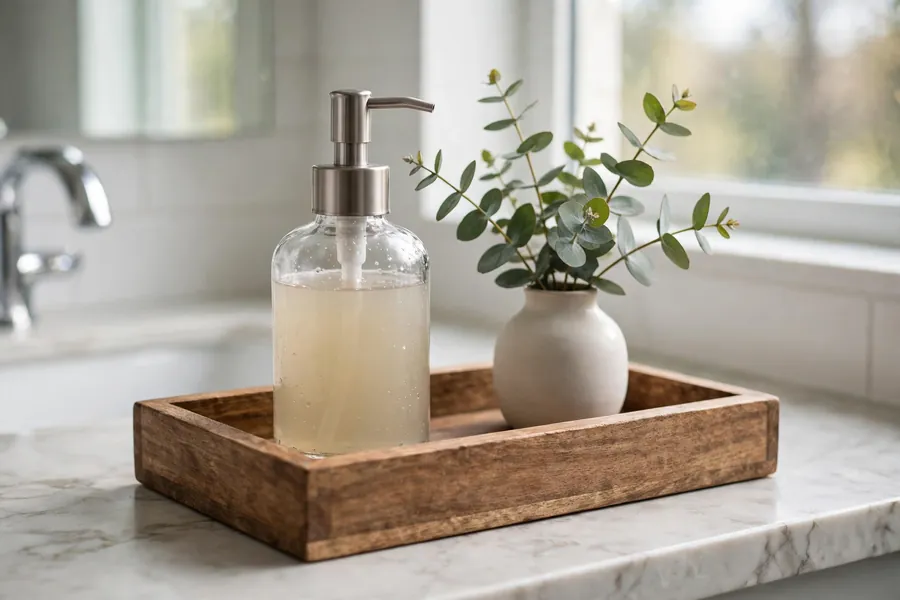
Sink decor stays to one object beside the faucet: a small plant in a sealed pot, a single bud vase, or a folded hand towel on a ring. Keep handles clear, soap in reach, and paper and fabric off the wettest six inches around the sink. A soap dispenser beats a soap dish: a dish holds standing water and softens the bar.
Corral the rest behind closed doors. Medicines, spares, and cleaners live behind closed doors, not on the counter. The counter test takes ten seconds: if an object has not been used in the last week, it moves off the counter.
How do you display and store towels?
Towels are the largest textile in the room, so they set the color. One towel color per room, in two sizes: bath towels and hand towels in the same color, with washcloths to match. White towels suit every scheme and bleach clean, but white shows makeup and self-tanner, so a mid-tone towel suits rooms where those are used daily. Match towels to the accent in the color table, not to a new color.
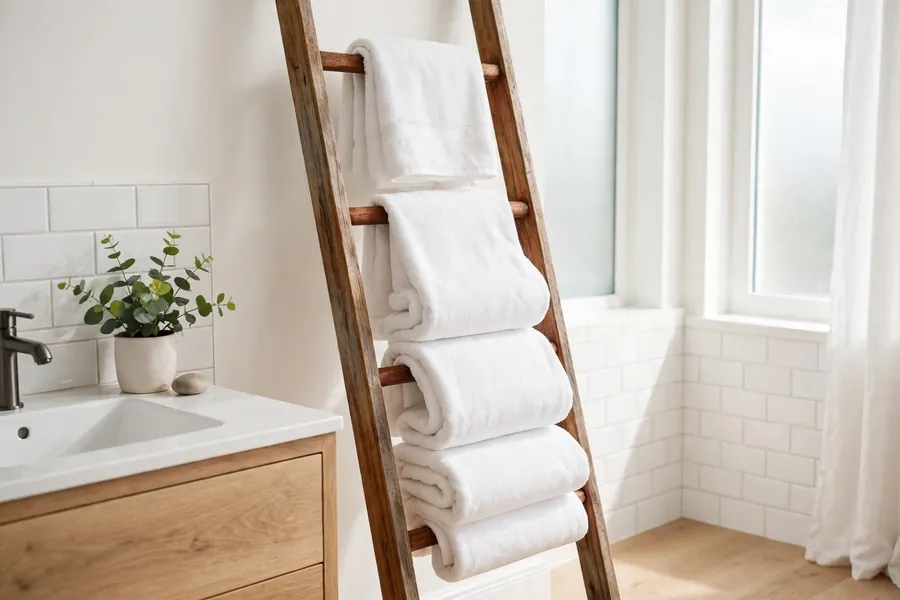
Hang towels open to dry. A towel bar spreads the towel flat and dries it fastest, while a hook folds it double and dries it slowest. Use bars for bath towels and hooks or rings for hand towels and robes. Hang the hand towel ring 18 to 24 inches from the basin edge, and bath towel bars within reach of a wet bather. A heated towel bar warms an already hung-open towel; a hardwired model needs a licensed electrician.
Store spares dry: a closed cabinet, a basket above splash height, or a ladder shelf. Fold spares in thirds so the edges face out, stack no more than three high, and keep one full set per person plus one guest set. Towels stored on the floor or on the toilet tank lid pick up moisture and dust, and a damp stack smells before it is ever used.
Which plants survive a bathroom?
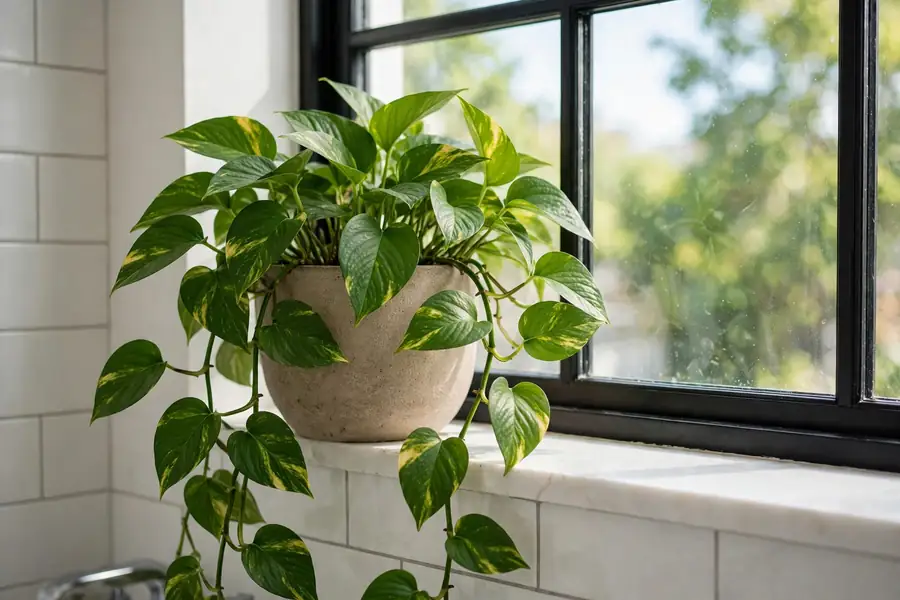
Plants suit bathrooms because most popular houseplants come from humid, shaded places, but light still decides which ones live. A bathroom with no window is not suitable for live plants, so choose a plant only for a bathroom with natural light. No plant prevents mold or dries a wet room, so treat plants as decor that tolerates the room, not as a fix for it.
| Plant | Light it needs | Water | Note |
|---|---|---|---|
| Pothos | Bright indirect, tolerates some shade | When the top inch of soil is dry | Trails from a shelf; cut back when it reaches the floor |
| Snake plant | Bright filtered light, partial shade | Rarely, let soil dry fully | Upright shape suits a floor corner; rots if overwatered |
| ZZ plant | Low light | Rarely, stores water in rhizomes | Slow grower, suits a powder room with natural light |
| Peace lily | Bright indirect | Once top few centimetres of compost are dry | Prefers moderate humidity; poisonous if chewed, keep out of reach of children and pets |
| Boston fern | Bright filtered light | Moderate water, less in winter | Needs humidity with good ventilation |
| Spider plant | Low to bright indirect | When soil is dry | Makes plantlets that hang well; keep out of spray |
| Chinese evergreen | Low light | When the top inch is dry | Compact, suits a counter corner away from the sink |
Place plants out of the direct spray zone, out of the path of the shower door, and in a pot with drainage that sits on a saucer. A pot without drainage drowns the roots in a humid room, and a saucer that never gets emptied breeds the same damp the fan is fighting. Keep pothos and peace lilies out of reach of toddlers and pets that chew leaves, since both are poisonous when eaten. Two live plants beat five struggling ones: one trailing, one upright. The site's own plant guides cover pothos and peace lily care in full.
What rug, mat, and shower curtain suit the room?
The floor textile is a safety object first and a decor object second. A bath mat needs a non-slip backing or a separate rug pad rated for wet floors, and the backing needs checking: cracked or peeling rubber backing slides, and a mat that slides on wet tile is a fall risk. Hang slow-drying memory foam mats over the tub edge after use. Replace a mat when the backing fails or it stays damp between showers.
Rugs follow the same rule at larger scale. A rug in front of the vanity needs the same non-slip backing, and a rug that covers the whole floor traps water at the edges where the fan cannot reach it. One mat at the tub or shower exit and one small rug at the vanity is enough. Wash bath textiles weekly: a damp mat grows mildew from the underside.
Keep one pattern: a patterned curtain with solid towels, or a solid curtain with patterned towels. Hang the rod level, the liner inside the tub or shower base, and the curtain outside, with the liner a little shorter than the curtain so it does not show below the hem. A weighted hem or magnets at the bottom keep the curtain from billowing inward during a shower.
How do you light a bathroom for looks and grooming?
Light at the mirror decides how the whole room reads, because faces are what eyes check first. Sconces flanking the mirror at eye level, centered 60 to 66 inches from the floor and 28 to 36 inches apart, light the face from both sides and cut the shadows a single overhead light casts under eyes and chin, following planning summaries read October 27, 2026. An over-mirror bar works when wall space is tight, sized at about 70 to 80 percent of the mirror width and centered 75 to 80 inches from the floor.
Ratings and wiring are safety decisions, not style decisions. Luminaires within the outside dimension of a bathtub or shower, up to 8 feet above the rim or threshold, need a damp-location marking, and a wet-location marking where subject to shower spray. All bathroom receptacles need ground-fault circuit interrupter (GFCI) protection, and no receptacle may sit inside a bathtub or shower or within 3 feet horizontally of the outside edge of a bathtub or shower stall, from the floor to 8 feet above the rim or threshold, apart from the narrow exceptions in the code. A licensed electrician should do any new wiring, new fixture box, or change to a hardwired fixture. Never run an extension cord across a wet bathroom floor to power a light or a heater.
A color rendering index (CRI) of 90 or above renders skin tones true, while 80 CRI shifts them visibly, according to lighting guidance summaries read October 27, 2026. Keep one color temperature across every fixture in the room, 2700K for warm and relaxing light or 3000K for a neutral task light, since mixed temperatures read as a mistake. Dim the mirror and ceiling lights with a dimmer rated for the lamps, and check both makers' lists first.
How do you decorate on a tight budget?
Spend in the order the eye notices, and skip what the eye never sees. First, fix the light: clean the fixtures, match the bulbs to one temperature, and add a dimmer where the wiring allows. Second, paint in a bath-formulated paint, the cheapest surface change that survives steam. Third, change the shower curtain, the towels, and the mat together in one scheme, since those three textiles set the room's color. Fourth, hang one mirror or one framed piece. Fifth, add the plant and the baskets. Stop there.
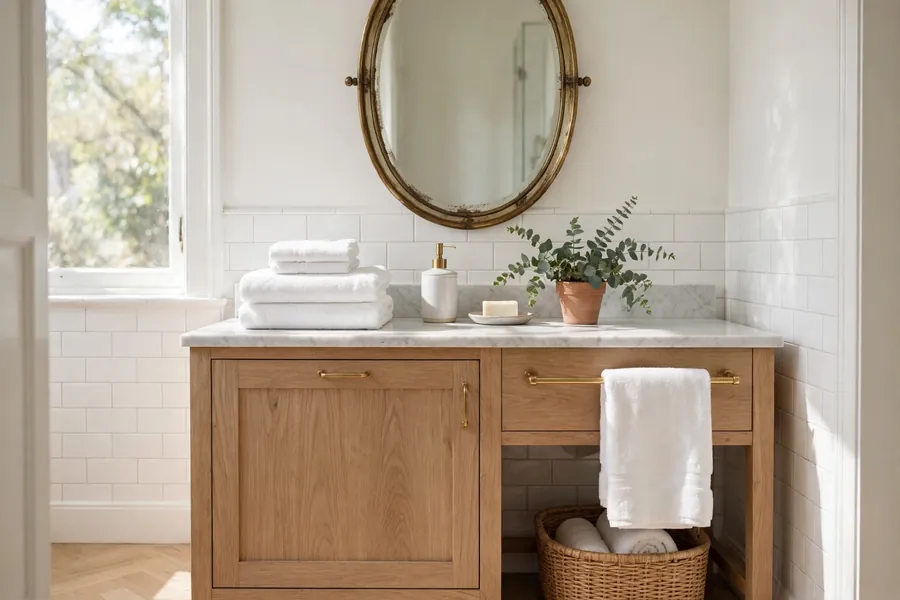
Renter-friendly swaps follow the same order without drilling. Peel-and-stick vinyl wallpaper on one dry wall, a tension shower rod, adhesive hooks rated for humidity, a freestanding shelf or ladder, a new curtain and towels, and a mirror that leans or hangs from an existing hook. Test adhesive hooks on a hidden spot first: steam weakens them. Never paint over tile or fixtures in a rental without written permission.
What to skip costs nothing to name. Skip a full retiling to chase a style, since tile is the most expensive surface and the least visible once towels and a curtain are in. Skip a new vanity when paint and hardware change the same front for a fraction of the work. Skip matching accessory sets: they read as a hotel set, not a chosen room.
Christmas decor is one swap: a red or deep green hand towel, a small wreath clear of lights and heat sources, and a candle that never burns unattended near towels. Keep the bathroom to the towel swap and one object.
Start with the mirror wall, not the accessories
A bathroom that looks planned starts at the mirror wall and works outward. Size the mirror to the vanity, set the sconces at eye level, and match the metal finish to the faucet. Then pick the base color and one accent, and set the towels in that accent. The most useful bathroom decor ideas are the quiet ones: a fan that clears steam, a mirror that fits, towels that dry, and a plant that lives. Buy the accessories last, one at a time, and only when a bare spot asks for an object. A room with five right decisions and three objects beats a room with twenty objects and no plan.
Quick answers to common questions
Can you hang regular art in a bathroom?
Yes, in a powder room or on a dry wall, with a sealed frame, glass or acrylic over the print, and a sealed back. In a full bathroom, keep art off the spray wall and use sealed frames, since open paper cockles fast.
What color makes a small bathroom look bigger?
Pale walls, a pale floor, and a large mirror make a small bathroom read larger, because they bounce the light the room already has. White, cream, and pale gray work best, with one accent in the towels. Dark colors suit small rooms only when the light is strong and the floor stays pale.
How do you keep bathroom decor from molding?
Run a fan sized to the room during and after showers, keep humidity below 60 percent, and dry wet surfaces within 24 to 48 hours, following EPA guidance read October 27, 2026. Choose glass, sealed wood, and vinyl over paper and raw wood.
Can you put wallpaper in a bathroom?
Yes, in vinyl or vinyl-coated form, on walls outside the direct spray zone, with the fan running during and after showers. Paper-only wallpaper warps in a full bathroom. Powder rooms take any wallcovering, including paper, since they have no shower steam.
How do you decorate a bathroom without drilling holes?
Use peel-and-stick vinyl wallpaper on a dry wall, a tension shower rod, adhesive hooks rated for humidity, a freestanding shelf, and a leaning mirror. Test adhesives first, since steam weakens them, and keep heavy objects off adhesive hooks.