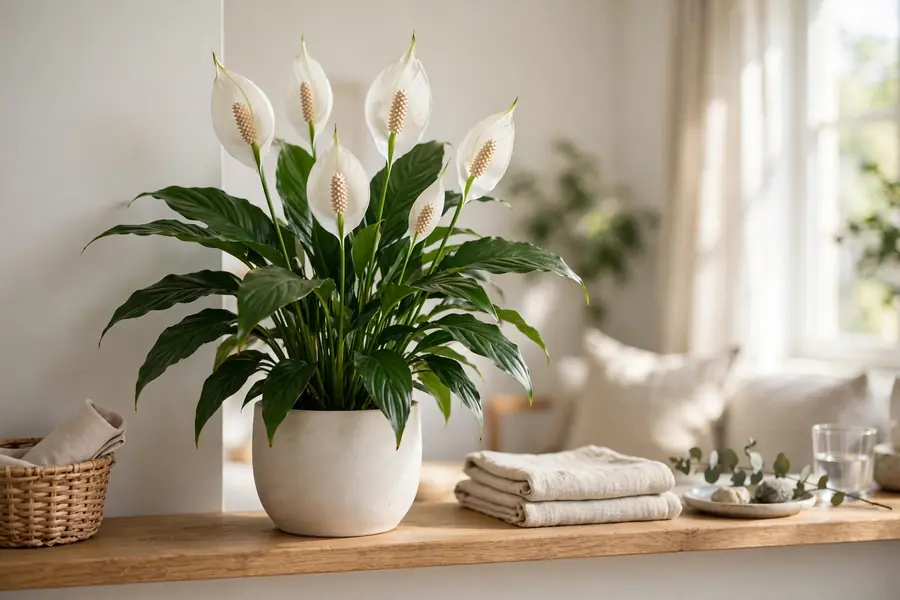
A peace lily is an easy, leafy houseplant with glossy dark green leaves and white, hood-shaped blooms that does best in bright indirect light, needs water when the top inch of soil is dry, and tells you when it is thirsty by drooping. Its scientific name is Spathiphyllum, and despite the name it is not a true lily. It grows well in ordinary homes, tolerates lower light than most flowering plants and is one of the most popular gift plants in the US. Peace lilies are toxic to cats and dogs, usually causing mouth irritation and vomiting but not the kidney damage that true lilies cause.
Most peace lily problems come from water: too much, too little or tap water with minerals the plant dislikes. This guide covers how to care for a peace lily indoors, what the "flower" really is, how to fix brown tips, yellow leaves, black leaves and drooping, how to get blooms, how to repot and propagate, whether it can live in water or outside, what it means and whether it is safe for pets.
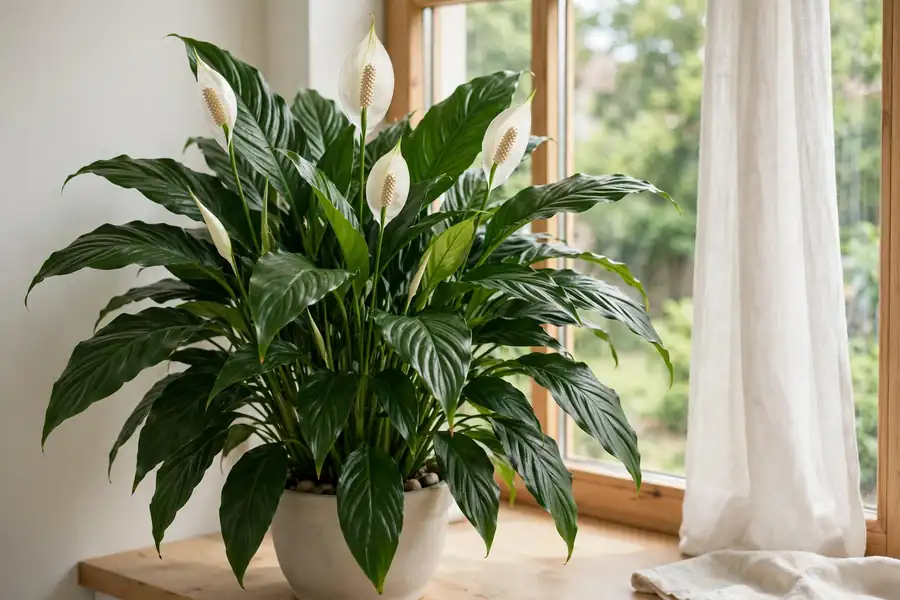
Peace lily at a glance
| Question | Short answer |
|---|---|
| Scientific name | Spathiphyllum (most often Spathiphyllum wallisii and hybrids) |
| Is it a true lily? | No. It is an aroid, related to anthurium and philodendron |
| Light | Bright indirect light. Tolerates low light but blooms less |
| Water | When the top inch of soil is dry, often about once a week. Never let it sit in water |
| Soil | Light, well-draining potting mix that holds some moisture |
| Temperature | About 65 to 80°F. Keep it above 55°F and away from cold drafts |
| Humidity | Likes moderate to high humidity, but copes with average homes |
| Feeding | Diluted balanced fertilizer every 6 to 8 weeks in spring and summer |
| Size | Usually 1 to 3 feet indoors. Large varieties reach 4 feet or more |
| Blooms | Spring and summer, though healthy plants can flower at other times |
| Pet safety | Toxic to cats and dogs. Mouth irritation, drooling and vomiting are the usual signs |
| Biggest problems | Brown tips, yellow leaves and drooping from watering mistakes or tap water |
| Difficulty | Easy, a good first houseplant |
What is a peace lily?
A peace lily is a tropical evergreen perennial in the genus Spathiphyllum, in the arum family (Araceae). It grows as a clump of arching, lance-shaped leaves on long stalks that rise straight from the soil. Wild species grow on the floor of rainforests in Central and South America, and some in Southeast Asia, where they live in shade and humidity. That explains what it wants in your home: soft light, steady moisture and warmth.
It is not a lily at all. True lilies (Lilium) grow from bulbs and belong to a different plant family. The "lily" in the name comes from the white flower's resemblance to a calla lily, which is also not a true lily. Peace lilies are closer relatives of anthuriums, pothos and philodendrons.
People also call it "peace plant," "spathe flower" or "closet plant." In Spanish it is often called lirio de la paz.
What does a peace lily look like?
A healthy peace lily has these features:
- Leaves: glossy, dark green, oval to lance-shaped with a pointed tip and a clear center vein. Leaves grow on stems that emerge from the base of the plant, with no trunk.
- The "flower": a white hood called a spathe, which is actually a modified leaf. It wraps around a thick cream or pale yellow spike called the spadix, where the tiny true flowers sit.
- Roots: thick, white to light tan, fleshy roots that fill the pot.
- Size: most small and medium plants sold in 6 to 10 inch pots stand 1 to 3 feet tall. "Sensation" and other giant varieties can grow 4 feet tall and almost as wide.
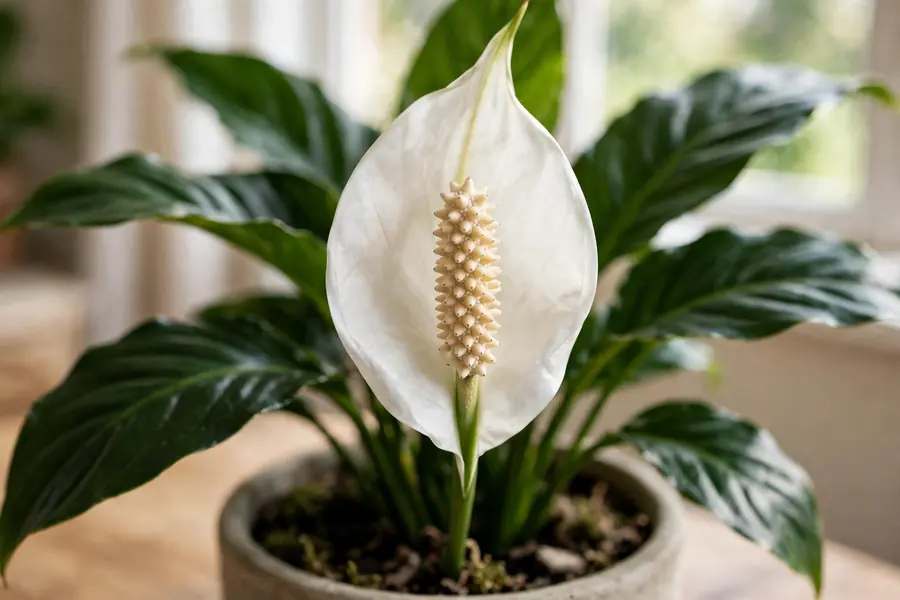
The white spathe lasts much longer than a normal petal. It often stays showy for several weeks to a couple of months, then slowly turns green and finally brown.
What are the main types of peace lily?
Plant tags often just say "peace lily," but varieties differ a lot in size and leaf look.
| Variety | Size | What sets it apart |
|---|---|---|
| Sensation (giant peace lily) | Up to 4 feet or more | Very large, deeply ribbed leaves and big blooms |
| Mauna Loa | 2 to 3 feet | The classic, most common peace lily |
| Domino (variegated) | 1 to 2 feet | Green leaves splashed with white or cream |
| Picasso | 1 to 2 feet | Leaves with white patches and edges |
| Small or dwarf types | 8 to 16 inches | Compact plants good for desks and shelves |
| Power Petite and similar | Under 2 feet | Smaller leaves and dense growth |
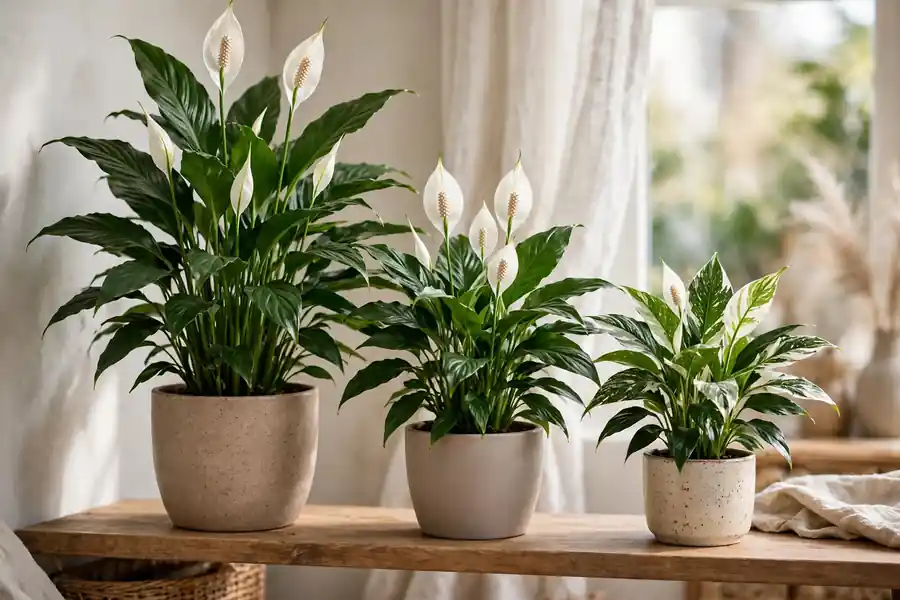
Care is almost identical across varieties. Variegated types need slightly brighter light to keep their patterns, and giant types need larger pots and more frequent watering.
Are there red, pink, purple or blue peace lilies? Not naturally. Peace lily spathes are white (some start slightly green). Plants sold with red, pink, purple or blue blooms are either dyed or tinted, in which case new flowers come in white, or they are a different plant altogether, such as an anthurium (flamingo flower), which really does come in red and pink. Be cautious of "rare" colored peace lilies online.
How much light does a peace lily need?
A peace lily grows best in bright, indirect light: near a window with sheer curtains or a few feet back from a bright window. It tolerates low light better than most flowering houseplants, which is why it is common in offices and bathrooms.
| Light | What happens |
|---|---|
| Bright indirect | Best growth and the most blooms |
| Medium | Healthy leaves, fewer blooms |
| Low light | Survives, but growth is slow, leaves may be darker and blooms are rare |
| Direct sun | Leaf scorch: yellow, pale or brown patches |
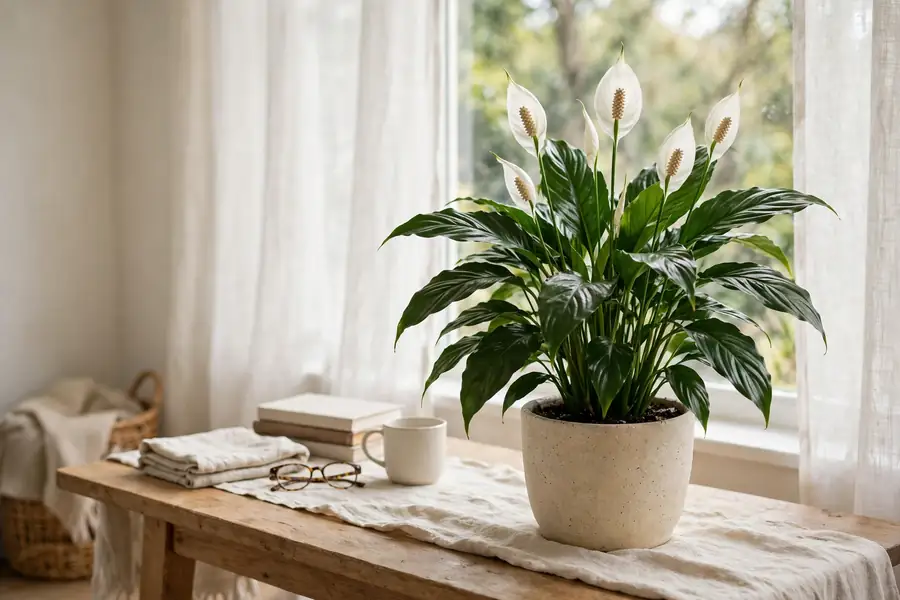
An east window is a good choice. A north window works in a bright room. A south or west window works if the plant sits a few feet back or behind a sheer curtain. Turn the pot a quarter turn every week or two to keep growth even.
Do peace lilies need sunlight? They need light, but not direct sun. A bright room is enough. If you want flowers, aim for a spot where you could comfortably read a book most of the day without turning on a lamp.
How often should you water a peace lily?
Water a peace lily when the top inch of soil feels dry, which is often about once a week in spring and summer and every 10 to 14 days in winter. The best test is your finger, not the calendar.
- Push a finger about an inch into the soil.
- If it is dry, water slowly until water runs out of the drainage holes.
- Let the pot drain for several minutes, then empty the saucer.
- If the soil is still damp, wait a day or two and check again.
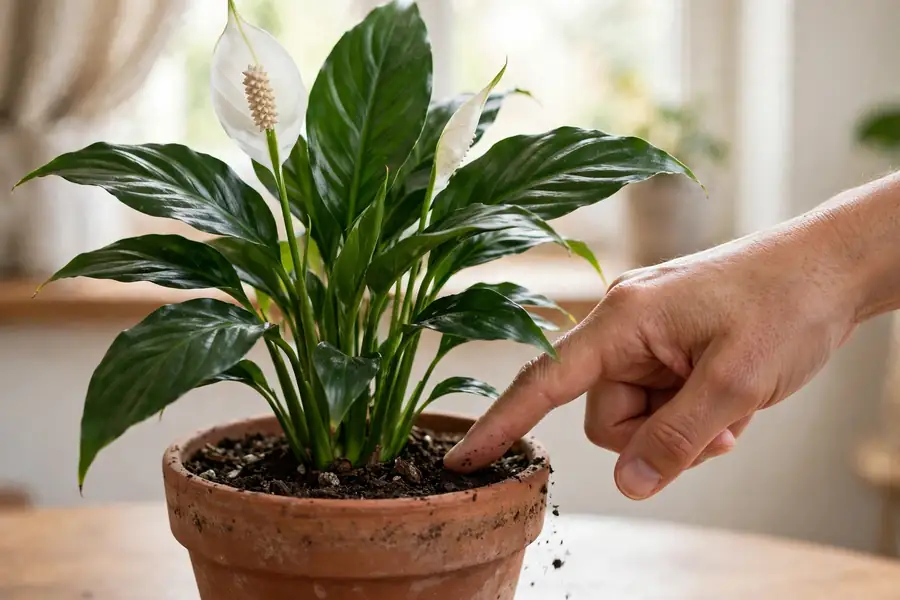
A few useful points:
- Peace lilies tell you when they are thirsty. The whole plant droops, and it usually perks up within hours of a good drink. A plant that wilts occasionally and recovers is not harmed. Repeated deep wilting does stress the plant, so do not rely on it as your watering method.
- Never leave it standing in water. Constant wet soil leads to root rot.
- How much water? Enough to wet the entire root ball, until it drains. A small pot may need only a cup, a big floor plant several cups.
- Winter: water less often, because the plant grows slowly and the soil dries more slowly.
- Misting: it is optional. Misting does little to humidity for long. A pebble tray, a humidifier or grouping plants works better.
Overwatered vs underwatered: the two look alike at first because both cause drooping.
| Sign | Underwatered | Overwatered |
|---|---|---|
| Soil | Dry, may pull away from the pot edge | Wet, soggy or smelly |
| Leaves | Droopy, but green and soft, recover after watering | Droopy, yellowing, may turn brown or black |
| Stems | Limp | Soft or mushy at the base |
| Fix | Water thoroughly | Let it dry, trim rotted roots, repot in fresh mix |
How long can a peace lily go without water? A healthy peace lily can usually handle a week or two of dry soil, and it will droop to warn you. Longer than that causes brown, crispy leaf edges and stress.
What kind of water is best for a peace lily?
Peace lilies are sensitive to fluoride, chlorine and mineral salts in tap water, which can cause brown leaf tips and edges. If you notice brown tips, try one of these:
- Use filtered, distilled or collected rainwater.
- Let tap water sit out overnight. Some gardeners find that it helps with chlorine, though it does not remove fluoride, and results vary.
- Flush the soil with plenty of water every few months to wash out built-up salts. Let it drain completely.
- Avoid softened water, which contains added salts.
What is the best soil and pot for a peace lily?
A peace lily likes a light, airy potting mix that holds moisture but drains well. A good mix is standard indoor potting soil with a handful of perlite or orchid bark added. Avoid heavy garden soil, which compacts and holds too much water.
Pot choice: use a pot with drainage holes. Choose one only 1 to 2 inches wider than the root ball. A pot that is too large keeps soil wet for too long. Plastic pots keep moisture longer than terracotta, so terracotta suits people who tend to overwater, while plastic suits people who forget.
Peace lilies don't mind being a little snug in the pot, and a slightly root-bound plant often blooms better.
How do you fertilize a peace lily?
Peace lilies are not heavy feeders. Feed with a balanced houseplant fertilizer diluted to half the label strength about every 6 to 8 weeks in spring and summer, and skip feeding in fall and winter. A bloom-boosting fertilizer with a bit more phosphorus can help a mature plant that is not flowering.
Too much fertilizer is a common cause of brown tips and salt buildup on the soil surface. When in doubt, feed less.
Homemade fertilizer and coffee grounds: diluted, cooled coffee or used coffee grounds are sometimes recommended, but results are mixed and grounds can stay wet and grow mold on top of the soil. A balanced fertilizer is more reliable. If you want a natural option, mixing a little finished compost into the potting mix at repotting gives a gentle boost, and the compost guide explains how to make your own.
What temperature and humidity does a peace lily like?
- Temperature: about 65 to 80°F. Anything below about 55°F can cause leaf damage, and cold drafts cause drooping and blackening.
- Humidity: moderate to high. Dry air from heaters or air conditioners causes brown tips. Group plants, use a humidifier or a pebble tray, or place the plant in a bright bathroom.
- Location: keep it away from heating vents, cold windows in winter and air conditioners.
Why is my peace lily drooping?
Drooping is the peace lily's way of talking. The most common causes:
| Cause | Clue | Fix |
|---|---|---|
| Thirst | Dry soil, plant recovers after watering | Water thoroughly |
| Overwatering and root rot | Wet soil, yellowing, smelly or mushy roots | Let the soil dry, remove rotted roots, repot |
| Root-bound | Roots circling the pot, water runs straight through | Repot to a slightly larger pot |
| Cold or drafts | Drooping after a chilly night or near a window | Move to a warmer spot |
| Too much sun or heat | Droop plus pale, scorched leaves | Move to indirect light |
| Transplant shock | Droop right after repotting | Keep it lightly moist and out of strong light for a few weeks |
| Pests | Sticky leaves, webs, tiny insects | Treat with insecticidal soap |
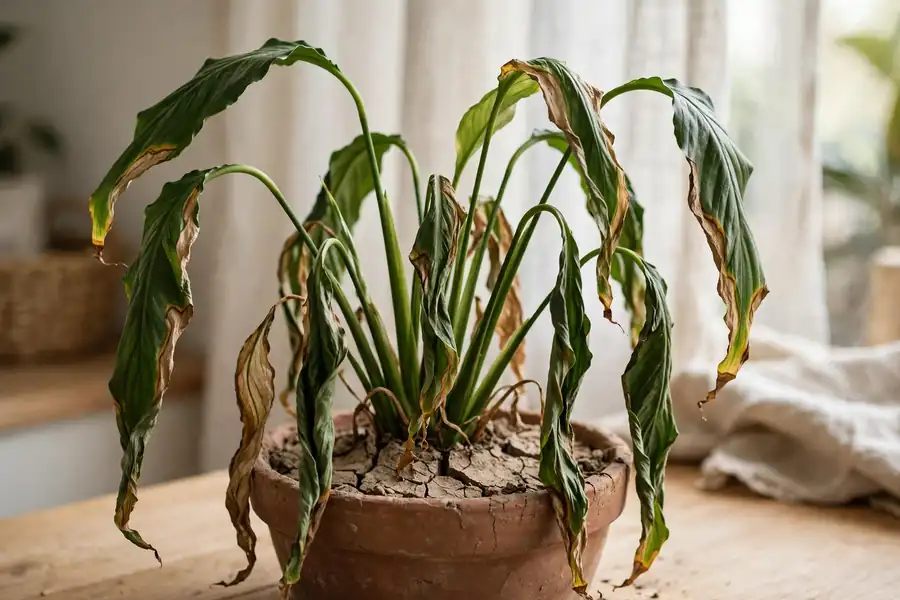
Why is my peace lily drooping even after watering, or with moist soil? If the soil stays wet and the plant still droops, suspect root rot. Slide the plant out and check. Healthy roots are firm and white. Rotted roots are brown, mushy and smell sour. Cut off the rotted parts and repot in fresh, dry mix in a clean pot with drainage.
Why is my peace lily drooping after repotting? Some drooping is normal for a week or two. Keep the soil lightly moist, avoid fertilizer and keep it out of direct sun while it recovers.
Why are peace lily leaves turning yellow?
A few yellow leaves are normal as old leaves age. Many yellow leaves signal a problem.
| Cause | Clue | Fix |
|---|---|---|
| Overwatering | Soil stays wet, lower leaves yellow first | Let the soil dry and improve drainage |
| Underwatering | Dry soil, yellowing with crisp edges | Water deeply and regularly |
| Low light | Pale, slow growth | Move to brighter indirect light |
| Too much sun | Yellow or bleached patches on exposed leaves | Move back from the window |
| Nutrient problems | Overall pale color, little growth | Feed lightly in the growing season |
| Natural aging | One old leaf at a time | Remove it |
| Root-bound or old soil | Yellowing plus roots out of the holes | Repot |
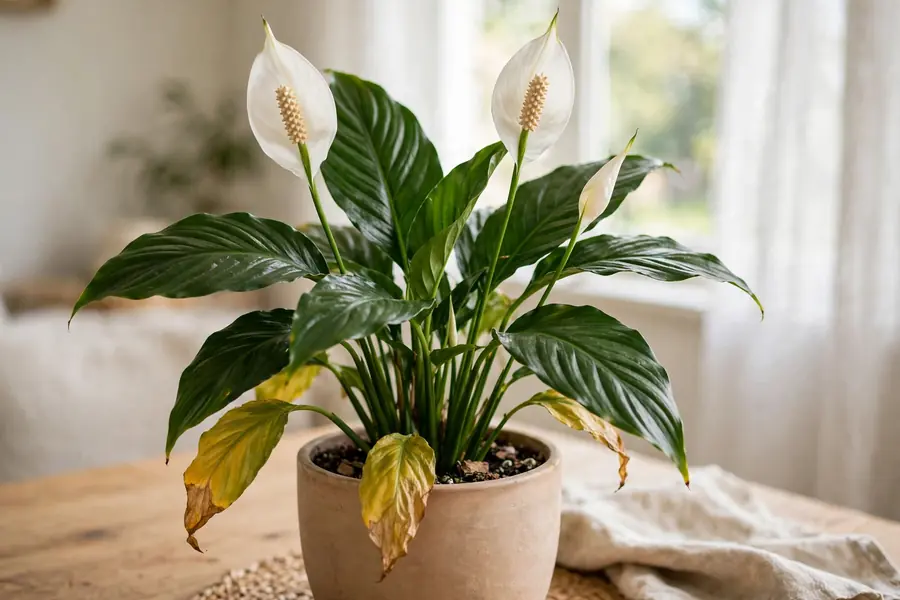
Should you remove yellow leaves? Yes. Cut the leaf stalk off at the base with clean scissors. Yellow leaves do not turn green again, and removing them keeps the plant tidy and helps it focus energy on new growth.
Why are peace lily leaves turning brown?
Brown tips are the most common peace lily complaint. They come from:
- Tap water minerals or fluoride. Switch to filtered or distilled water.
- Dry air. Raise the humidity.
- Inconsistent watering. Both drought and soggy soil damage roots and cause browning.
- Too much fertilizer. Flush the soil and cut back.
- Direct sun. Brown, dry patches in the middle of leaves.
- Cold drafts.
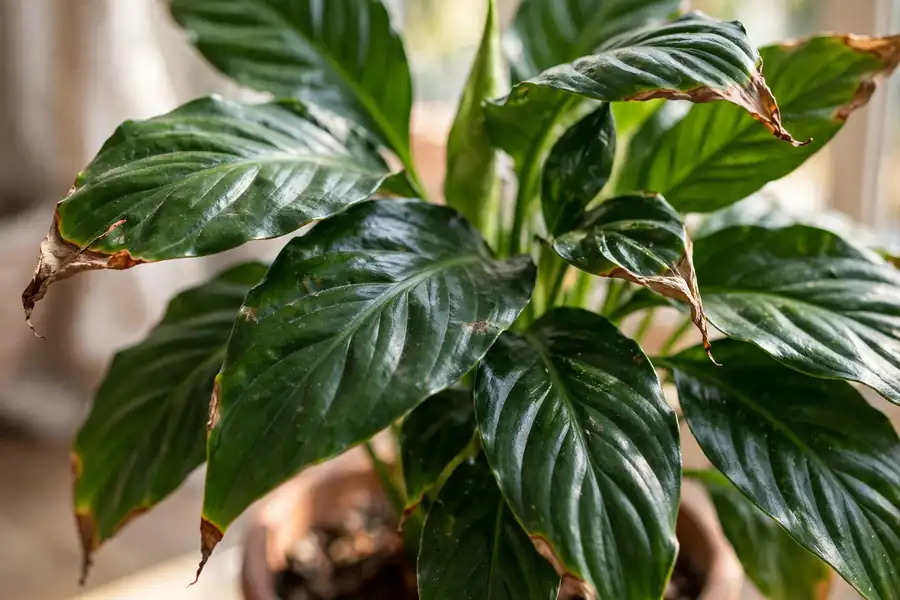
How do you treat brown tips? You cannot turn brown tissue green again, but you can stop more. Fix the cause, then trim the brown parts with clean scissors. Cut along the natural leaf shape, leaving a very thin brown edge so you do not cut into healthy tissue. Remove fully brown leaves at the base.
Why are the peace lily flowers turning brown? Spathes turn green and then brown as they age, which is normal after weeks or months. Early browning can come from dry air, direct sun, too much fertilizer or heat. Cut brown flowers off (see the pruning section below).
Why are peace lily leaves turning black?
Black leaves or leaf edges usually mean something more serious than brown tips:
- Overwatering and root rot is the top cause. Check the roots and soil.
- Cold damage from drafts or temperatures below about 55°F turns leaves dark and soggy.
- Fertilizer burn from heavy feeding.
- Fungal leaf spot from wet leaves and poor airflow.
Remove blackened leaves, correct the cause and, if roots are rotting, repot into fresh mix. If the plant has few healthy roots left, it may not recover. In that case, divide off any healthy sections and start over.
Why are peace lily leaves curling?
Leaf curling usually points to thirst, low humidity, heat stress or pests such as spider mites. Check the soil, move the plant away from vents and inspect the undersides of leaves for tiny insects.
How do you revive a dying peace lily?
Many peace lilies bounce back from poor treatment. Work through these steps:
- Check the soil and roots. Are they dry and hard, or wet and smelly? Lift the plant out of the pot to look.
- If dry: soak the pot in a basin of water for 20 to 30 minutes, drain fully and trim crispy leaves.
- If rotting: cut off black, mushy roots, repot in fresh mix in a clean pot with drainage and water lightly.
- Remove dead leaves at the base.
- Fix the light and water issues described in this guide.
- Be patient. Recovery can take several weeks. Do not fertilize a stressed plant.
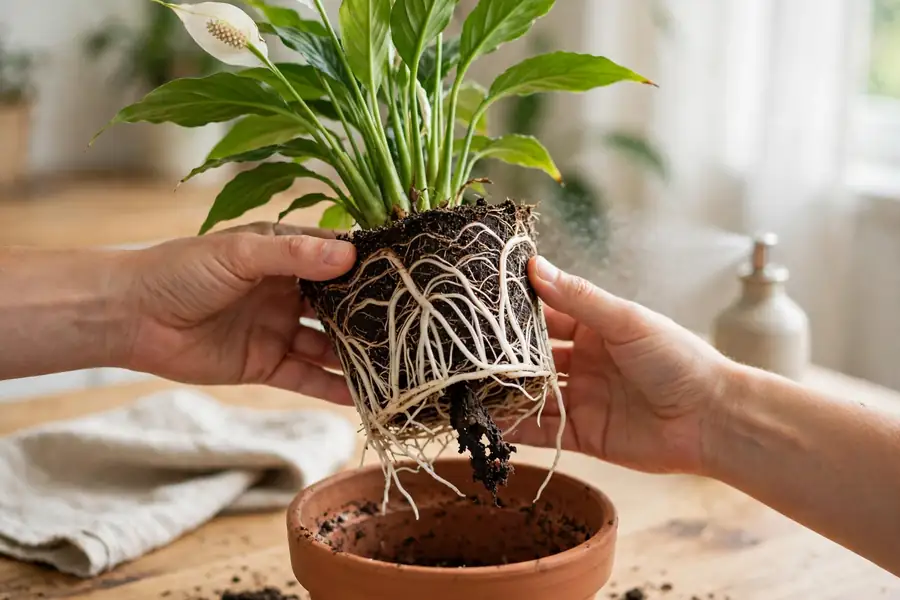
How do you save a peace lily that is nearly dead? If most leaves are gone, look for any firm white roots and new growth. A plant with live roots can regrow. If the whole crown is mushy and roots are all black, it is likely too late. You can still try dividing off any firm, green sections.
Why is my peace lily not blooming?
A peace lily that has glossy green leaves but no flowers is almost always lacking light, maturity or care.
| Reason | What to do |
|---|---|
| Too little light | Move to bright indirect light. This is the most common cause |
| Plant is too young | Young plants may need a year or more to mature |
| Too little fertilizer | Feed lightly in spring and summer |
| Pot too large | Peace lilies often bloom when slightly root-bound |
| Stress from cold, drought or overwatering | Fix the conditions and wait |
| Natural rest | Some plants rest in fall and winter |
How do you get a peace lily to bloom? Give it bright indirect light, regular watering, a light feeding every 6 to 8 weeks in the growing season and a snug pot. Plants often flower in spring, but a happy peace lily can bloom more than once a year. Greenhouses sometimes use plant hormones to push blooms on plants sold in stores, so a store plant that bloomed at purchase may rest a while at home. This is normal.
How long do peace lily flowers last? Often several weeks to two months or more, depending on the plant and its conditions.
Why are my peace lily flowers turning green? As a spathe ages, it slowly changes from white to green. It is natural. Low light or heavy fertilizer can speed up the green color. Once a flower is fully green, it will not turn white again, and you can cut it off.
How do you prune a peace lily and cut off dead flowers?
Peace lilies need little pruning.
- Dead flowers: cut the flower stalk off at the base, where it meets the plant, using clean scissors or shears. Do not leave a stub.
- Dead or yellow leaves: cut the leaf stalk off at the soil line.
- Brown tips: trim only the brown part, following the leaf's shape.
- Cutting the whole plant back: a badly stressed peace lily can be cut right down to the base. It often regrows new leaves if the roots are healthy.
Wipe tools with rubbing alcohol before and after so you do not spread disease.
How do you repot a peace lily?
Repot when roots circle the inside of the pot, grow out of the drainage holes, or water runs straight through. This usually happens every 1 to 2 years. The best time is spring, when growth is active.
- Water the plant a day ahead so the roots are not dry.
- Choose a pot 1 to 2 inches wider than the current one, with drainage holes.
- Gently slide the plant out. Loosen tight roots with your fingers and trim any black or mushy ones.
- Add a layer of fresh potting mix to the new pot. Set the plant at the same depth it grew before.
- Fill around the root ball with mix and press lightly. Do not pack it hard.
- Water thoroughly until it drains, then empty the saucer.
- Keep it out of strong light and do not fertilize for 4 to 6 weeks.
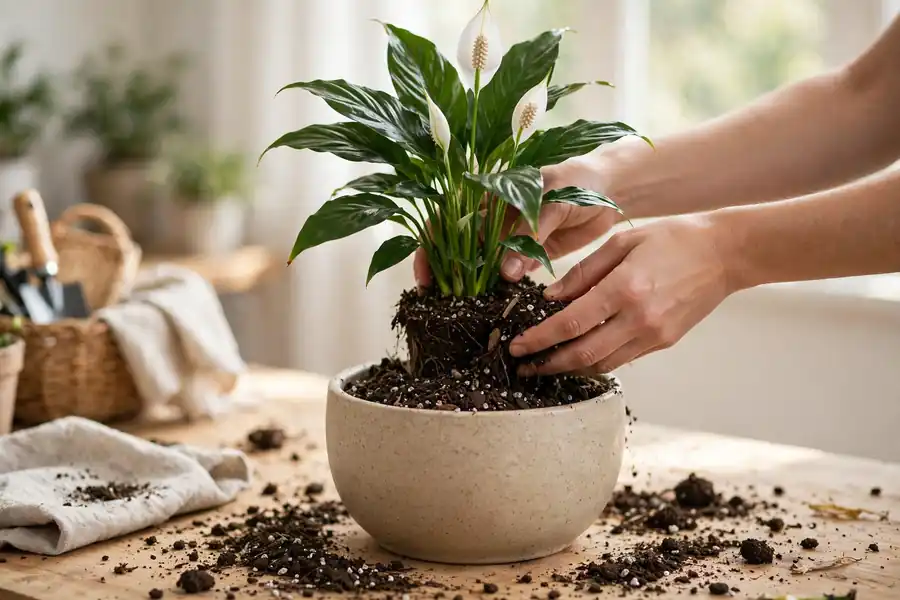
What size pot for a peace lily? Most grow well in 6 to 10 inch pots. Giant varieties may need 12 inches or more. Do not jump more than one or two inches in size, or the extra soil stays wet.
Do peace lilies like to be root-bound? They tolerate it and often bloom better when slightly snug, but severely crowded roots cause drooping, yellow leaves and constant thirst.
How do you propagate a peace lily?
The reliable way is division, because a peace lily grows as a clump of plants.
- Water the plant a day or two ahead.
- Take it out of the pot and shake off loose soil so you can see the roots.
- Find natural clumps, each with several leaves and its own roots.
- Gently pull or cut the clumps apart. Each section needs a healthy root system.
- Pot each division in a pot with fresh mix and water well.
- Keep the new plants lightly moist and in indirect light for a few weeks. Expect some drooping at first.
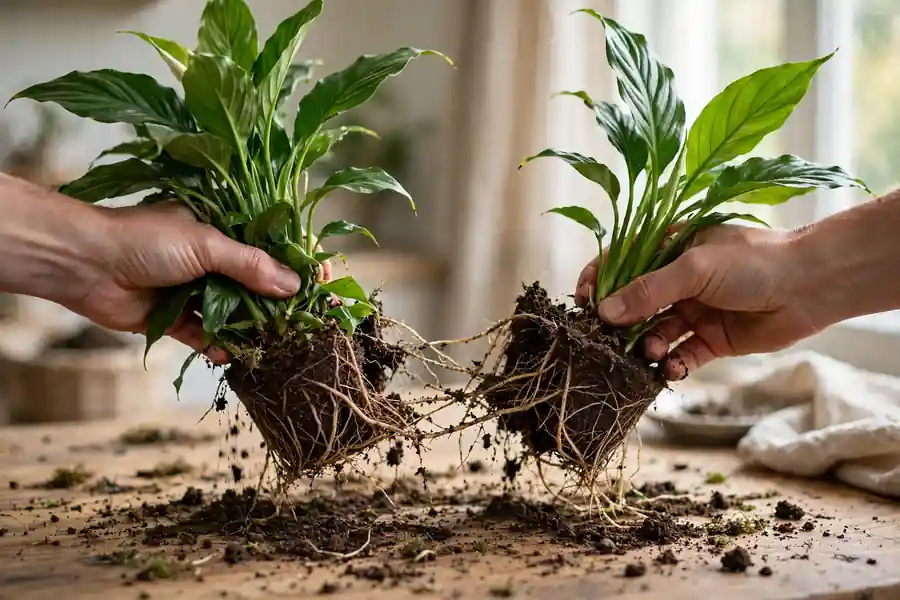
Spring is the best time. Dividing at repotting time is the easiest.
Can you propagate a peace lily from a leaf or cutting? No. A single leaf will not grow into a new plant, because the new growth needs part of the root-and-crown section. Division is the method that works.
Can you grow a peace lily from seed? Home growers rarely do. Seeds are hard to obtain, because most houseplant peace lilies are propagated commercially, and seedlings are slow. Be wary of listings for "peace lily seeds." Buying a small plant is much simpler.
Can you propagate a peace lily in water? Not from a cutting, but a divided plant can be rooted in water (see below).
Can a peace lily grow in water?
Yes, with care. A peace lily can live with its roots in water, as in a hydroponic setup or vase, as long as the crown and leaves stay above the water.
- Take a healthy plant and rinse the soil off the roots.
- Place it in a container so that only the roots are in water. A neck-down vase or a pot with a net lid works well.
- Refresh the water every one to two weeks and rinse the roots.
- Use filtered or rainwater and add a very diluted liquid fertilizer once a month in the growing season.
- Keep the plant in bright indirect light.
A peace lily kept in water does not need the usual watering routine, but roots still need clean water and some oxygen. Cloudy water or slimy roots mean the water needs changing.
Can a peace lily live outside?
Only in warm climates or in summer. Peace lilies are hardy outdoors only in frost-free regions, roughly USDA zones 10 to 12, where they grow as shade-loving garden plants. In colder areas:
- Summer: put the pot in a shady, sheltered spot on a patio once night temperatures stay above 55°F. Keep it out of direct sun.
- Fall: bring it indoors before nights drop below about 55°F, and check for pests first.
- Winter outdoors: a peace lily left outside in freezing weather will die back or die.
Is a peace lily an indoor or outdoor plant? Indoor in most of the US. Is it a perennial? Yes, in the right climate it lives for years and keeps growing, but it is not frost hardy.
How big does a peace lily get, and how long does it live?
Most indoor peace lilies reach 1 to 3 feet tall. Giant varieties such as Sensation can reach 4 feet or more with a similar spread. A full-grown plant is mostly limited by its pot and light.
How long does a peace lily live? With good care, many peace lilies live for many years, and plants lasting five to ten years or more are common as long as you repot and divide them occasionally. Short-lived plants are usually victims of overwatering.
Is a peace lily toxic to cats and dogs?
Yes. The ASPCA lists peace lily (Spathiphyllum) as toxic to cats and dogs. The leaves and flowers contain tiny needle-like calcium oxalate crystals. When a pet chews on the plant, these crystals cause pain and irritation.
Signs in cats and dogs:
- Drooling and pawing at the mouth
- Burning, irritation or swelling of the mouth, tongue and lips
- Vomiting
- Difficulty swallowing
- Reduced appetite
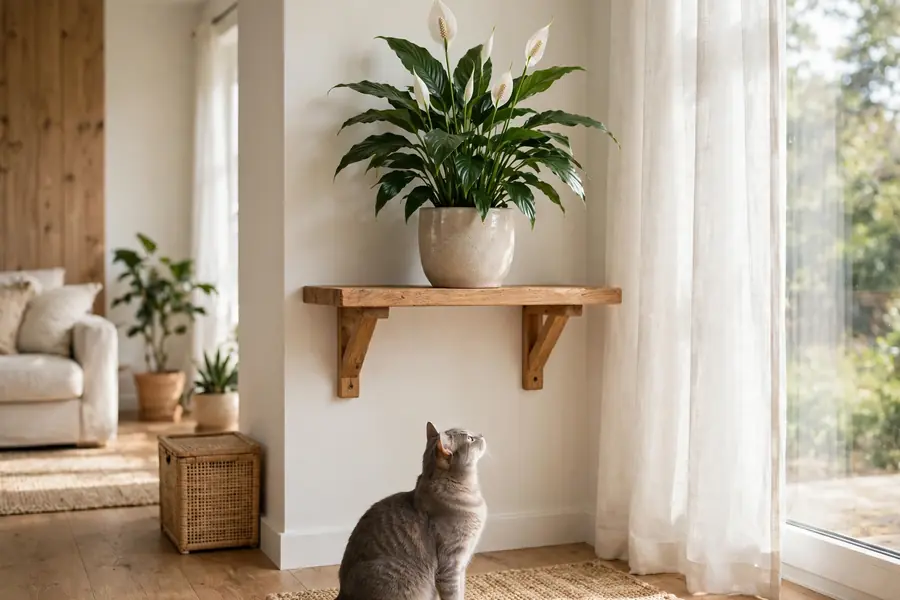
Mouth irritation is the typical effect, and serious poisoning is uncommon. In rare cases, swelling in the mouth or throat can make breathing difficult, which is an emergency.
Is a peace lily as dangerous as a true lily? No. True lilies (Lilium) and day lilies (Hemerocallis) can cause severe kidney failure in cats, and even small amounts are an emergency. Peace lilies do not cause that kidney damage. They are still not a plant to leave where a pet will chew on it.
What should you do if your cat or dog eats a peace lily?
- Remove any plant pieces from the pet's mouth.
- Offer a little water or a small amount of milk or yogurt, which some vets suggest can soothe the mouth, if your pet will drink.
- Call your vet or a pet poison hotline (the ASPCA Animal Poison Control Center is 888-426-4435, and a fee may apply).
- Go to an emergency vet right away if your pet has trouble breathing, swelling, repeated vomiting or will not stop drooling.
If your cat is unsure, a wise move is to keep the plant on a high shelf or in a room the pet cannot enter, or choose a pet-safe plant instead.
Is a peace lily toxic to humans? The same crystals can irritate the mouth and skin. Small children who chew leaves can get mouth burning and drooling. Keep it out of reach of toddlers, wash your hands after handling it if you have sensitive skin, and call poison control if someone eats part of it. Serious harm is unusual.
Do peace lilies purify the air?
Peace lilies became famous for removing indoor air pollutants in a well-known lab study from the late 1980s. In real homes, a few plants have very little effect on air quality compared with ventilation. Grow a peace lily because it is attractive and easy, not as an air purifier.
Is a peace lily good for a bedroom or bathroom? Yes for both, if the light is suitable and pets cannot reach it. Peace lilies like a bathroom's humidity, and a bedroom with bright indirect light suits them. Claims that a peace lily helps you sleep are not well supported. Grow it for looks.
What does a peace lily mean?
The peace lily is a symbol of peace, purity, harmony and sympathy. Its white spathe looks like a flag of surrender or a white flag of peace, which is how the plant got its name.
Common meanings:
- Peace and tranquility: it is a popular housewarming and office gift.
- Purity and innocence: from the white color.
- Sympathy and renewal: it is often given to grieving families, because it is long-lasting and stands for hope and rebirth.
- Prosperity and good luck: in some traditions it is believed to bring harmony to a home.
Spiritual meaning: people link it to calm, healing and moving on after loss. These meanings are cultural traditions, not facts about the plant.
What plants look like a peace lily?
| Plant | How it differs |
|---|---|
| Calla lily (Zantedeschia) | Grows from a rhizome and is usually an outdoor or cut flower, with a funnel-shaped spathe and no glossy rosette of leaves |
| Anthurium | Same plant family. Heart-shaped red, pink or white spathes and a more upright spike |
| Chinese evergreen (Aglaonema) | Also an easy aroid, but grown for patterned leaves, not blooms |
| Pothos and philodendron | Vining aroids with no white spathe |
Peace lily vs calla lily: a peace lily is a tropical houseplant that stays in a pot indoors and tolerates low light. A calla lily is a garden or cut flower that likes sun and goes dormant in winter. Anthurium vs peace lily: anthuriums like brighter light and have waxy, heart-shaped blooms in many colors. Peace lilies are easier and more forgiving.
Quick answers to common questions
How often should you water a peace lily?
When the top inch of soil is dry, usually about once a week in spring and summer and less in winter. Water until it drains, and never let it sit in water.
Is a peace lily toxic to cats and dogs?
Yes. The ASPCA lists it as toxic to both. It usually causes mouth irritation, drooling and vomiting, not the kidney failure caused by true lilies. Call your vet if a pet chews it.
Why are the leaves on my peace lily turning yellow or brown?
Yellow leaves usually mean overwatering or low light, and brown tips usually come from tap water minerals, dry air, inconsistent watering or too much fertilizer. Use filtered water and keep the watering steady.
Why is my peace lily drooping?
Most often because it is thirsty, which a good drink fixes within hours. If the soil is wet, suspect root rot. Other causes are being root-bound, cold drafts and transplant shock.
How do you get a peace lily to bloom?
Give it bright indirect light, regular watering, a light feeding every 6 to 8 weeks in the growing season and a snug pot. Low light is the most common reason for no blooms.
Keep reading: snake plant care, spider plant care, how to compost and more houseplant guides.
Is a peace lily worth growing?
Yes. A peace lily is one of the most forgiving flowering houseplants: it handles low light, tells you when it needs water and rewards you with elegant white blooms. Give it bright indirect light, water only when the top inch is dry, use filtered water if you see brown tips, repot every year or two and keep it away from curious pets. If you do, a peace lily can stay healthy in your home for many years.