
A bathroom stays clean when the method fits the material in front of you. Tile, stone, glass, chrome, and grout each fail in a different way when the wrong cleaner touches them, so the order below works from the least risky surfaces toward the toilet, and the cleaner changes with the surface. This is how to clean bathroom surfaces without trading a clean room for etched stone, dulled chrome, or grout that crumbles under a stiff brush.
At a glance
| Task | Cleaner | Tool | Dwell time |
|---|---|---|---|
| Weekly wipe of tile and fixtures | pH-neutral cleaner or mild dish soap in water | Soft cloth or non-scratch sponge | None, wipe and rinse |
| Grout lines | Neutral tile and grout cleaner | Narrow grout brush | 5 to 10 minutes |
| Disinfecting hard surfaces | Diluted bleach, label first | Cloth, not a spray bottle of home mix | At least 1 minute, surface kept wet |
| Stone counters and floors | pH-neutral stone cleaner or a few drops of mild dish soap | Soft cloth | None, rinse and dry |
| Glass and mirrors | Glass cleaner or diluted vinegar on glass only | Squeegee or lint-free cloth | None |
| Exhaust fan grille | Mild soap and water, power off | Soft cloth, vacuum brush tool | None |
What order should you clean a bathroom in?
Work dry first, then wet, from the top down, and finish at the toilet and the floor. The toilet goes near last because it carries the heaviest soil, and the cloth used on it stays with it.
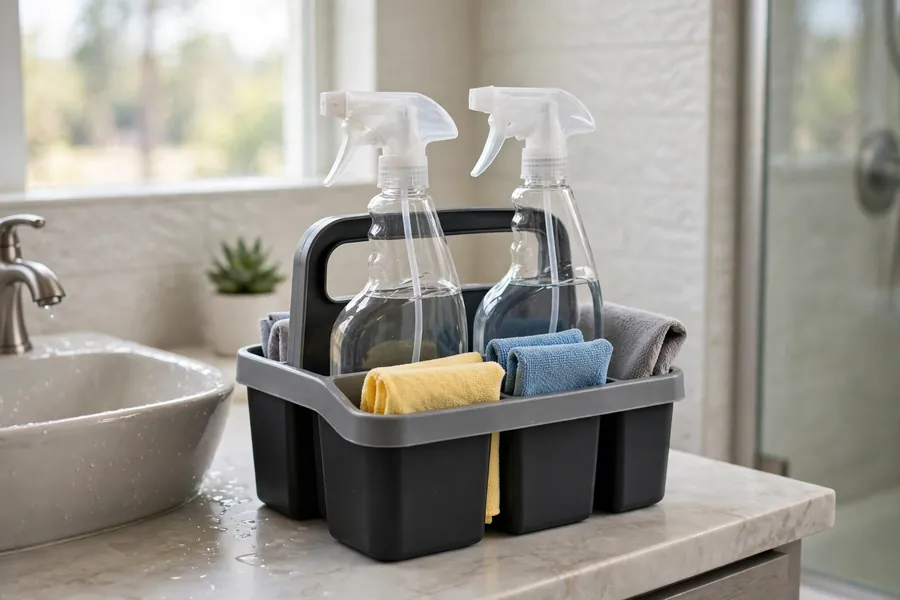
Dust high ledges, the fan grille, light fixtures, and shelf tops with a dry cloth, then sweep or vacuum the floor. Apply cleaner where it needs dwell time, to the shower walls, the toilet bowl, and the grout lines, and let it sit while you clean the mirror and the sink. Scrub and rinse each wet area in turn, wipe the toilet last, and mop the floor from the far corner back toward the door.
A fast clean follows the same order with a shorter list: clear surfaces, wipe the mirror and sink, brush the bowl, wipe the seat and base, and sweep the floor. It suits a room cleaned fully within the last week, and it does not replace grout work, fan cleaning, or drain care.
What counts as a deep clean?
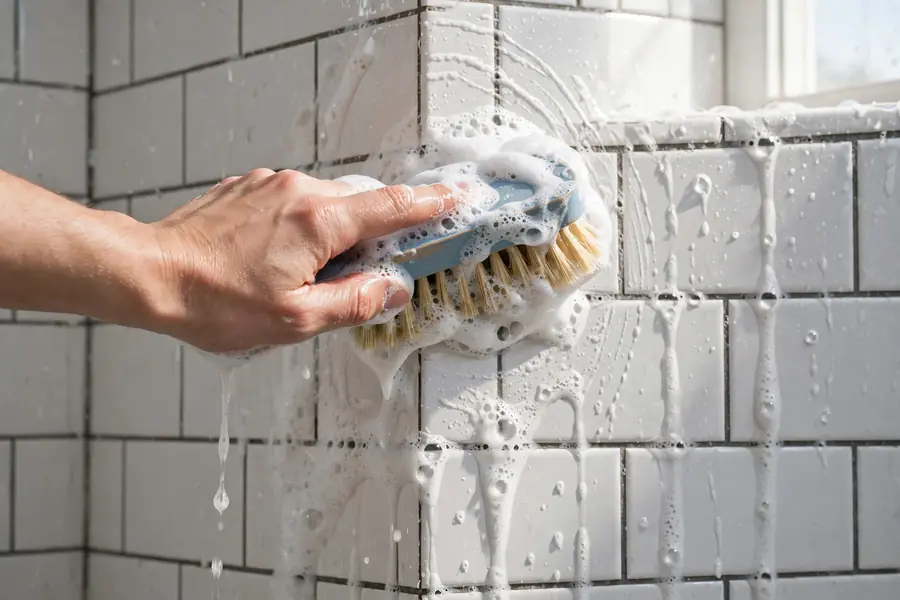
A deep clean adds every job the weekly wipe skips: grout lines scrubbed and rinsed, the fan grille washed, the sink overflow and stopper cleaned, the toilet base and hinges wiped, cabinets and baseboards wiped, and mineral buildup treated at faucets and the showerhead. A deep clean never means stronger chemicals. It means longer dwell time, a brush where a cloth cannot reach, and a second rinse.
| Cadence | Jobs |
|---|---|
| Daily | Squeegee shower glass after the last shower, hang towels spread out, wipe toothpaste and water spots off the sink |
| Weekly | Full room order, mirror, sink, toilet, shower walls, floor |
| Monthly | Grout lines, fan grille, overflow hole, stopper, cabinets, baseboards, mineral deposits |
| Every few months | Drain check and stopper clean, caulk and grout inspection, fan interior dusting with the power off |
Daily habits carry most of the weight. A squeegee pass stops mineral spots from setting on glass, and a sink wiped after brushing keeps toothpaste from drying into a film.
How to Clean Bathroom Surfaces Without Mixing Cleaners
Never mix bleach with ammonia, acids, vinegar, or any other cleaner. Mixing bleach with ammonia or an acid makes vapors that can cause serious harm, and US Centers for Disease Control and Prevention guidance read October 27, 2026 states the rule plainly: never mix household bleach with any other cleaner or disinfectant.
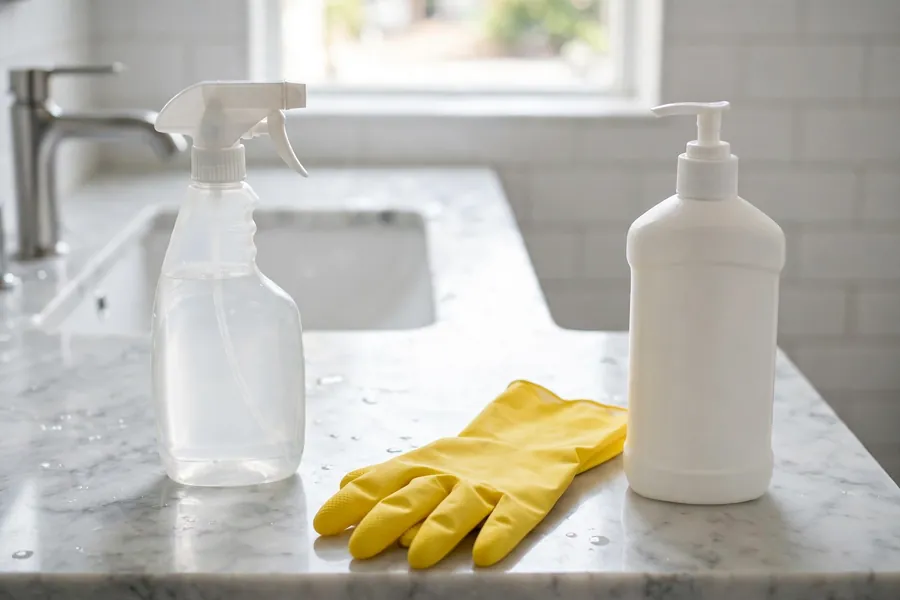
Bleach is a disinfectant, not a general cleaner, and the label on the bottle comes first. Where the bottle gives no directions, CDC guidance read October 27, 2026 gives a fallback of 5 tablespoons, or one third of a cup, of regular unscented household bleach with 5 percent to 9 percent sodium hypochlorite per gallon of room temperature water, or 4 teaspoons per quart. Leave the solution on the surface for at least 1 minute and keep the surface visibly wet for that time. Mix a fresh batch daily, since a diluted solution loses strength after 24 hours. Keep bleach off stone, colored grout, and metal finishes unless the label says it is safe there.
Vinegar cuts mineral deposits and soap film on glass and ceramic, and it has no place on stone, on grout that is already soft, or mixed with bleach. Vinegar is an acid, and acid etches marble, limestone, travertine, and other calcareous stone, leaving dull marks that cleaning cannot reverse. Baking soda is a mild abrasive paste for ceramic and porcelain only. Hydrogen peroxide in a household 3 percent solution lifts stains on grout and lightens mildew marks on hard surfaces, and it still needs a label check before use on stone or colored grout, and it must never be mixed with vinegar or bleach in the same session. Soap, water, and mechanical action are enough for most weekly work.
How do you clean tile without damage?
Identify the tile before choosing a cleaner, because the wrong acid or abrasive does the damage. Glazed ceramic and porcelain take a pH-neutral cleaner or mild dish soap in warm water, a soft cloth or non-scratch sponge, and a full rinse.
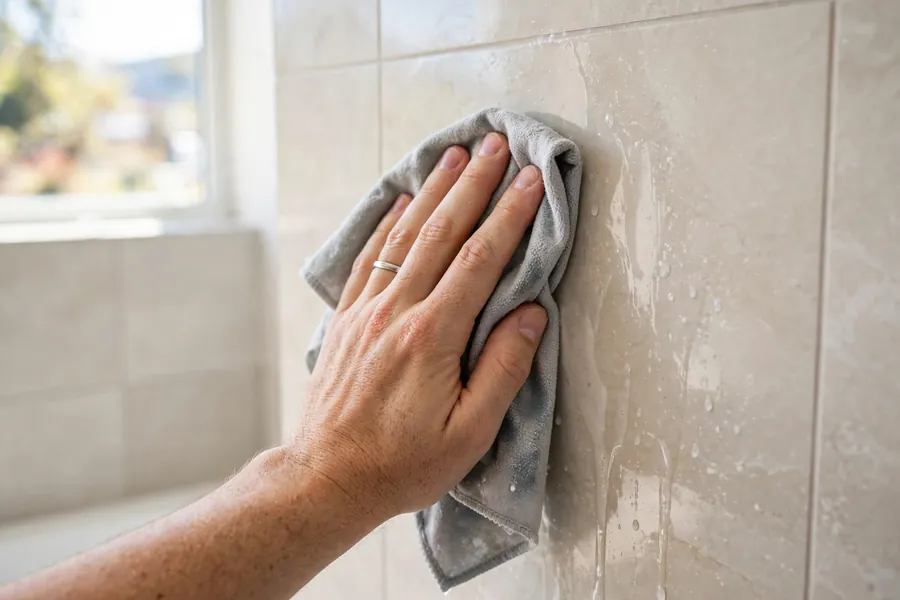
Natural stone tile, including marble, travertine, limestone, and slate, takes a pH-neutral stone cleaner or a few drops of mild dish soap in warm water, a soft cloth, a rinse, and a full dry. Natural Stone Institute care guidance read October 27, 2026 gives the same line: neutral pH cleaner, soft cloth, no acidic cleaners, and spills blotted at once with a paper towel, not wiped. Acid, citrus, vinegar, and descaling sprays etch calcareous stone, and a scouring pad scratches the surface.
Vinyl and linoleum floors take a mild cleaner made for resilient floors, a damp mop, and a rinse with clean water. Never flood the floor, since water at the seams lifts edges and swells the core. Squeegee shower walls after every shower and dust mop floors before wet mopping, since grit under a mop scratches glaze and stone alike.
How do you clean grout in a shower and on the floor?
Grout is cement, and it holds soil in its pores while the tile face stays smooth. Sweep or vacuum the floor first, then apply a neutral tile and grout cleaner and let it dwell 5 to 10 minutes. MAPEI product guidance read October 27, 2026 gives 2 ounces per gallon for light cleaning and 4 ounces per gallon for heavy soil for its concentrated tile and grout cleaner, and says to agitate, pick up the dirty solution, and rinse with clean water.
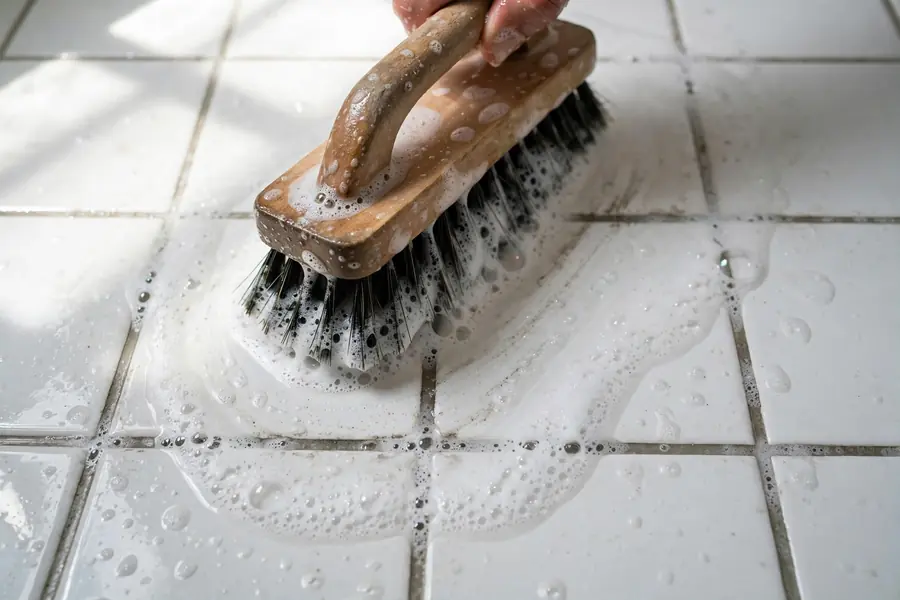
White grout turns gray from soil sitting in the pores, and a neutral cleaner with dwell time and a brush restores it in most cases. Where dark marks stay after two passes, a hydrogen peroxide solution or an oxygen based cleaner made for grout can lift them, after a test spot on a hidden joint and a check that the product suits the tile beside it. Alkaline grout cleaners with a pH near 11 cut heavy grease and soap film, and MAPEI guidance read October 27, 2026 warns that its alkaline grout joint cleaner is not for polished stone or waxed surfaces. Acid cleaners strip cement grout.
How do you clean a shower, glass doors, and tub?
Clear every bottle and item out of the shower first, since cleaner sprayed around bottles leaves rings of untouched soil. Ceramic and porcelain walls take a pH-neutral or bathroom cleaner, a non-scratch sponge, and a rinse. Stone shower walls take a pH-neutral stone cleaner only, with no vinegar, citrus, or descaling spray. Acrylic and fiberglass tubs and shower bases scratch easily, so use a soft sponge and a non-abrasive cleaner, and never a scouring pad or a stiff brush on the base.
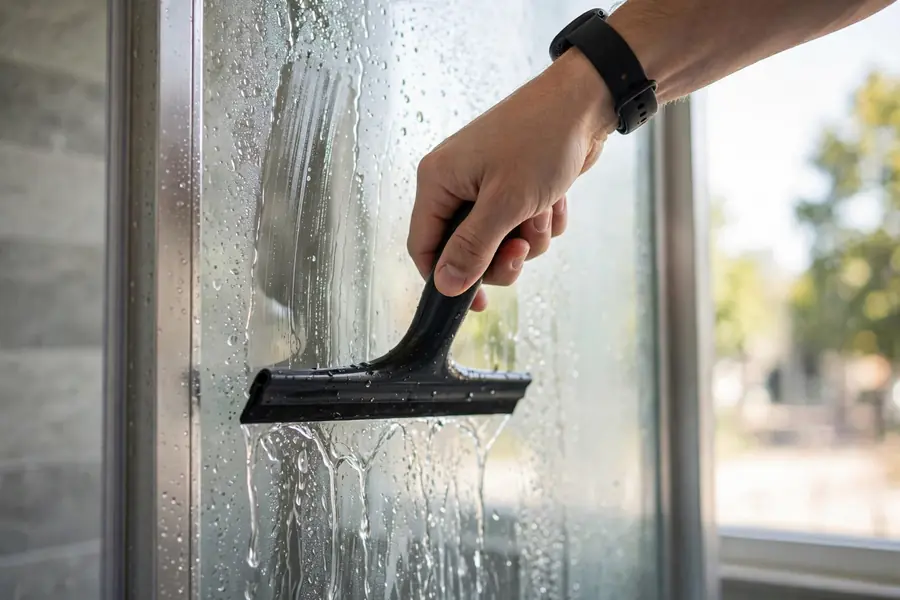
Glass doors and panels need two passes: a cleaner pass for soap film and a drying pass for spots. Spray a glass cleaner or a diluted vinegar solution on glass only, wipe with a lint-free cloth, and finish with a squeegee from the top down. Hard water spots that survive a wipe need a mineral deposit remover made for glass and a soft cloth. Never use a razor blade or a scouring pad on tempered shower glass.
Enameled cast iron takes a non-abrasive bathroom cleaner and a soft sponge, and chips at the drain or rim must be kept dry and watched, since a chip lets water reach the iron under the enamel.
How do you clean a sink, faucet, and countertop?
Wipe the sink basin with a pH-neutral cleaner or mild dish soap, a soft cloth, and a rinse, and dry the rim and the back edge where water pools. A scouring pad dulls the glaze on porcelain and vitreous china sinks.
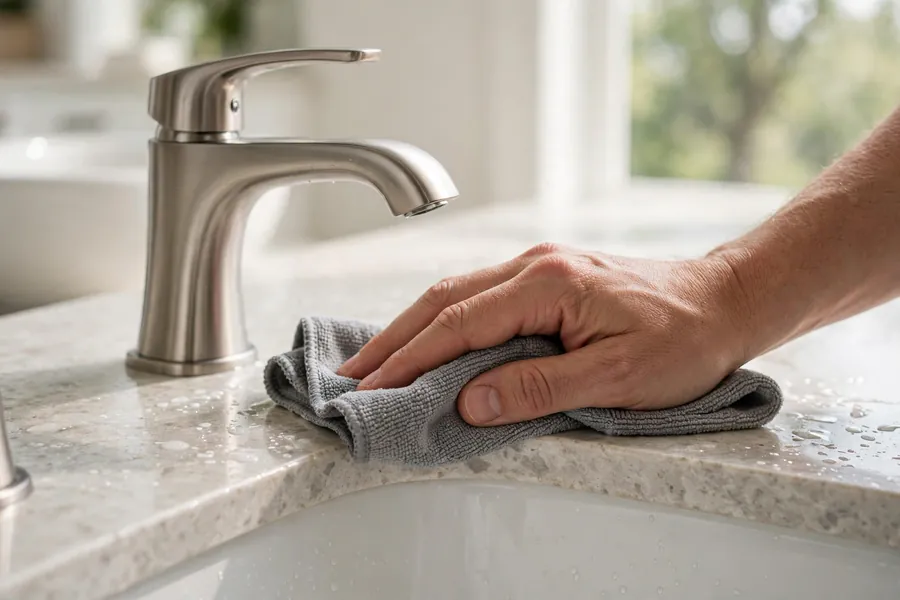
The overflow hole needs its own pass once a month. Push a small brush or a cloth wrapped around a finger into the opening, wipe the rim of the hole, and flush it with clean water. The stopper lifts out in most sinks, and hair and soap collect under it, so pull it, wipe it, rinse the drain opening, and set it back. The aerator on the faucet unscrews by hand or with padded pliers, and mineral grit collects in its screen. Soak the screen in diluted vinegar in a cup, rinse it, and screw it back on, taking care not to lose the washer.
Countertops follow the material, and the table below gives the rule for each common type. Quartz here means engineered quartz slabs, and the maker care sheet for the exact slab comes first, since resin content and finish vary.
| Countertop | Cleaner | Keep off it |
|---|---|---|
| Granite | pH-neutral stone cleaner or mild dish soap | Vinegar, citrus, abrasive pads |
| Engineered quartz | Mild dish soap and water, soft cloth | Abrasive pads, harsh chemicals, hot pans |
| Marble | pH-neutral stone cleaner, soft cloth | Vinegar, citrus, descalers, toilet bowl cleaner |
| Cultured marble | Mild non-abrasive cleaner, soft cloth | Scouring pads, acids, acetone based products |
| Laminate | Mild dish soap and water | Abrasive pads, bleach left standing |
How do you clean a toilet and the floor around it?
Apply toilet bowl cleaner under the rim, let it dwell for the time the label states, and brush the bowl including the waterline, the trap, and under the rim, then flush with the lid down. Clean the outside after the bowl with a cloth kept for the toilet only: handle, lid, seat, hinges, tank, and base.
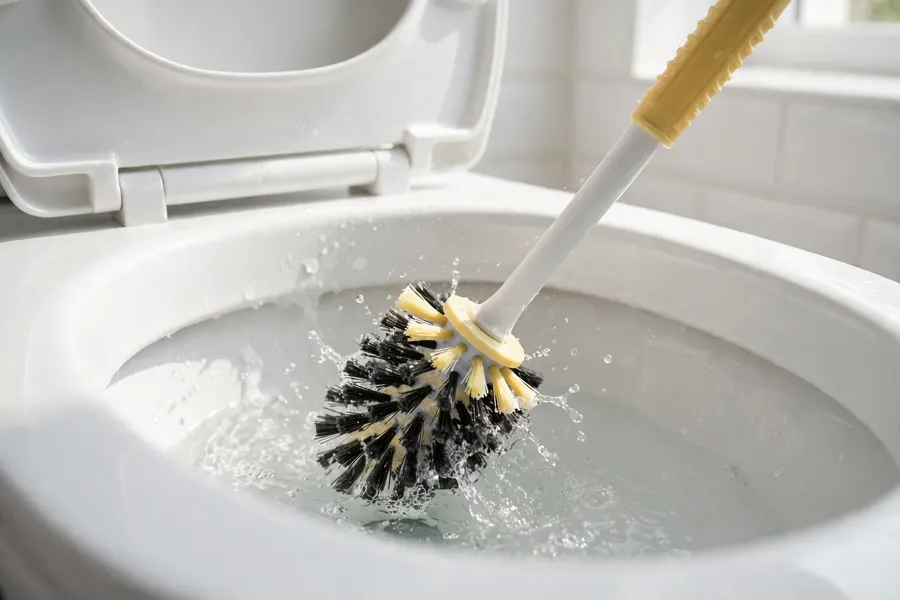
Urine smell around a toilet usually comes from the floor and the base, not the bowl. Mop the floor around the base with a bathroom cleaner, wipe the base and the caulk line at the floor, and check the seat bolts for looseness, since a rocking seat lets liquid reach the floor under the hinge. Never mix toilet bowl cleaner with bleach or any other cleaner, and never pour two cleaners into the bowl together.
How do you clean a bathroom drain that smells?
A drain smells when biofilm, hair, and soap sit in the stopper, the drain opening, and the trap. Pull the stopper, wipe it and the drain opening with a brush and a bathroom cleaner, and rinse with hot water from the tap.
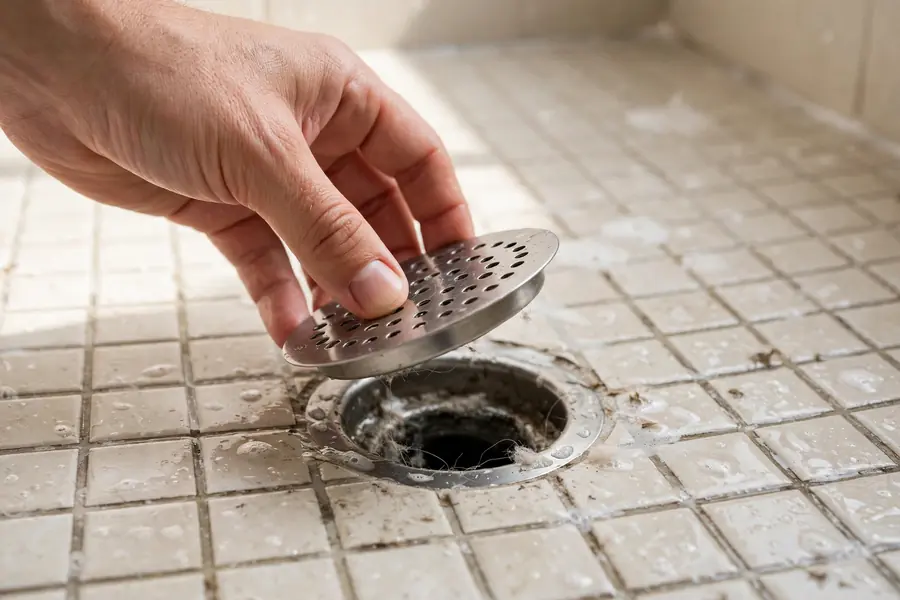
The P-trap under the sink holds water as a seal, and its job is plumbing, not cleaning. A homeowner can clean the stopper and the visible drain parts, and a trap that must be taken apart, or a drain that stays slow after the stopper and opening are clean, belongs to a plumber. Baking soda and vinegar fizz in a drain and do not clear a clog, and a chemical drain opener can damage pipes, seals, and finishes, so neither is a cleaning method. A slow drain with standing water, gurgling from other fixtures, or sewage odor through the house is a plumbing problem, and the water to that fixture should be left off until it is checked.
Hair belongs in the bin, not the drain. A drain screen or hair catcher in the shower and tub stops most of it, and the screen gets emptied after every shower.
How do you clean a mirror without streaks?
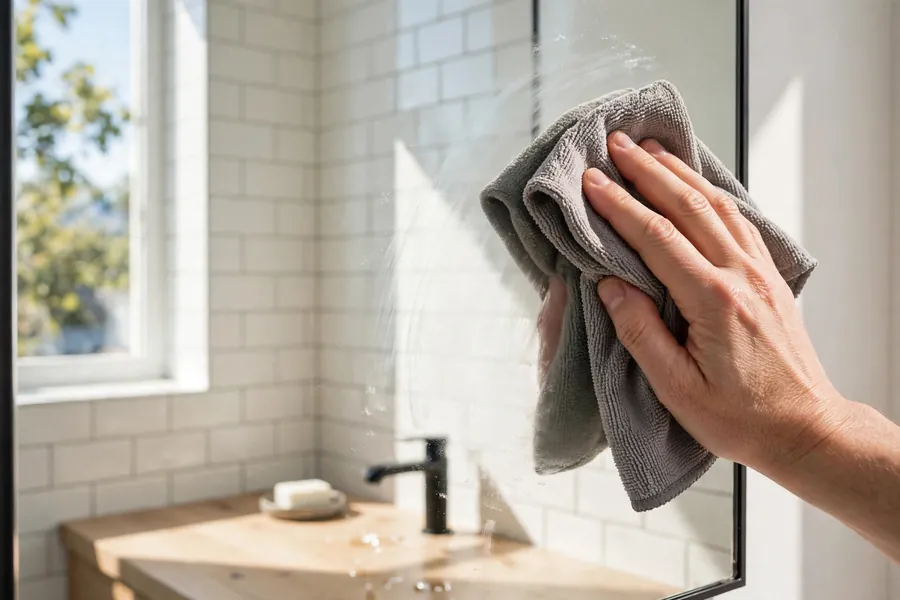
Dust the mirror first, since grit under a cloth scratches glass. Spray glass cleaner onto the cloth, not the mirror, wipe in overlapping passes, and buff dry with a second lint-free cloth or a squeegee. Vinegar and water in equal parts works on plain glass, and a commercial glass cleaner works where vinegar is kept off nearby stone. A cloudy mirror is usually cleaner residue, and residue comes off with a fresh cloth and clean water.
How do you clean painted walls and the ceiling?
Wash painted walls with a soft sponge wrung nearly dry, mild dish soap in warm water, and a rinse with a second damp sponge, working from the bottom up on the wash pass so drips do not run down a dry wall and leave lines. Never soak a wall, and never use an abrasive pad on paint.
The ceiling takes a dry dusting first with a long handled duster, then a damp sponge on a pole with the same mild soap, wrung nearly dry. Yellow drips and spots on walls and ceilings are usually condensation carrying soap, minerals, or nicotine residue down the wall, and they wipe off with the same mild wash, with a second pass on the drip line itself. Walls that sweat after every shower point to a ventilation problem, not a cleaning failure.
How do you clean mold and mildew in a bathroom?
Fix the water first, then clean the mold, since mold returns wherever moisture stays. US Environmental Protection Agency guidance read October 27, 2026 states the order plainly: clean up the mold and fix the water problem, or the mold problem will come back. Scrub mold off hard surfaces with detergent and water, rinse, and dry the surface fully. The EPA page read October 27, 2026 adds that drying water damaged areas within 24 to 48 hours stops most mold growth, and that indoor humidity should stay below 60 percent, ideally between 30 and 50 percent.
Wear gloves, goggles without ventilation holes, and an N-95 respirator when cleaning a moldy area, as EPA guidance read October 27, 2026 recommends. The size of the patch decides who does the job: EPA guidance read October 27, 2026 says a moldy area less than about 10 square feet, roughly a 3 foot by 3 foot patch, can in most cases be handled by the homeowner following the guidelines. Larger areas, heavy water damage, sewage or contaminated water, mold inside the heating and cooling system, mold hidden behind walls, or health concerns in the household all point to an experienced contractor, and the EPA guidance says to check references and ask the contractor to follow EPA or equivalent professional guidelines. Do not run the heating and cooling system if it may be contaminated with mold.
Scrub grout with detergent and water and dry it, and where dark marks stay in the joint, the grout may be stained even after the mold is gone. Caulk that stays dark, soft, or loose after cleaning is past saving, and it must be removed and replaced, since mold grows through the seal and no surface cleaner reaches it. Do not paint or caulk over a moldy surface. Bleach is not the default answer for mold.
How do you clean a bathroom exhaust fan and vent?
Switch the power off at the service panel or breaker before touching the fan. Broan-NuTone fan manuals read October 27, 2026 give the same first step for every model: disconnect power at the service panel, then remove the grille. Pull the grille down to release its springs, clips, or screws, wash it in warm water with mild soap, rinse it, and let it dry fully before it goes back. While the grille is off, vacuum dust from the housing, the blower wheel, and the blades with a brush tool, or wipe them with a soft dry cloth, and do not bend the blades. Keep water off the motor and the electrical parts.
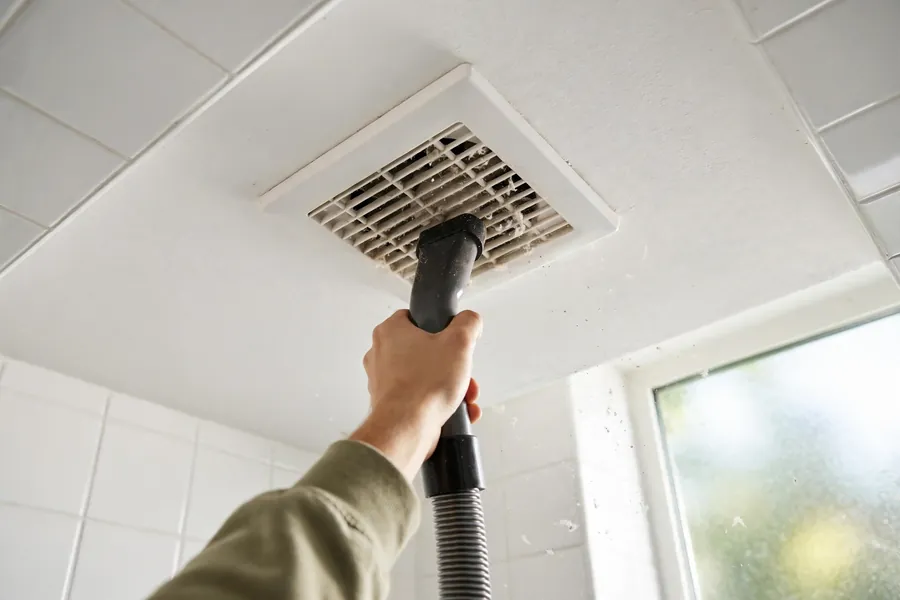
A fan with a light needs the same power off step, and the lens or diffuser washes in mild soap and water after it cools, dried fully before it goes back. Without removing the cover, vacuum the grille slots and wipe the grille face, knowing dust inside the housing stays put. A duct that holds dust, mold, or water needs a ventilation contractor. Run the fan during the shower and for 15 to 20 minutes after, as Broan-NuTone manuals read October 27, 2026 recommend, so moisture leaves the room instead of settling on walls and ceilings.
How do you clean bathroom fixtures by finish?
Chrome takes a mild cleaner and a soft cloth, dried at once to stop water spots, and an abrasive pad or an acid cleaner dulls it. Brushed nickel and polished nickel take mild soap and water and a soft cloth, and vinegar, citrus, and abrasive pads must stay off them, since acid pits the plating. Brass and gold finishes, including brushed gold, take mild soap and water and a soft cloth, and polishing compounds and acids strip the coating. Matte black fixtures take mild soap and water and a soft cloth, and abrasive pads and harsh chemicals wear the coating to a patchy gray. Stainless steel takes a mild cleaner and a soft cloth wiped with the grain, and chlorine bleach and chloride cleaners pit it. Oil-rubbed bronze takes mild soap and water and a soft cloth, and acids and abrasives remove the dark finish unevenly.
| Finish | Cleaner | Keep off it |
|---|---|---|
| Chrome | Mild cleaner, soft cloth, dry at once | Abrasive pads, acids |
| Brushed and polished nickel | Mild soap and water, soft cloth | Vinegar, citrus, abrasive pads |
| Brass and gold, including brushed gold | Mild soap and water, soft cloth | Polishes, acids, abrasive pads |
| Matte black | Mild soap and water, soft cloth | Abrasive pads, harsh chemicals |
| Stainless steel | Mild cleaner, wipe with the grain | Bleach, chloride cleaners, steel wool |
| Oil-rubbed bronze | Mild soap and water, soft cloth | Acids, abrasive pads |
A mild cleaner with a longer dwell restores dull chrome in most cases. Pitting that stays after cleaning is damage to the plating, and no cleaner restores it, so the fixture needs refinishing or replacement.
How do you clean bath mats, rugs, and the shower curtain?
Shake mats and rugs outside, then wash them by the care label on the back. Cotton and polyester mats usually take a machine wash in warm water with mild detergent, and the label states the temperature and cycle, so the label comes first. Rubber backed mats and rugs must air dry flat, since dryer heat cracks and curls the backing and the mat slides on the floor after.
A stone bath mat takes a rinse, a wipe with mild soap, and a full air dry, with no harsh chemicals and no soaking. A shower curtain and liner wash in the machine where the label allows, in warm water with mild detergent, and hang back up at once to dry, since a liner left folded in the machine mildews.
How do you clean bathroom cabinets and baseboards?
Wipe cabinet fronts and handles with a soft cloth wrung nearly dry, mild dish soap in warm water, and a dry towel after, since standing water swells wood and lifts laminate edges. Wood cabinets take no abrasive pads and no ammonia based cleaner. Baseboards take a damp cloth or a vacuum brush tool first, then a wipe with mild soap, and the joint where the baseboard meets the floor holds dust and hair, so the brush tool goes along it before the wet pass.
What do you do when a bathroom floods?
Turn off power to the room at the service panel if water stands near outlets or switches, stop the water at the fixture shutoff or the main valve, keep people and pets out of standing water that may carry sewage, and call a plumber or a water damage restoration professional for sewage water, a large volume, or water that has reached walls, subfloor, or rooms below, then dry the area within 24 to 48 hours as EPA guidance read October 27, 2026 recommends, since mold follows standing water fast.
Start with the surface that sets the rules
The room cleans fastest when the hardest surface decides the cleaner and the rest of the routine follows. Stone sets a pH-neutral rule, glass sets a drying rule, grout sets a dwell time rule, and the toilet sets the order. That sequence is how to clean bathroom tile, stone, glass, and fixtures in one pass without a second round for damage done by the first cleaner. The guidance here reflects sources read October 27, 2026, and the label on the bottle in hand wins over any general rule when the two differ.
Quick answers to common questions
How often should a bathroom be deep cleaned?
A deep clean every month suits most bathrooms, with a full weekly clean between rounds and a squeegee pass after every shower.
Can bleach and vinegar be used in the same cleaning session?
No. Bleach must never be mixed with vinegar, ammonia, acids, or any other cleaner, since the vapors can cause serious harm. Use one cleaner, rinse fully, and only then use a different one on another surface.
What removes dark stains from grout?
A neutral tile and grout cleaner with 5 to 10 minutes of dwell time and a narrow brush removes most soil, and a hydrogen peroxide solution or an oxygen based grout cleaner lifts marks that stay after two passes.
How do you stop a bathroom sink drain from smelling?
Pull the stopper, scrub it and the drain opening with a bathroom cleaner, clean the overflow hole, and run water for a full minute so the trap refills. A smell that stays after that, or a drain that stays slow, needs a plumber check.
Is steam cleaning safe for tile and grout?
Steam is safe on sealed ceramic and porcelain tile and sealed grout, and it must stay off unsealed stone, unsealed grout, vinyl seams, and painted walls, where heat and moisture lift edges and soften finishes. Check the tile and grout sealer guidance first, and dry the surface after.