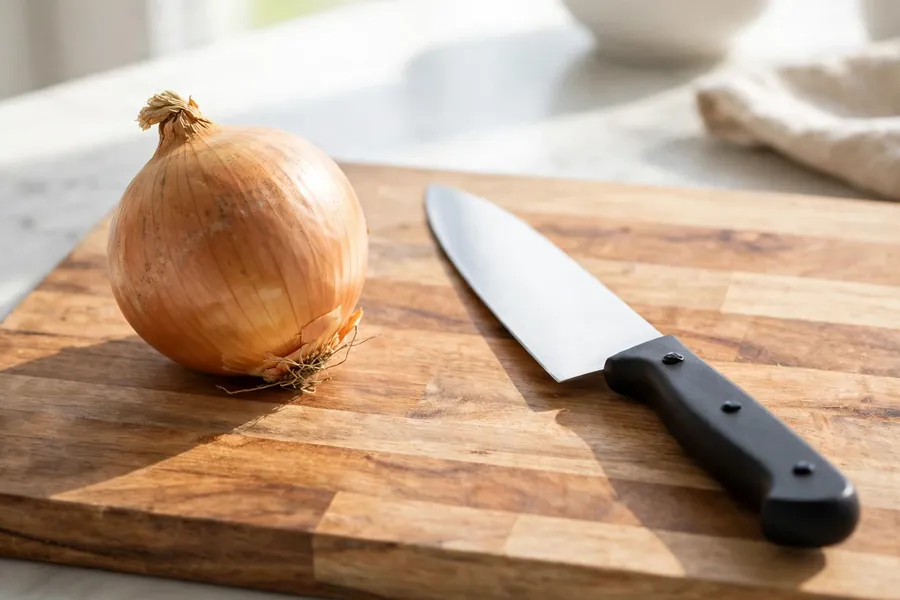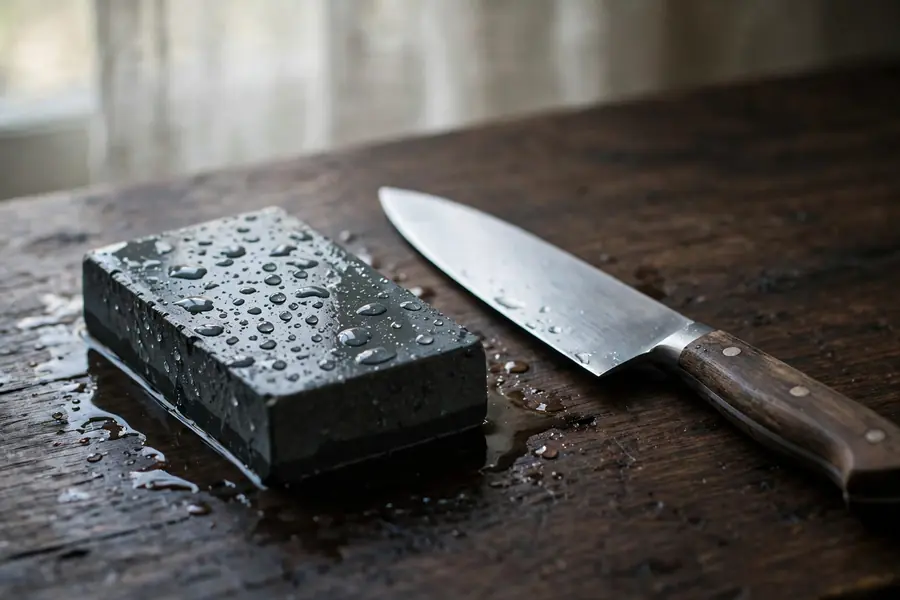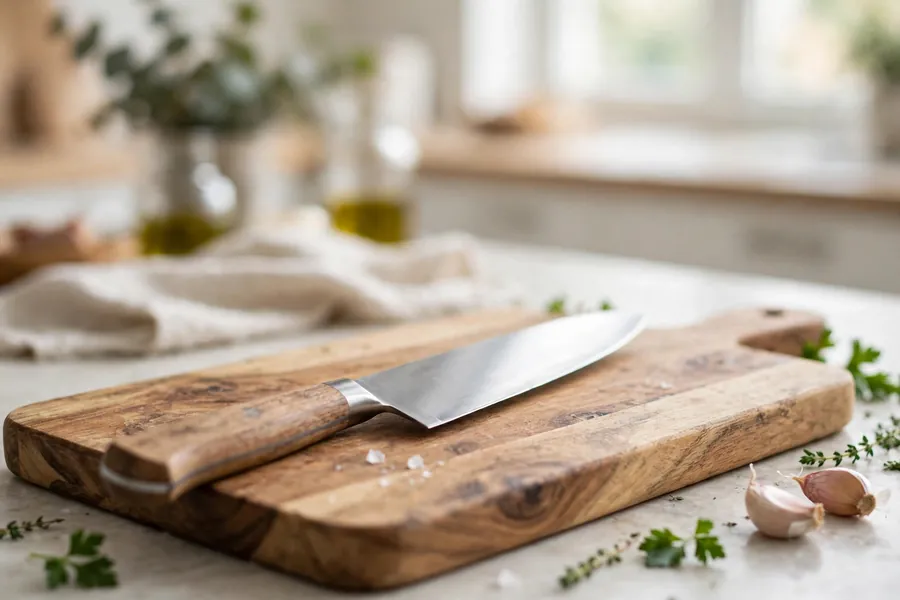
The best kitchen knives for your kitchen are the ones matched to your hand, your cutting style, and the food you cook most, judged on steel, edge angle, construction, and care, not on a brand name or a piece count. Sharpness and durability judgments in this guide come from maker specs and trade sources read on 27 October 2026, not from testing by this site. Start with one chef knife that fits your hand, add a paring knife and a bread knife, and buy more only when a job shows you need it. More guides sit under Kitchen.
Knife choices at a glance
| Decision | Pick this | Skip this |
|---|---|---|
| Chef knife | 8 inch blade, full tang, steel named on the sheet | A knife with no steel or hardness stated |
| Second knife | Paring knife for detail work in hand | A second chef knife in a different style |
| Third knife | Serrated bread knife for crust and tomatoes | A serrated chef knife for daily chopping |
| Steel | 56 to 61 HRC for most home cooks | The hardest steel you can find, by default |
| Edge | The maker angle, kept with the matching tool | A fixed 20 degree sharpener on a 14 degree edge |
| Storage | Strip, block, or sheaths that keep edges apart | A loose drawer where blades knock together |
Which knife types do you actually use?
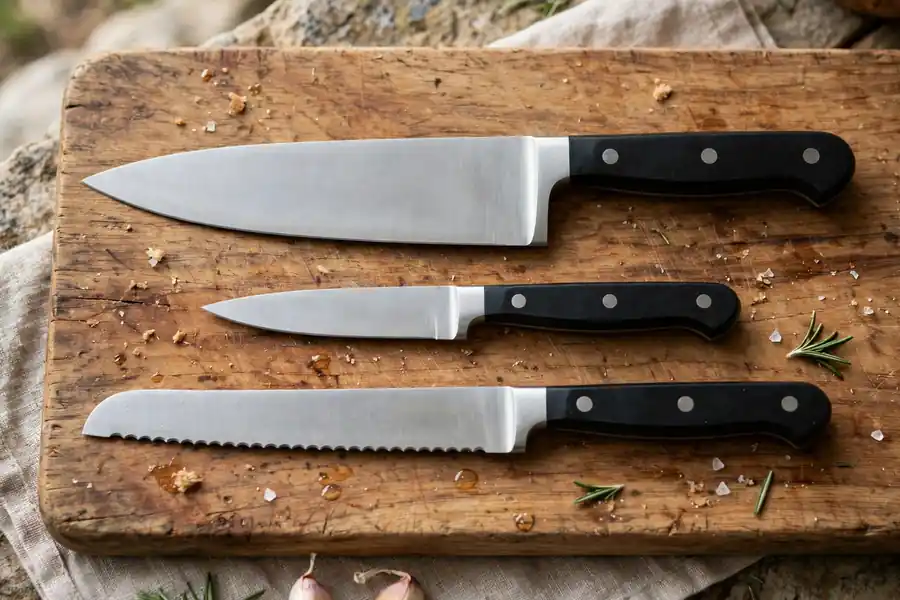
A chef knife does most of the work in a home kitchen, and the rest of the drawer earns its place only when it does a job the chef knife does badly. Buy the chef knife first, use it for a month, and let the gaps in your prep tell you what to add.
| Type | Blade | Daily work | Do not use it for |
|---|---|---|---|
| Chef knife | 8 inch, curved belly | Chopping, slicing, mincing, rock cuts | Bones, frozen food, prying lids |
| Santoku | 7 inch, flatter edge | Push cuts, vegetables, thin slices | Rock chopping, heavy squash |
| Nakiri | 6 to 7 inch, flat edge | Vegetables, straight up and down cuts | Meat, bones, rock cuts |
| Paring knife | 3 to 4 inch | Peeling, trimming, detail work in hand | Board work that needs a longer blade |
| Utility or petty | 5 to 6 inch | Sandwiches, fruit, small board jobs | Work a chef knife or paring knife covers |
| Bread knife | 8 to 10 inch, serrated | Crusts, tomatoes, soft loaves | Sharpening on a flat stone, prying |
| Steak knife | 4 to 5 inch, plain or serrated | Meat at the table | Prep work on a board |
| Cleaver | Heavy, thick spine | Bones and hard squash, with a heavy cleaver only | Delicate slicing, thin vegetable work |
A santoku suits a cook who push cuts more than rock chops, since its flatter edge meets the board along more of its length. A thin Chinese style cleaver is a vegetable knife, not a bone tool, so check the spine thickness and weight first. Steak knives are a table decision, bought for the seats you serve. A serrated edge keeps cutting after a plain edge dulls, but it is hard to restore at home and needs a tapered rod or a professional.
Should you buy a set or buy singles?
A set makes sense for a first kitchen or a single gift, when every piece will get used and the block or storage is part of the deal. It stops making sense when half the slots hold knives you never reach for. Count the pieces you would use in a normal week, not the pieces in the box.
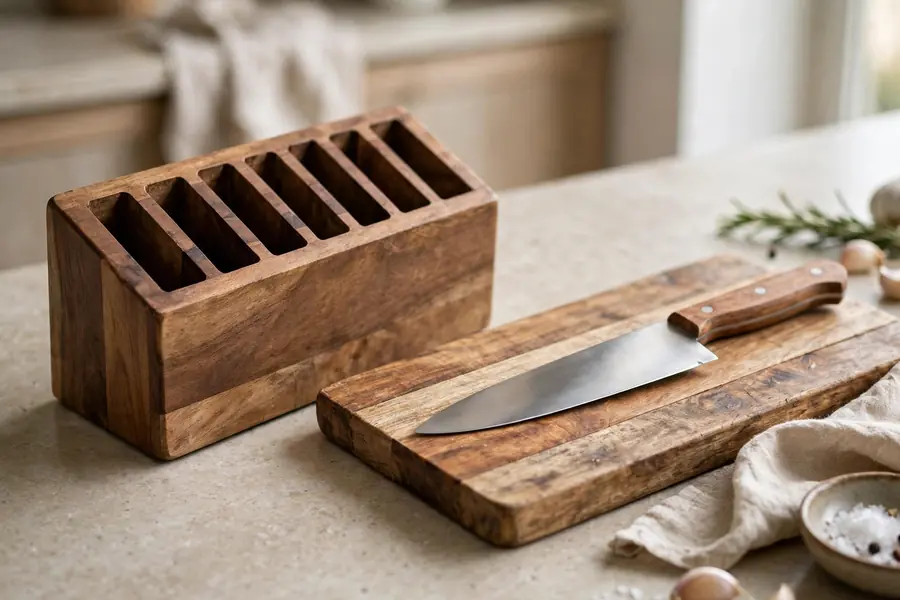
A typical set holds a chef knife, a paring knife, a utility knife, a bread knife, steak knives, kitchen shears, a honing steel, and a block. The chef knife, paring knife, and bread knife do the daily work, and a honing steel earns its place only if it matches the steel hardness of the knives in the set. Read the sheet for each blade, not only the chef knife. A block takes counter space, a magnetic strip needs wall space, and drawer storage needs sheaths or a dock.
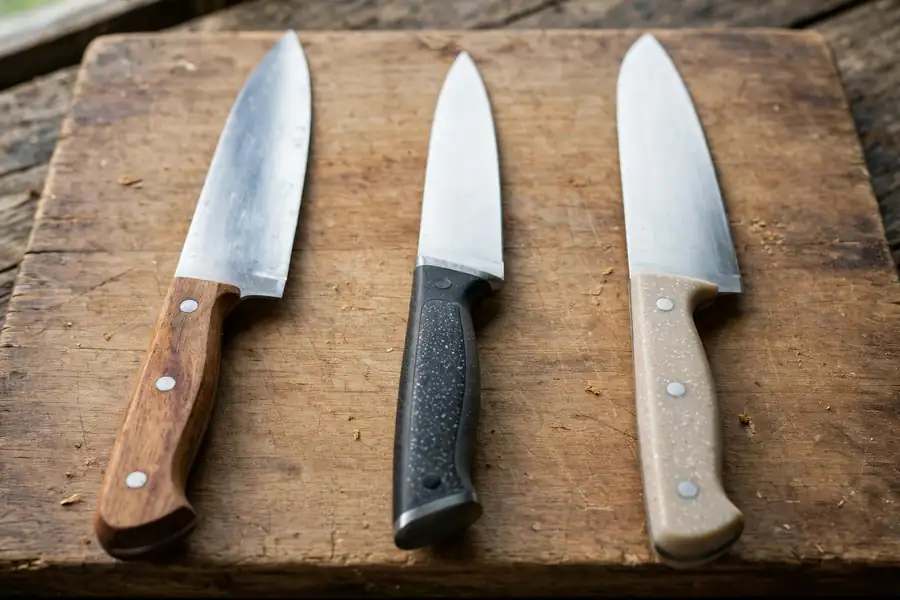
Buying singles costs more per knife and gives you control over each choice. Buy the chef knife at the quality you can afford, then add a paring knife and a bread knife in the same steel family so one sharpening routine serves all three. Two or three good singles beat a large set of unnamed steel.
Forged or stamped: what does construction change?
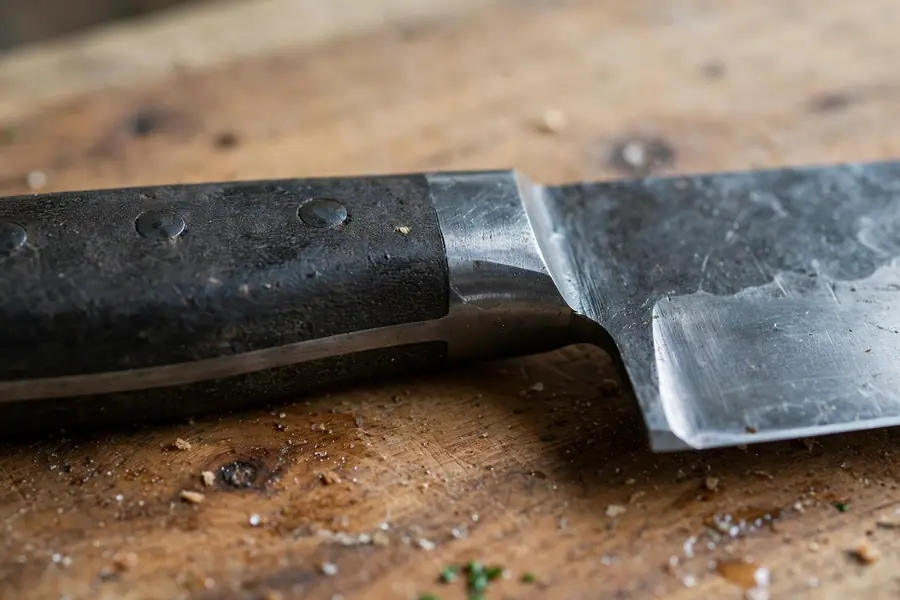
Forging shapes a heated billet of steel under pressure, while stamping cuts a blade from a rolled sheet. Both methods can make a good knife, and the steel and heat treatment matter more than the method name on the box. Judge construction by weight, balance, bolster, and tang, not by the word forged alone.
| Construction | How it is made | Feel | Trade-off |
|---|---|---|---|
| Forged | Heated billet shaped under pressure, often in 40 or more steps at Wusthof | Heavier, blade forward, solid bolster | Costs more, heavier in long prep |
| Stamped | Blade cut from a rolled sheet, fewer steps | Lighter, thinner, easier to handle | Less heft, less blade presence for heavy work |
Wusthof states on its own site, read on 27 October 2026, that its forged knives go through over 40 steps and carry a bolster that helps balance the knife, while its laser cut stamped blades go through 14 steps, cost less, run lighter, and have no bolster. A full tang runs the full length and width of the handle and gives the strongest handle joint. A partial tang saves weight and cost and is fine on a light knife. A full bolster adds weight and protects the hand, but it blocks the heel of the blade on a flat stone. A half bolster leaves the heel open to the stone and keeps most of the balance benefit.
Wood handles grip well when dry but swell or loosen if soaked, so wash and dry them at once. Pakkawood is wood stabilized with resin, and Shun uses it for handles that resist moisture while keeping a wood look. Composite handles, including G10 fiberglass laminate, shrug off water and heat. Steel handles are hygienic, as on Global knives, but they turn slick with grease, so the dimpled pattern is part of the grip. Soft synthetic handles, such as the Fibrox handle Victorinox uses, stay non slip when wet. Balance is a hand test: hold the knife in a pinch grip and check that it neither dives forward nor drags back. Listings read on 27 October 2026 put 8 inch chef knives in this group at about 6 to 9 ounces.
What makes the best kitchen knives hold an edge?
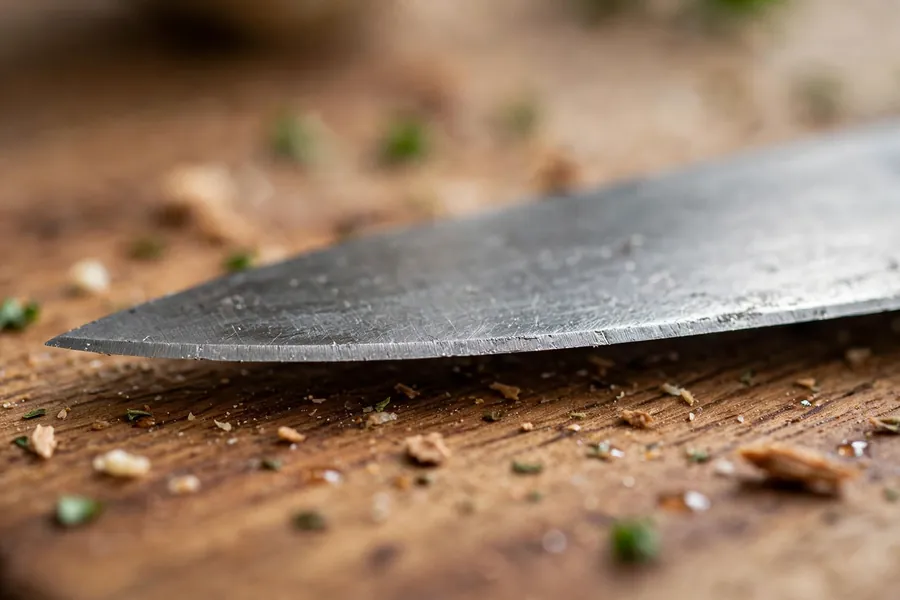
Steel decides how long an edge lasts, how hard it is to bring back, and how much care the blade needs. Carbon raises hardness and edge retention, chromium resists rust, and vanadium, molybdenum, and tungsten refine the grain so the edge can be ground fine, as Shun explains on its blade steels page, read on 27 October 2026. Hardness is measured on the Rockwell C scale, written HRC. A higher number holds a fine edge longer and chips sooner on bone, frozen food, or a hard board. A lower number rolls sooner, sharpens faster, and bends where a harder edge cracks.
| Steel | Hardness | Edge life | Sharpening | Care |
|---|---|---|---|---|
| X50CrMoV15, German stainless | 58 HRC | Good, needs regular honing | Easy, on a steel or a stone | Rinse and dry, resists rust well |
| AUS-8, Japanese stainless | 57 to 59 HRC | Good, a step above soft stainless | Easy, forgiving on a stone | Rinse and dry, resists rust well |
| VG-10 and VG-MAX, Japanese stainless | 60 to 61 HRC | Longer, holds a fine edge | Needs a whetstone, slower than soft steel | Rinse and dry, wipe acids off promptly |
| SG2 or R2, powdered stainless | 62 to 64 HRC | Longest in this list | Hardest at home, needs a good stone | Rinse and dry, still chips on hard hits |
| High-carbon, White and Blue steels | 60 to 64 HRC | Long, very keen feel | Easy on a stone, takes a fine edge | Dry at once, oil lightly, will stain and rust |
| 440C stainless | Varies by maker | Varies, judge by stated hardness | Varies with hardness | Rinse and dry, check the maker sheet |
| Ceramic, zirconia | No steel hardness rating | Holds an edge a long time | No honing steel, needs a diamond tool or a pro | No rust, chips on bone, frozen food, and hard boards |
The hardness figures in this table come from maker listings and steel data summaries read on 27 October 2026. Wusthof listings put its X50CrMoV15 at 58 HRC, Shun puts VG-MAX at 60 to 61 HRC, Global lists CROMOVA 18 at 56 to 58 HRC, and Victorinox listings put its Fibrox steel at 55 to 56 HRC. When a maker states no hardness, judge the knife by the steel name and the edge it holds in your hand, not by the price.
Damascus steel is layered construction, not a steel grade. A Damascus blade sandwiches a hard core steel between softer layers, and the wavy pattern comes from those layers. The pattern does not cut better. The core steel decides edge life, so a Damascus knife with a VG-10 or VG-MAX core performs like that core steel. Hand forged and custom knives are shaped by a smith in small batches. The terms mean more labor and more finishing, not a better edge by default, so check the steel, hardness, and angle the same way as on a factory knife. Ceramic knives hold an edge longer than steel and never rust, but they chip on bones, frozen food, and hard boards, and they cannot be honed on a steel. Treat ceramic as a slicer for fruit, vegetables, and boneless meat, not as a general chef knife.
What edge angle should the knife have?
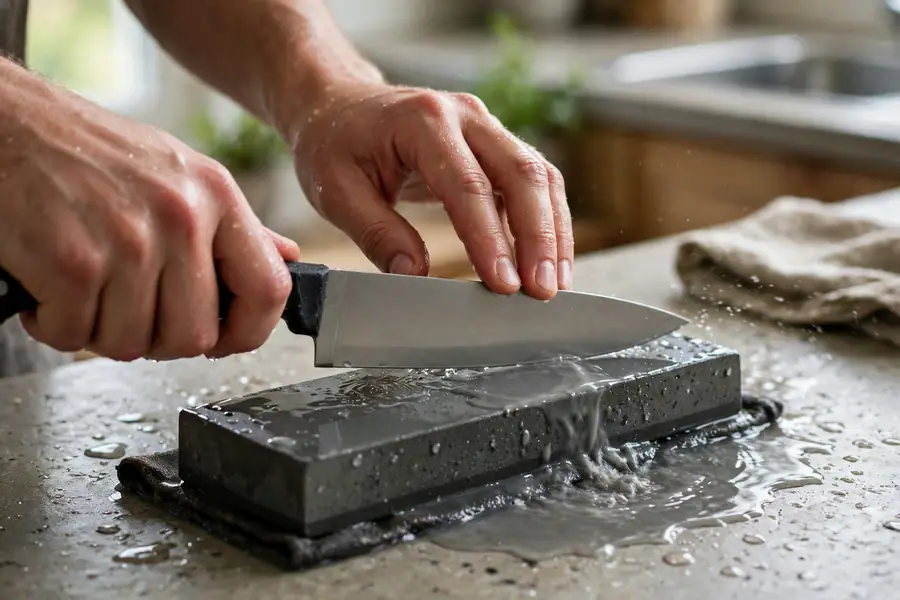
Edge angle is the bevel ground on each side of the blade, measured in degrees from the center line. A narrower angle bites with less pressure and has less steel behind it, so it cuts keenly and chips sooner. A wider angle has more steel behind it, so it survives hard boards and twisting, at the cost of a less keen feel. Match the sharpening tool to the angle the maker states.
| Maker | Edge angle per side | Source read 27 October 2026 |
|---|---|---|
| Wusthof, standard blades | 14 degrees | Wusthof own site |
| Wusthof, Asian style blades | 10 degrees | Wusthof own site |
| Shun Classic line | 16 degrees per side | Shun listings and FAQ summaries |
| Global | 15 degrees, sharpening guidance 10 to 15 degrees | Global listing and Global care guidance |
| Victorinox Fibrox | 15 degrees on listings, 20 degrees in honing guidance | Retailer listings and Victorinox care guidance |
Wusthof states the 14 degree and 10 degree figures on its own product pages, and Shun listings put the Classic line at 16 degrees per side. Global lists the G-2 at 15 degrees with a convex edge, and Global care guidance calls for a waterstone at 10 to 15 degrees or a ceramic stone. Retailer listings disagree on the Fibrox edge, with some stating 15 degrees per side and others stating 20 degrees, and they put the steel at 55 to 56 HRC. Follow the sheet that came with your knife, and when the two disagree, use the wider honing angle for upkeep and the listed factory angle only when you reset the edge on a stone.
A double bevel grinds both sides of the blade and suits most home cooks, right handed or left handed. A single bevel grinds one side only, appears mostly on Japanese specialty knives such as yanagiba slicers, and is cut for one hand. Do not buy a single bevel knife as a first chef knife. For the method behind each angle, including whetstone work, honing, and serrated and ceramic blades, see how to sharpen kitchen knives.
How do German, Japanese, French, and American knives differ?
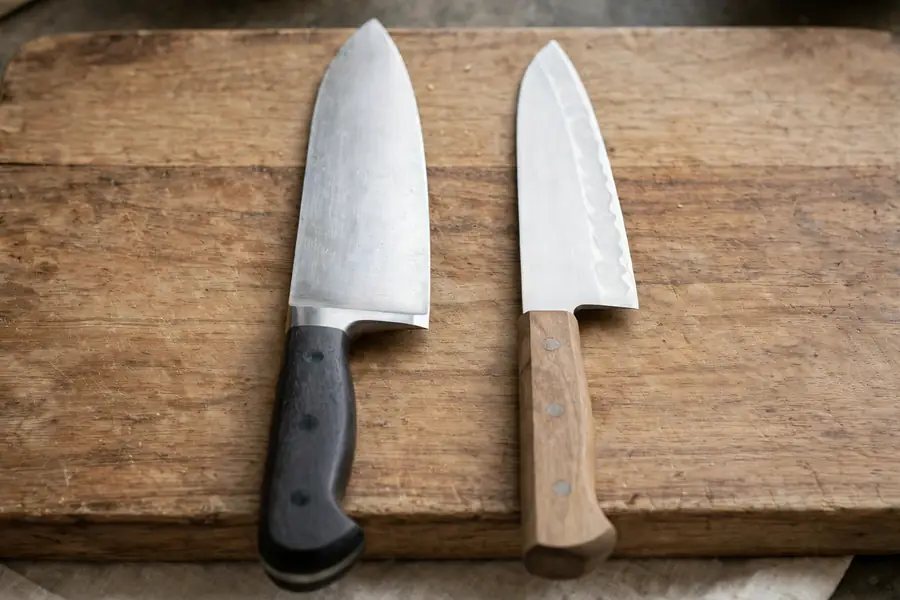
Tradition shapes steel, angle, weight, and handle, and no tradition wins on every job. A German knife forgives a heavy hand, a Japanese knife rewards a light, straight cut, and a French knife splits the difference with a curved belly made for rock chopping. An American knife follows one of those styles, so read the spec instead of the flag.
| Tradition | Steel | Edge | Feel | Handle |
|---|---|---|---|---|
| German | X50CrMoV15 stainless, 58 HRC | 14 degrees per side, Wusthof standard | Heavier, blade forward, full bolster common | Western, triple rivet, wood or composite |
| Japanese | VG-10, VG-MAX, SG2, AUS-8, high-carbon | 15 to 16 degrees per side, thinner blade | Lighter, nimble, push cut first | D-shaped or octagonal wood, or Western on export lines |
| French | Stainless or carbon, maker stated | Western angle, maker stated | Curved belly, rock chop first, full bolster common | Western, wood or composite |
| American | Stainless and high-carbon, maker stated | Maker stated, German or Japanese style | Varies widely, no single style | Western, wood, composite, or steel |
German knives are made for rock chopping and dense vegetables, and their softer steel comes back fast on a honing steel. Japanese knives are made for push cuts and thin slices, and their harder, thinner blades hold a keen edge longer and chip sooner on twisting cuts. French knives, in the Sabatier profile, carry a curved belly and a pointed tip for rock chopping and fine tip work. American knives have no single tradition, since makers in the United States work in German styles, Japanese styles, and their own hybrids, so the steel, angle, and weight on the sheet matter more than the country on the box.
Origin labels need the same care. A knife can carry steel made in one country and be ground, assembled, and finished in another, so the steel origin is not always the knife origin. "Made in USA" and "American made" intents are answered by reading the maker own origin statement for the exact line, not by assuming every knife from a US brand is made in the United States. No origin ranking follows from this check.
What should each budget tier buy?
Budget tiers answer what a band of spending buys in construction, steel, and finish. No tier guarantees a good knife, and a tier label on a listing is not a spec. Check the steel, the hardness, and the tang at every tier, and spend the money on the chef knife first.
| Tier | What to expect | Prioritize | Skip |
|---|---|---|---|
| Under $50 | Stamped stainless, simple handle, stated steel on better lines | Fit in hand, named steel, a hardness figure | Large sets with unnamed steel and no hardness stated |
| Under $100 | Forged or good stamped steel, full tang, better handle fit | Chef knife quality over piece count, a matching honing tool | A block full of knives you will not use |
| Under $200 | Harder Japanese steel or premium German forged, better fit and finish | The one knife you use most, a whetstone to keep it | Paying for pattern, packaging, or a famous name alone |
| High end | Hand finished blades, harder steels, fitted handles, maker support | Fit, warranty terms in writing, sharpening support | A knife bought for display that never meets a board |
At the lowest tier, a stamped knife with a named steel and a handle that fits your hand beats a forged knife with no steel stated. At the middle tiers, one good chef knife plus a paring knife beats a set. At the high end, the money buys finishing, fit, and support as much as steel, so hold the knife and read the warranty terms before you pay. Steels, angles, and construction do not change yearly, so this guidance is current as of October 2026. Check the maker sheet, since listings change.
Which knife fits your cooking and your hands?
An everyday home cook needs a chef knife, a paring knife, and a bread knife, in a steel that forgives a missed hone. A beginner should start there, in the softer middle of the hardness range, where the edge comes back on a steel and a mistake on a board costs a roll, not a chip. Learn the grip and the board first, and add harder steel only when sharpening stops feeling like a chore.
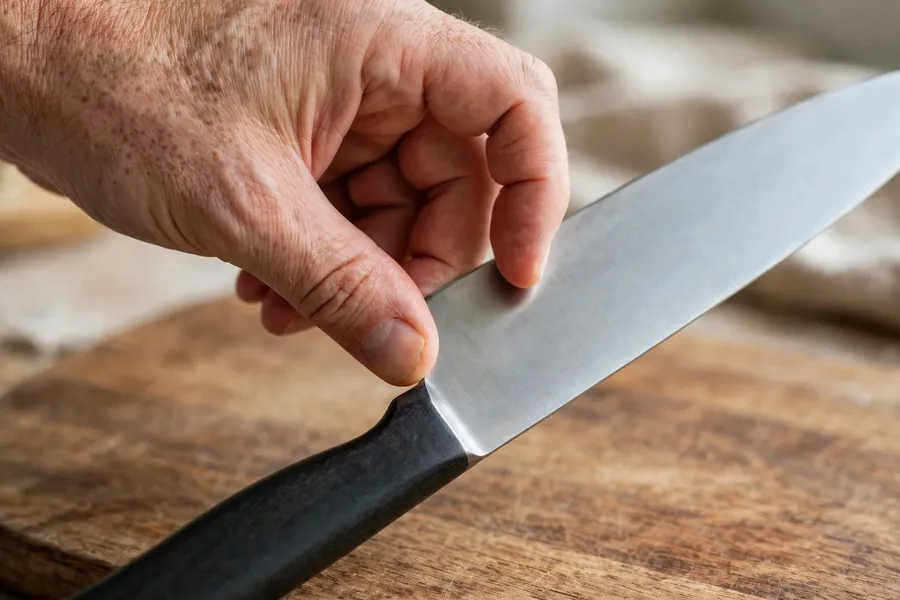
A professional cook works at volume, sharpens often, and needs a knife that comes back fast between services. That usually means a softer work knife for heavy prep plus a harder slicer for fine work. The choice is about maintenance speed, not prestige.
Vegetarian cooking favors a santoku or a nakiri, since the flat edge push cuts vegetables cleanly. No cleaver is needed for a vegetable kitchen. For arthritic hands, a lighter knife with a larger, soft grip and a shorter blade is easier to hold through long prep. Comfort in your own hand is the test. A small kitchen favors fewer, shorter blades: a 6 or 7 inch chef knife or santoku, one paring knife, and a bread knife, stored on a strip or in sheaths.
Kid safe knives carry rounded tips and short blades, and they still cut, so supervision and locked storage matter more than the tip shape. Teach children that a knife is a tool, that it stays on the board, and that it goes back to its stored place after use. No knife keeps an edge forever without care: every steel edge dulls with use, ceramic holds its edge longer and then chips, and a serrated edge keeps biting longer but still dulls and is hard to restore. Buy for the sharpening routine you will actually keep, not for a promise of no maintenance.
How do you keep a good edge?
An edge dulls on hard boards, in a dishwasher, and against bone and frozen food, and it chips when it twists or pries. Glass, stone, and ceramic boards dull any edge fast, so use wood or plastic boards. A dishwasher knocks blades against other items and heats handles, so hand wash and dry at once, even when a maker calls a handle dishwasher safe. Never use a chef knife to pry, to cut frozen food, or to chop bone.
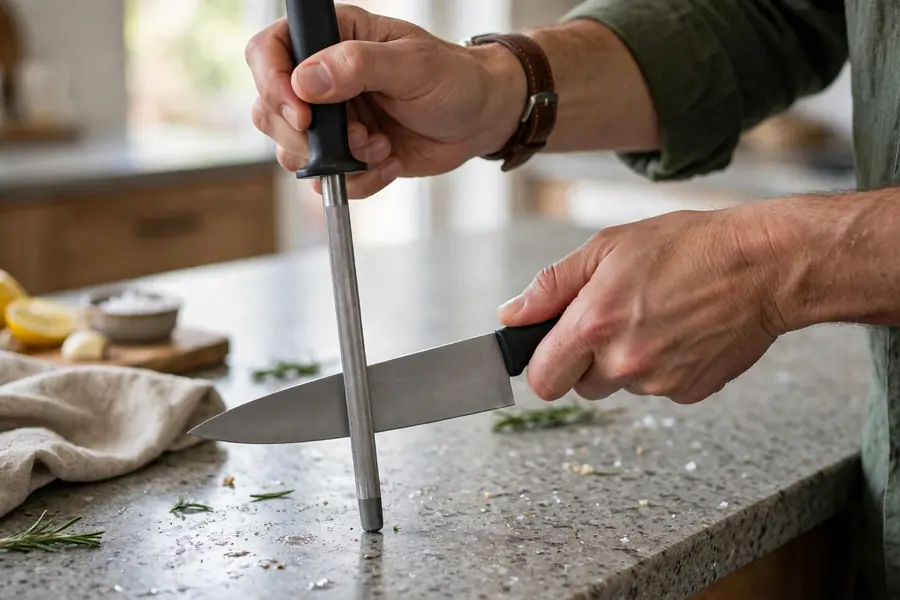
Honing and sharpening are different jobs. Honing realigns a rolled edge without grinding a new one, and it belongs in the daily routine before cooking. Sharpening grinds steel off to form a new edge, and it belongs on a stone or through a professional when honing stops helping. A honing steel or ceramic rod suits soft and middle hardness steel, while a hard Japanese edge needs a whetstone, which runs in coarse, medium, and fine bands. A pull-through sharpener is fast and removes more steel, and a fixed angle slot grinds a new bevel onto a knife ground to a narrower angle, so check the angle before you use one. An electric sharpener suits a cheap soft knife and shortens the life of a fine one.
Storage protects the edge between uses. A magnetic strip holds blades apart on the wall, and a block holds blades apart in slots that need cleaning, since crumbs and moisture collect inside. Sheaths or a drawer dock protect blades stored in a drawer, and a loose drawer is the fastest way to dull a new knife. Carbon steel needs one more step: dry it fully, then wipe a thin coat of food-safe mineral oil on the blade before storage. Do not use cooking oil, since it turns sticky over time. Stainless steel needs no oil, only drying. An old knife leaves the kitchen safely when its blade is wrapped in thick cardboard, taped shut, and labeled, and local waste rules are checked before it goes in the bin.
What do you check before you buy?
Check the spec sheet before you pay, and buy the knife whose specs you can verify. A listing that hides the steel, the hardness, or the construction is asking you to trust the brand name, and this guide gives you no reason to do that.
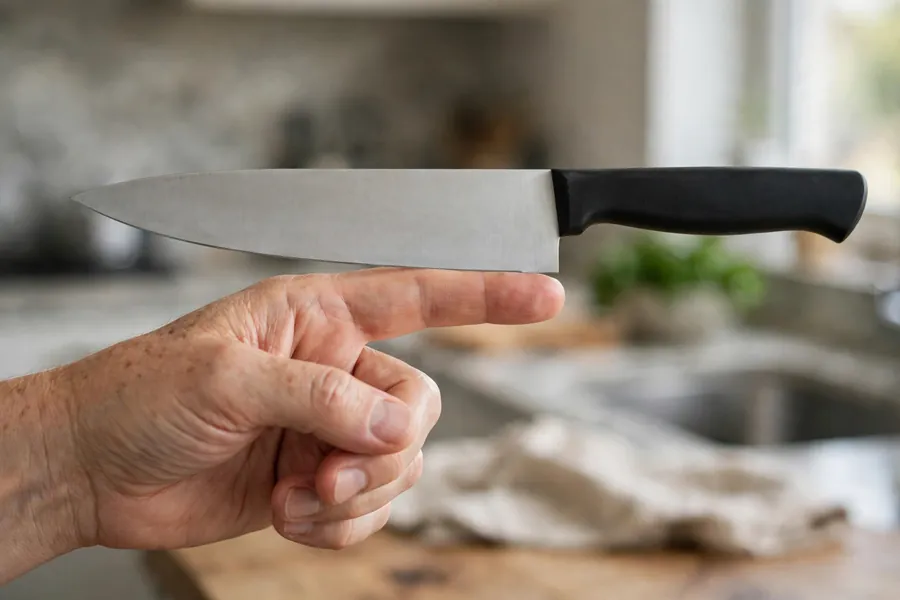
Check the steel name first, then the hardness range, then the edge angle, then the tang and the handle material. Hold the knife when you can, and test the pinch grip, the handle fit, and the weight. Read the warranty terms in writing, since makers write different terms for defects, wear, and misuse, and a warranty never promises the edge stays sharp. Confirm who sharpens the knife and what a maker sharpening service costs in postage and time. Where you buy matters for returns and warranty support, not for the knife itself. Buy where you can hold the knife, return it if the fit is wrong, and reach the maker for warranty help, and ignore deal claims, since a discount on the wrong knife is still the wrong knife.
Read reviews for handle comfort, chipping reports, and handle loosening, not for a single score. A review score blends price, looks, shipping, and use, so it tells you little about steel or angle. Look for repeated reports of the same fault across many cooks, and weigh a chipping report against how the knife was used.
Quick answers to common questions
Is a more expensive knife always sharper?
No. A higher price buys finishing, fit, harder steel, and maker support, but the edge angle and the steel decide how the knife cuts on day one. A well ground mid tier knife with a stated steel and angle outcuts a costly knife with a thick edge and no specs stated. Hold the knife, read the sheet, and judge the edge by the angle and the steel, not by the price tag.
Can a ceramic knife replace a steel chef knife?
No, except for slicing fruit, vegetables, and boneless meat. A ceramic blade holds an edge longer than steel and never rusts, but it chips on bones, frozen food, and hard boards, and it cannot be honed on a steel. Keep a steel chef knife for general work and use ceramic only where its limits are safe.
Do Damascus knives cut better than plain steel knives?
No, not because of the pattern. Damascus describes layered construction, and the core steel decides edge life and sharpening. A Damascus knife with a VG-10 or VG-MAX core cuts like that core steel, and a Damascus knife with an unnamed core cuts like an unnamed steel. Buy the core spec, not the pattern.
How many knives does a home cook need?
Three knives cover most home cooking: a chef knife, a paring knife, and a bread knife. Add a santoku or a nakiri for vegetable heavy prep, a utility knife for small board jobs, and steak knives for the table only when those jobs come up weekly. A drawer full of unused knives adds clutter, not capability.
Does a lifetime warranty mean the knife lasts forever?
No. A lifetime warranty covers defects in materials and workmanship as the maker defines them, and terms differ by maker and by line. Wear, misuse, dishwasher damage, and edge dulling sit outside most warranties. Read the exact terms before you buy, and keep the proof of purchase with the knife.
What should you buy first?
The best kitchen knives to start with are one chef knife, one paring knife, and one bread knife, each with a named steel and a handle that fits your hand. Choose the chef knife by fit first and steel second, choose the paring knife for detail work in hand, and choose the bread knife for crusts and tomatoes. Add a santoku or a nakiri only when push cutting fills your prep, and add a set only when every piece in it earns a weekly job. Fit, steel, and angle decide the result, and the brand name decides none of it.