Grease, crumbs, and spills do not need a stronger cleaner. They need the right order and the right cleaner for each material. This guide shows how to clean kitchen grease and daily soil from cabinets, counters, sinks, drains, appliances, and floors without etching stone, lifting a cabinet finish, or pushing grease around. Work top to bottom, dry before wet, and match every surface to its cleaner first. More guides sit under Kitchen.
Kitchen cleaning at a glance
| Zone | First move | Cleaner type | Finish rule |
|---|---|---|---|
| Cabinets | Dust dry, wipe with the grain | Mild dish soap, warm water | Dry at once, water out of joints |
| Counters | Clear grit, wipe in sections | Matched to the material | Rinse and dry, never flood a seam |
| Sink and faucet | Rinse, scrub basin, then drain | Dish soap, baking soda paste | Dry the basin so spots do not set |
| Appliances and hood | Soak filters and grates first | Degreaser for grease | Dry filters fully before refitting |
| Floor and grout | Sweep or vacuum, mop damp | pH-neutral floor cleaner | Dry grout, no standing water |
How to clean kitchen surfaces in the right order?
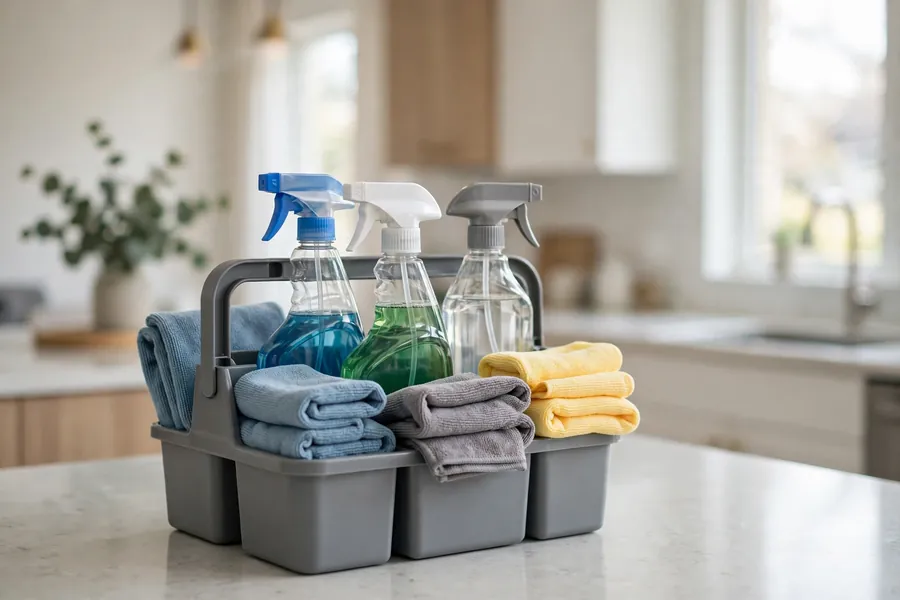
Start at the top and end at the floor, because everything you knock loose lands below. Clear counters completely, start every soak first, then work down: cabinet tops and the hood, upper cabinets and walls, appliances, counters, sink, and floor last. Change rinse water the moment it turns cloudy.
- Clear counters, move small appliances to the table, and empty the trash can.
- Start soaks: hood filters, stove grates, and the microwave turntable in hot, soapy water.
- Dry dust the high line: cabinet tops, the hood shell, light fixtures, and door casing tops.
- Wipe upper cabinets, walls, and the backsplash with the cleaner each surface takes.
- Wipe appliance exteriors and handles, then clean appliance interiors.
- Wipe counters, then scrub the sink, faucet, and drain.
- Sweep or vacuum the floor, mop it damp, and dry the edges and corners.
A fast clean uses the same order at smaller scale: clear one surface, wipe it, and move on. After a big cook, bag trash and load dishes first, then start at the top. While you cook, keep a damp and a dry cloth at the counter, wipe spills at once, and put tools back as each task ends.
| Routine | What it covers | When it holds |
|---|---|---|
| Daily | Counters, sink, stove top, spills, cloths hung to dry | Every day food is cooked |
| Weekly | Cabinet fronts, handles, appliance exteriors, hood shell, floor mop, trash can | Once a week in a used kitchen |
| Deep clean | Cabinet tops and insides, hood filters, oven and fridge interiors, grout, drain, walls | When film, odor, or grit shows |
No fixed time fits every kitchen. A kitchen with a year of grease film needs soak time and repeat passes. If a surface still feels tacky after one pass, the cleaner needs more dwell time, not a stronger chemical.
What is the difference between cleaning, sanitizing, and disinfecting?
Cleaning removes soil, grease, and most germs with soap and water. Sanitizing lowers germs to a level public health rules treat as safe. Disinfecting kills most germs left on a surface. The order is fixed: clean first, because dirt shields germs from the chemical. The Centers for Disease Control and Prevention home cleaning guidance, read October 27, 2026, states that regular cleaning alone is enough in most homes unless someone is sick or at higher risk of illness.
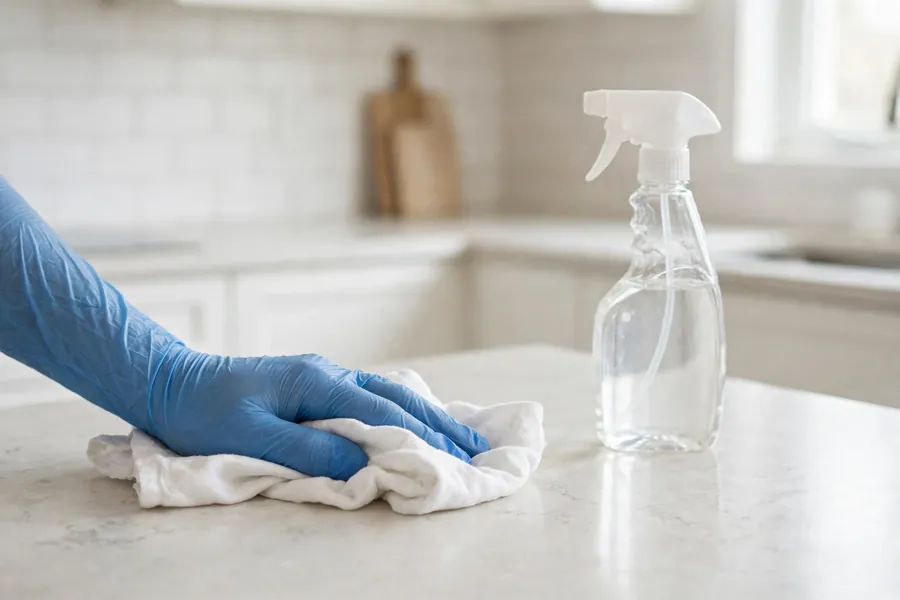
Sanitize food contact surfaces after a flood or a recalled food item in the fridge, with a sanitizer or a weaker bleach solution made exactly as the label directs, for a surface the label approves. Disinfect when someone is sick or has a weakened immune system, with an EPA-registered disinfectant or a stronger bleach solution, again exactly as the label directs. Keep the surface wet for the full contact time on the label, and rinse food contact surfaces when the label tells you to.
Never mix cleaning products. The CDC home cleaning guidance states it plainly: do not mix products or chemicals with each other. Bleach mixed with ammonia or with an acid such as vinegar gives off toxic gas. Use two cleaners in sequence, with a full rinse and dry between them. Wear gloves and eye protection when the label calls for them, ventilate the room, and keep chemicals away from children and pets. Read the label before the first spray, every time. Labels change.
How do you clean greasy cabinets without ruining the finish?
Identify the finish before you wet a cloth. A cabinet finish is a thin coating, and the wrong cleaner dulls it, lifts it at a seam, or swells the board under it. Dust dry first. Then wipe with a microfiber cloth wrung nearly dry in warm water with a few drops of mild dish soap, moving with the grain on wood. Rinse with a second cloth wrung in clean water, and dry at once with a third cloth. Test every new cleaner on the inside edge of a door, and stop if the finish dulls, softens, or turns sticky.
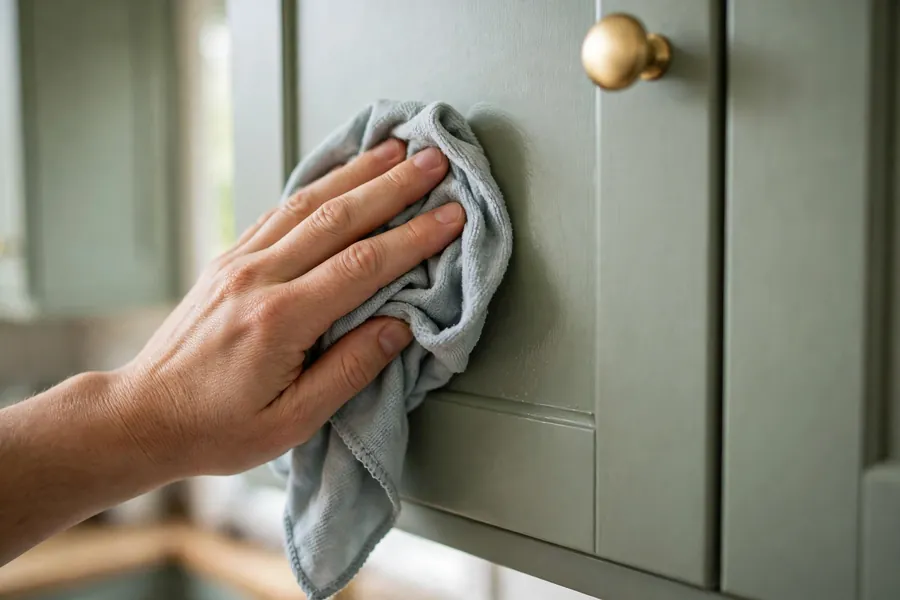
| Finish | Cleaner | Never use | Failure sign |
|---|---|---|---|
| Sealed wood | Dish soap, barely damp cloth | Scouring pads, ammonia, harsh degreasers | Haze, raised grain, swollen joints |
| Painted | Diluted dish soap, pat dry | Abrasive pads, eraser sponges | Burnished sheen, thinned paint |
| White painted, yellowed | Diluted dish soap, repeat passes | Chlorine bleach, abrasive powder | Chalked or peeling paint |
| Laminate and thermofoil | Mild soap, soft cloth | Steam, soaking, heat at edges | Lifted edge, bubbled foil |
| Oak and cherry | Dish soap, with the grain, dry fast | Standing water, steel wool | Dark marks, rough grain |
| Matte and high gloss | Diluted dish soap, light pressure | Abrasive pads, gritty polish | Shiny patches, scratches |
Grease needs dwell time, not force. Lay a warm, soapy, well wrung cloth over the greasy band near the stove and handles for 2 to 3 minutes, then wipe in short passes, rinsing the cloth often. Repeat a gentle pass instead of scrubbing harder. A baking soda paste lifts a stubborn spot on sealed wood and painted cabinets when rubbed lightly with a soft cloth in the direction of the grain. Keep it off raw or oiled wood, rinse fully, and dry the spot. Skip vinegar on cabinets: dish soap cuts grease without acid.
Inside cabinets, empty one shelf at a time, vacuum crumbs, wipe with the same soapy cloth, rinse, and dry before food goes back. Wipe hardware, handles, and hinges with a damp cloth, drying metal at once. The tops of cabinets collect greasy dust: lay a damp cloth over the film to soften it, wipe, rinse, and dry, without flooding the top edge. Before painting or refinishing, cabinets need a full degrease wash, a clean water rinse, and a complete dry, with no soap residue left. If a door is swollen, peeling, or soft at the bottom edge, cleaning will not fix it. That door needs repair or refinishing.
Which cleaner fits each countertop material?
Match the cleaner to the surface in front of you, not to the cleaner under the sink. Clear grit first, wipe in small sections, rinse, and dry. A counter that stays wet at a seam stains, swells, or spots faster than one that gets a harsh cleaner once.
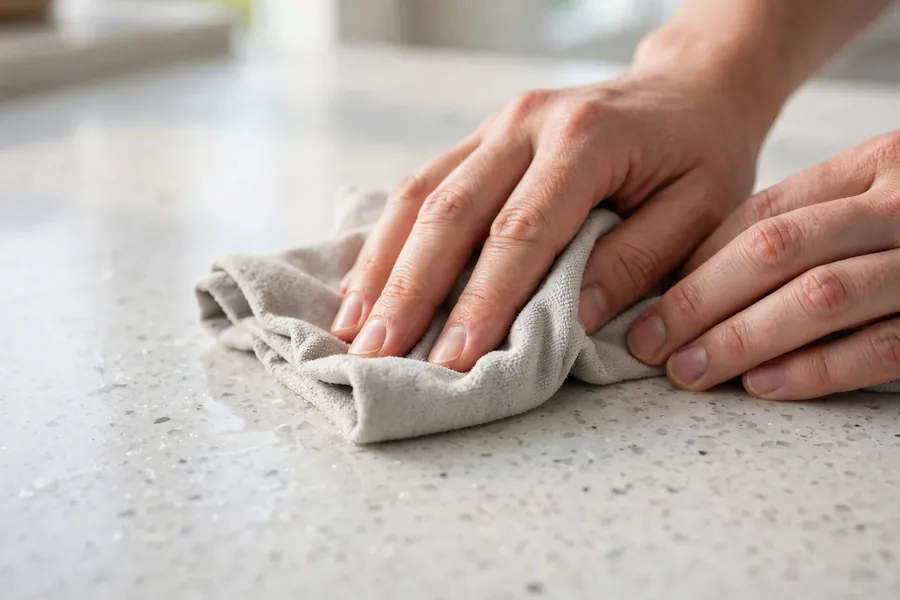
| Material | Daily cleaner | Avoid | Damage sign |
|---|---|---|---|
| Granite | pH-neutral stone cleaner, mild dish soap | Abrasive pads, harsh alkali, acid left sitting | Dull sealer, dark stain ring |
| Engineered quartz | Mild dish soap, warm water | Abrasive pads, bleach, solvents | Haze in the resin, discolored patch |
| Marble and limestone | pH-neutral stone cleaner, soft cloth | Vinegar, lemon, acid cleaners | Etch mark, dull spot |
| Butcher block and wood | Hot, soapy water, dry at once | Long soaking | Raised grain, split seam |
| Laminate | Mild soap and water, soft cloth | Abrasive pads, standing water | Scratched sheen, swollen seam |
| Tile and grout counters | pH-neutral cleaner, soft cloth | Acid on cement grout | Eroded grout, loose tile |
Marble and limestone are calcareous stone, made mostly of calcium carbonate, and acid etches them. The Natural Stone Institute care guidance, read October 27, 2026, states that calcareous stone needs mild, non-acidic cleaners, that spills must be blotted at once rather than wiped wider, and that a sealer is an impregnator that improves stain resistance without making stone stain proof. An etch mark is damage to the finish, not dirt, and it needs a stone restorer to repolish. Granite is harder and more acid resistant, but its sealer is not, so use a pH-neutral stone cleaner on granite too, and reseal on the schedule your supplier or sealer maker gives. If water darkens the stone and stays dark instead of beading, ask your supplier about resealing.
Engineered quartz is resin bound, so its weak point is the resin. Wash it with mild dish soap and warm water and a soft cloth, rinse, and buff dry. Do not use bleach, abrasive pads, or strong solvents, and do not set a hot pan straight on it. Do not seal quartz: a penetrating sealer cannot soak into a nonporous slab, so it sits on top and wears in patches. Butcher block takes hot, soapy water and fast drying, and food-safe board oil when the wood looks pale. Tile counters take the same pH-neutral cleaner as tile floors, with grout joints rinsed and dried.
How do you clean a sink, faucet, and drain that smell?
Clean the basin, then the faucet, then the drain, because drain odor comes back if the basin still holds the soil that feeds it. Rinse the basin with hot water, scrub the drain rim, overflow slot, and counter seam with dish soap and a non-scratch sponge, then rinse and dry.
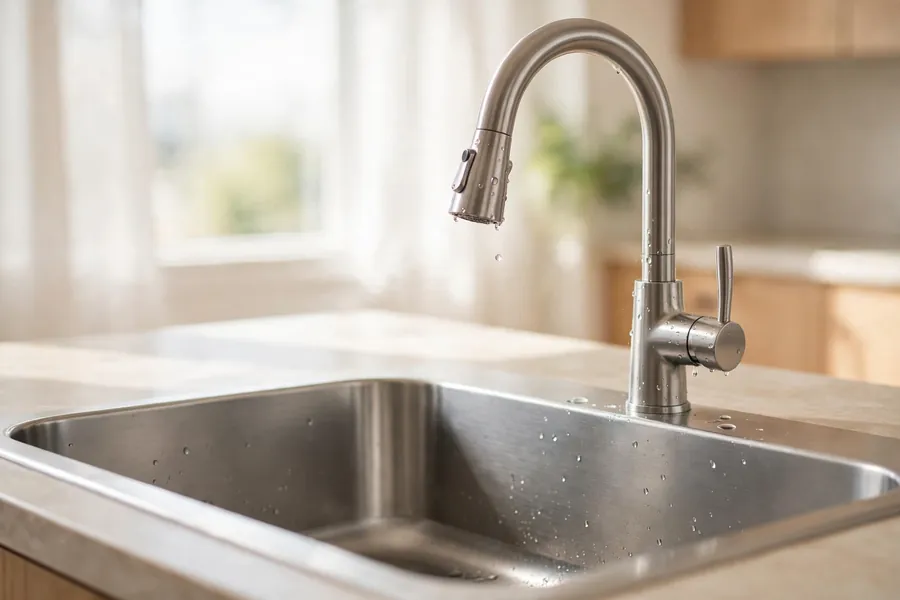
Stainless steel takes a baking soda paste rubbed gently in the direction of the grain lines, then a rinse and a dry buff. Never use steel wool on stainless steel. Porcelain and ceramic sinks take a non-abrasive sponge and dish soap, with baking soda paste for stains; abrasive powder chips glaze at the drain. Black and composite sinks take mild soap and water and a soft cloth, rinsed and dried so hard water leaves no white marks. White sinks take mild soap and baking soda paste. Check the maker care sheet before any bleach.
Faucets take a soft cloth with mild dish soap and water, rinsed and dried. For scale on the spout base, wrap a cloth soaked in a 50/50 mix of warm water and white vinegar around the scaled spot for 10 minutes, then rinse and dry, keeping vinegar off plated finishes longer than that. The aerator is where low flow usually starts. Unscrew it by hand, note the order of screens and washers, soak the parts in a 50/50 mix of warm water and white vinegar, brush with a soft toothbrush, rinse, and put them back in the same order. Kohler faucet care guidance, read October 27, 2026, gives that 50/50 soak for aerator scale. If flow stays weak or the faucet drips from the handle, call a plumber.
Drain smell usually lives in the disposal baffle or in biofilm inside the drain, not in the trap. Baking soda and vinegar fizz does not scrub the rubber flaps where food collects. To clean a disposal, switch the power off at the switch or breaker and test that it is dead. Lift the rubber splash guard and scrub both sides with hot, soapy water and a brush, using tongs for anything stuck inside. Never put a hand in a disposal, even with the power off. Restore power, then run cold water and grind two cups of ice with a half cup of coarse salt. Never pour a chemical drain cleaner into a disposal. For a drain without a disposal, scrub the stopper and drain rim and flush with hot, soapy water. A drain that gurgles, drains slowly in more than one fixture, or smells of sewer gas after flushing needs a plumber. Fruit flies need the food source removed: scrub the drain rim, stopper, and baffle, flush with hot, soapy water, and keep food scraps out of the sink.
How do you clean appliances and a greasy range hood?
Soak first, wipe second. Lift out stove grates, burner caps, drip pans, hood filters, and the microwave turntable, and soak them in hot, soapy water with a degreaser where grease is thick. While they soak, wipe the appliance shells. Grease softens in warm soapy water faster than it yields to scrubbing.
Gas grates and burner caps soak, then scrub with a non-scratch sponge, rinse, and dry fully before refitting. A glass or ceramic stove top needs a cool surface, a plastic scraper held low for stuck food, and a non-abrasive cleaner made for glass tops. Never use a dry razor scraper or a scouring pad on glass. Inside an oven, lay a baking soda paste over baked-on soil, let it sit, and wipe it away, rinsing until no paste stays. Use the self-clean cycle only as the oven maker manual directs. Empty the fridge shelf by shelf, and wash, rinse, and dry shelves and drawers before food returns. Steam a bowl of plain water in the microwave, then wipe the softened interior. Rinse the dishwasher filter under running water and wipe the door gasket with a damp cloth.
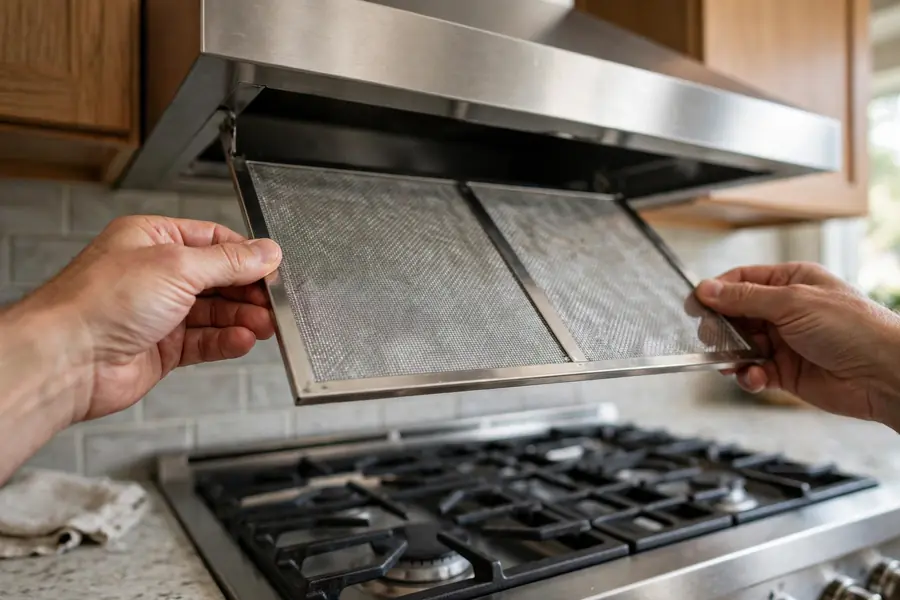
The range hood is a grease trap. Lift the metal filters out, soak them in hot water with dish soap and a degreaser, scrub with a soft brush, rinse, and dry them fully before they go back. Wipe the hood shell inside and out with a degreaser on a cloth, rinse, and dry. An exhaust fan gets the same treatment with the power off. If the fan rattles, smells of burning, or will not run after cleaning, switch it off and call an electrician or appliance technician. Stainless steel fronts wipe in the direction of the grain with a microfiber cloth and mild dish soap, then rinse and buff dry. Greasy light fixtures get a switch-off and cool-down, then a wipe with a damp, soapy cloth and a dry cloth. Never spray cleaner into a socket or onto a hot bulb. Knives get washed by hand in hot, soapy water and dried at once. A small rust spot takes a gentle rub with baking soda paste, then a rinse and a fast dry.
How do you clean tile floors and grout without hazing them?
Sweep or vacuum first. Grit under a mop scratches tile and grinds into grout. Mop with a well wrung mop and the cleaner your floor takes, in small sections, rinsing the mop often. Floors want damp, not wet. Dry the floor, including edges and corners where mop water pools.
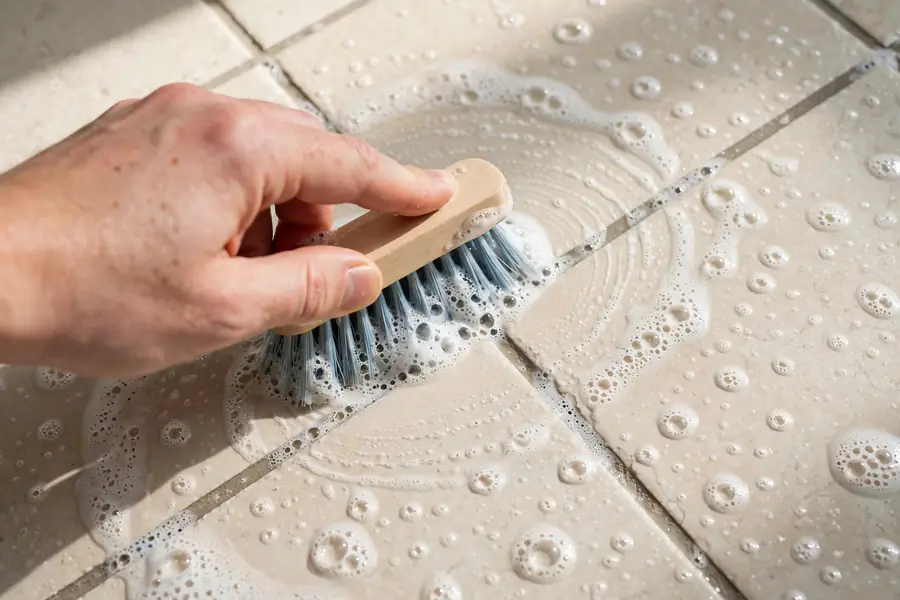
Ceramic and porcelain tile take a pH-neutral floor cleaner mixed as the label directs. Vinyl and linoleum take mild soap and water with a soft mop, rinsed and dried, with no flooding at seams. Hardwood takes a barely damp mop and a cleaner made for wood floors. Never steam mop a wood floor and never leave water standing on it. Stone and brick floors take a pH-neutral stone cleaner and a soft mop, with grit swept up first. Blot an oil spill from the edge inward, wash with dish soap and warm water, rinse, and dry. Do not hose an indoor floor.
Grout needs one method, done well. The Tile Council of North America guidance, read October 27, 2026, states that acid cleaners erode alkaline cement grout and strip sealers, while neutral and alkaline cleaners are the safe choice for grout care. Apply a pH-neutral or mildly alkaline grout cleaner to the grout lines, let it dwell for the time on the label, and scrub along the lines with a grout brush, working in small sections so the cleaner does not dry on the floor. Rinse with clean water until no cleaner stays in the joints, and dry the floor fully. Do not use a wire brush on grout. Cracked or crumbling grout needs regrouting by a tile professional. Shake mats and rugs outside, wash as their label directs, and dry fully before they go back.
How do you clean grease off walls, ceilings, and a backsplash?
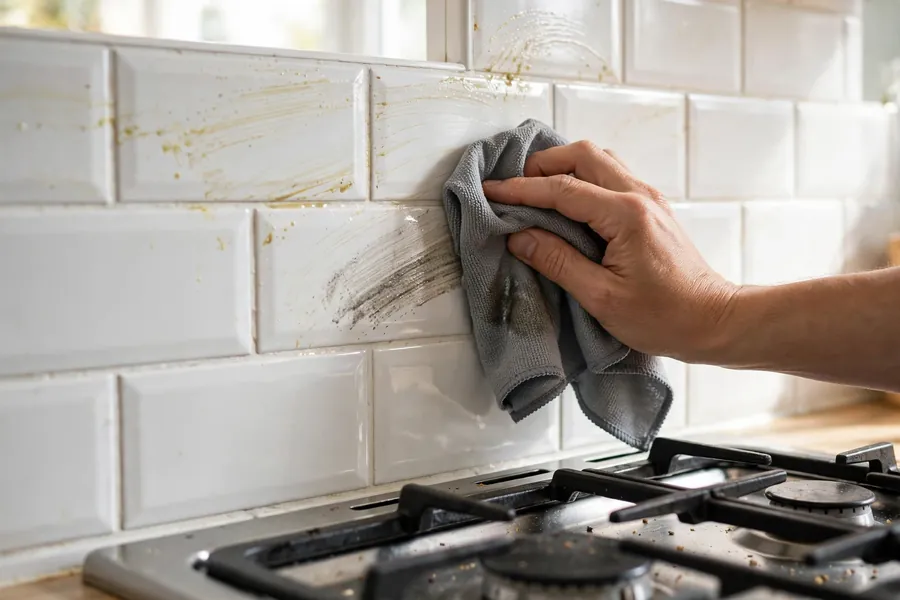
Work top to bottom, and keep the cloth damp rather than dripping. Spray a degreaser onto the cloth, not onto the wall, so it does not run into outlets or behind trim. Lay the damp cloth on the greasy band for a few minutes of dwell time, wipe in short passes, rinse with a clean damp cloth, and dry. Painted walls take a mild degreaser or dish soap solution, rinsed well. A ceiling takes the same method with a well wrung cloth on a flat mop head, in small patches. Never soak a ceiling or spray upward into a light fixture. Tile backsplash takes a pH-neutral cleaner and a soft cloth, rinsed and dried, and its grout takes the same cleaner with a soft brush. Before painting a wall or ceiling, wash grease off fully with a degreasing cleaner made for pre-paint cleaning, rinse, and let the surface dry completely. Paint over grease peels.
What should you use for sponges, towels, and wood tools?
A kitchen sponge is a consumable, not a fixture. Wring it dry after every use and stand it where air reaches it. Replace it when it smells after washing, when it tears, or when it stays damp and holds soil. Keep separate cloths for counters and for floors, and never wipe a counter with the cloth that just mopped the floor. Towels and rags go through a hot wash with detergent and dry fully before reuse.
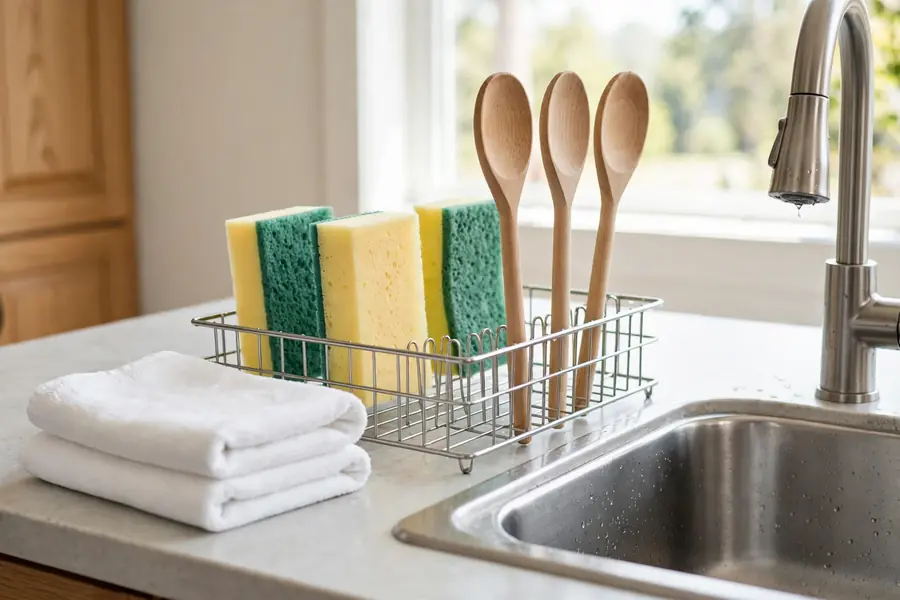
Wooden utensils and spoons wash in hot, soapy water, rinse, and dry standing up with air around them. Do not soak wood tools for hours. A cracked, splintered, or deeply stained wooden spoon gets thrown out. Silicone utensils wash in hot, soapy water or in the dishwasher if the maker label allows it. Shears and scissors wash in hot, soapy water, with the pivot wiped and dried at once. Vacuum fabric chair cushions first, then spot clean as the fabric label directs. A wood table takes a daily wipe with a barely damp cloth and a fast dry. The trash can empties fully, washes with hot, soapy water inside and out, rinses, and dries before a fresh liner goes in. Sprinkle baking soda in a dry can for odor, and wipe the lid and rim each time.
How do you handle mold, mice, and raw meat cleanup safely?
Stop and judge the scale before you scrub. Small surface mold on a hard, nonporous surface under a sink takes detergent and water, a scrub, a rinse, and a full dry, with the leak that fed it fixed. The EPA mold guidance, read October 27, 2026, advises physical removal with detergent and water and complete drying for small cleanup, and it does not recommend bleach as a routine mold treatment. Large growth, mold inside a wall cavity or duct, mold after flooding, or mold where someone has asthma or a weakened immune system is not a cleaning job. Leave it alone and call a mold remediation professional. Do not dry sweep or dry vacuum moldy material.
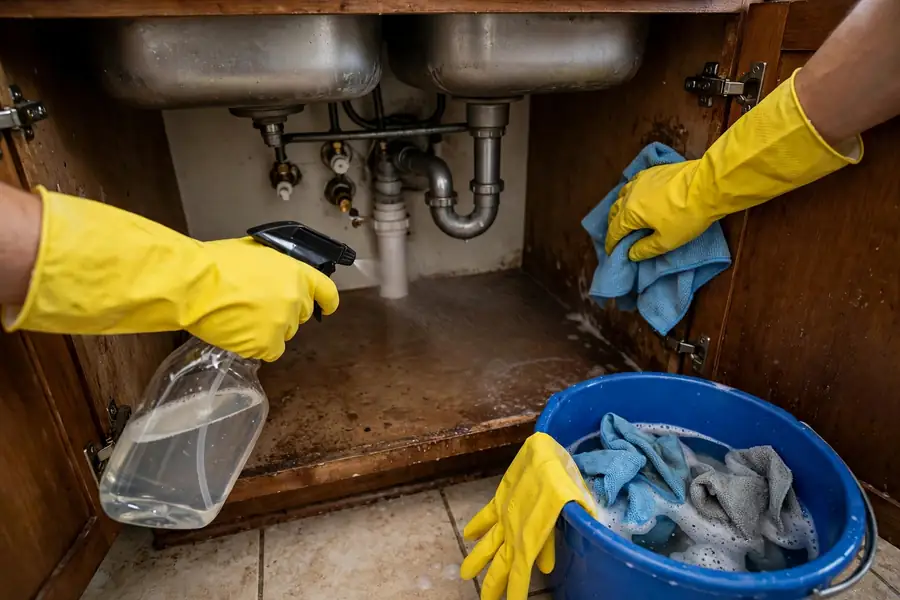
Cleanup after mice follows a fixed sequence, and the first rule is never to sweep or vacuum droppings dry. The CDC rodent cleanup guidance, read October 27, 2026, states that dry sweeping sends contaminated dust into the air. For a few droppings in a kitchen cabinet, wear rubber or plastic gloves, spray the droppings, urine spots, and nesting material until very wet with a disinfectant or a fresh mix of 1.5 cups of household bleach in 1 gallon of water, let it soak for 5 minutes or the time on the disinfectant label, and pick the material up with paper towels. Throw the towels in a covered trash can, wipe the hard surfaces with disinfectant, and wash your hands after removing the gloves. For a closed-up room, open doors and windows for 30 minutes and leave the space while it airs out. Heavy infestation or droppings in ducts needs professionals: call pest control and a duct cleaning service.
Raw chicken cleanup happens every time. Wash hands, cutting boards, knives, and counters with hot, soapy water after raw chicken touches them, before they touch bread, salad, fruit, or cooked food. The CDC food safety guidance, read October 27, 2026, gives that wash after each food item as the rule against cross contamination. Use separate boards for raw meat and ready-to-eat food. After pest control treatment, follow the treatment label: wash food contact surfaces, dishes, and utensils as the label directs, ventilate as directed, and do not mop treated baseboards or floors until the label allows it. If the label gives no cleaning instruction, ask the pest control company first.
Quick answers to common questions
Can you use vinegar on granite and marble counters?
No on marble and limestone: acid etches calcareous stone and leaves a dull mark washing will not remove. On granite, vinegar can wear the sealer. Use a pH-neutral stone cleaner on both, blot spills at once, and dry the surface.
How do you get sticky grease off cabinets without stripping the paint?
Wipe with a microfiber cloth wrung nearly dry in warm water with a few drops of mild dish soap, let a warm soapy cloth dwell on the greasy band for 2 to 3 minutes, and wipe in short passes. Rinse with clean water and dry at once. Test on a hidden spot first, and repeat a gentle pass instead of scrubbing harder.
Why does the drain still smell after baking soda and vinegar?
The fizz does not scrub the rubber splash guard or the biofilm inside the disposal. Switch the power off, scrub both sides of the guard with hot, soapy water, then grind ice and coarse salt under cold water. If the smell persists with slow draining or sewer gas odor, call a plumber.
How often should you replace a kitchen sponge?
Replace it when it smells after washing, tears, or stays damp, rather than on a fixed date. Wring it dry after every use and stand it where air reaches it.
Is bleach safe on kitchen counters?
Only on a hard, nonporous surface the product label approves, mixed exactly as the label directs, and rinsed when the label tells you to rinse. Bleach is wrong for natural stone, wood, and many sealed finishes, and it must never be mixed with ammonia or an acid. For most counters, dish soap or a pH-neutral cleaner is the safer daily choice.
What does a clean kitchen look like when the work is done right?
A clean kitchen feels dry, smells of nothing, and shows no tacky film on a cabinet front, no ring in the sink, and no grit underfoot. That result comes from order and material sense, not from a shelf of strong chemicals. Start at the top, match the cleaner to the material, give the cleaner time to dwell, rinse, and dry every surface. That is how to clean kitchen grease, spills, and daily soil so they do not return as stains, smells, and damaged finishes. Keep six items on hand: microfiber cloths, mild dish soap, a pH-neutral cleaner, baking soda, white vinegar, and a grout brush, with gloves for chemical work. If a surface changes color or softens after cleaning, stop and check the maker care sheet.