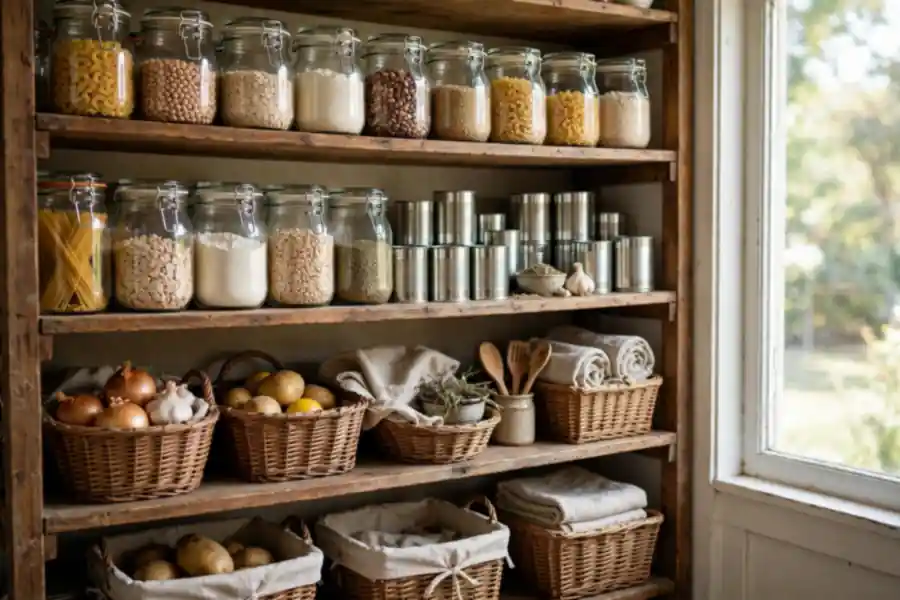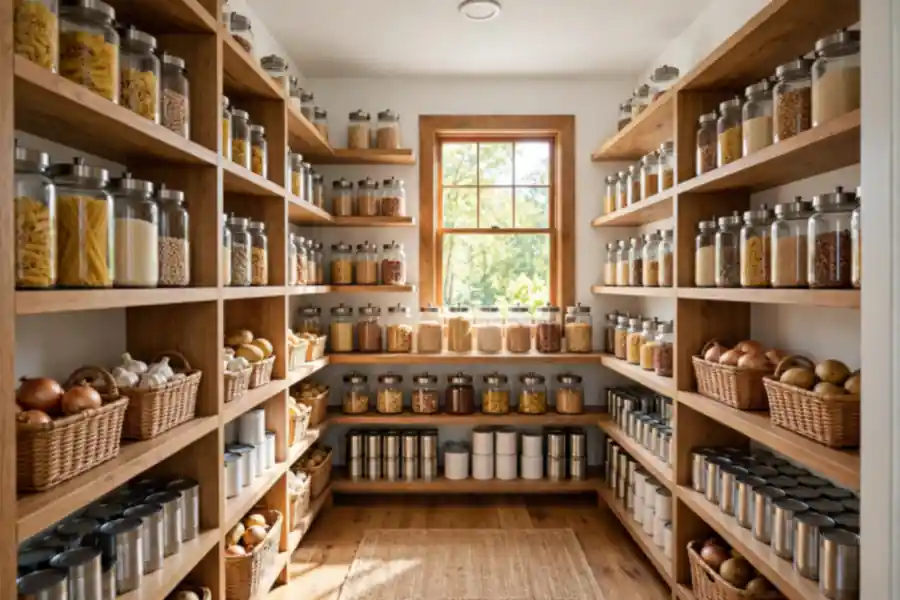
This guide shows how to organize kitchen pantry shelves so they hold after a month of real cooking: empty the pantry, sort what stays, clean the shelves, set zones by use, put food in labeled airtight containers, and put new stock behind old stock so the oldest food gets used first. That order matters. Containers bought before sorting never fit the food you actually keep, and zones set by food type instead of frequency put daily food out of reach. More guides sit under Kitchen.
Pantry organization at a glance
| Job | Rule | What it prevents |
|---|---|---|
| Empty and sort | Everything out, then keep, toss, and donate piles | Zoning food you no longer want |
| Zone by use | Daily food at eye level, heavy food low, rare food high | Digging behind backup stock for dinner |
| Contain | Airtight, labeled, measured to the shelf | Spills, pests, and mystery jars |
| Rotate | New stock behind old stock | Food expiring at the back |
| Reset weekly | Five minutes, every week | Slow drift back to clutter |
What order should you work in to organize a pantry?
Work in one order: empty, sort, clean, zone, contain, label, and put back. Skipping a step is how pantries fail. Sorting with food still on the shelves hides duplicates, and buying containers before sorting fills the pantry with boxes sized for food you were about to throw out.
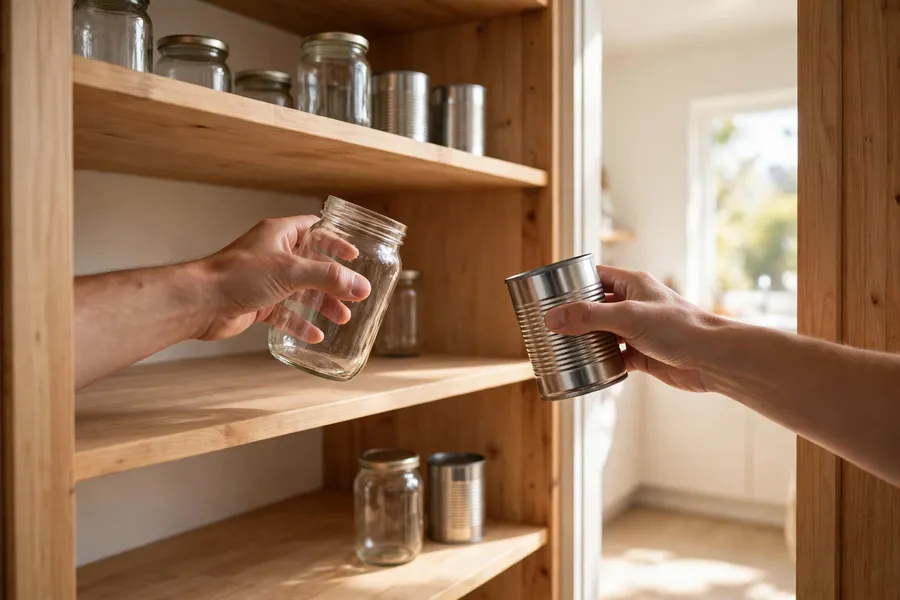
Take everything out, including door racks and the floor of the pantry. Set food on the counter or table in groups as it comes out, so you can see duplicates at once. Three bags of rice, two open boxes of the same cereal, and four half-used jars of the same sauce are normal finds. Keep one open bag of each staple and move sealed duplicates to a backup spot.
Sort into three piles: keep, toss, and donate. Toss anything with signs of pests, mold, an off smell, a swollen or badly dented can, or a spill that has soaked the box. Toss opened food that has sat far past its quality window and lost its smell, color, or texture. Donate unopened, in-date food you know you will not use. Do not donate opened food.
Clean the shelves while they are bare. Wipe them with hot soapy water, get into corners and shelf-pin holes where crumbs collect, and dry them fully before food goes back. A damp shelf softens boxes and feeds mold. Line wire shelves with flat liners so small jars stand steady and packets do not slip through. Measure each shelf now, depth, height, and width, and write the numbers down. Every container decision after this point uses those numbers.
How to organize kitchen pantry zones by use and frequency?
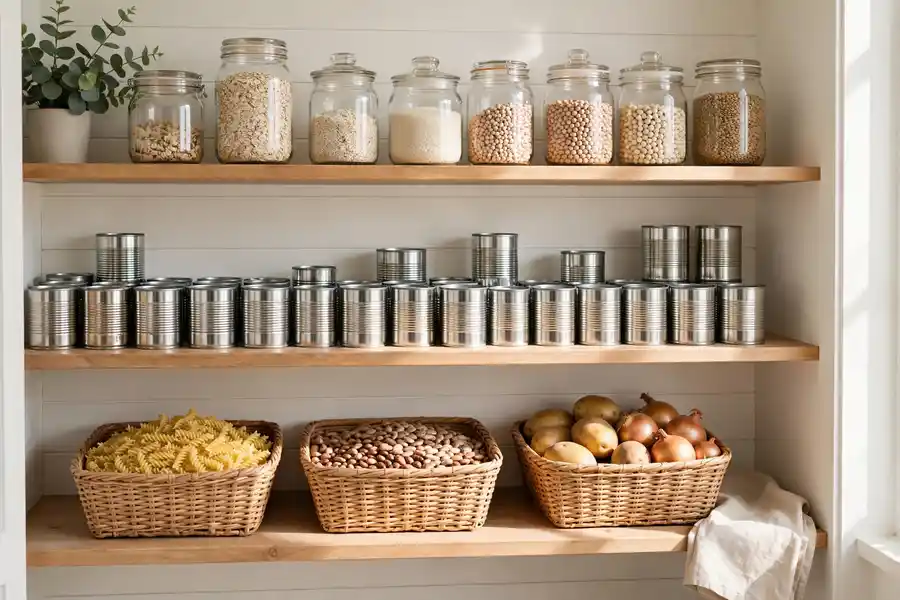
A zone is a fixed home for one kind of cooking, and a zone earns its shelf by how often you use it, not by food type alone. Daily food goes at eye level. Heavy food goes low, where lifting it is safe and a fall hurts nothing. Light, rarely used food goes high. That single rule places almost every item without debate.
| Zone | Shelf | What lives there |
|---|---|---|
| Breakfast and daily | Eye level | Cereal, oats, coffee, tea, bread box, peanut butter |
| Cooking staples | Eye level | Pasta, rice, canned tomatoes, broth, sauces you use weekly |
| Baking | One shelf, mid | Flour, sugar, baking powder, chocolate, dried fruit |
| Snacks | Low or mid | Crackers, bars, chips, one open box of each |
| Cans and jars | Low shelf | Beans, soup, canned fish, pickles, heavy jars |
| Oils and spices | Away from heat | Oils, vinegar, spice jars, hot sauce |
| Bulk and backup | High shelf or floor | Sealed duplicates, bulk rice, paper goods |
Keep one zone per shelf where the pantry allows it. When two zones must share a shelf, split it with a bin or a riser so the border holds. Put the zone label on the shelf edge or the bin, not in your head. Anyone in the house should be able to put a bag of rice away without asking where it goes.
The door is a zone too, for small, light items only: spice jars, packets, small bottles, and wraps. Door racks hold a few pounds per shelf, so never load them with full canisters or large jars. A door that will not close is a zone that failed.
What should you decant, and what stays in its package?
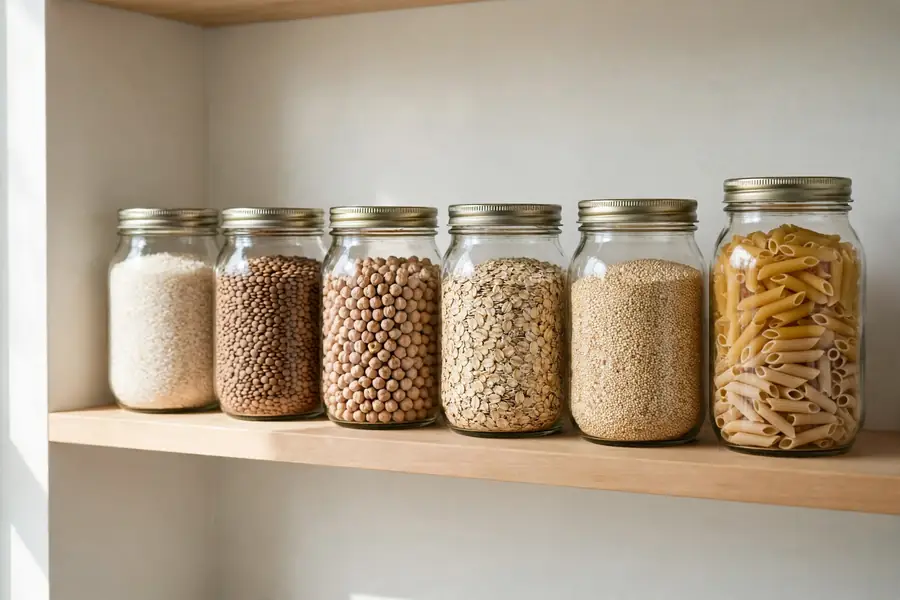
Decant dry staples that come in bags or thin boxes: flour, rice, pasta, cereal, oats, sugar, and coffee. A rigid airtight container keeps out moisture and pantry moths, shows how much is left, and stacks without tearing. Decant only after sorting, and only as much as you use before it stales. A five-pound bag of flour in a house that bakes twice a year does not need a large canister. It needs a smaller bag next time.
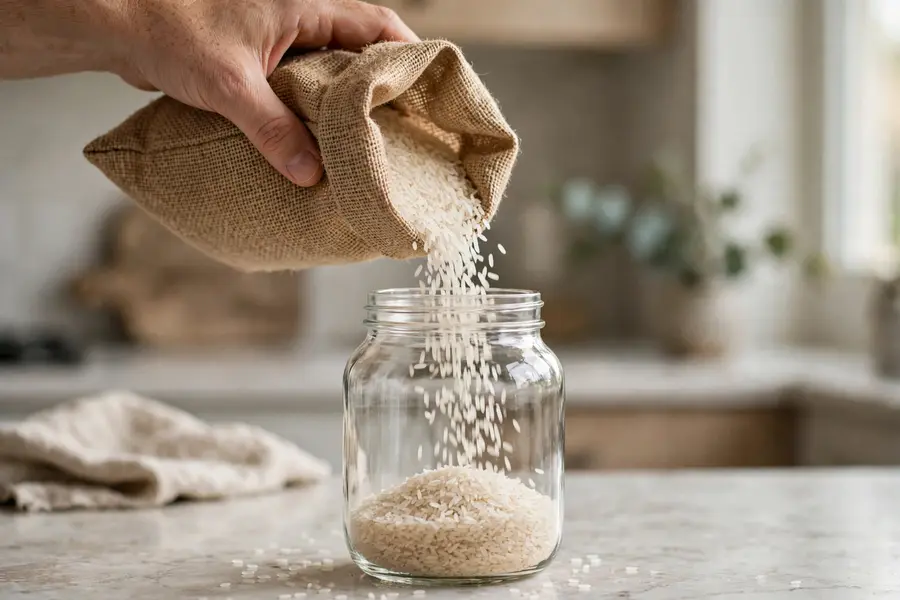
Leave food in its original package when the label matters. Sauces, seasoning mixes, and anything with allergen or cooking directions printed on it stay in the package, and the package goes inside a labeled bin. Single-serve packets, bars, and snack bags stay in their wrappers inside a bin, so hands grab one without opening a fresh box. Opened bags that cannot be decanted get folded tight, clipped, and stored inside a bin, never loose on a shelf.
Choose the seal first and the material second. A latch lid with a silicone gasket, or a screw lid that turns tight, is what keeps air and insects out. Snap lids that flex open and flip tops with thin hinges fail first. Glass shows contents at a glance, takes heat, and does not hold odors, but it is heavy and it breaks. Rigid plastic is light and survives a fall, but it can stain from tomato sauce and hold the smell of spices. Use glass for flour, rice, and spices, and plastic for cereal, snacks, and anything a child carries.
Size every container to the shelf it will sit on. Measure the shelf depth and height, then buy containers at least an inch shorter than the depth so fingers can grip them, and short enough that the shelf above clears the lid. A container that fits the shelf but blocks the door wastes the whole pantry. Stack only containers made to stack, with flat lids and matching footprints, and keep the heaviest stack low.
Label every decanted container with two facts: what is inside and the date it was opened. A roll of tape and a marker does the job, and a label on the front, not the lid, reads when containers are stacked. Flour and sugar look alike in identical jars, and powdered sugar looks like flour until it ruins a sauce. Labels are what make the system usable by everyone in the house.
How do you lay out shelves, deep shelves, and doors?
Shelves 15 to 18 inches deep hold one row of bins without hiding a second row behind it. Deeper shelves need a system, because food at the back of a 24 inch shelf is food you will forget. Give every deep shelf bins with handles, one bin per zone, and a front-row rule: nothing sits behind a bin except sealed backup stock, and backup stock comes forward when the front bin empties.
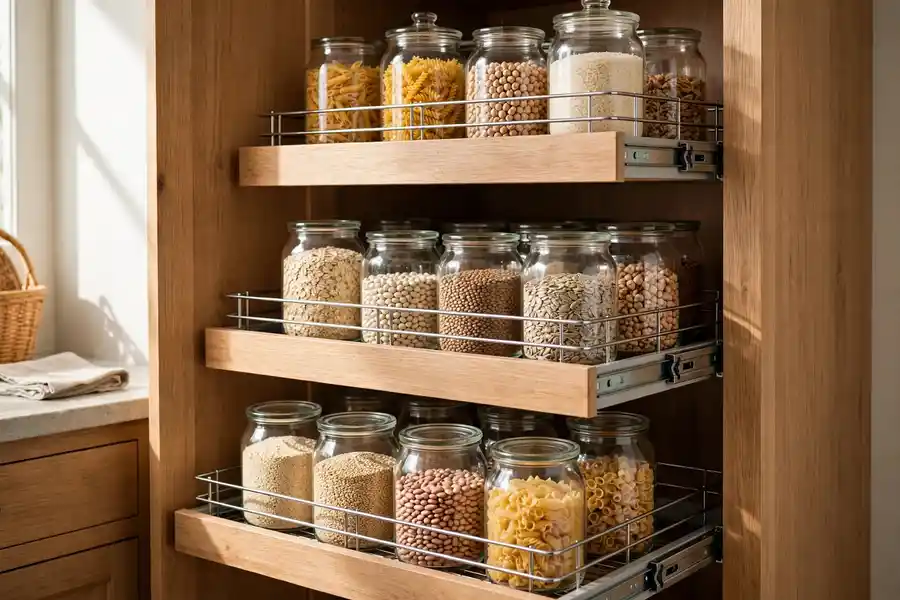
Risers double a shelf for cans and small jars. Put the taller row at the back and the shorter row in front, so every label faces out and nothing hides behind a taller can. A tiered step does the same job for spices, with the smallest jars in front. Turntables earn their place on corner shelves and deep shelves, for oils, vinegar, and sauces that would otherwise sit three deep. One turntable per shelf is enough. Two turntables crowd each other and neither one turns.
Pull-out shelves and pull-out pantries change the rule in a good way. A pull-out brings the back of the shelf to you, so zones can run front to back instead of side to side. Keep one category per pull-out, label the front, and do not overload the slides. A pull-out loaded past its weight limit sags, sticks, and then stops being used.
Pantry shapes each need their own layout. A walk-in pantry takes zones on three walls, with daily food on the wall you face when you walk in and bulk stock on the far wall. A reach-in pantry takes one zone per shelf, with the door rack for spices and packets. A pantry closet takes bins on every shelf and a door rack, and needs a cool, dry check before food moves in, since closets near ovens or hot water pipes run warm. A narrow pull-out pantry takes one category per column, with tall bottles at the bottom and small jars at the top.
How do you organize a small pantry without losing a shelf?
A small pantry is fixed by cutting, not by buying. Cut duplicates first: one open bag of each staple, one open box of each cereal, one open jar of each sauce. Move sealed duplicates and rarely used food out of the pantry entirely, to a labeled backup box in another cabinet or a closet. A small pantry that holds backup stock has no room left for daily food.
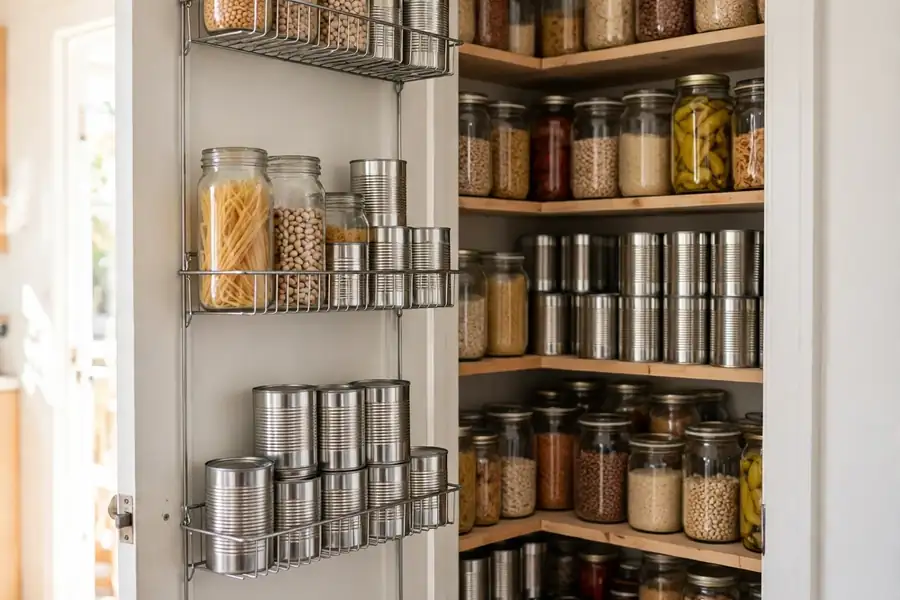
Use vertical space before floor space. A shelf riser adds a second tier for cans and small jars. Stackable containers use the full height between shelves. A door rack takes spices, packets, and small bottles off the shelves. Hooks on the inside of the door hold measuring cups and small bags. Do not stack food on the pantry floor unless it is heavy and sealed, like a bag of potatoes in a bin, since floor food collects dust and gets kicked.
Run the one-cabinet zone plan when the whole pantry is a single cabinet. Top shelf: backup stock and rarely used food. Middle shelf, at eye level: daily breakfast and cooking staples. Bottom shelf: heavy cans and jars. Door: spices and packets. Keep only one of each item open, and keep the backup box elsewhere. A small pantry works when every item has one home and the backup box, not the pantry, absorbs the extras.
How do you organize a kitchen with no pantry at all?
A kitchen with no pantry needs one cabinet run like a pantry, not five cabinets run like storage. Pick the cabinet nearest the stove or prep counter, empty it, and give it the same zones, containers, and labels as a pantry: daily food at eye level, heavy cans low, spices on the door or a tiered step. One cabinet with zones beats a whole kitchen of scattered shelves, because dinner is cooked from one spot.
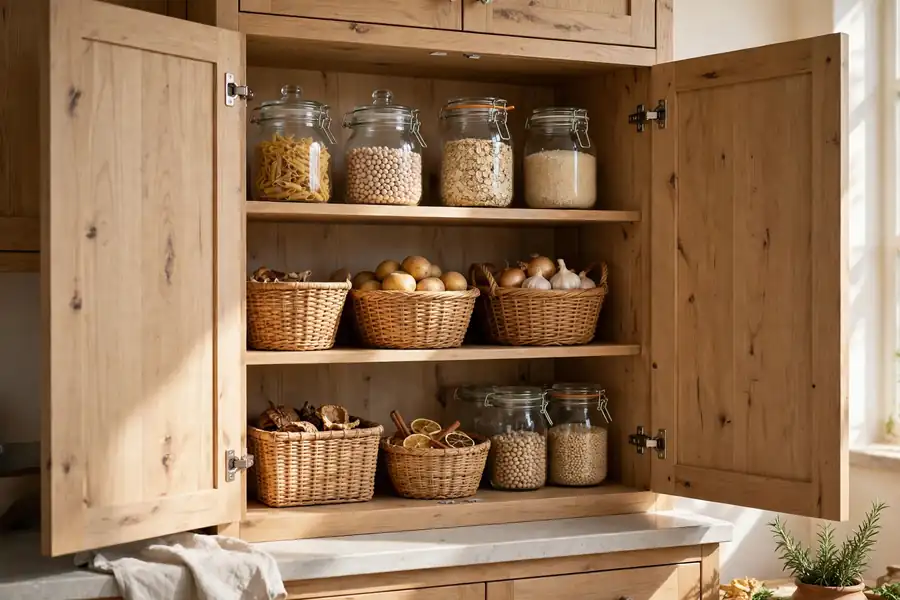
A freestanding cabinet or armoire works the same way when cabinet space is short, as long as it stands in a cool, dry spot away from the stove and the dishwasher. Give it shelves at pantry depths, a door rack for spices, and bins with handles on every shelf. A rolling cart holds daily items only: coffee, tea, cereal, and snacks for the week. It is a working station, not storage, so restock it weekly and keep backup stock in the cabinet.
A closet becomes a pantry when it is cool, dry, and dark, with shelves added and a door rack fitted. Check the temperature first. A closet sharing a wall with an oven, or sitting over a furnace, runs too warm for food. Wall shelves take daily jars, oils, and spices, but only away from the stove and out of direct sun. Heat and light stale oils and fade spices faster than any container can fix.
How long do pantry staples keep, and what do the dates mean?
Date labels are about quality, not safety, with one exception. The United States Department of Agriculture Food Safety and Inspection Service states that product dating is not required by federal regulation except for infant formula, and it recommends the phrase "Best if Used By" because it tells shoppers the food will be at its best quality by that date. Food past its date should still be safe and wholesome if handled properly, until spoilage is evident. Spoilage shows as an off odor, an off flavor, or a changed texture. If a food has developed those signs, do not eat it, whatever the date says.
"Sell by" tells the store how long to display a product. "Best if used by" tells you when quality starts to fall. "Use by" is the last date the maker recommends for peak quality, except on infant formula, where it is a safety date and the formula must not be used after it. Coded packing dates on cans are for the maker, not for you. Read the label, then judge the food itself.
| Staple | Quality window | Note |
|---|---|---|
| White rice | 1 to 2 years | Keep tightly closed, cool and dry |
| Brown rice | 6 to 12 months | Natural oils turn rancid sooner |
| White flour | 6 to 8 months | Airtight container, off smell means toss |
| Whole wheat flour | 3 to 6 months | Refrigerate to slow rancidity |
| Dried pasta | 2 years unopened, 1 year opened | Airtight once opened |
| Dried beans and lentils | About 12 months | Older beans take longer to soften |
| Vegetable oil | 6 months unopened, 1 to 3 months opened | Rancid smell means toss |
| Granulated sugar | 2 years | Keep tightly covered and dry |
| Ground spices | 2 to 3 years | Aroma test decides, replace when faded |
| Whole spices | 3 to 4 years | Grind as needed for full flavor |
| High-acid canned food | 12 to 18 months | Tomatoes, fruit, pickles |
| Low-acid canned food | 2 to 5 years | Meat, vegetables, soup, beans |
| Vinegar | 2 years unopened | Flavor holds, cloudiness is normal |
These figures are quality windows from the New Mexico State University Extension Guide E-118 for whole wheat flour and spices, and from the North Dakota State University Extension Food Storage Guide FN579 for the other staples, read on 27 October 2026, with canned food windows from the USDA Food Safety and Inspection Service food product dating guidance read the same day. Extension guides differ on some items, and storage conditions move the numbers, so use the aroma, smell, and texture tests before the calendar. A can that is swollen, leaking, or badly dented on a seam goes out, whatever its date says.
Where does each food belong, and what must stay apart?
Spices need a cool, dark, dry spot away from heat and steam, never above the stove. Heat and light fade color and aroma, and steam from a pot clumps ground spices. Keep spice jars small, airtight, and on a tiered step or a door rack where every label reads. Buy whole spices when you can, and grind what you need, since whole spices hold flavor far longer than ground.
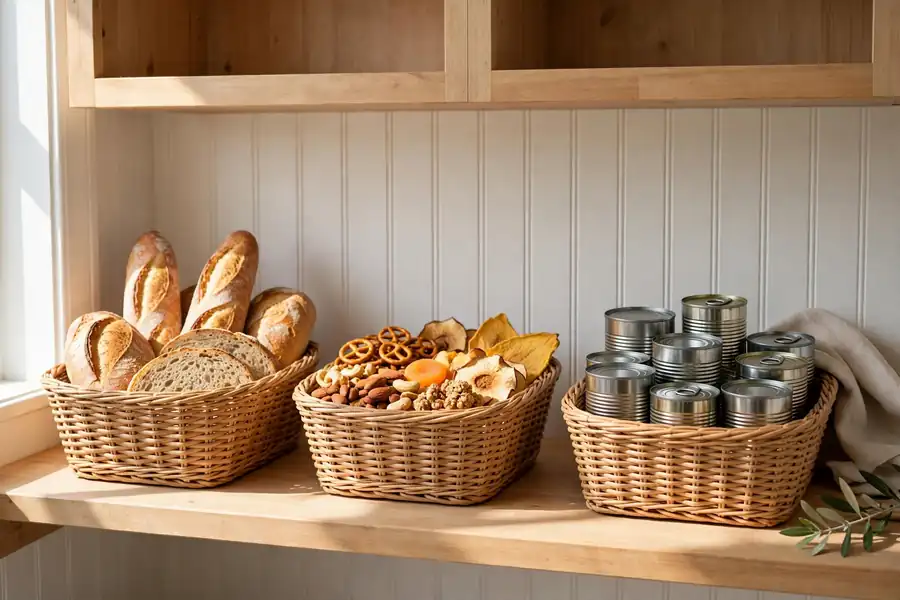
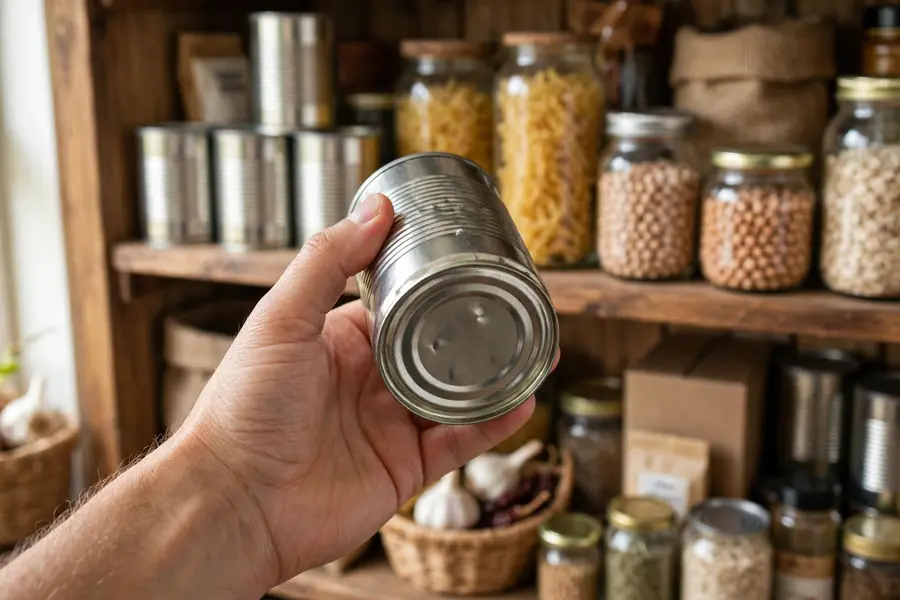
Cans and jars go low, labels facing out, heaviest at the bottom. A low shelf takes the weight without risk, and a falling can from a low shelf does little harm. Sort cans by meal, not by size: tomatoes with pasta and broth, beans with rice and taco seasoning, soup together. Check cans as they go in. A swollen can, a leaking can, or a can with a deep dent on a seam is thrown out, and rust on a can means the seal may fail.
Oils and vinegar sit away from heat and light, tightly closed, on a turntable or a single shelf where bottles cannot tip. Heat turns oil rancid, and light does the same job slower. Olive oil and vegetable oil belong in the pantry, not next to the stove. Keep the bottle you use daily at the front, and the backup bottle sealed behind it.
Onions, garlic, and potatoes need different storage conditions. Dry onions store in a mesh bag in a cool, dry, well-ventilated place away from sunlight. Potatoes store in a cool, dry, well-ventilated area away from light. Garlic stores cool and dry in a dark place. University of Maine Cooperative Extension storage guidance, read on 27 October 2026, states onions in a mesh bag in a cool, dry, well-ventilated place away from sunlight, potatoes in a cool, dry, well-ventilated area away from light, and garlic cool and dry in a dark place.
Bread and most fresh produce do not belong in a pantry. Bread keeps a few days in a bread box or bag, then goes stale, and a closed pantry does nothing to stop it. Most fruit ripens on the counter and then belongs in the refrigerator, and most vegetables belong in the refrigerator from the start. The pantry holds dry, shelf-stable food. When fresh food moves in, it pushes dry food out and brings moisture with it.
How do you keep the system working after the first month?
A pantry stays organized on a routine, not on willpower. Run a five-minute reset once a week: put stray items back in their zones, fold and clip open bags, and check the open-item list before shopping. Run a monthly check: sweep for expired and stale food, wipe the shelves, and pull one bag of unopened food you will not use for donation. A pantry that gets five minutes a week never needs another full empty-out.
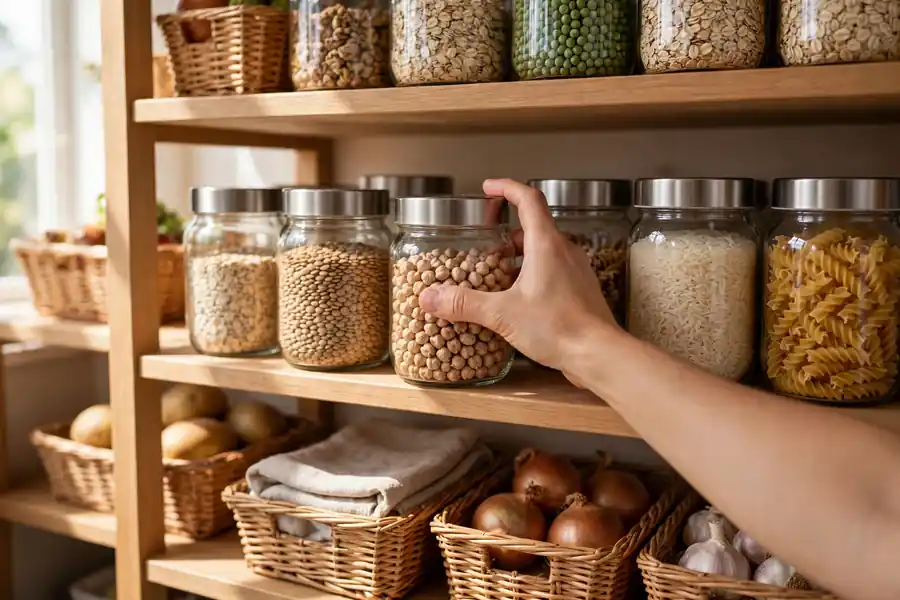
Keep one inventory list, on the pantry door or on your phone, and check it before shopping. The list holds only what is running low and what is out, not a full catalog of the pantry. New stock goes behind old stock, always, so the oldest food is used first. That rule, first in, first out, is the whole rotation system, and it works only when the front of every shelf is the oldest item.
Buy bulk only when three tests pass: it fits the pantry in a sealed container, it gets used before it stales, and the container seals airtight. Bulk rice in a house that eats rice weekly passes. A bulk bag of flour in a house that bakes twice a year fails, and the flour goes rancid in the back of the shelf. Bulk buying saves money only when the food is eaten, not when it is stored.
Give children one snack bin on a low shelf, filled once a week, so small hands reach their own food without pulling down the whole shelf. Keep pet food in its own sealed container on a low shelf, away from human food, with the scoop stored inside the container. A pet food bag left open draws pantry moths and spills kibble into every corner.
A system has failed when you see three signs: an overflow bin with no home, decanted jars with no labels, and zones that have drifted, with cans on the baking shelf and pasta in the snack bin. The fix for each is the same and takes minutes: empty the one shelf, put each item back in its zone, and label the jar. Do not reorganize the whole pantry because one shelf drifted.
What do you do about pantry moths, damp, and heat?
Pantry moths arrive in dry food from the store, and the sign is webbing, clumped grains, or small moths near the pantry. The Indian meal moth is the most common pantry moth, and its larvae chew through plastic bags and thin cardboard, so a sealed-looking box is no protection. Throw out infested food, vacuum the shelves and corners with a crevice attachment, and wash the surfaces with warm water and soap before food goes back. Restock in thick glass or rigid plastic containers with tight lids, and use older food first. Freeze suspect dry goods at 0 degrees F or lower for four to seven days, which kills all insect life stages, including eggs and pupae. Never use mothballs near food. Mothballs are pesticides, and their gases do not belong near food or food preparation areas. The National Pesticide Information Center pantry moth guidance, from Oregon State University, read on 27 October 2026, states the same steps: discard infested food, vacuum and wash, and store bulk food in thick-walled glass or plastic containers.
Damp and heat undo a pantry faster than clutter does. A pantry must stay cool and dry, away from the stove, the oven vent, and dishwasher steam. Damp shelves soften boxes, clump sugar and salt, and grow mold on shelf edges. Fix leaks first, leave small air gaps behind bins so air moves, and never store food against a warm wall. A pantry that smells musty has a moisture problem, not an organization problem, and no bin fixes it until the moisture is gone.
Quick answers to common questions
Should you empty the whole pantry before you organize it?
Yes. Take everything out, including door racks and the floor. You cannot see duplicates, expired food, or pest signs with food still on the shelves, and zones set around food that stays put are zones built on clutter.
What size containers fit a standard pantry shelf?
The size that fits your shelves, measured first. Measure depth, height, and width, then buy containers at least an inch shorter than the shelf depth and short enough to clear the shelf above with the lid on. Stack only containers made to stack, with flat lids and matching footprints.
How do you keep pantry moths out of flour and rice?
Store flour and rice in thick glass or rigid plastic containers with tight lids, use older stock first, and keep shelves vacuumed and dry. Throw out any food with webbing or larvae, and freeze suspect dry goods at 0 degrees F or lower for four to seven days before restocking.
Can you store onions and potatoes in the same bin?
Onions store in a mesh bag in a cool, dry, well-ventilated place away from sunlight, potatoes store in a cool, dry, well-ventilated area away from light, and garlic stores cool and dry in a dark place.
How often should you clean out a pantry?
Run a five-minute reset every week and a date and shelf check every month. A full empty-out, with shelves wiped and every item checked, belongs once or twice a year, or at once when moths or damp appear.
What does a pantry that holds look like after a month?
The test of how to organize kitchen pantry work is an ordinary Tuesday six weeks later: dinner ingredients sit at eye level, the oldest rice is in front, labels read at a glance, and nothing has drifted to the wrong shelf. A pantry that holds does not look styled. It looks used, with one open bag of each staple, one bin per zone, and a shopping list that matches what is actually low. The measure of the system is not how it looked on the day it was organized. It is how little work it takes to keep it that way, five minutes a week, with zones that match how your household actually cooks.