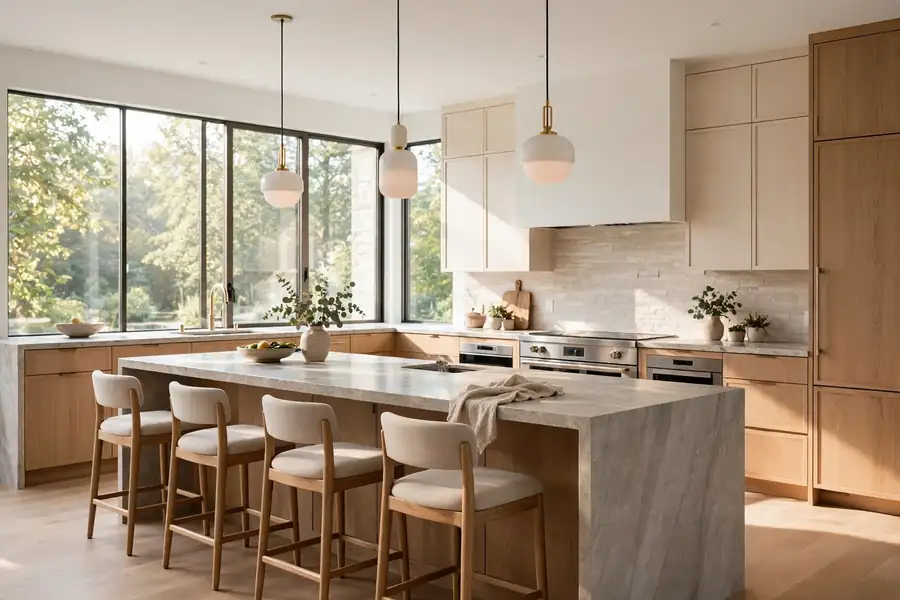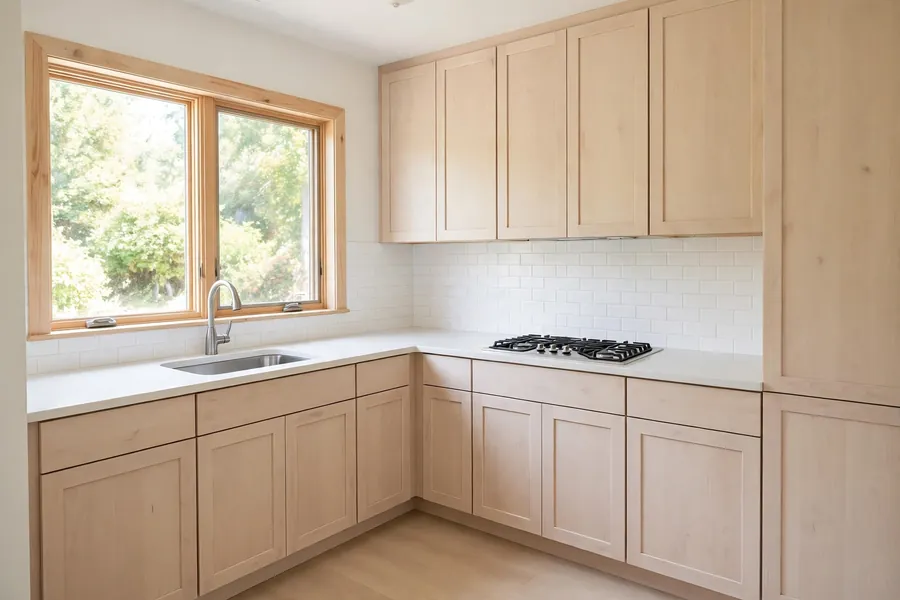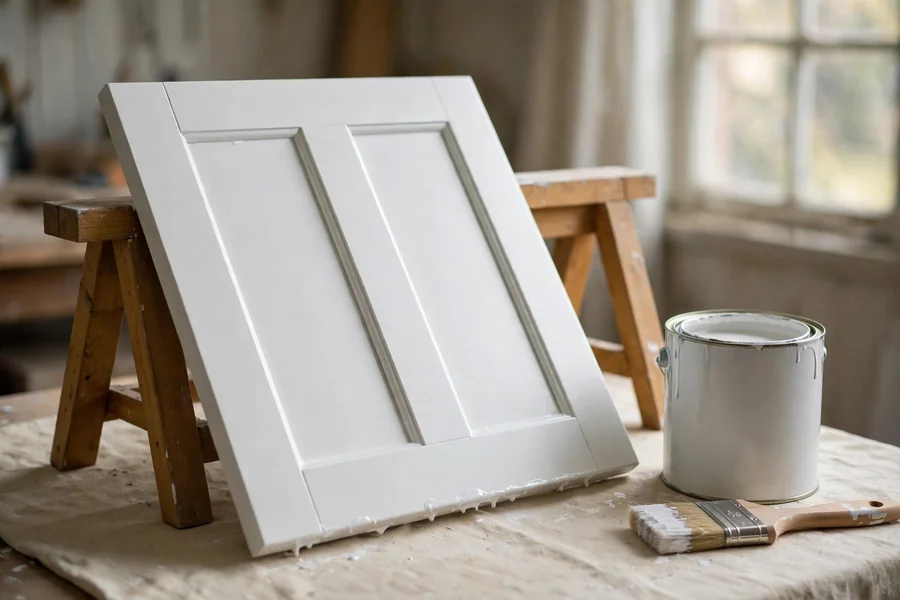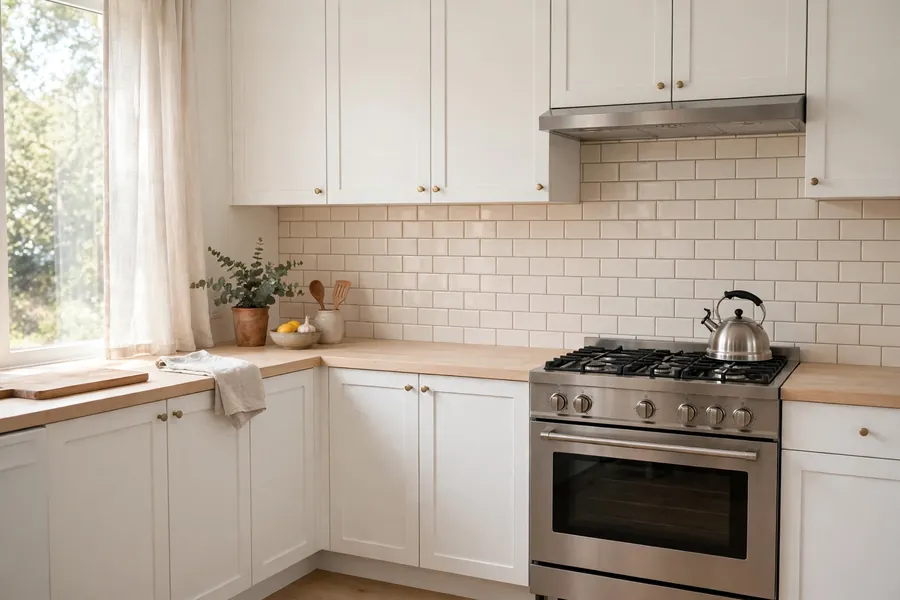
Start with the wall you cook against, not with a tile sample you liked in a store. Good kitchen backsplash ideas protect the wall behind the stove and sink, suit the cabinets and countertop already in the room, and stay easy to wipe down after a real meal. Pick the material for heat and water first, then pick color and pattern. For the rest of the room, see the Kitchen chapter page.
Backsplash choices at a glance
| Choice | Best for | Watch out for |
|---|---|---|
| Glazed ceramic or porcelain tile | Daily cooking, tight budgets | Dark grout shows uneven joints |
| Natural stone tile or slab | A calm wall with strong veining | Sealing, acid marks, heat on quartz |
| Glass or mosaic tile | Light, color, a small accent wall | Many grout lines, soft glass scratches |
| Brick, wood, or metal | Texture in a farmhouse or industrial room | Porous brick, combustible wood, soft metal dents |
| Peel-and-stick, paint, or wallpaper | A rental or a low budget refresh | Heat, steam at seams, short life |
Which tile should you pick: ceramic, porcelain, or subway tile?
Glazed ceramic tile is the default for a working kitchen. The glaze sheds water and grease, and a damp cloth clears most splashes. Porcelain tile is denser, so it resists chips and stains a little better, and porcelain made to look like stone gives that look with less upkeep than real stone. Both take heat behind a range well when set with the right adhesive. Choose porcelain where pans knock the wall. Choose ceramic where cost matters most.
Subway tile is a size and shape, not a material. The classic 3 inch by 6 inch rectangle works in ceramic, porcelain, and glass. Lay it in a running bond for a traditional room, in a straight stack for a modern room, or upright in a vertical stack to make a short wall read taller. A handmade look tile with an uneven glaze suits a warm, lived in room, but its edges vary, so joints will vary too. Dry lay it first to blend shade differences. For a timeless result, keep the tile warm white or cream and the grout close in tone to the tile.
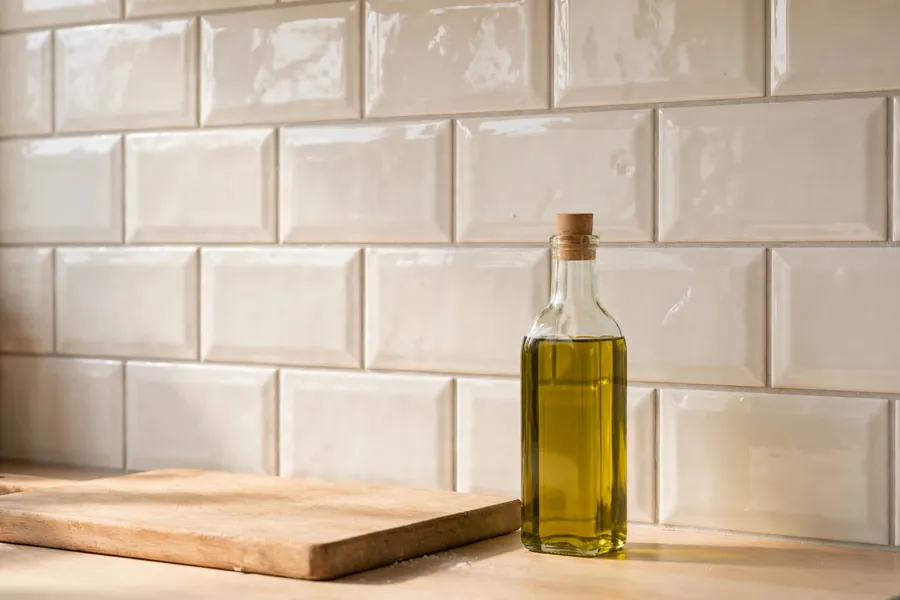
Zellige tile is handmade clay tile from Morocco with an irregular surface, uneven edges, and a glaze that pools in places. Each tile differs, and that variation is the point. It suits a boho room, a Mediterranean room, and a warm modern room where a flat machine tile would read cold. It needs a setter who has worked with handmade tile. Seal it if the maker sheet says so, and test grout on a spare tile first, since dark grout can stain a crackled glaze.
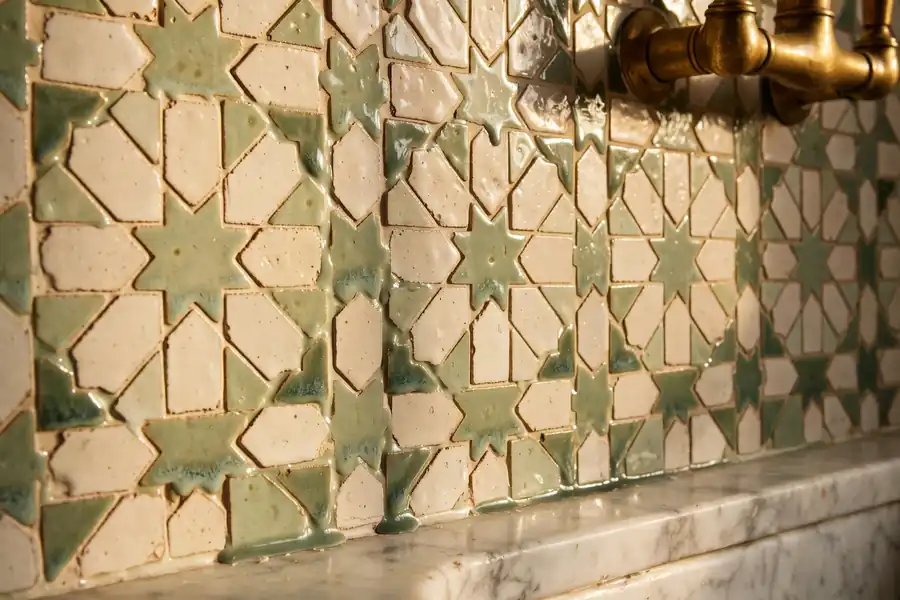
When do mosaic, glass, and patterned tile make sense?
Mosaic tile is small tile sold on sheets, and it earns its place as an accent, not as a full wall in a busy kitchen. Penny rounds, small squares, and mixed stone and glass sheets add pattern behind a sink or in a niche. Small tile means many grout lines, and grout lines collect grease. Use mosaic in a band, in a panel behind the range, or on a short run, and keep the field tile large and plain.
Glass tile reflects light, so it brightens a dark corner and suits a coastal room, a contemporary room, and a small kitchen with little natural light. It is nonporous, so water and stains stay on the surface. Glass scratches more readily than glazed ceramic, and adhesive shows through pale or clear glass, so the setter must use a white adhesive made for glass.
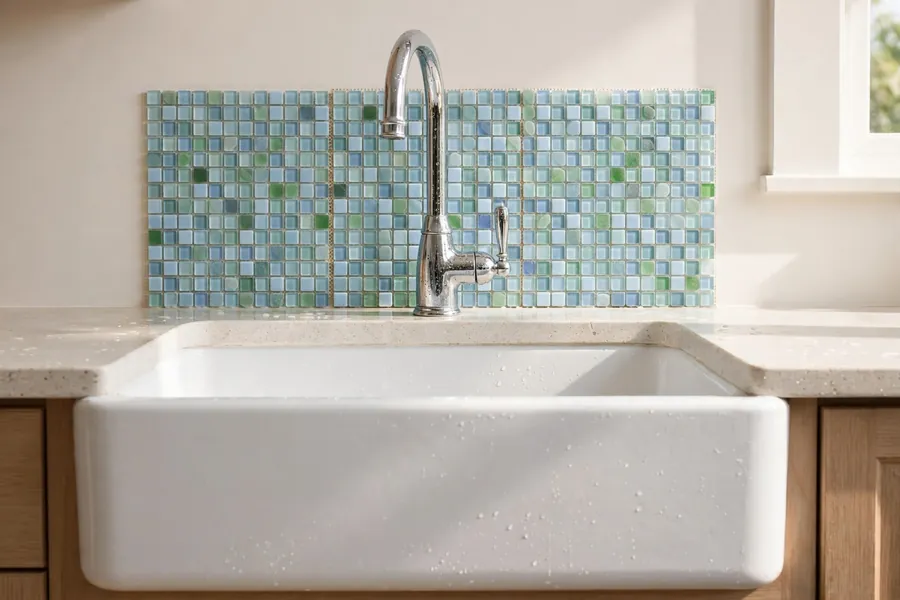
Patterned tile covers cement look tile, encaustic look porcelain, and printed ceramic with a repeated motif. It gives a cottage room or a Mediterranean room a focal wall. A strong pattern across a long wall fights with veined stone, busy wood grain, and open shelves. Keep patterned tile to one wall, keep the countertop plain, and order enough tile from one batch.
Hexagon tile and herringbone and chevron patterns change the feel of plain tile without changing the material. Hexagons suit a mid-century modern room and a small accent panel, but each edge cut wastes tile, so order extra. Herringbone needs more cuts and a setter who can keep the angles true. Chevron is herringbone cut at an angle so the points meet in a straight line, and it costs more to set.
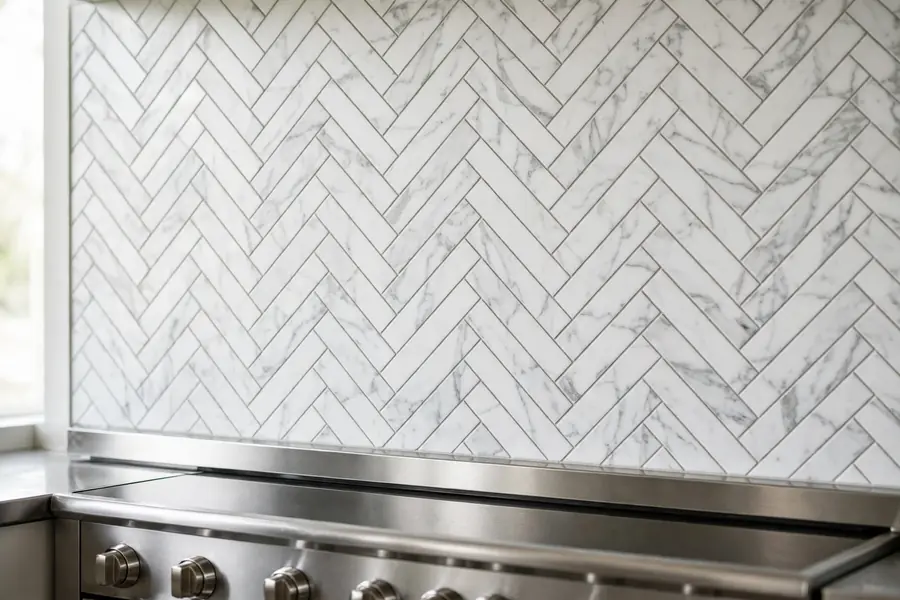
What should you know before you choose natural stone or a slab?
Natural stone tile brings veining no printed tile matches, and it suits a traditional room, a rustic room, and a calm modern room where the stone is the one feature on the wall. Marble tile shows soft veining, and it marks when acid sits on it. Lemon juice, vinegar, and tomato sauce can dull marble, and a sealer slows stains without stopping acid marks. Granite tile is harder and less fussy than marble, and most granite needs little sealing. The Natural Stone Institute states in its sealing position, read on 27 October 2026, that most granite countertops do not need to be sealed, that sealing marble and granite makes sense in many cases, and that a quality sealer should last ten to fifteen years and resist water and oil based stains. Travertine has pits and a warm tone. Fill its holes and seal it, or grease will sit in the pits. Quartzite is harder than marble and still needs sealing. Slate is dark and rough and needs sealing. Limestone is soft and porous, and is a poor pick behind a range or a sink.
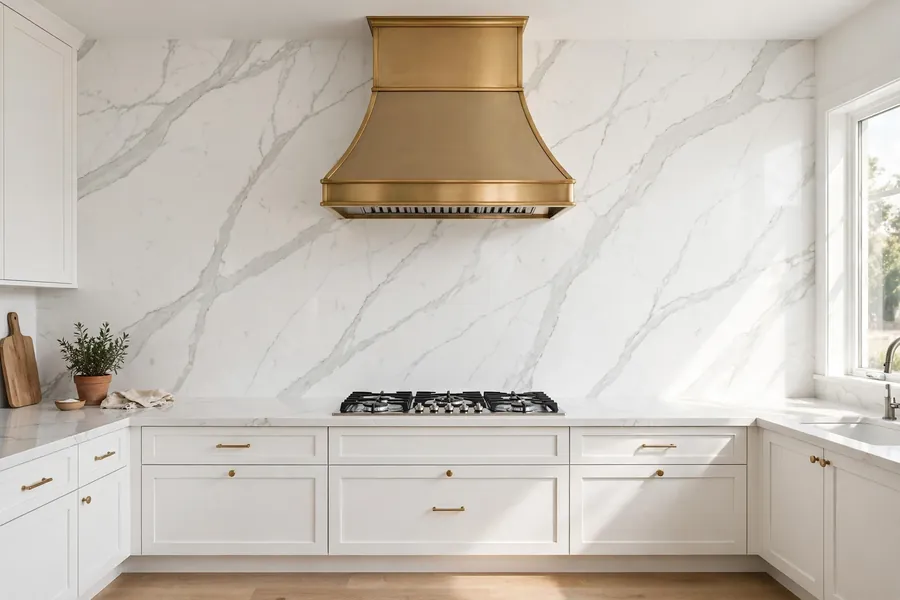
A slab backsplash runs one piece of stone or engineered quartz from the countertop to the cabinets, or to the ceiling, with no grout lines. It suits a contemporary room and a modern room where a clean wall matters more than pattern. A stone slab handles heat behind a range better than engineered quartz. Engineered quartz holds resin that binds the stone grains, and that resin can scorch, yellow, or warp with sustained high heat. Summaries of maker guidance read on 27 October 2026 put the safe range for most engineered quartz near 300 degrees Fahrenheit, or 150 degrees Celsius, and range makers often call for a metal backguard or a set clearance behind a high output gas range. Check the sheets for the exact slab and range before you order.
Where do brick, wood, and metal fit?
Brick gives a farmhouse room and an industrial room warmth and texture that flat tile cannot match. Thin brick veneer is lighter than full brick, and a whitewashed finish keeps the texture while it lightens a dark room. Brick is porous, so grease soaks in unless the surface is sealed, and mortar joints collect dust. Use brick away from direct frying splashes, or seal it well.
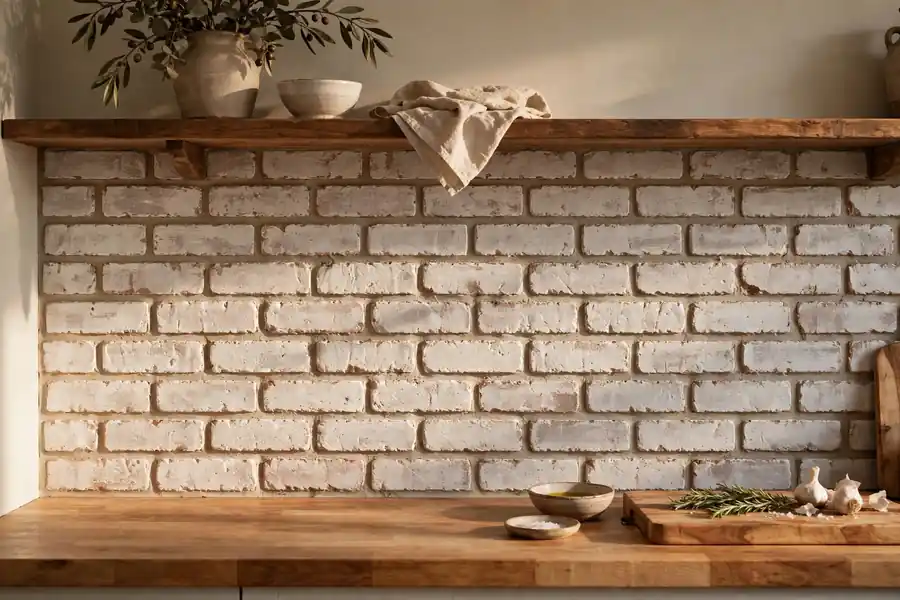
Wood covers shiplap, beadboard, and plank walls. Shiplap suits a farmhouse room and a cottage room, and beadboard suits a cottage room and a traditional room with painted cabinets. Seal wood on all sides, including cut ends, or steam and splashes will swell it and lift paint. Wood is combustible, so it has no place tight behind a gas range unless the range maker allows it with a set clearance or a heat shield.
Metal covers stainless steel sheet, stainless tile, copper, and tin. Stainless steel suits an industrial room and a modern room, and a single sheet behind a range wipes clean and takes heat. It shows fingerprints, so a brushed finish hides marks better than a mirror finish. Copper warms a traditional room and an eclectic room, and it darkens and spots with heat and touch unless it carries a clear coat, which itself can yellow near heat. Tin tile dents with a knock from a pan, so it suits a low traffic wall better than the wall behind a busy stove. Check that metal tile is rated for the heat zone you plan, and use an adhesive made for metal.
What are the limits of peel-and-stick tile, paint, and wallpaper?
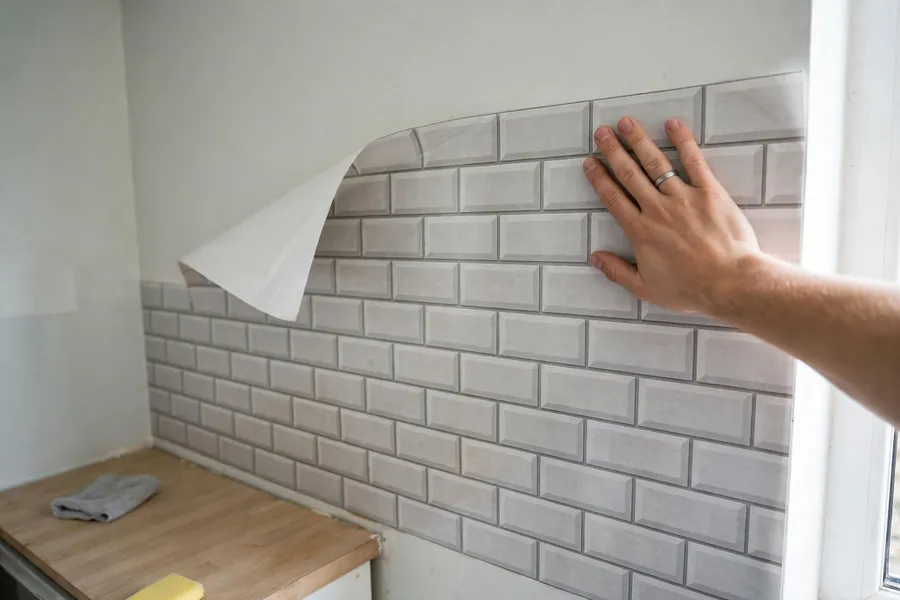
Peel-and-stick tile is a thin vinyl, gel, or metal faced sheet with an adhesive back, and it fits a rental, a short term update, or a first test of a color before you commit to real tile. It needs a clean, smooth, dry wall, and it sticks best on painted drywall or over flat existing tile with shallow joints. Deep grout lines show through and break the bond, and grease stops the adhesive from holding. The limit is heat and steam. Adhesive softens with sustained heat, edges lift, and vinyl can warp near a burner. One maker listing read on 27 October 2026 kept its tile at least 16 inches from a gas stove or advised against use behind a gas stove at all. Read the sheet for the exact tile you buy, and use real tile or metal directly behind a gas range.
Painted tile is existing tile coated with a bonding primer and a hard wearing paint, and it suits a sound tile wall whose color you dislike. It fails where the prep fails. Grease must come off, gloss must be dulled, and the primer must bond to tile, or the paint peels at the sink and the stove. Painted tile scratches and chips with pan knocks. Do not expect paint to fix cracked or loose tile.
Wallpaper made for kitchens adds pattern fast and suits a dry wall away from direct water. It needs a smooth wall and a paste rated for the paper, and a clear protective coat if the maker allows one, or steam will lift seams. A wipeable paper lasts longer than a plain paper.
Which backsplash color works with the light in your kitchen?
White tile is the safest pick when you want the room to read bright and the cabinets and countertop to lead. Warm white and cream suit warm wood and rooms that run cool, while a stark bright white suits a room with strong daylight and cool gray cabinets. A white wall shows grease near the stove, so a gloss glaze that wipes clean matters more than the exact shade. Gray tile reads calm with white cabinets, but a cool gray can turn cold in a room with little sun. A warm greige stays softer in low light. Black tile suits a room with ample light, pale cabinets, and a pale countertop. It shows dust, so a matte black tile with a mid tone grout hides marks better than a gloss black tile with white grout.
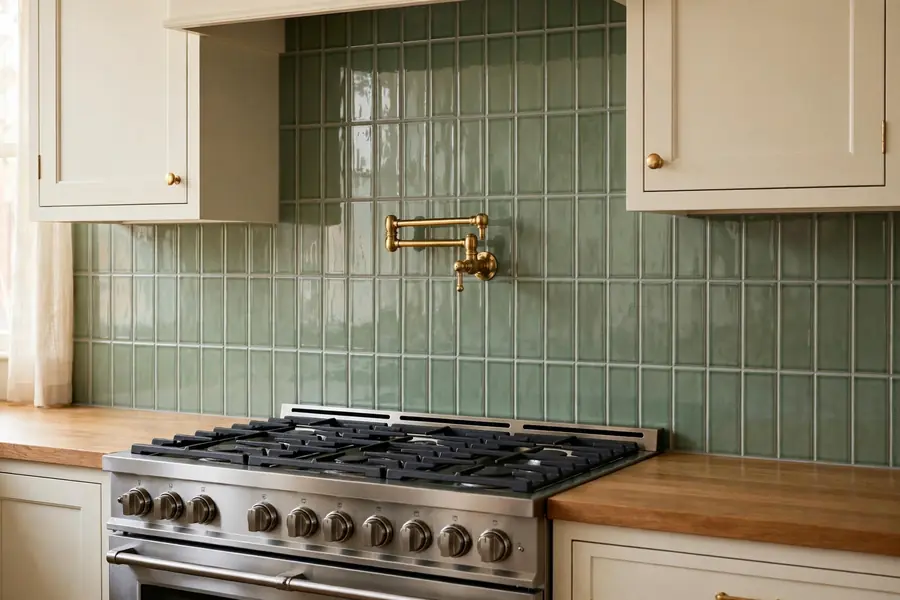
Blue tile ranges from pale dusty blue to deep navy. Pale blue suits a coastal room and a cottage room, and it pairs with white cabinets and light wood. Navy reads best as one wall or a panel behind the range. Green tile ranges from soft sage green to deep forest green. Sage green is the warm, muted green seen across 2026 design coverage, and it suits cream cabinets and warm wood. Deep green needs a pale countertop and strong light. Beige and cream tile suit warm rooms and honey wood, and they hide dust better than white. Brown tile suits wood cabinets and a rustic room, but a dark brown wall needs strong light. A neutral wall is the pick when the countertop has strong veining or the cabinets carry the color. A colorful wall is the pick when the cabinets and countertop are plain. Test a large sample on the wall in daylight and at night before you order.
Which backsplash pairs with your cabinets and countertops?
Pair the backsplash with what stays. Cabinets and countertops cost far more to change than tile, so pull their tones first. If the countertop has strong veining, pick a quiet tile. If the countertop is plain, the tile can carry pattern or color. If the cabinets carry color, keep the tile pale and plain.
| Cabinets | Backsplash direction |
|---|---|
| White cabinets | Warm white subway, pale gray, sage green, marble look porcelain, pale blue glass |
| Dark cabinets | Pale warm tones, cream zellige, light stone slab, white tile, mid tone grout |
| Wood and oak cabinets | Cream, warm white, pale sage, handmade tile, light washed brick |
| Maple and cherry cabinets | Warm white, cream, pale green, warm beige stone |
| Honey oak cabinets | Cream, warm beige, soft green, warm brown undertones, no cool gray |
| Gray and grey cabinets | Warm white, pale greige, white tile with gray grout, pale blue or green glass |
| Sage green cabinets | Warm white, cream, marble look, pale beige stone, soft white glass |
| Blue cabinets | Warm white, cream, pale gray, marble look, brass toned metal |
| Cream cabinets | Pale blue, sage green, warm white, soft pattern, pale beige stone |
| Brown cabinets | Cream, warm white, pale beige stone, light glass, warm gold undertones |
| Countertop | Backsplash direction |
|---|---|
| Granite with strong pattern | Quiet tone from the stone, large format tile, pale slab |
| Quartz with light veining | Subway, zellige, pale stone, glass in a tone from the slab |
| Marble countertop | Pale tone from the marble, matching slab, quiet porcelain |
| Butcher block | Cream, warm white subway, handmade tile, pale green, beadboard on a dry wall |
| Black countertop | Pale tile, warm white, cream, light stone, light reflecting glass |
| White countertop and white cabinets | Warm tone, pale color, soft pattern, or texture |
A white on white kitchen needs texture or tone to avoid a flat wall. A handmade glaze, a beveled edge, a soft sage or pale blue tile, or a quiet stone slab gives the wall depth. Keep the grout close in tone to the tile, since a dark grid will dominate the wall.
How high should a backsplash run, and how do you fit it around stoves, sinks, and windows?
The standard run is the wall between the countertop and the underside of the wall cabinets. Figures attributed to the National Kitchen and Bath Association Kitchen Planning Guidelines in summaries read on 27 October 2026 put the standard countertop to wall cabinet gap at 18 inches, with at least 15 inches of clearance above a working counter, and that 18 inch band is the usual backsplash height. Measure from the finished countertop surface to the underside of the cabinet box, and include any light rail, since the rail sets the lowest point.
A full height backsplash runs from the countertop to the ceiling, or to the underside of a range hood, and it suits a wall with no upper cabinets and a wall behind a range. It uses more tile and shows any wall that is out of plumb, so check the wall with a long level before you order. Behind a range, run the tile to the underside of the hood or to the ceiling, and follow the range and hood sheets for clearance. Summaries of the same National Kitchen and Bath Association guidance read on 27 October 2026 put the minimum cooktop to hood gap at 30 inches. Behind a sink, run the tile a little past each side of the sink. If the sink sits under a window, run the tile up the sides of the window, or stop at the window trim with a clean edge trim. On an island, a backsplash applies only where a raised bar or a wall meets the counter.
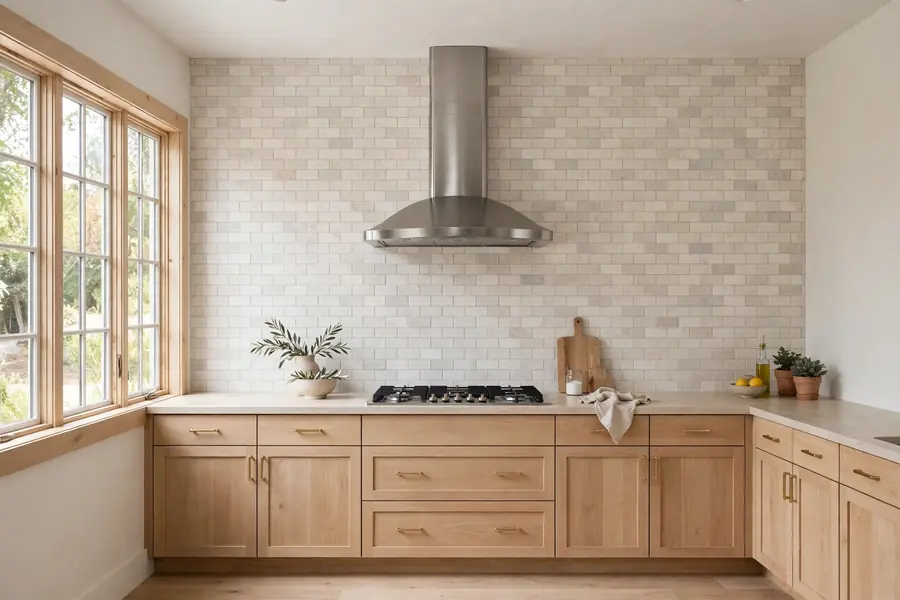
Outlets and switches need a plan before tile goes up. Mark each box, cut tile to fit tight around the box, and use box extenders so the outlet sits flush with the finished tile face. A setter should never bury a box behind tile. Edge trim covers the raw edge of tile at a cabinet, a window, or an open end. At the joint where tile meets the countertop, use a flexible sealant, not hard grout, since hard grout cracks there.
Grout sets the look and the upkeep of a tile wall. Grout maker guidance read on 27 October 2026 gives sanded grout for joints from 1/8 inch to 1/2 inch wide, unsanded grout for joints from 1/16 inch to 1/8 inch wide, and epoxy grout as the most stain resistant type, with almost no porosity and no need for sealing. Use sanded grout for wide joints. Use unsanded grout for narrow joints, polished stone, and glass tile, since sand can scratch a soft surface. Use epoxy grout behind a stove and a sink. Seal cement grout after it cures, and reseal it when water stops beading on the joint. Keep grout lines even with spacers.
Outdoor kitchen walls need a short note only. An outdoor backsplash must take rain, sun, and freeze and thaw, so use porcelain tile, natural stone rated for outdoor use, or a metal panel, with an adhesive and grout rated for outdoor use. Wood, peel-and-stick tile, paint, and wallpaper do not belong on an outdoor wall.
How do kitchen backsplash ideas change in a small kitchen?
A small kitchen needs a backsplash that adds light without adding visual clutter. Large tile with thin joints reads calmer than small mosaic tile, since fewer grout lines break the wall into pieces. A pale tile in warm white, cream, or pale gray reflects light.
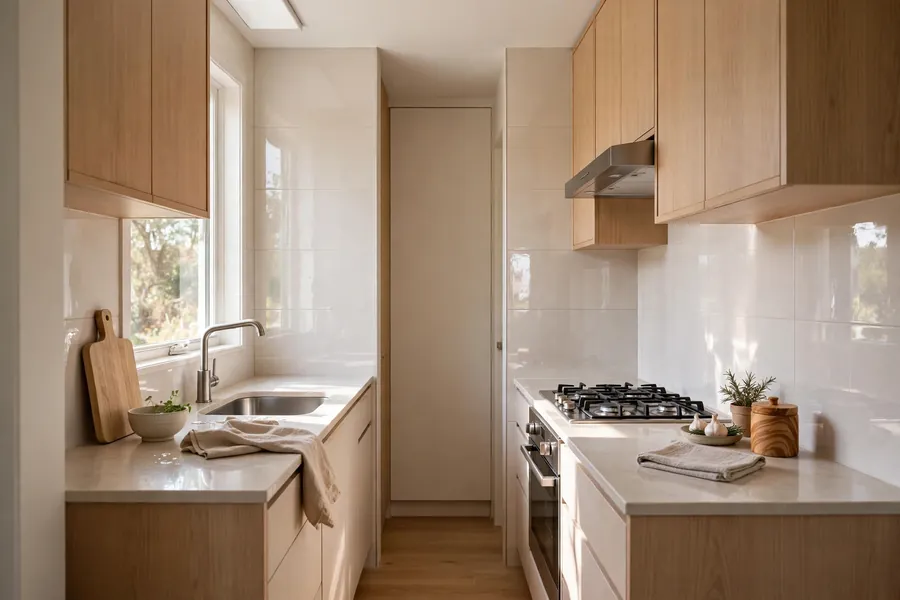
A galley kitchen has two long walls close together, so a busy pattern on both walls can feel tight. Pick one wall for pattern or color, usually the range wall, and keep the sink wall plain and pale. A slab or a large format porcelain panel cuts grout lines to almost none, and that clean wall makes the room feel larger. If a slab is out of budget, a 4 inch by 12 inch or 6 inch by 12 inch tile in a straight stack gives a similar calm read for less cost.
How do you keep backsplash costs down without a cheap look?
Cost sits in three places: tile, labor, and wall prep. Angi cost guidance updated on 24 September 2026, read on 27 October 2026, puts a professionally installed backsplash at 480 dollars to 1,500 dollars for a typical 35 square foot area, with an average near 1,000 dollars, and 15 dollars to 40 dollars per square foot. Removal of an old backsplash adds 3 dollars to 6 dollars per square foot in the same Angi guidance. Get a quote for your wall before you set a budget.
If the old tile is sound and flat, a new grout color, a deep clean, and a fresh seal can lift the wall for little cost. If the old tile must go, a large ceramic subway tile in a straight stack is the lowest cost real tile route, since it cuts fast. A patterned tile, a herringbone layout, and a mosaic sheet all add labor time and waste, so they cost more. A slab costs the most, since templating, fabrication, and handling sit on top of the stone price.
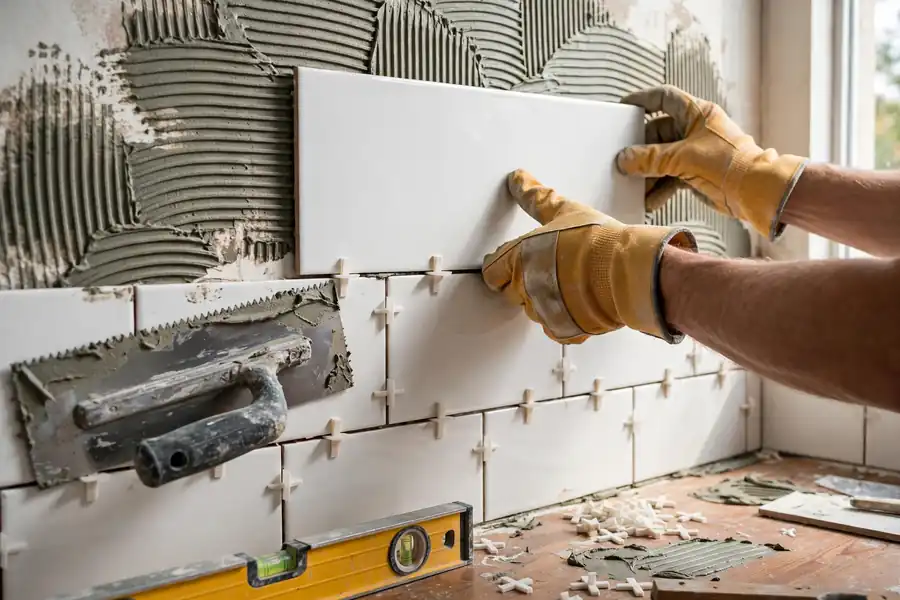
Do it yourself work saves labor only when the wall is flat, the tile is large and plain, and the cuts are few. Hire a setter for handmade tile, for stone slab, for epoxy grout, and for any wall with many outlets, windows, or angles. Tile the range wall first, and order all tile from one batch, with spare tile for cuts and for a future repair.
What is current in 2026, and what should you treat as a passing trend?
Design coverage read on 27 October 2026 points one way for 2026: warmer, calmer, and taller. Warm neutrals in cream, taupe, and beige have pushed cool gray aside. Handmade and zellige tile with an uneven glaze leads the tile looks, and full height runs and slab walls lead the layout looks. Subway tile stays, but in warm tones, in a vertical stack, or with a beveled edge. Sage green and muted blue lead the accent colors.
Treat a passing trend as a small, cheap change, not as a full wall. A bold pattern or a strong color is easy to tire of, and a full wall of it is costly to change. A quiet tile wall with one strong accent panel lets you change the accent later. A short 4 inch strip, a busy mosaic across a long wall, and a high contrast grid with black grout on white tile all read dated in 2026 coverage. If you love a strong look, put it behind the range, and keep the rest of the wall plain.
What safety checks come before you cut tile or touch an outlet?
Tile work hides three risks: power, dust, and heat. Switch power off at the breaker before you remove an outlet cover or move a box, and test that the circuit is dead before you touch a wire. Hire a licensed electrician to move an outlet, add a circuit, or change wiring. Wear eye protection, gloves, and a dust mask rated for fine dust when you cut tile, and cut wet tile outside or in a ventilated space. Keep the work area ventilated when you seal stone or grout, and follow the sealer sheet for cure time. Check the heat rating for the exact wall material and the exact range before you set tile behind a gas range.
Quick answers to common questions
What is the standard height for a kitchen backsplash? The standard run is 18 inches, from the finished countertop to the underside of the wall cabinets. A full height run to the ceiling suits a wall with no upper cabinets and the wall behind a range.
Can you install tile over an existing backsplash? Yes, when the old tile is sound, flat, and firmly bonded. Clean and degrease the old tile, dull the gloss, and use an adhesive rated for tile over tile. Remove loose or cracked tile first, and do not tile over tile that moves or sounds hollow when tapped.
Which grout color shows the least dirt? A mid tone gray grout shows the least daily dirt behind a sink and a stove. White grout stains fastest, and a very dark grout shows dust and makes uneven joints stand out.
How do you measure a backsplash wall before you order tile? Measure each wall run in width and height, multiply width by height for square footage, add the runs together, and add 10 percent for cuts and breakage, as Angi guidance read on 27 October 2026 advises. Order all tile from one batch.
Is a slab backsplash harder to repair than tile? Yes. A chipped tile can be cut out and replaced on its own, while a damaged slab often needs a fabricator to repair or replace a large piece. Keep spare tile for a tile wall.
What is the best backsplash choice for most kitchens?
For most kitchens, the sound choice is a glazed ceramic or porcelain tile in a warm pale tone, laid in a straight stack or a running bond, with grout close in tone to the tile and sealed cement grout or epoxy grout behind the stove. That wall takes heat, wipes clean, and suits most cabinets. The right kitchen backsplash ideas for your room follow from the cabinets and countertop you already have, the light in the room, and how hard you cook. Order large samples and test them on the wall in your light.