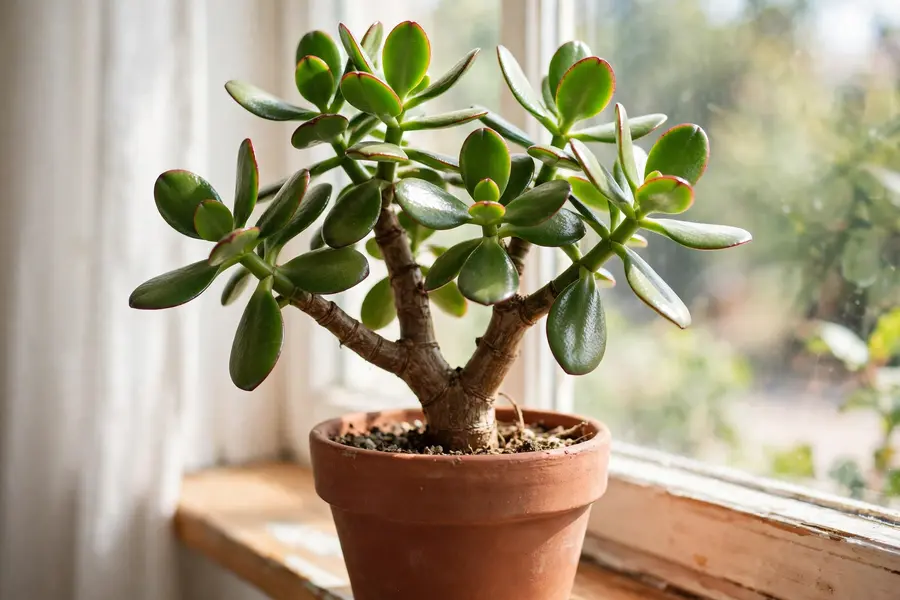
A jade plant (Crassula ovata) is a slow-growing succulent with thick, glossy oval leaves and a woody trunk. It needs 4 to 6 hours of bright light, a gritty succulent mix and a pot with drainage. Water only when the soil is completely dry, roughly every 2 to 3 weeks in summer and monthly or less in winter. Overwatering is the main killer. Jade plants are easy to propagate from a leaf or stem, can live for decades, and are toxic to cats and dogs.
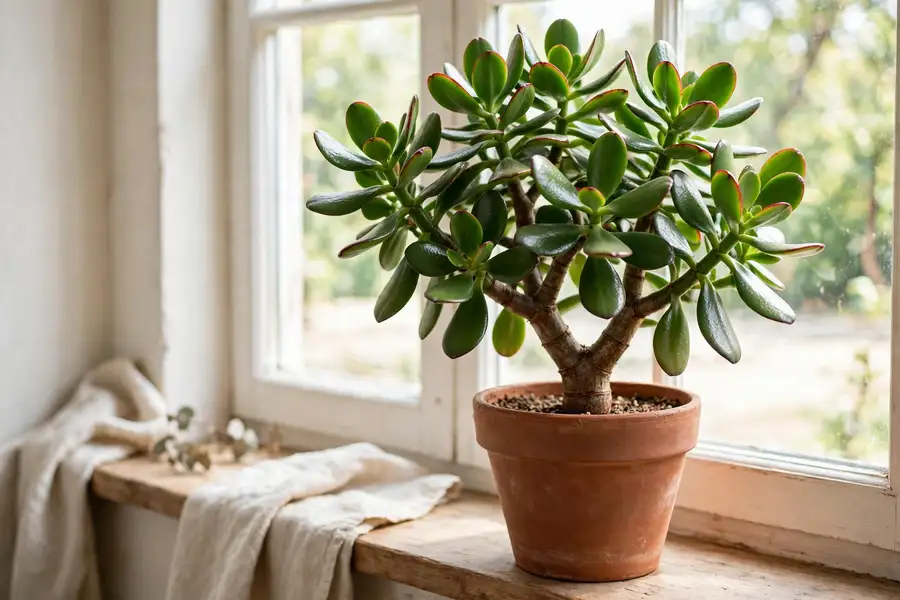
Jade plant at a glance
| Question | Answer |
|---|---|
| Scientific name | Crassula ovata (also Crassula argentea) |
| Is it a succulent? | Yes, in the stonecrop family (Crassulaceae). Native to South Africa and Mozambique |
| Light | 4 to 6 hours of bright light. Some direct sun is fine |
| Water | When soil is fully dry. Every 2 to 3 weeks in summer, monthly or less in winter |
| Soil | Cactus or succulent mix with extra perlite or pumice |
| Temperature | 65 to 75°F days, 50 to 55°F nights. Keep above 45°F, no frost |
| Humidity | Average household. No misting |
| Feeding | Half-strength fertilizer 2 or 3 times in spring and summer |
| Size | 2 to 3 ft indoors, up to 6 ft or more outdoors |
| Growth rate | Slow, a few inches a year |
| Lifespan | Decades. Old plants are passed down in families |
| Outdoors | Year-round in zones 10 to 11. Summer only elsewhere |
| Pets | Toxic to cats and dogs |
How often should you water a jade plant?
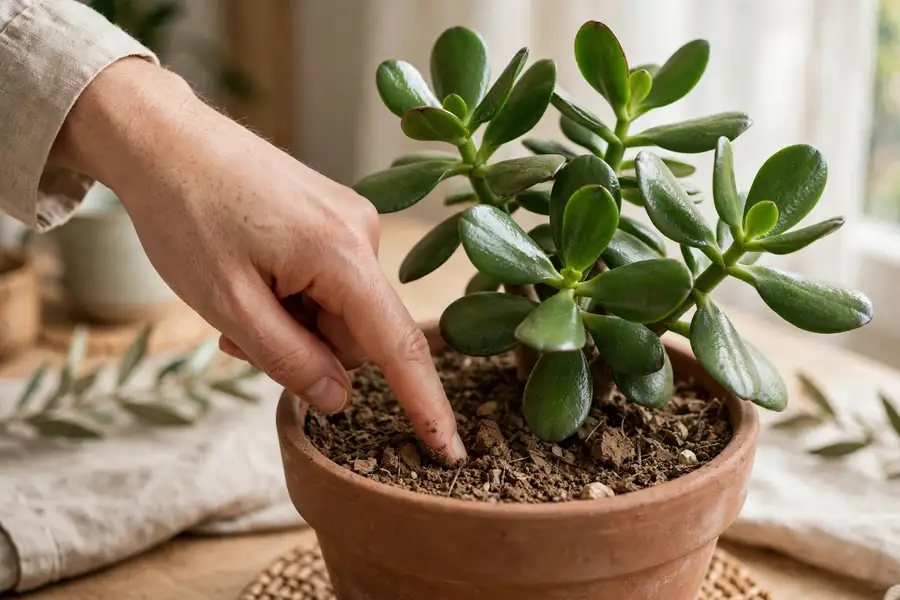
Water when the soil is completely dry all the way down. Push a finger or skewer 2 inches in. If any moisture shows, wait.
| Season | Typical schedule |
|---|---|
| Spring and summer | Every 2 to 3 weeks |
| Fall and winter | Every 4 to 6 weeks, or less |
Soak the soil until water drains out, empty the saucer, and let it dry out fully again. Small pots dry faster, large pots slower. Self-watering pots keep roots too wet. Use them only if you refill rarely.
| Sign | Overwatered | Underwatered |
|---|---|---|
| Leaves | Soft, mushy, yellow, drop at a touch | Wrinkled, shriveled, firm but thin |
| Stem | Soft or black at the base | Firm |
| Soil | Wet for days | Bone dry, pulling from the pot |
| Fix | Let dry, check roots, repot | Water thoroughly |
How much light does a jade plant need?
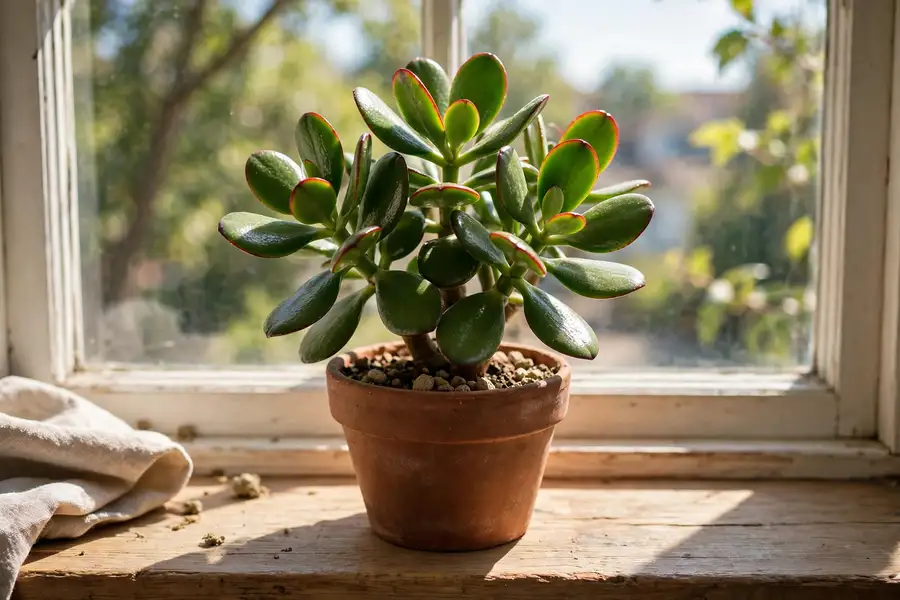
4 to 6 hours of bright light a day. A south or west window is best. Morning sun is gentle. Strong afternoon sun through glass can scorch leaves.
- Low light: stretched, leggy growth and small leaves.
- Bright light: compact growth and red leaf edges, which are healthy.
- Moving outdoors: introduce sun over 1 to 2 weeks. Sudden full sun causes sunburn, which shows as white, tan or brown patches.
- Dark rooms: add a grow light for 10 to 12 hours a day.
What soil and pot does a jade plant need?
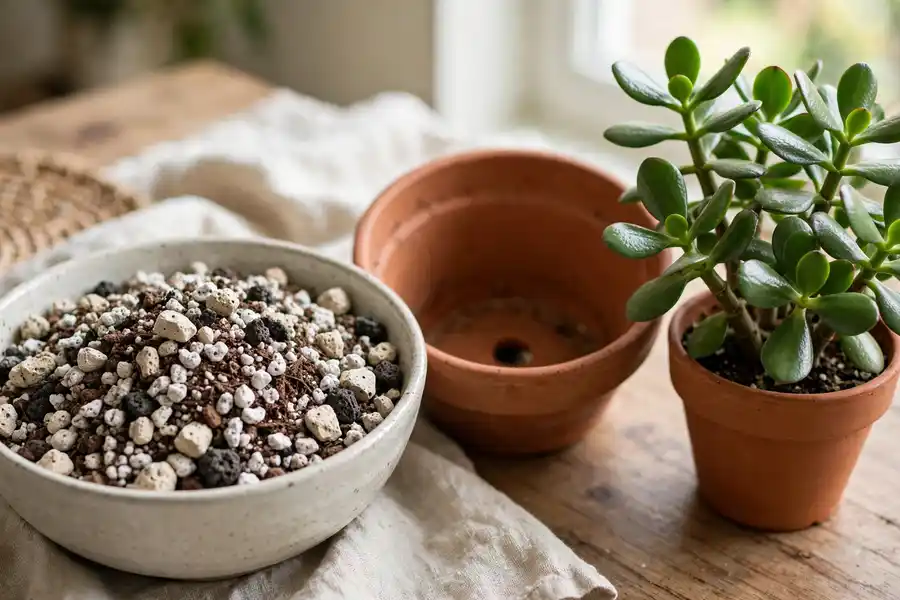
- Soil: cactus or succulent mix with extra perlite or pumice, about 2 parts mix to 1 part grit. Heavy, wet-holding soil causes root rot.
- Pot: drainage holes are a must. Terracotta dries faster and suits overwaterers. Pick a pot only 1 to 2 inches wider than the root ball.
- Weight: jade gets top-heavy. Use a heavy, stable pot.
- Root bound: jade tolerates snug roots.
How do you fertilize a jade plant?
Feed 2 or 3 times in spring and summer with a balanced or succulent fertilizer diluted to half strength. Skip fall and winter. Too much fertilizer causes weak, leggy growth.
What temperature and humidity does a jade plant like?
Average room temperatures of 65 to 75°F suit it, and cooler nights of 50 to 55°F help it flower. Anything below about 45°F damages it, and frost kills it. Average humidity is fine. Keep it away from drafts and heaters.
How do you repot a jade plant?
Repot every 2 to 3 years in spring, or when the plant tips over or roots fill the pot.
- Leave the soil dry for a few days first.
- Slide the plant out gently. Branches and leaves snap easily.
- Shake off old soil and trim any black or mushy roots.
- Set it in a pot 1 to 2 inches wider with fresh gritty mix.
- Wait about a week before watering to let root wounds heal.
How and when do you prune a jade plant?
When: spring to early summer, when it grows fastest. Any time is possible.
How:
- Use clean, sharp shears.
- Cut just above a pair of leaves. Two new branches grow from that spot, making the plant bushier.
- Remove dead, damaged or crossing branches.
- Take off no more than a third at once.
- Remove lower branches to make a tree shape.
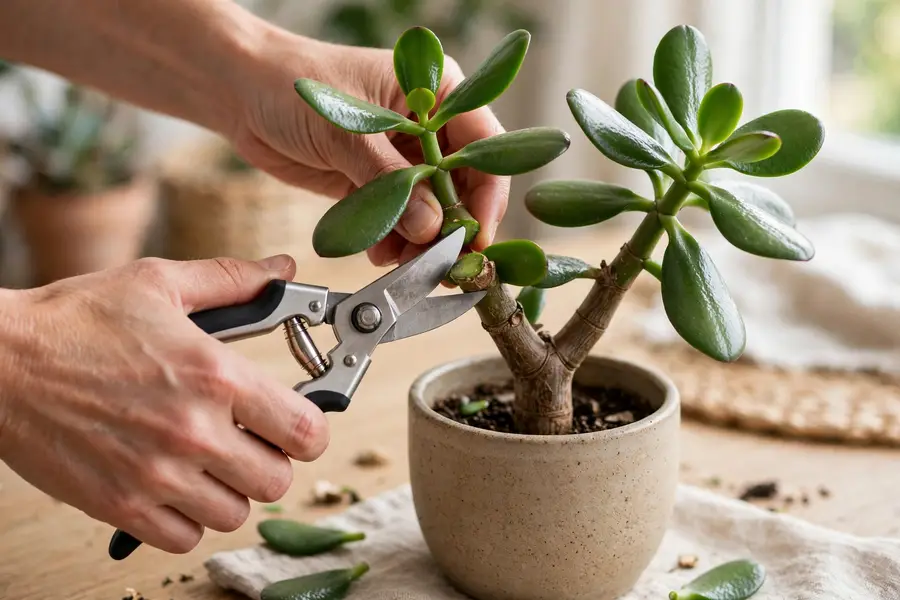
Leggy jade plant: cut stretched stems back to a leaf pair, move the plant to brighter light and root the cuttings. Making it bushy: cut branch tips so each makes two new shoots.
How do you propagate a jade plant?
Both leaves and stems root easily. Spring and summer are best.
From a stem cutting (fastest):
- Cut a 3 to 4 inch piece just below a leaf pair.
- Remove the lower leaves.
- Let the cut end dry and form a callus for a few days.
- Plant in dry, gritty succulent mix.
- Wait about a week, then water lightly. Roots form in 2 to 4 weeks.
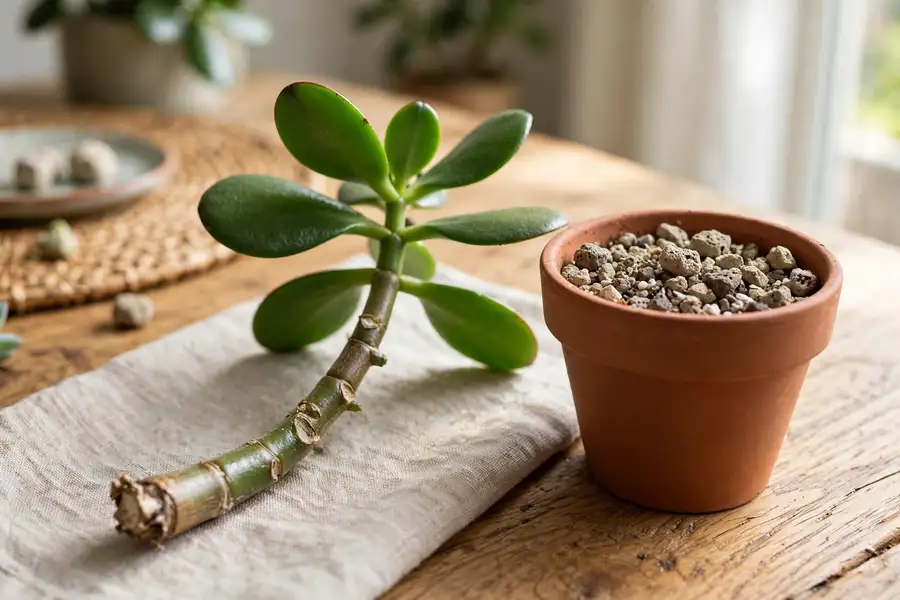
From a leaf:
- Twist off a healthy, plump leaf with its base intact.
- Let it callus for a few days.
- Lay it on top of dry succulent mix, or set the base in shallowly.
- Mist the soil lightly, not the leaf. Tiny roots and a baby plant appear in a few weeks. It takes months to grow into a small plant.
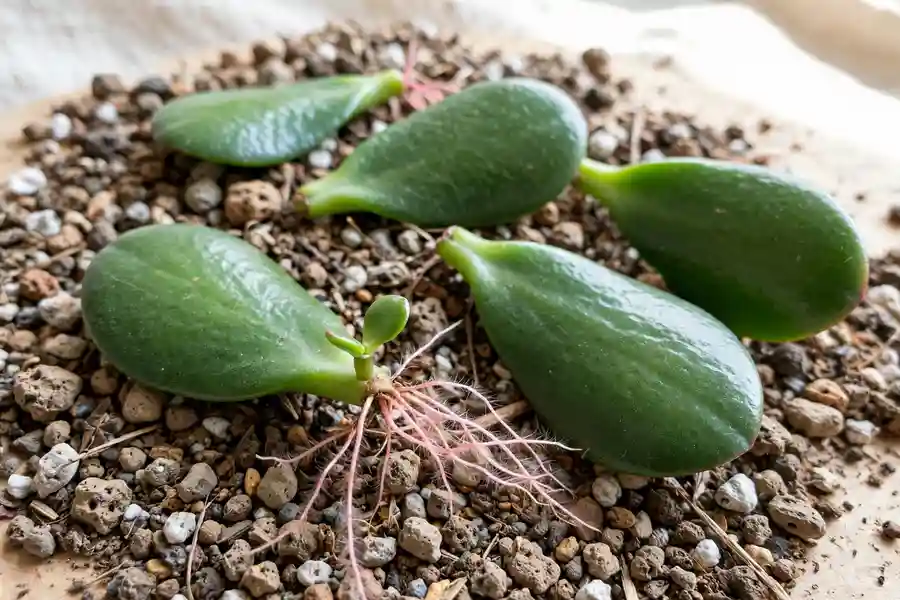
In water: possible with a callused stem cutting. Keep only the cut end touching water, change it weekly, and move the cutting to soil once roots form. Water-grown cuttings rot more easily than soil-grown ones.
Seeds are rare and slow. Cuttings are the practical route.
How do you grow a jade plant as a bonsai?
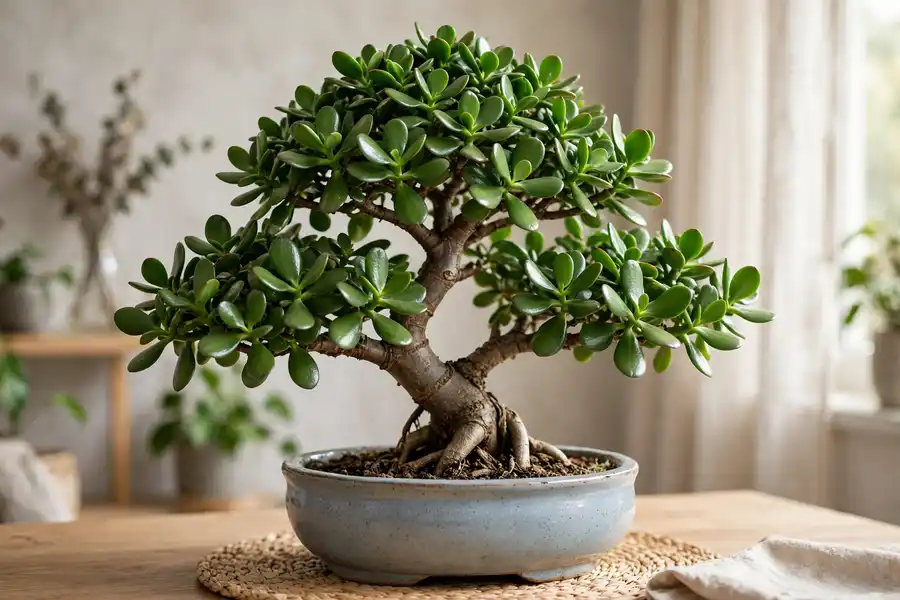
Jade is one of the easiest bonsai plants.
- Pick a plant with a thick trunk.
- Prune branch tips and remove lower leaves to show the trunk.
- Shape by pruning more than wiring, since branches are brittle.
- Repot into a shallow pot with gritty mix and trim roots lightly.
- Give bright light and water sparingly.
What are the types of jade plant?
| Type | Look |
|---|---|
| Standard jade (Crassula ovata) | Oval green leaves with red edges in bright light |
| Gollum (finger jade, ET's fingers) | Tube-shaped leaves with suction-cup tips |
| Hobbit | Smaller, curled tube leaves |
| Hummel's Sunset (sunset jade) | Golden-yellow leaves with red edges |
| Variegated, tricolor, Lemon & Lime | Cream, yellow or pink-striped leaves |
| Crosby's Compact, dwarf, mini or baby jade | Small, compact growth |
| Ripple jade | Wavy leaves. Often a related species (Crassula arborescens) |
| Silver dollar jade | Round, silvery leaves with red edges. A related species |
| Blue Bird | Blue-green leaves |
| Trailing or weeping jade | Sold names for trailing Crassula types, good for hanging pots |
| Pink jade | Sold forms with pink-tinged leaves or flowers |
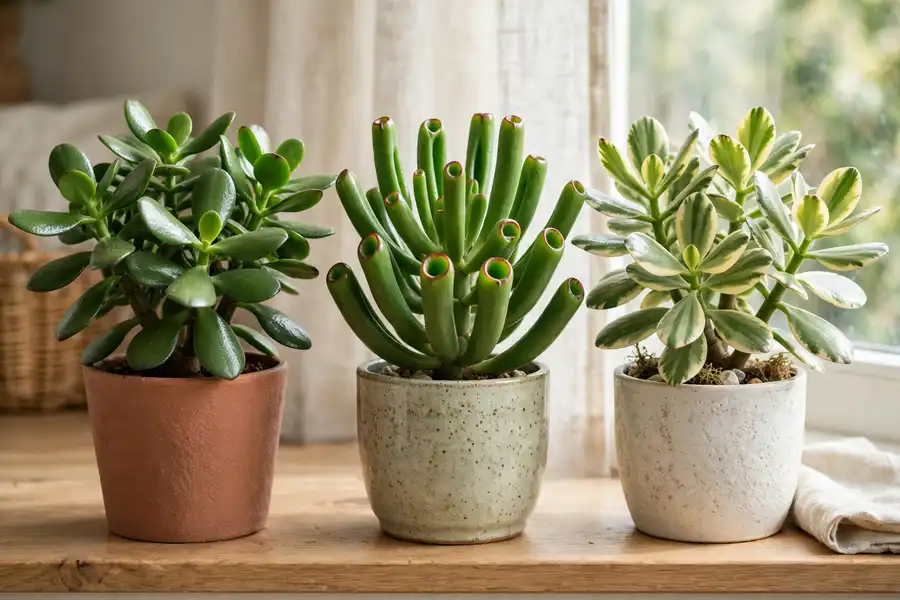
Names vary by seller, so check the Latin name.
Elephant bush vs jade plant: elephant bush (Portulacaria afra) has smaller leaves on reddish-brown stems and is often sold as "dwarf jade." It is a different plant that is usually described as safer around pets.
Plants called "jade" that are not jade plants: jade vine (a tropical climbing plant), jade pothos and "pearls and jade" pothos, jade necklace (Crassula marnieriana, a small stacked-leaf succulent) and "jade" snake plants. Money plant: a jade plant is called a money or lucky plant. The Pachira "money tree" and pothos "money plant" are different plants.
Why is my jade plant dropping leaves?
| Cause | Fix |
|---|---|
| Overwatering or root rot (most common) | Let dry fully, check roots, repot in fresh mix |
| Underwatering | Water deeply |
| Cold draft or temperatures below 45°F | Move to a warmer spot |
| Low light or a sudden move | Give bright light and let it adjust |
| Pests | Check for mealybugs and scale |
| Leaves falling at a touch | Usually overwatered |
Why are jade plant leaves wrinkled, yellow, red or spotted?
| Symptom | Cause | Fix |
|---|---|---|
| Wrinkled, shriveled | Thirst, or root rot that stops water uptake | Water if dry. If soil is wet, check roots |
| Yellow | Overwatering, poor drainage | Let dry, improve drainage |
| Red edges or tips | Bright light or cool temperatures. Healthy | None needed |
| Purple tint | Cold or sun stress | Move out of drafts, acclimate to sun |
| White spots | Hard-water minerals, powdery mildew or mealybugs | Wipe off. Mealybugs look cottony |
| Brown or black spots | Sunburn, fungal spots, or overwatering | Remove leaves, cut watering, improve airflow |
| Brown bumps | Scale insects | Scrape off, wipe with rubbing alcohol |
| Drooping | Overwatering or thirst | Check soil first |
| Falling over | Top-heavy plant, shallow roots or rot | Use a heavy pot, prune, check roots |
| Not growing | Winter rest, low light | Wait for spring, give light |
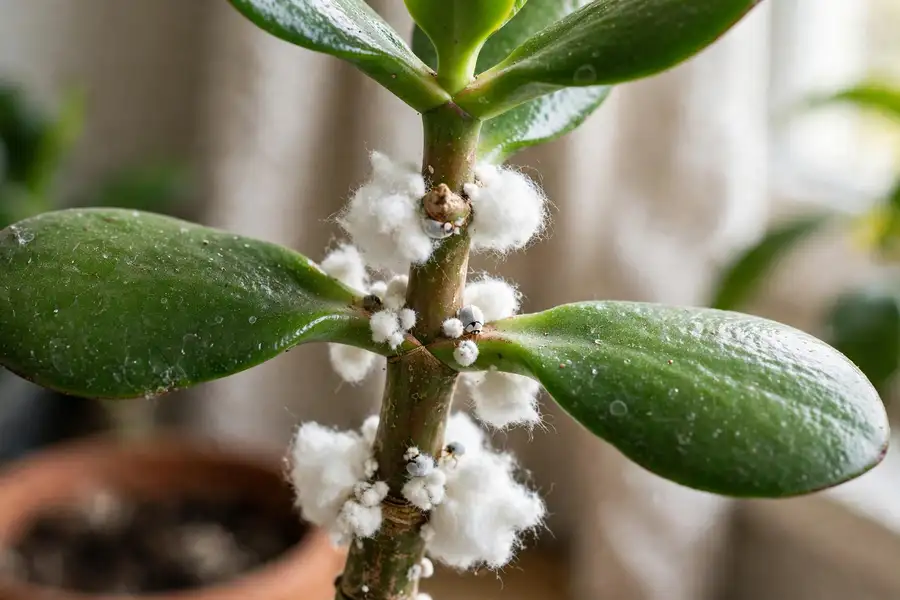
Mealybugs, scale and spider mites: dab pests with cotton soaked in rubbing alcohol, isolate the plant and repeat weekly. Root rot: unpot the plant, cut away black, mushy roots, dry the plant for a few days and repot in fresh mix.
How do you revive a dying jade plant?
- Check the soil and roots. Wet with black roots means rot. Dry with shriveled leaves means thirst.
- If rotted, cut off bad roots, let the plant dry for a few days and repot in fresh gritty mix.
- If thirsty, water deeply once and wait.
- Move to bright light and stop fertilizing.
- Root healthy stems or leaves as backup.
Does a jade plant flower?
Yes, on mature plants. Clusters of small, star-shaped white or pale pink flowers appear in late fall or winter. Cool nights, bright light and a dry rest in fall help trigger them. Young plants rarely bloom. Red-flowered "jade plants" are usually other Crassula species.
How big does a jade plant get and how long does it live?
Indoors, it reaches 2 to 3 feet, sometimes 5 feet. Outdoors in warm climates it can reach 6 feet or more with a thick trunk. It grows a few inches a year. Healthy plants live for decades, and some are reported to be 50 to 100 years old.
Can a jade plant live outside?
Yes in zones 10 to 11, in full sun to part shade. In colder areas, put it outdoors in summer and bring it in before nights fall below about 50°F. Acclimate gradually to sun. Frost kills it.
When should you plant a jade plant?
Plant or repot in spring or summer. Outdoors, plant after frost danger passes. Cuttings root best in warm weather.
Is a jade plant toxic to cats and dogs?
Yes. The ASPCA lists the jade plant as toxic to cats and dogs. Most cases cause mild stomach upset, with vomiting and diarrhea. In some pets, lethargy, wobbliness, tremors or a changed heart rate can occur. Keep it out of reach, and call your vet or the ASPCA Animal Poison Control Center at 888-426-4435 (a fee may apply) if a pet eats it. Humans can get mild stomach upset from eating it.
What does a jade plant mean and where should you put it?
The jade plant stands for luck, prosperity, friendship and growth. In feng shui it is a money plant, often placed near an entrance, on an office desk or in the southeast "wealth" area of a home, and kept out of bathrooms. It is a popular housewarming and business gift. Health or air-purifying claims are weak, so grow it for looks and meaning.
Disadvantages: toxic to pets, slow growth, prone to rot if overwatered and top-heavy as it grows.
Quick answers to common questions
How often should you water a jade plant?
When the soil is completely dry: every 2 to 3 weeks in summer, monthly or less in winter.
How much light does a jade plant need?
4 to 6 hours of bright light. A south or west window is best.
Why is my jade plant dropping leaves?
Most often overwatering and root rot. Cold, thirst, low light and pests also cause it.
How do you propagate a jade plant?
Take a stem or leaf, let it callus for a few days, set it in dry gritty mix and water lightly after a week.
Is a jade plant toxic to cats and dogs?
Yes. It usually causes vomiting and diarrhea. Call a vet if a pet eats it.
Keep reading: snake plant care, spider plant care, monstera plant and more houseplant guides.
Is a jade plant worth growing?
Yes, if you can resist watering it. A jade plant is a long-lived, low-care succulent that rewards bright light, gritty soil and neglect with years of growth and easy cuttings.