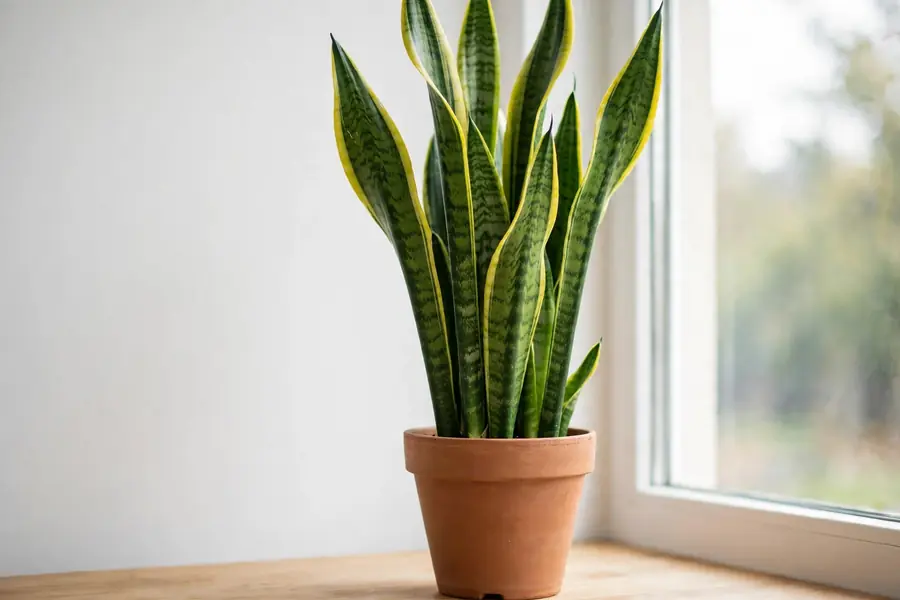
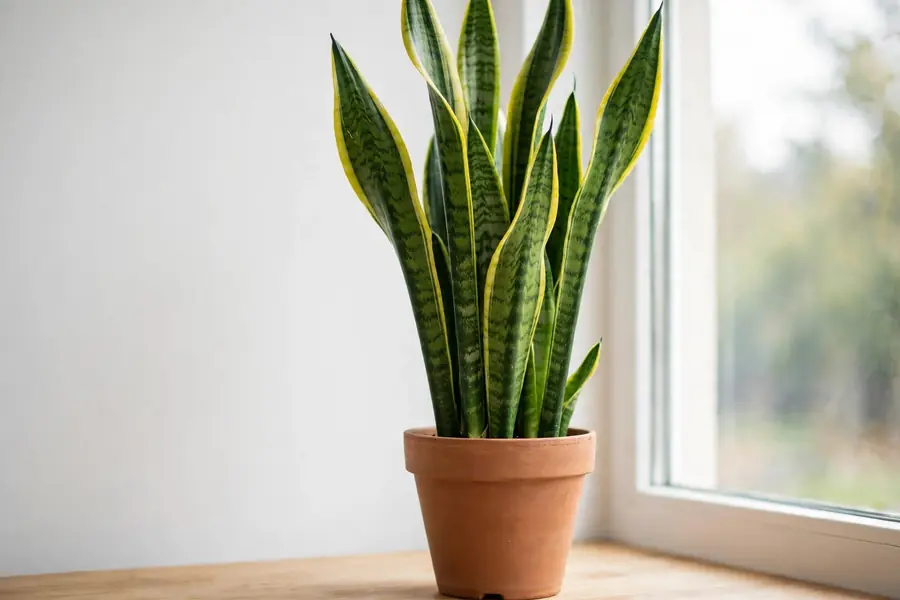
A snake plant is a tough indoor plant with stiff, upright leaves that grows well in bright indirect light, needs water only when its soil is dry, and suits a beginner who forgets to water. Its current scientific name is Dracaena trifasciata, and it was long sold as Sansevieria trifasciata. Most plants grow 1 to 4 feet tall indoors, grow slowly, and live for years with little care. One warning matters first: the ASPCA lists it as toxic to cats and dogs, so keep it out of reach of pets that chew plants.
Snake plant at a glance
| Question | Short answer |
|---|---|
| Scientific name | Dracaena trifasciata, formerly Sansevieria trifasciata |
| Other names | Mother-in-law's tongue, Saint George's sword, viper's bowstring hemp |
| Light | Bright indirect light is best; it tolerates low light and some gentle direct sun |
| Water | Only when the soil is fully dry, about every 2 to 3 weeks in summer and less in winter |
| Soil | Fast draining cactus or succulent mix in a pot with drainage holes |
| Temperature | 60 to 85 degrees Fahrenheit; keep it above 50 degrees Fahrenheit |
| Humidity | Normal room humidity is fine; it does not need misting |
| Feeding | A weak feed once or twice in spring and summer only |
| Repotting | Every 2 to 3 years, or when roots fill the pot |
| Toxic to pets? | Yes, toxic to cats and dogs. The ASPCA lists saponins as the cause of stomach upset |
| Best for | Beginners, low light rooms, bedrooms, offices, and busy owners |
What is a snake plant?
A snake plant is an evergreen perennial from West Africa with thick, sword-shaped leaves that grow up from underground rhizomes. The leaves store water, which is why it survives dry soil and missed waterings better than most houseplants. In plant terms it acts like a succulent, even though its leaves are flat and stiff rather than fleshy and round.
It is also called mother-in-law's tongue, in Spanish lengua de suegra, and older plant tags may still say Sansevieria. The name changed when botanists moved Sansevieria into Dracaena, but shops still use both names for the same plant. A plant sold as a Sansevieria, a snake plant, or a Dracaena trifasciata is the same species unless the variety name is different.
Indoors, most types reach 1 to 4 feet tall. Tall types suit a floor pot in a living room corner. Short types, such as bird's nest forms, suit a desk, shelf, or bathroom. Growth is slow to moderate, so do not expect a new leaf every week. In a bright room you will see new leaves in spring and summer. In a dim room the plant may hold still for months and still be healthy.
What are the benefits of a snake plant?
A snake plant gives you a tall, tidy plant that needs little water, fits a narrow spot, and stays green in low light. It works in a bedroom, living room, bathroom with a window, and office because it does not drop leaves, does not need high humidity, and does not need frequent feeding.
It is often sold as an air purifier. That claim needs care. NASA's Clean Air Study did test Sansevieria trifasciata in sealed chambers and found it could remove formaldehyde and benzene from the air in those test conditions. A normal room is not a sealed chamber, and one plant will not clean the air in a whole house. Treat air cleaning as a small bonus, not a reason to buy it for health.
Some people keep it in a bedroom because it uses CAM photosynthesis and can release oxygen at night, unlike most plants. That is true in a limited sense, but the amount from one plant is small. The real bedroom benefit is simpler: it is quiet, tidy, and hard to kill.
In feng shui and in folk belief, a snake plant is linked with protection and good luck, and some people place it near a door or in a living room for that reason. That is a belief, not a proven effect. If you like the look and the story, place it where it gets light and where pets cannot chew it. If you want a plant purely for luck, the care rules in this guide still apply.
It also has limits. It is not a pet-safe plant, it does not like cold rooms, and it will rot if it sits in wet soil. Those three limits decide whether it is right for your home more than any benefit claim does.
Which snake plant variety should you pick?
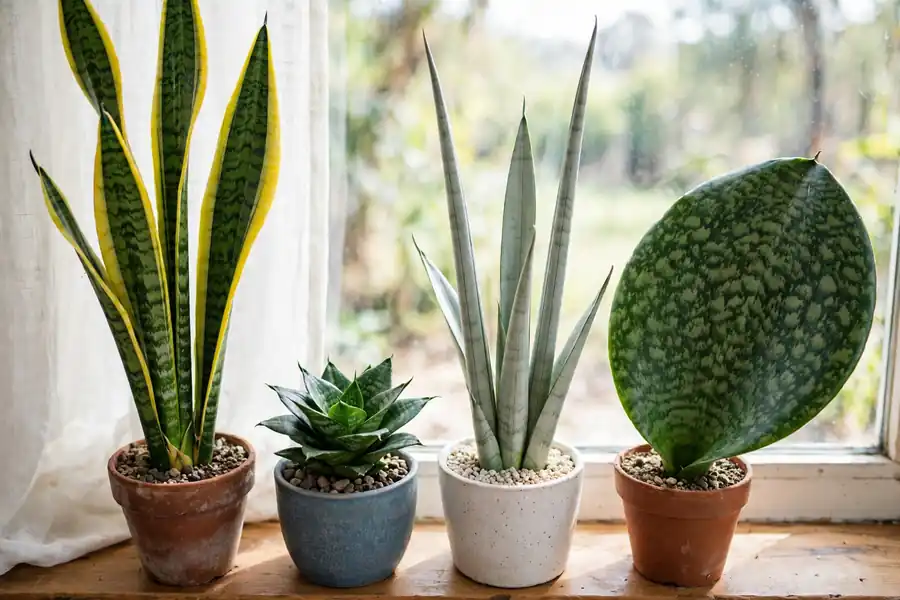
Pick by size and light, not by name alone. Tall types need a floor pot. Short types need a small pot and suit a table. Variegated types, with yellow or cream edges, need more light than plain green types to hold their color.
| Variety | Look and size | Best spot |
|---|---|---|
| Laurentii | Tall, green leaves with yellow edges, 2 to 4 feet | Floor pot in bright indirect light |
| Moonshine | Tall, pale silvery green leaves, 1 to 2 feet | Bright room, modern living room or bedroom |
| Whale Fin, also called Masoniana | One or a few very wide leaves, up to 3 feet | Large pot, bright indirect light |
| Bird's Nest, also called Hahnii | Short rosette, 6 to 12 inches | Desk, shelf, small pot |
| Golden Hahnii | Short rosette with yellow edges, 6 to 8 inches | Small pot in bright light |
| Cylindrical, also called Cylindrica | Round, spear-like leaves, 1 to 3 feet | Bright room, narrow pot |
| Starfish, also called Boncel | Short, fan-shaped leaves, 6 to 12 inches | Small pot, bright light |
| Fernwood | Thin, arching green leaves, 1 to 2 feet | Table or floor pot |
| Zeylanica | Tall, dark green leaves with wavy bands, 2 to 3 feet | Floor pot, tolerates lower light than Laurentii |
| Black Coral | Tall, dark green leaves with light bands, 2 to 3 feet | Floor pot in bright indirect light |
| Black Gold | Tall, dark green leaves with gold edges, 2 to 3 feet | Floor pot in bright light |
| Variegated types in general | Mixed green, yellow, cream, or white leaves | Bright indirect light; color fades in low light |
| Dwarf types, including Samurai | Very short, thick leaves, 4 to 8 inches | Small pot, desk, shelf |
Rare and named types, such as Black Dragon, Whitney, Sayuri, Twisted Sister, and Spiral forms, follow the same care rules as the types above. Price and size vary more than care does. A rare name does not mean a different watering schedule.
How much light does a snake plant need?
A snake plant needs bright indirect light for best growth, but it will survive in low light. That gap between survive and thrive is the main light rule to learn.
Place it near an east window, or a few feet back from a south or west window with a sheer curtain. It can take a few hours of gentle morning sun. Harsh midday sun through glass can bleach or scorch leaves, so move it back if pale patches appear.
In low light, growth slows, new leaves are smaller, and yellow edges on variegated types fade toward green. That does not mean the plant is dying. It means it is waiting for more light. Move it to a brighter spot and growth should restart in spring.
In a room with no window, such as a windowless bathroom or office, a snake plant will last longer than most plants, but it will not grow well. If you must use a dark room, give it a grow light for part of the day, or rotate it to a bright room for a few weeks at a time.
Outside, it can take bright light if you move it out in steps over a week or two. A sudden move from indoors to full sun can scorch leaves. Indoors, it does not need direct sun to flower or to stay healthy.
How often should you water a snake plant?
Water a snake plant only when its soil is dry all the way down, not just dry on top. Push a finger 2 inches into the soil, or lift the pot to feel its weight. If the soil is still damp, wait.
| Season and spot | Typical gap between waterings |
|---|---|
| Summer, bright room | Every 2 to 3 weeks |
| Summer, low light room | Every 3 to 4 weeks |
| Winter, heated home | Every 4 to 6 weeks |
| Winter, cool room | Every 6 weeks or more, only when fully dry |
These are guides, not a fixed calendar. A small pot in a warm room dries faster than a large pot in a cool room. A plant in a plastic pot dries slower than the same plant in terracotta.
To water, soak the soil until water runs from the drainage holes, then empty the saucer. Do not leave the pot standing in water. Water in the morning so excess moisture does not sit cold overnight. In winter, water even less, because growth slows and soil stays wet longer.
Signs help more than a calendar. A plant that needs water may have wrinkled or slightly curled leaves and very dry soil. A plant that has had too much water may have yellow, soft, or mushy leaves at the base. When in doubt, wait a few more days. Underwatering is easier to fix than root rot.
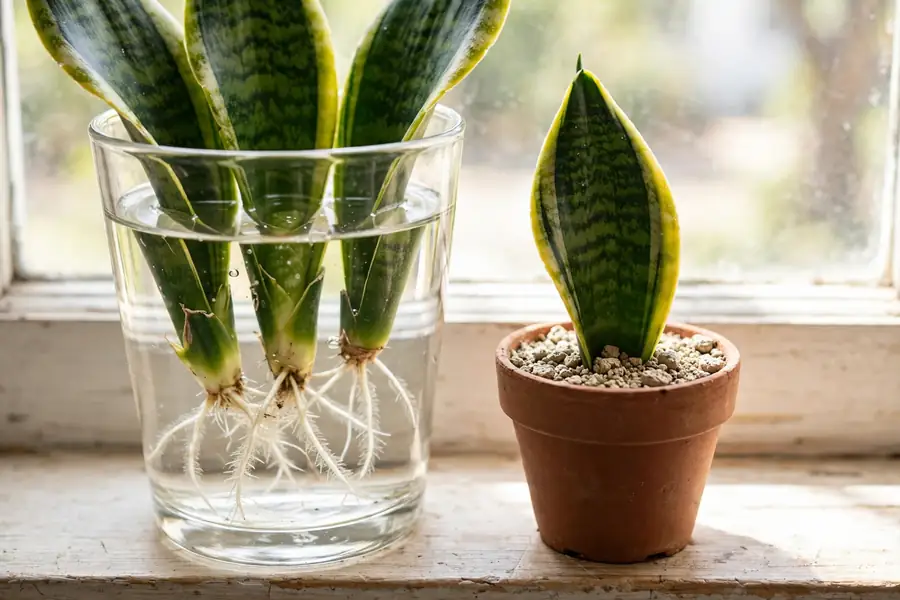
A snake plant can grow in water for months if you change the water weekly, but long-term health is better in soil. If you keep cuttings in water, move them to soil once roots are 1 to 2 inches long, so the roots can adapt to a drier mix.
What is the best soil and pot for a snake plant?
The best soil for a snake plant is a fast draining mix that lets water pass through and does not stay soggy. A bagged cactus or succulent mix works well on its own. You can also mix 2 parts regular potting soil with 1 part perlite and 1 part coarse sand or pumice. That mix holds enough moisture for roots and still drains fast.
Can you use succulent soil for a snake plant? Yes. That is one of the best choices, because snake plants store water in their leaves and roots and rot in heavy soil. Plain garden soil is too dense. A mix made only of peat or compost holds too much water on its own, though a small amount of finished compost can be part of a gritty mix. For how to make compost at home, see How to Compost.
The pot matters as much as the soil. Use a pot with drainage holes. Terracotta dries faster and suits a person who tends to overwater. Plastic holds moisture longer and suits a warm, dry room. A heavy pot also helps a tall plant stay upright and resist a knock from a pet or child.
Pot size should be snug. Pick a pot only 1 to 2 inches wider than the current pot. A pot that is too large holds wet soil around the roots for too long. Snake plants grow well when slightly root bound, so do not rush to a large pot.
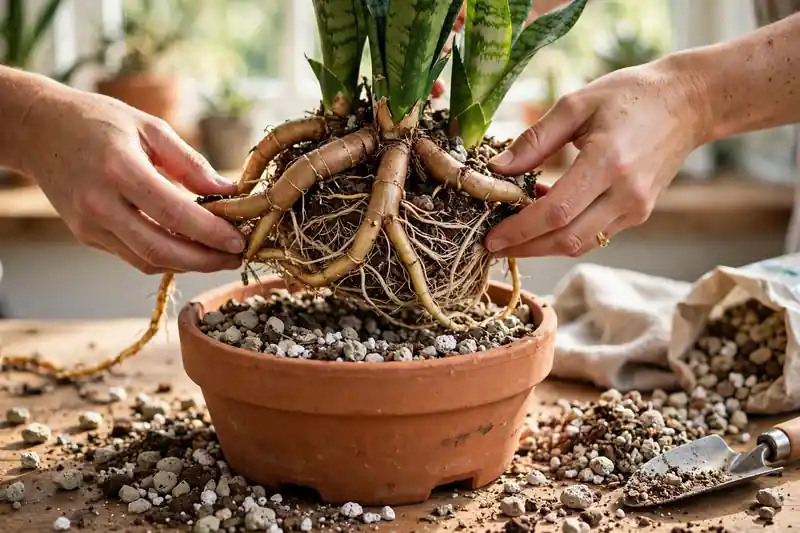
Healthy roots are firm, pale, and thick, with rhizomes that look like short underground stems. Soft, dark, or mushy roots point to rot. If you find rot during repotting, cut the soft parts off with a clean knife, let the cuts dry for a day, and replant in fresh dry mix.
How do you propagate a snake plant?
You can propagate a snake plant by division, by pups, or by leaf cuttings in water or soil. Division is fastest and keeps the parent plant's look. Leaf cuttings are slower and cheaper, because one leaf can make many plants.
| Method | Speed | Keeps variegation? | Best for |
|---|---|---|---|
| Division and pups | Instant new plants | Yes | Mature, crowded plants |
| Leaf cuttings in water | Roots in 4 to 8 weeks, pups in 2 to 3 months | No, often reverts to green | Watching roots grow |
| Leaf cuttings in soil | Roots in 6 to 10 weeks, pups in 2 to 6 months | No, often reverts to green | Sturdy roots, no move from water to soil |
Propagate by division
- Water the plant a day before, so it slides out of the pot with less stress.
- Tip the plant out and shake off loose soil until you can see the rhizomes.
- Find natural groups of leaves with their own roots. Tease them apart by hand, or cut a thick rhizome with a clean knife.
- Give each new section at least one leaf group and some roots.
- Pot each section at the same depth as before, in fresh gritty mix.
- Water lightly, place it in bright indirect light, and resume normal care after 2 weeks.
Pups are small side shoots that grow from the rhizome. Wait until a pup has its own roots and a few leaves before you separate it. A rootless pup should stay attached to the parent until roots form.
Propagate by leaf cuttings in water
- Cut a healthy leaf near the base with clean scissors or a knife.
- Cut the leaf into 3 to 4 inch sections. Mark the bottom end, the end that was near the soil. Upside down sections will not root.
- Let the cut ends dry for 1 to 2 days until they callus over. This step cuts the risk of rot.
- Stand the bottom end in a jar with 1 inch of water. Keep the jar in bright indirect light.
- Change the water weekly.
- Move the cutting to soil when roots are 1 to 2 inches long. Long water roots can be brittle and may struggle in dry soil.
Propagate by leaf cuttings in soil
- Cut and callus the leaf sections as above.
- Plant the bottom end about 1 inch deep in gritty cactus or succulent mix.
- Keep the soil lightly moist, not wet, while roots form.
- Place the pot in bright indirect light and warm air, about 65 to 80 degrees Fahrenheit.
- Wait. A firm cutting that has not rotted is still working, even if you see no growth for weeks. New pups often appear in 2 to 6 months.
One rule saves disappointment: leaf cuttings from a variegated plant, such as Laurentii with yellow edges, usually grow back plain green. The yellow edge is a chimera pattern in the parent tissue, and leaf pieces do not carry it. If you want to keep yellow edges, use division or pups.
You can also propagate from a single leaf, from a leaf tip, or from rhizome pieces, but the three methods above cover most home needs. Do not strip a weak plant of all its leaves to make cuttings. Leave enough healthy leaves for the parent to recover.
How do you repot a snake plant?
Repot a snake plant every 2 to 3 years, in spring, or sooner if roots push out of the drainage holes, crack a pot, or fill the pot so water runs straight through. A plant that is slightly root bound is normal. Repotting is not a yearly job.
- Water a day before, so the root ball holds together.
- Tip the plant out and shake off old soil. Check the roots. Cut off soft, dark, or mushy roots.
- Pick a pot 1 to 2 inches wider than the old pot, with drainage holes.
- Add fresh gritty mix, set the plant at the same depth as before, and fill around the roots. Do not bury leaves deeper than they were.
- Water lightly, then wait until the soil is dry before you water again. This pause lets cut roots callus and cuts the risk of rot.
If you want more plants, repotting is the best time to divide. If you want one large plant, keep the groups together in the new pot. After repotting, keep the plant in bright indirect light and out of cold drafts for 2 weeks.
How do you care for a snake plant indoors?
Indoor care is mostly light, water, and temperature. The rest is light touch.
Keep the temperature between 60 and 85 degrees Fahrenheit for growth. It can cope with a short spell near 50 degrees Fahrenheit if the soil is dry, but frost will kill it. Keep it away from cold drafts, radiators, and air vents that blast hot or cold air.
Normal room humidity, about 30 to 50 percent, is fine. It does not need misting, a pebble tray, or a humidifier. Misting can trap water at leaf bases and raise the risk of rot.
Feed only in spring and summer. Use a balanced houseplant feed at half strength, once a month at most, or once or twice in the whole season. Overfeeding can burn roots and cause brown tips. Coffee grounds are not a good feed for a snake plant. They hold moisture, can mold on the surface, and add nothing the plant needs in a gritty mix. Skip feeding in fall and winter, and skip feeding a new cutting until you see new growth.
In a bedroom, place it near a window with bright indirect light and out of reach of pets. In a bathroom, it works only if the bathroom has a window or good light. A dark bathroom will keep it alive for a while, but growth will stop. In a living room or office, a tall type makes a good corner plant because it takes little floor space for its height.
Clean the leaves now and then with a damp cloth, so dust does not block light. Trim only damaged leaves. Cut a damaged leaf at the base with clean scissors. You can also trim a tall leaf that flops over, but do not cut healthy leaves for shape alone. Pruning does not make a snake plant bushy, because new leaves grow from the base, not from cut tips.
Winter care is simple: water less, stop feeding, and keep it warm. If growth stops in winter, that is normal. Resume normal care in spring.
Can a snake plant live outside?
A snake plant can live outside in warm climates, in USDA zones 9 to 12, where frost is rare. In cooler areas, treat it as a houseplant and move it outside only in summer.
Outside, give it bright light with some shade from harsh midday sun. Move it out in steps over a week or two, so leaves do not scorch. Water only when the soil is dry, just as indoors. Rain can keep soil wet for days, so a pot with drainage and a gritty mix matters even more outside.
Bring it back inside before night temperatures fall below 50 degrees Fahrenheit. Cold damage shows as black or mushy patches on leaves. If cold damage is small, cut the damaged leaves at the base and keep the plant warm and dry. If the whole base is mushy, the plant may not recover, but firm leaves can still be used as cuttings.
Why does a snake plant flower, and what should you do?
A snake plant flower is rare indoors, and it is not a sign of trouble. A mature, slightly root bound plant in bright light may send up a tall stalk with small white or greenish flowers. The flowers are fragrant, most strongly at night, and they may drip sticky nectar.
Flowering is linked with maturity, bright light, and mild stress, such as being root bound or slightly dry. It does not mean the plant is dying, and it does not mean you did something wrong. Some growers see a bloom as a sign the plant is settled and mature.
You can leave the flower stalk until it fades, then cut it at the base. If nectar drips on furniture, place a tray under the pot or cut the stalk early. Flowering does not harm the plant, and the plant will keep growing after the bloom fades.
Is a snake plant toxic to cats and dogs?
Yes. A snake plant is toxic to cats and dogs, and it is not safe for pets that chew plants. The ASPCA lists Sansevieria trifasciata, the older name for Dracaena trifasciata, as toxic to cats and dogs. The cause is saponins in the leaves.
If a cat or dog chews a leaf, watch for drooling, nausea, vomiting, diarrhea, loss of appetite, or low energy. Most cases are mild and settle with vet care, but do not wait if vomiting or diarrhea keeps going, if there is blood, or if a small pet seems weak. Remove the plant, note how much was eaten, and call your vet or the ASPCA Animal Poison Control Center. Do not make a pet vomit unless a vet tells you to.
This risk applies to all varieties, including Moonshine, Laurentii, and Whale Fin, and to flowers as well as leaves. A cat licking a leaf may still get stomach upset, even if it does not swallow a large piece. For people, the risk is lower. Chewing a leaf can cause nausea and mouth irritation, so keep it away from small children who put things in their mouths.
Safe placement helps. Put the plant on a high shelf or stand that a cat cannot reach, in a room pets do not enter, or behind a door that stays shut. A heavy pot also stops a knocked-over plant from becoming a chew session on the floor. If your cat or dog chews plants often, skip a snake plant and pick a pet-safe plant instead, such as a spider plant or a rattlesnake plant, which is a Calathea type with a similar patterned look.
A faux or artificial snake plant is an option if you want the look with no pet risk. A good fake plant looks tidy from a distance, needs no water, and works in a dark room. It will not grow, clean air, or flower, and cheap fakes can look flat up close. Check the leaves and pot before you buy, and keep it clean so dust does not dull it.
Why is my snake plant turning yellow, drooping, or curling?
Most snake plant problems trace back to water, light, or cold. Use the table to match the sign to the likely cause, then fix one thing at a time.
| Problem | Likely cause | What to do |
|---|---|---|
| Leaves turning yellow | Too much water, poor drainage, or root rot | Let soil dry fully, check drainage, cut soft roots, replant in fresh gritty mix |
| Yellow leaves with soft base | Root rot from wet soil | Cut mushy parts, let cuts dry a day, replant in dry mix, water lightly |
| Leaves drooping or falling over | Overwatering, root rot, or a pot that is too large | Check roots, repot into a snug pot with drainage, stake tall leaves for a few weeks |
| Leaves curling or curling inward | Underwatering, low light, or cold drafts | Water when soil is dry, move to brighter light, move away from cold air |
| Brown tips or brown spots | Overfeeding, dry air, cold damage, or inconsistent watering | Stop feeding, water only when dry, keep it warm, trim brown tips at an angle |
| Wrinkled leaves | Underwatering or roots that cannot take up water | Soak once, then return to dry-between-watering care; check roots if it does not improve |
| Plant not growing | Low light, winter rest, or a pot that is too large | Move to brighter light, wait for spring, do not repot into a much larger pot |
| Plant dying or mushy at base | Severe root rot or frost | Save firm leaves as cuttings; discard mushy base and soil |
To revive a struggling plant, start with the base. If the base is firm, the plant can usually recover with dry soil, bright indirect light, and warm air. If the base is soft and mushy, cut away all soft tissue and use firm leaves for cuttings. A healthy plant has firm, upright leaves and firm, pale roots. An unhealthy plant has soft, yellow, or drooping leaves and dark, mushy roots.
Overwatered and underwatered plants can look alike at first, because both may droop. Check the soil to tell them apart. Wet soil with soft leaves points to overwatering. Bone dry soil with wrinkled leaves points to underwatering.
How do you buy a snake plant?
Buy a snake plant by size, health, and spot, not by a brand name. A small plant in a 4 inch pot suits a desk. A medium plant in a 6 to 10 inch pot suits a table or floor corner. A large or tall plant in a 10 to 14 inch pot suits a living room floor.
Prices vary by size, variety, and shop, and they change by region. As a rough guide in the United States in 2026, small plants often cost about 10 to 25 dollars, medium plants about 25 to 50 dollars, and large plants about 50 to 100 dollars or more. Rare varieties and very large plants cost more. Check the price at the shop near you before you budget, because a named variety or a large pot can push the price above these ranges.
Check the plant before you buy. Pick firm, upright leaves with no soft spots, yellow patches, or mushy base. Check under the leaves for pests and check the soil for a sour smell or standing water. A plant with roots growing out of the drainage holes is root bound, but that is not a defect for a snake plant. It just means you should repot it soon.
For a "near me" search, look at local garden centers, nurseries, and plant shops first. They can tell you the variety, the pot size, and the light it had. Large home and garden stores also stock common types, such as Laurentii and Moonshine, but stock varies by store and season. Online sellers and delivery can work for common types, but check the return policy for cold damage in winter and heat damage in summer.
A real plant grows, can be propagated, and may flower. A faux plant needs no care and works in a dark room, but it will not grow. If you are buying for a pet home, a dark room, or a spot you will not tend, a faux plant may be the honest choice. If you want a living plant, buy the size that fits your spot, not the largest plant in the shop.
Quick answers to common questions
How often should you water a snake plant?
Water only when the soil is fully dry. That is about every 2 to 3 weeks in summer and every 4 to 6 weeks in winter, with longer gaps in low light or cool rooms.
Is a snake plant toxic to cats and dogs?
Yes. The ASPCA lists it as toxic to cats and dogs because saponins cause vomiting, diarrhea, and drooling. Keep it out of reach of pets that chew plants, and call a vet if symptoms keep going.
How do you propagate a snake plant?
Divide a mature plant or separate pups for instant new plants that keep variegation. Leaf cuttings in water or soil also work, but they are slower and variegated types often grow back green.
How much light does a snake plant need?
Bright indirect light is best. It tolerates low light and some gentle direct sun, but growth slows in low light and harsh midday sun can scorch leaves.
Why is my snake plant turning yellow?
Yellow leaves most often mean too much water or poor drainage. Let the soil dry fully, check that the pot drains, and cut away any soft, mushy roots before you replant in fresh gritty mix.
Is a snake plant worth it?
A snake plant is worth it if you want a tidy, low care indoor plant for a bright room, a bedroom, or an office, and you can keep it out of reach of pets that chew plants. It forgives missed waterings, fits a narrow spot, and stays green with little feeding or repotting.
Skip it, or pick a faux plant or a pet-safe plant instead, if your cat or dog chews leaves often, if your only spot is cold or has no light at all, or if you want a fast growing plant that fills a room in one season. For most other homes, it is one of the easiest houseplants to keep alive, and the care in this guide is enough to keep it healthy for years.