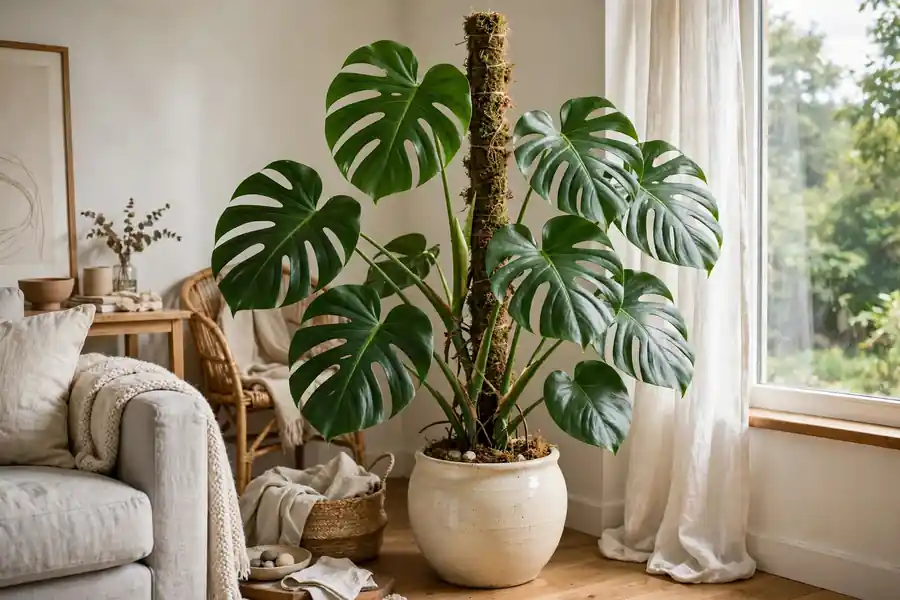
A monstera plant is a fast-growing tropical climber with big, glossy, heart-shaped leaves that develop deep splits and holes as the plant matures. It grows best in bright indirect light, needs water when the top couple of inches of soil are dry and benefits from a pole or trellis to climb. The most common type is Monstera deliciosa, also called the Swiss cheese plant. It is easy to grow, easy to propagate from stem cuttings and toxic to cats and dogs if chewed.
Monsteras are popular because a single healthy plant makes a room look like a jungle. They are also forgiving. Most problems, like yellow leaves, brown edges and leaves without holes, trace back to water, light or plant age. This guide covers what a monstera is, the main types, how to care for one, how to repot, prune, support and propagate it, how to fix common problems, and whether it is safe for pets.
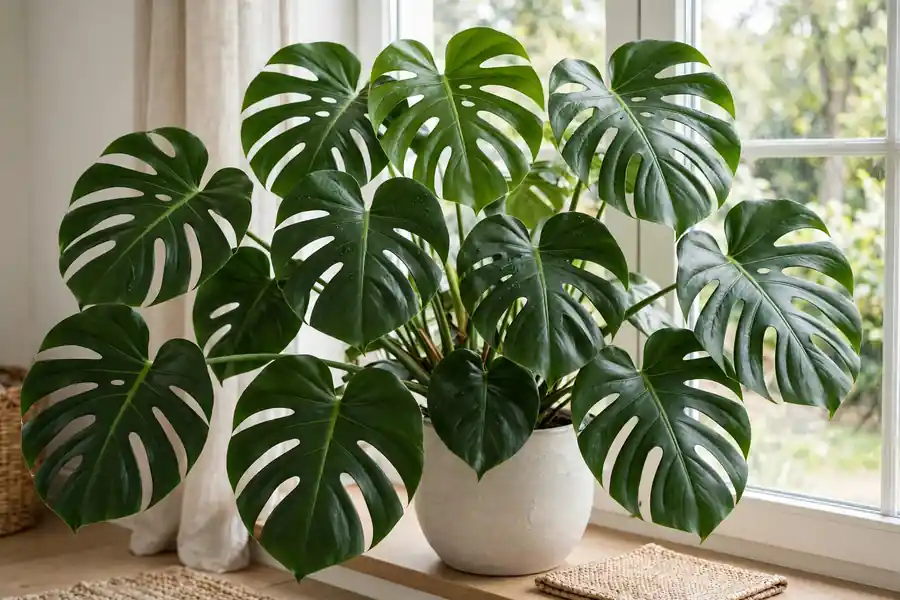
Monstera plant at a glance
| Question | Short answer |
|---|---|
| Common name | Monstera, Swiss cheese plant, split-leaf philodendron |
| Scientific name | Monstera deliciosa (the most common type) |
| Family | Arum family (Araceae), related to philodendron, pothos and peace lily |
| Light | Bright indirect light. Tolerates medium light but grows slowly and splits less |
| Water | When the top 2 inches of soil are dry, about every 1 to 2 weeks |
| Soil | Chunky, well-draining mix: potting soil with perlite and bark |
| Temperature | About 65 to 85°F. Keep it above 55°F |
| Humidity | Average to moderately humid. Appreciates 40 to 60 percent |
| Feeding | Balanced fertilizer about monthly in spring and summer |
| Size | 3 to 8 feet indoors with support. Much larger outdoors in the tropics |
| Support | A moss pole, trellis or stake helps leaves grow bigger |
| Pet safety | Toxic to cats and dogs (mouth irritation, drooling, vomiting) |
| Biggest problems | Yellow leaves from overwatering, no splits from low light or youth, brown edges from dry air |
| Difficulty | Easy |
What is a monstera plant?
A monstera plant is a tropical vine in the genus Monstera, in the arum family (Araceae). The best known is Monstera deliciosa, which is native to the rainforests of southern Mexico and Central America, where it climbs trees using aerial roots and grows leaves up to three feet wide. The name "monstera" is often linked to the Latin word for "monstrous" or "abnormal," a nod to its oversized, oddly cut leaves.
In nature, a monstera starts on the forest floor with small, heart-shaped leaves, then climbs toward the light. As it climbs and matures, the leaves get bigger and develop their famous splits and holes. Indoors, you can imitate this by giving the plant bright light and something to climb.
What does a monstera plant look like?
- Leaves: large, glossy, dark green and heart-shaped. Young leaves are solid. Mature leaves have deep splits along the edges and oval holes near the center.
- Stems: thick, climbing and woody with visible joints called nodes.
- Aerial roots: brown, rope-like roots that grow from the nodes and reach for support or the soil.
- Flowers and fruit: only on mature plants and rare indoors (see below).
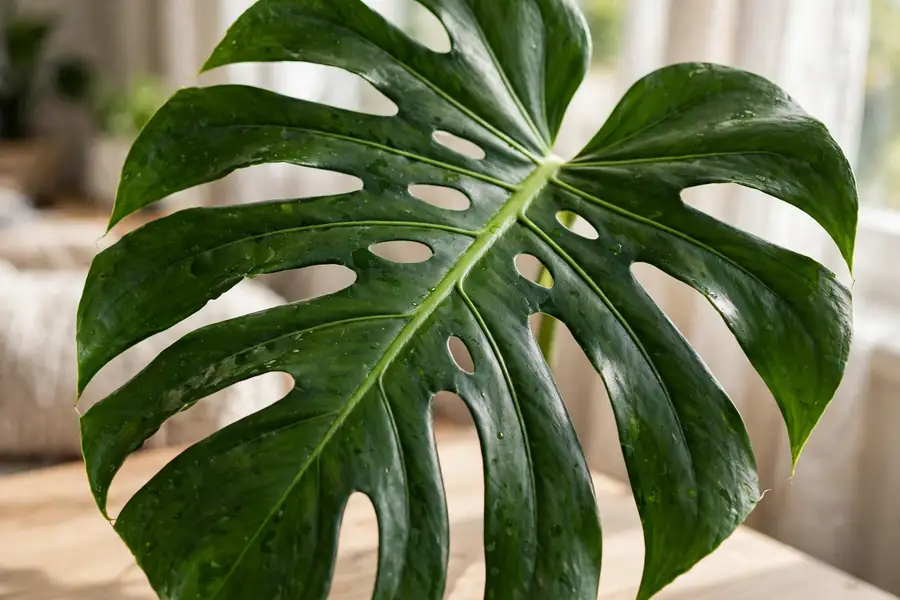
Is a monstera a philodendron? They are close relatives in the same family, and Monstera deliciosa is often sold as "split-leaf philodendron." But monstera and philodendron are different genera. Monsteras usually have splits and holes in their leaves. Most philodendrons do not. A different plant, sometimes also called split-leaf philodendron, is a self-heading tree philodendron with deeply lobed leaves but no holes.
What colors is a monstera plant? The standard monstera is green. Variegated types have white or cream patches (see types below). Plants advertised as pink, red, golden, silver or black monsteras are often not true monsteras or are heavily marketed variegated plants, so check the Latin name before you buy.
What are the main types of monstera?
There are about 50 species in the genus, but a handful are common in homes.
| Type | What it looks like | Notes |
|---|---|---|
| Monstera deliciosa (Swiss cheese plant) | Large heart-shaped leaves with splits and holes | The classic and the easiest to find |
| Monstera adansonii (Swiss cheese vine, monkey leaf) | Smaller leaves with many oval holes, a trailing or climbing vine | Good for hanging baskets and shelves |
| Thai Constellation | A variegated Monstera deliciosa with cream flecks on the leaves | Variegation is stable because the plant is a lab-grown cultivar |
| Monstera albo (albo variegata) | Green leaves with large white patches | The white parts have no chlorophyll, so growth is slower and the plant needs bright light. Variegation can revert |
| Monstera Peru (karstenianum) | Small, thick, deeply textured dark green leaves with no splits | Sources disagree on its exact identity, so treat the name loosely |
| Monstera esqueleto (epipremnoides) | Leaves with many large, uniform holes along the midrib | Botanical name and look vary by seller |
| Monstera obliqua | Leaves with more hole than leaf | Very delicate, a challenge indoors |
| Monstera dubia | A creeping plant with flat, silvery juvenile leaves that change when it climbs | A shingling climber |
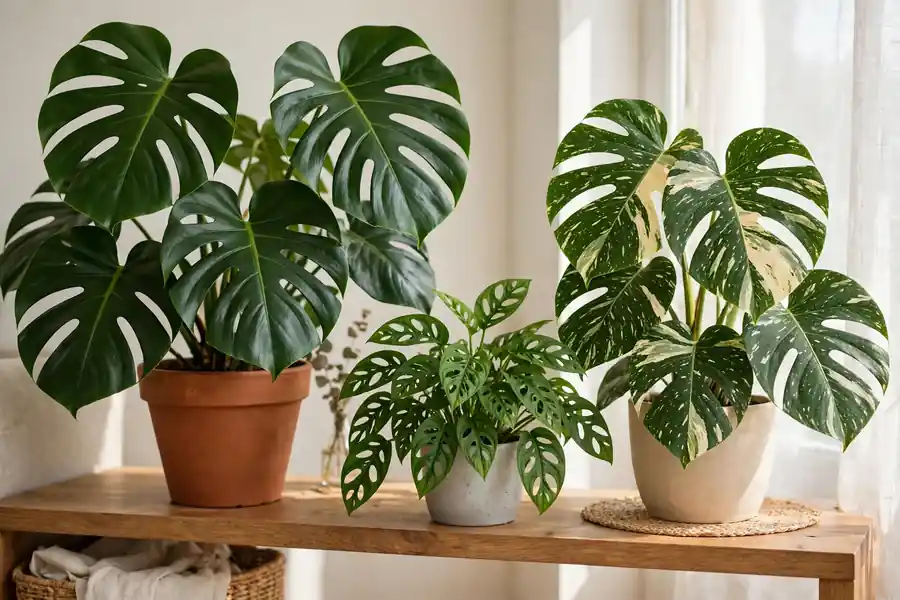
What is a mini monstera? Plants sold as mini monstera or Monstera minima are usually Rhaphidophora tetrasperma, a different genus in the same family. It looks like a smaller monstera with split leaves, grows well in pots and needs the same type of care. True monsteras also have smaller types, such as adansonii.
Swiss cheese plant vs monstera: "Swiss cheese plant" is a common name for Monstera deliciosa, and sometimes for Monstera adansonii as well. So a Swiss cheese plant is a monstera. If you want to tell them apart, deliciosa has big leaves with deep splits on the edges, while adansonii has smaller leaves with holes and a solid edge.
What plants look like a monstera? Philodendron (split-leaf and cutleaf types), Rhaphidophora tetrasperma, pothos and tree philodendron. If a plant has big glossy leaves and no splits, it may be a heartleaf philodendron or a young monstera.
How much light does a monstera plant need?
A monstera wants bright, indirect light. A spot near an east window, or a few feet back from a south or west window with a sheer curtain, works well.
| Light | What happens |
|---|---|
| Bright indirect | Fast growth, large leaves, more splits |
| Medium | Slower growth, smaller leaves, long gaps between nodes |
| Low | Leggy, small leaves with few or no splits |
| Direct afternoon sun | Scorched, bleached or brown patches |
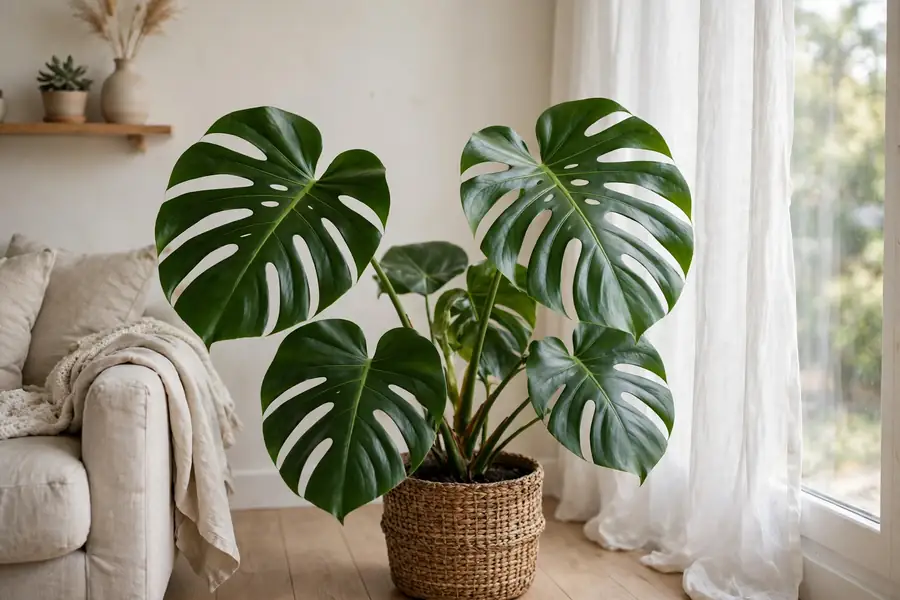
Light is the biggest factor in leaf size and splitting. If new leaves come in smaller or without holes, the plant likely needs more light. A grow light helps in a dark room or in winter. Pick a full-spectrum bulb and place it 12 to 24 inches above the plant for about 10 to 12 hours a day.
Variegated types need even brighter indirect light, because the white patches make less food.
How often should you water a monstera plant?
Water a monstera when the top 2 inches of soil are dry, usually every 1 to 2 weeks in spring and summer and every 2 to 3 weeks in winter. Poke your finger into the soil to check. Water slowly until it drains from the bottom, then empty the saucer.
- Never let it sit in water. Soggy soil causes root rot, the main cause of monstera death.
- Water less in winter, because growth slows and soil stays damp longer.
- Use room-temperature water. If you see brown tips, filtered or rainwater can help.
- A heavier pot or a big plant dries more slowly, so go by the soil, not a schedule.
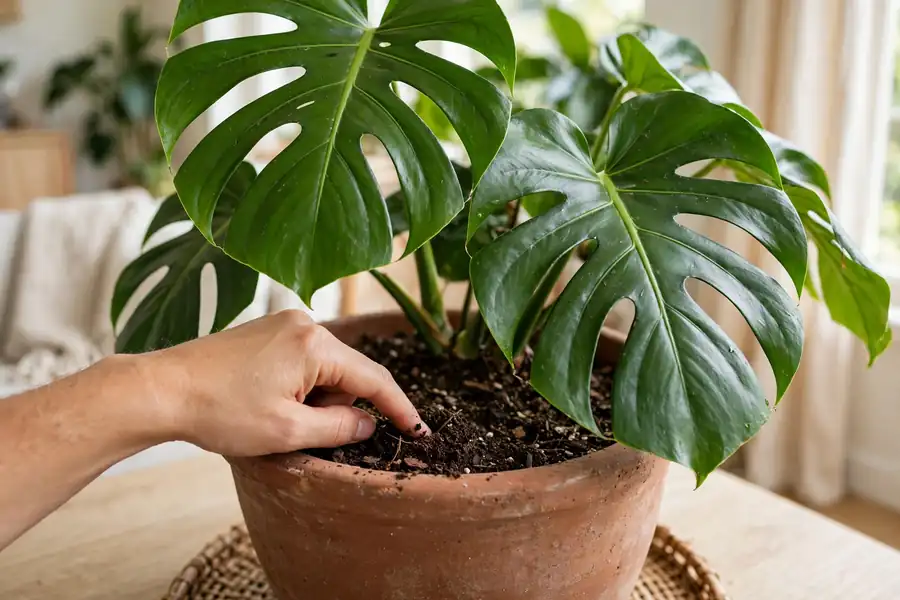
| Sign | Underwatered | Overwatered |
|---|---|---|
| Leaves | Droopy, curling, crispy brown edges | Yellow, droopy, may turn brown or black |
| Soil | Dry, hard, may pull from the pot edge | Wet for days, may smell sour |
| Stems | Firm but limp leaves | Soft or mushy at the base |
| Fix | Water thoroughly and regularly | Let soil dry, trim rotted roots, repot in fresh mix |
What is the best soil and pot for a monstera?
Monsteras are climbers that grow on trees, so their roots like air and drainage. A good mix is:
- 2 parts standard indoor potting soil
- 1 part perlite or pumice
- 1 part orchid bark or coco chips
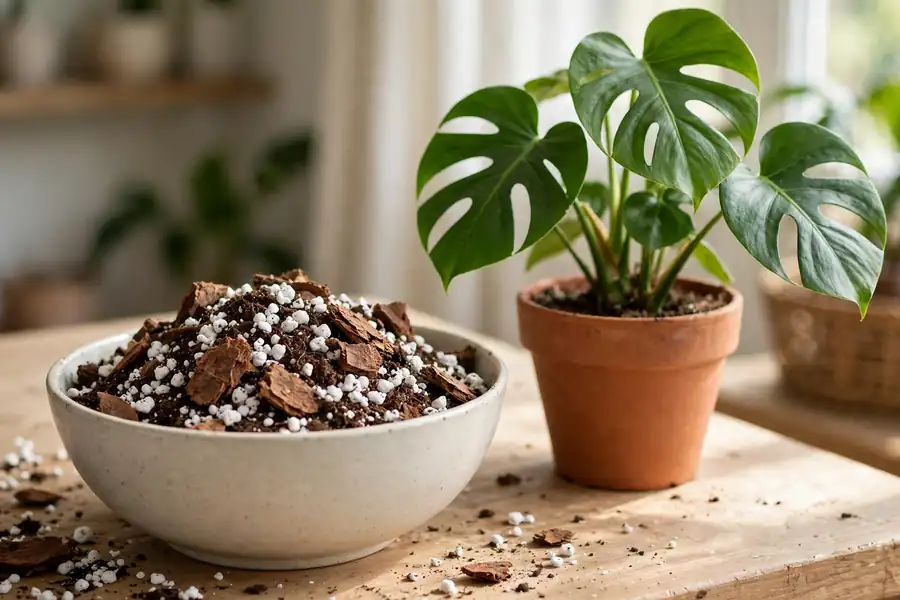
A ready-made aroid mix works too. Avoid heavy garden soil or mixes that stay wet.
Pot choice: use a pot with drainage holes that is 1 to 2 inches wider than the root ball. Terracotta dries faster and suits people who overwater. Plastic holds moisture longer. A plant in a pot that is too big stays wet for too long and rots. A large mature monstera needs a heavy, stable pot or it may tip over. For the size, most plants do well in 8 to 14 inch pots, and big floor plants use 14 to 20 inch pots.
How do you fertilize a monstera?
Feed a monstera about once a month in spring and summer with a balanced liquid houseplant fertilizer at half the label strength. Skip feeding in fall and winter. Too much fertilizer causes brown leaf edges and salt buildup, so when in doubt, feed less. A slow-release granular fertilizer applied in spring also works.
Mixing a little finished compost into the soil when you repot gives a gentle boost, and the compost guide explains how to make your own.
What temperature and humidity does a monstera like?
- Temperature: about 65 to 85°F. Below 55°F, growth stops and leaves may blacken.
- Humidity: average home humidity is fine, but 40 to 60 percent keeps leaves glossier and prevents crispy edges.
- Keep it away from heating vents, air conditioners and cold drafts.
To raise humidity, group plants, use a humidifier or place a pebble tray under the pot. Misting has only a short effect.
How do you support a monstera plant?
A climbing monstera grows bigger leaves with more splits when it has something to climb. In nature, it climbs tree trunks, and the aerial roots grip the bark.
Support options:
- Moss pole or coco coir pole: the most popular choice. Push it into the pot near the main stem and tie the stem to it with soft plant ties or velcro tape. Mist the pole sometimes so the aerial roots can attach.
- Trellis: good for a wide plant against a wall.
- Bamboo stakes: a cheap option for small plants.
- Wooden board or cork: for a natural look.
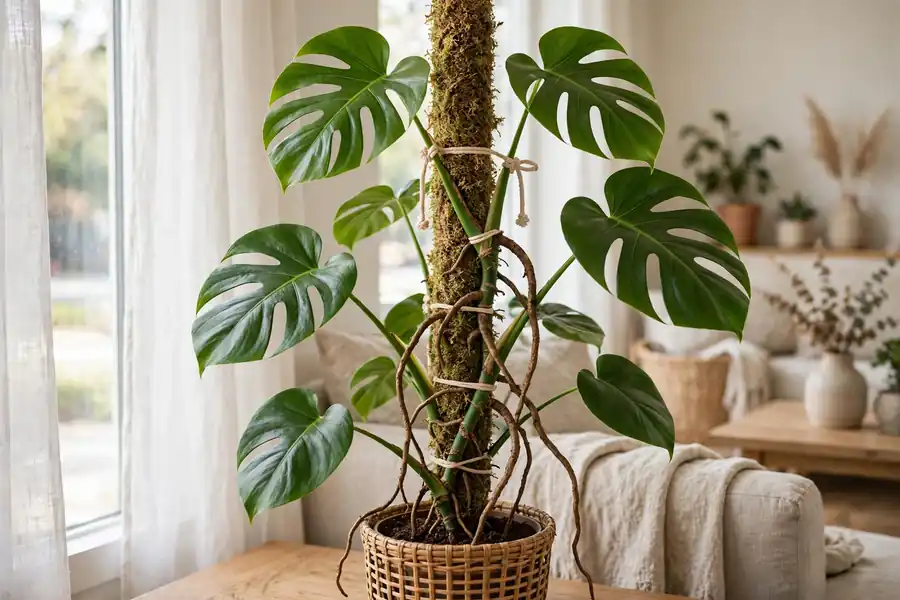
How do you tie up a monstera and keep it upright? Tie the main stem loosely to the support below a leaf, leaving space for the stem to thicken. Check the ties every few months. Use soft material, not wire.
How tall should the pole be? Choose one that is taller than the plant now, since it will keep growing. You can add an extension later.
Aerial roots do not need to grab a pole for the plant to climb, but they help the plant feel secure. You can also tuck them back into the soil.
What are the aerial roots on a monstera?
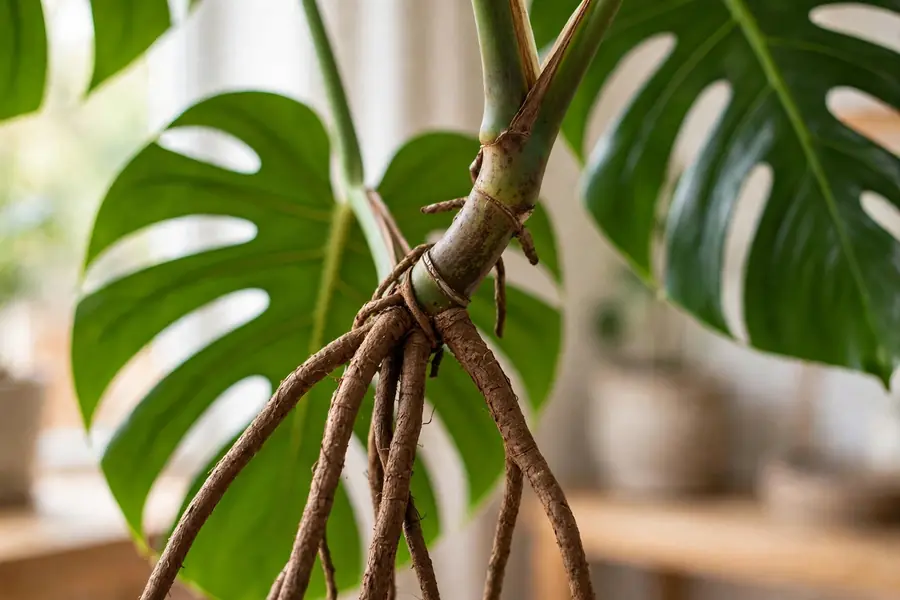
Aerial roots are brown, rope-like roots that grow from the stem nodes. They help the plant anchor to trees, take up water and climb.
- Do not cut them off unless they are messy. Trimming a few is fine, but a plant needs them to climb.
- Guide them into the pot or to the pole.
- Roots growing out of the pot's drainage holes mean the plant may be root-bound.
Why does my monstera plant not have holes or splits?
The splits are called fenestrations. A monstera without them is usually one of these:
| Reason | What to do |
|---|---|
| Young plant | Young plants make solid leaves. Splits usually start as the plant matures, often after 2 to 3 years |
| Not enough light | Move to brighter indirect light |
| No support | Give it a pole or trellis to climb |
| Pot too small or poor feeding | Repot and feed in the growing season |
| Species | Some types, like Monstera Peru or the true Monstera adansonii, have different patterns |
Be patient. New leaves usually get bigger and more split over time, as long as the plant has light and support.
How do you repot a monstera plant?
Repot every 1 to 2 years in spring, or when roots circle the pot or poke out of the drainage holes.
- Water the plant a day or two before so the roots are not dry.
- Choose a pot 1 to 2 inches wider than the current one, with drainage holes.
- Slide the plant out and loosen tight roots. Trim any black or mushy roots.
- Add fresh mix to the new pot, set the plant at the same depth and fill around the roots.
- Add or reposition the moss pole.
- Water thoroughly and place in bright indirect light. Hold off on fertilizer for a month.
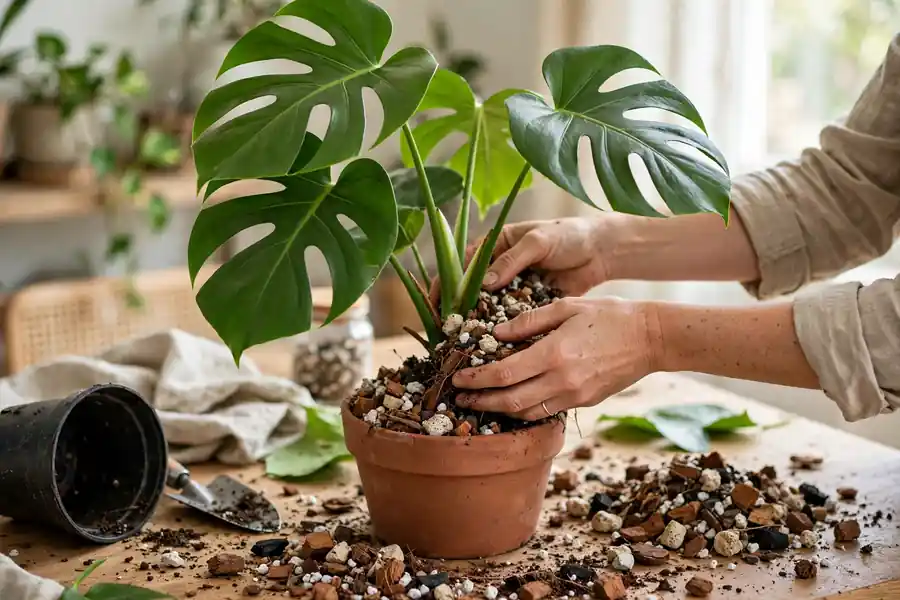
For very large plants, top-dress with fresh soil each year instead of repotting. A drooping plant right after repotting usually recovers in a week or two.
How do you prune a monstera plant?
Monsteras are easy to prune, and trimming keeps them from getting leggy.
- Use clean, sharp scissors or pruners and wipe them with rubbing alcohol.
- Cut stems about a quarter inch above a node, which is the bump where a leaf and aerial root grow. New growth often sprouts from the node below the cut.
- Remove yellow, brown or damaged leaves at the base of their stalks.
- Cut long, bare vines back to a leaf to encourage bushier growth.
- Do not remove more than a third of the plant at once.
Prune in spring or summer. Monstera sap can irritate skin, so wear gloves if you have sensitive skin. You can root the cuttings (see below).
How do you propagate a monstera plant?
The easiest method is a stem cutting with a node. A leaf alone will not grow into a new plant.
- Pick a healthy stem with at least one node and one leaf. Nodes with a small aerial root root fastest.
- Cut about half an inch below the node with clean scissors.
- In water: place the cutting in a jar so the node is under water and the leaf is above. Keep it in bright indirect light and change the water weekly. Roots usually show in 2 to 4 weeks.
- In soil or moss: plant the node in moist, airy mix or sphagnum moss, and keep it lightly damp.
- When water roots are a few inches long, move the cutting to a pot of airy mix. Keep the soil moist for the first few weeks.
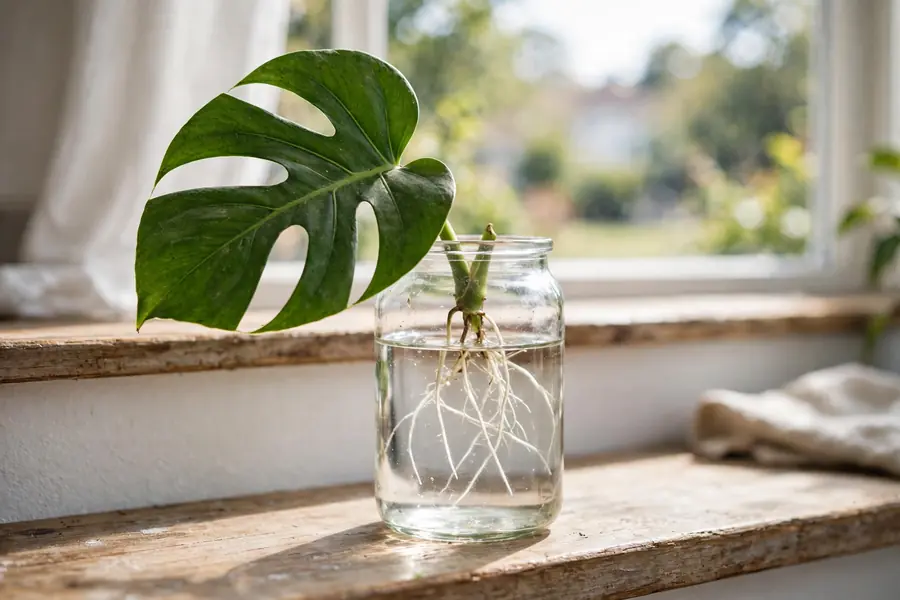
Can you grow a monstera in water? Cuttings root well in water and can stay for a while, but they usually grow better once moved to soil. Long-term water growth is possible with clean water and occasional diluted fertilizer.
How do you split or divide a monstera? If a plant has several stems and their own roots, you can slide it out of the pot and gently separate sections with roots. Otherwise, take stem cuttings. Spring is the best time.
When should you plant a monstera cutting? Spring and summer are best, when the plant grows fastest. Cuttings can root in winter too, but slowly.
Monstera seeds: monsteras rarely set seed indoors, and plants grown from seed take years to mature. Cuttings are far more practical.
Why are my monstera leaves turning yellow?
A single old lower leaf turning yellow now and then is normal. A lot of yellowing is a signal.
| Cause | Clue | Fix |
|---|---|---|
| Overwatering | Soil stays wet, several leaves yellow, droopy | Let soil dry and improve drainage. Check roots |
| Underwatering | Dry soil, yellow and crispy edges | Water deeply and regularly |
| Low light | Pale leaves, slow growth | Move to brighter light |
| Nutrient shortage | Pale overall color, little growth | Feed monthly in spring and summer |
| Natural aging | One lower leaf at a time | Remove the leaf |
| Pests | Yellow speckles, webbing or sticky residue | Treat with insecticidal soap |
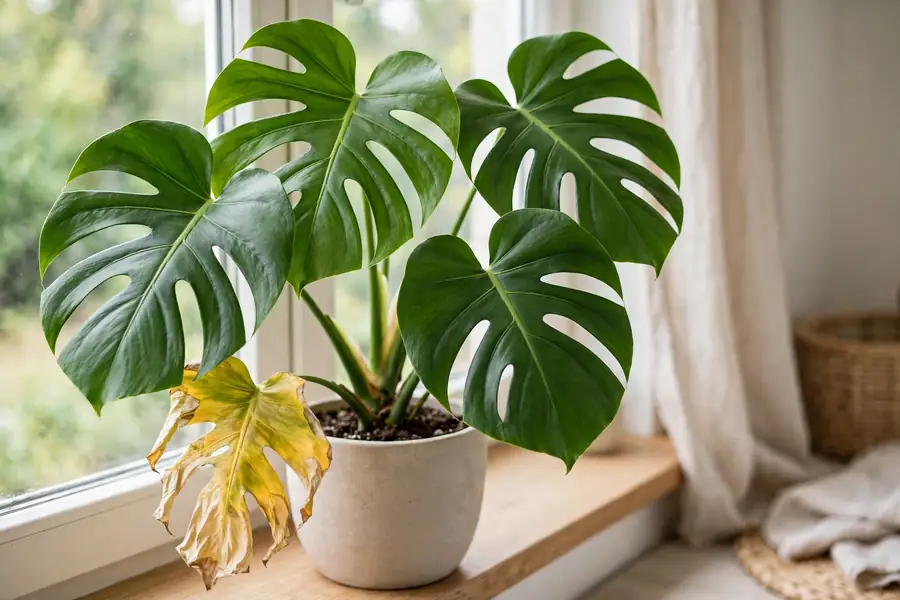
Yellow leaves do not turn green again, so cut them off at the base.
Why are my monstera leaves turning brown?
- Dry air or underwatering: crispy brown edges and tips. Water more evenly and raise humidity.
- Too much sun: brown, dry patches in the middle of leaves.
- Overwatering or root rot: brown spots with a yellow halo, or soft brown patches.
- Fertilizer burn: brown edges and white crust on the soil.
- Cold drafts: brown or black patches on leaves near a window.
Black leaves usually mean root rot or cold damage. Check the roots, remove rotted ones and repot in fresh mix.
You cannot make brown tissue green again. Trim the brown parts or remove the whole leaf, and fix the cause.
Why are my monstera leaves curling or drooping?
- Thirst: the most common cause. Leaves curl inward and droop, then recover after watering.
- Overwatering and root rot: drooping with wet soil.
- Low humidity or heat: curling and crispy edges.
- Root-bound: roots fill the pot and the soil dries fast.
- Pests: check leaf undersides for spider mites or thrips.
- Cold or draft: drooping and darkening after a chilly night.
Check the soil first. If dry, water well. If wet, let it dry and inspect the roots.
Why is my monstera dripping water? Droplets on the leaf tips are normal. The plant pushes out excess moisture, especially in humid rooms or after heavy watering. It is not a problem unless the soil is always soggy.
Why is my monstera leggy?
A leggy monstera has long stems and small leaves spaced far apart. It almost always means too little light. Move it to brighter indirect light, add a pole and prune back leggy vines to encourage fuller growth.
How do you save a dying monstera plant?
- Check the soil and roots. Wet and smelly means rot. Dry and crumbly means thirst.
- If rotting, cut off all black, mushy roots and repot in fresh, chunky mix in a clean pot with drainage.
- If dry, soak the pot in a basin of water for 20 to 30 minutes and let it drain.
- Remove dead leaves, keep it in bright indirect light and avoid fertilizing until you see new growth.
- Be patient. Recovery can take weeks.
If the stem is firm and green, you can often save the plant even if most leaves are gone. If the stem is mushy, take cuttings from any healthy part with a node and root them in water.
Do monstera plants flower and produce fruit?
Yes, but rarely indoors. A mature monstera can produce a creamy white spathe wrapped around a spike called the spadix, similar to a peace lily flower. Flowering needs a large, old plant and plenty of light, warmth and humidity.
The flower can turn into an edible fruit called the monstera fruit or "fruit salad," which smells and tastes like a mix of pineapple and banana. Fruiting indoors is unusual, and the fruit takes a long time, often a year or more, to ripen.
Safety note: the unripe fruit and the rest of the plant contain calcium oxalate crystals that irritate the mouth and throat. Only fully ripe fruit is treated as edible, and the green scales need to fall off or be removed. Do not eat monstera fruit unless you are sure it is ripe, and if you are unsure, skip it.
Is a monstera plant toxic to cats and dogs?
Yes. The ASPCA lists Monstera deliciosa as toxic to cats and dogs. All parts of the plant contain insoluble calcium oxalate crystals, which release when chewed.
Signs in pets:
- Drooling and pawing at the mouth
- Burning and irritation of the mouth, lips and tongue
- Vomiting
- Difficulty swallowing
- Reduced appetite
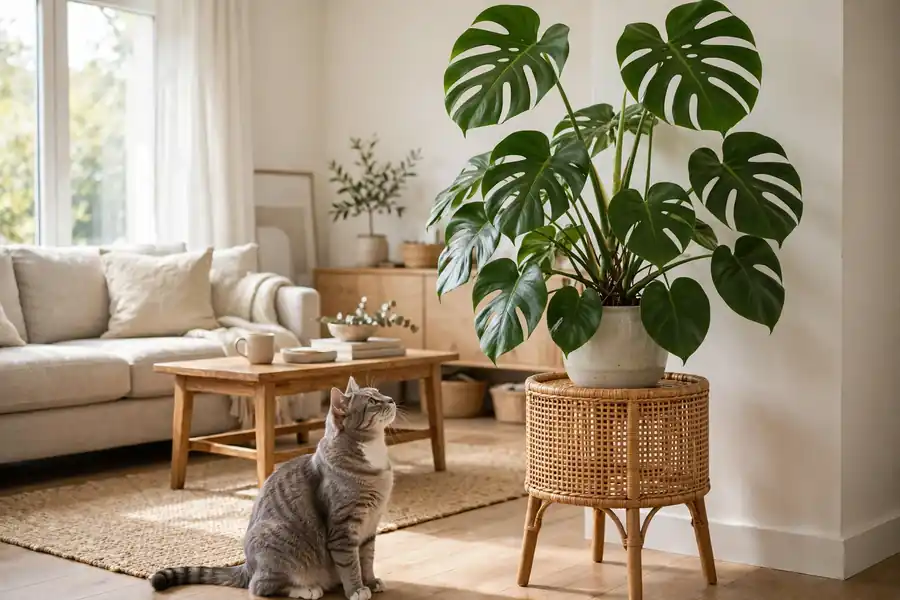
The effects are usually mild to moderate, and serious poisoning is uncommon. Swelling in the mouth or throat that makes breathing hard is an emergency.
What to do if your pet chews a monstera:
- Remove plant pieces from the pet's mouth.
- Offer a little water to rinse the mouth.
- Call your vet or the ASPCA Animal Poison Control Center at 888-426-4435 (a fee may apply).
- Go to an emergency vet if your pet has trouble breathing, swelling or ongoing vomiting.
Keep monsteras on a high shelf or in a room the pet cannot reach, or choose a pet-safe plant. Hanging a Monstera adansonii does not make it safe, because trailing vines are easy for cats to pull down.
Is monstera toxic to humans? The same crystals can irritate the mouth and skin. Keep it out of reach of small children and wash your hands after pruning if you have sensitive skin. Chewing a leaf usually causes burning and drooling.
Can a monstera plant live outside?
Only in warm climates. Monstera deliciosa is hardy outdoors in frost-free regions, roughly USDA zones 10 to 12, where it grows in shade or filtered light and can become very large. In colder areas:
- Summer: put the pot outside in bright shade once nights stay above about 55°F. Avoid direct sun, which burns the leaves.
- Fall: bring it inside before nights drop below 55°F. Check for pests first and rinse the leaves.
- Winter: frost damages or kills it.
Outdoors, the plant tolerates humidity and warmth, but wind can shred the leaves.
Is a monstera an indoor or outdoor plant? An indoor plant in most of the US and an outdoor plant in tropical climates.
How big does a monstera plant get?
Indoors, a monstera typically reaches 3 to 8 feet tall with leaves 1 to 2 feet wide, depending on pot size, support and light. In the wild, a monstera can climb 60 feet or more with leaves up to 3 feet long.
To keep it smaller, prune the top, use a smaller pot and give it less fertilizer. To let it grow big, add a tall pole, bright light and regular feeding.
Does a monstera plant have benefits?
Monsteras are mostly grown for their looks: they add greenery, a tropical feel and a natural focal point. They may also make a space feel calmer. The idea that houseplants clean the air comes from a well-known lab study from the late 1980s. In real homes, a few plants have little effect on air quality compared with ventilation, so grow a monstera for its beauty.
Disadvantages: it is toxic to pets, it needs space and sometimes a pole, its sap can irritate skin and it can get large.
What does a monstera plant mean?
The monstera symbolizes growth, abundance and a connection to nature, because it grows quickly and has a lush, tropical look. Some people link the splits in its leaves to resilience and to adapting to light. These are popular meanings, not fixed traditions. The monstera leaf is also a well-known design motif.
Monstera vs philodendron vs pothos
| Plant | Leaves | Growth |
|---|---|---|
| Monstera | Large with splits and holes when mature | Climbing, large |
| Philodendron | Heart-shaped or lobed, usually no holes | Climbing or self-heading |
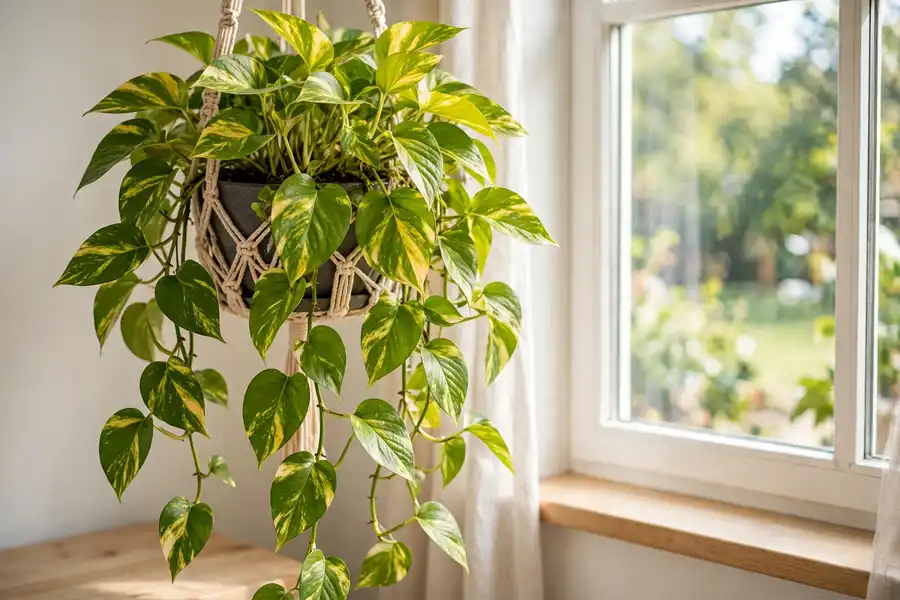
| Pothos | Smaller, waxy, heart-shaped, often variegated | Trailing or climbing |
All three are in the arum family and are toxic to pets. They also share similar care: bright indirect light, water when the top inch or two is dry and no standing water.
Quick answers to common questions
How often should you water a monstera plant?
When the top 2 inches of soil are dry, usually every 1 to 2 weeks in spring and summer and less in winter. Water until it drains and never leave it in water.
Why does my monstera not have holes or splits?
It is usually too young, in too little light, or has nothing to climb. Splits appear as the plant matures, and bright indirect light and a pole speed this up.
Is a monstera plant toxic to cats and dogs?
Yes. The ASPCA lists it as toxic to both. It usually causes mouth irritation, drooling and vomiting. Call your vet if a pet chews on it.
How do you propagate a monstera plant?
Cut a stem just below a node, with one leaf, and root it in water or moist soil. Roots form in 2 to 4 weeks. A leaf alone will not root.
Why are my monstera leaves turning yellow?
Overwatering is the most common cause. Other causes are underwatering, low light, lack of nutrients and natural aging of lower leaves. Check the soil moisture and drainage first.
Keep reading: peace lily care, spider plant care, snake plant care, how to compost and more houseplant guides.
Is a monstera plant worth growing?
Yes. A monstera plant is one of the most rewarding houseplants: it grows fast, makes dramatic leaves, roots easily from cuttings and forgives the occasional missed watering. Give it bright indirect light, let the top couple of inches of soil dry between drinks, add a pole to climb and keep it away from curious pets. With that, your monstera plant will keep adding bigger, more split leaves for many years.