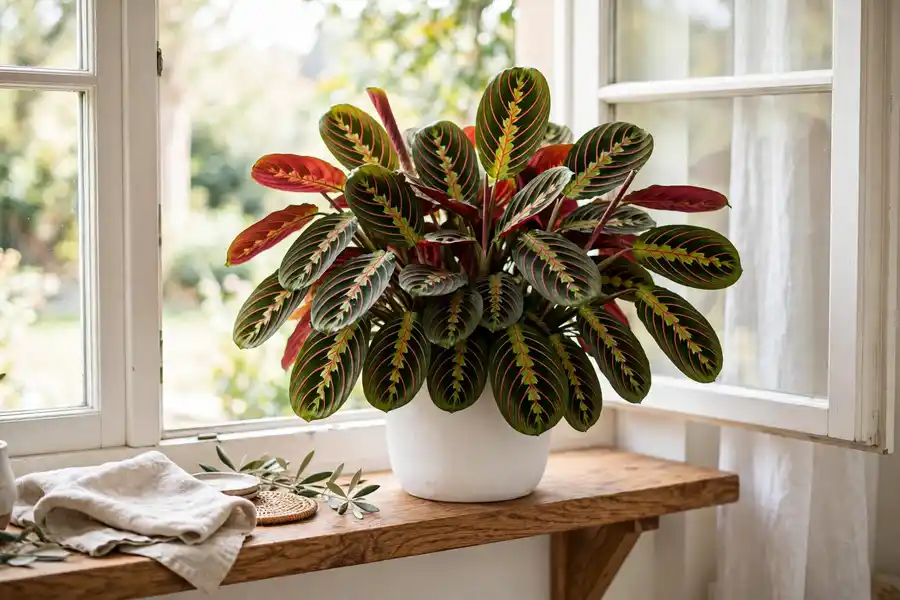
A prayer plant (Maranta leuconeura) is a low, trailing houseplant with patterned leaves that fold upward at night like hands in prayer. It needs bright indirect light, evenly moist soil, 50 percent or more humidity and filtered or distilled water, because tap water minerals brown the tips. It is not toxic to cats or dogs. Propagate it by division or by stem cuttings taken just below a node.
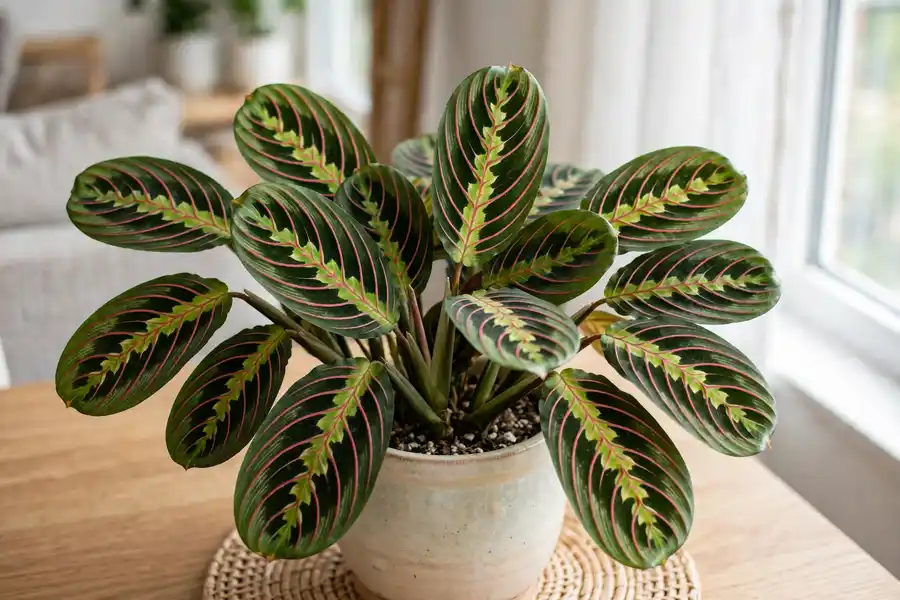
Prayer plant at a glance
| Question | Answer |
|---|---|
| Scientific name | Maranta leuconeura (family Marantaceae) |
| Origin | Tropical forest floor in Brazil |
| Other names | Maranta, herringbone plant, rabbit's foot, rabbit tracks |
| When to plant or repot | Spring or early summer |
| Light | Bright indirect. No direct sun |
| Water | Keep evenly moist. Water when the top inch is dry, about every 5 to 10 days |
| Water type | Filtered, distilled or rainwater is best |
| Humidity | 50 to 60 percent |
| Temperature | 65 to 80°F. Keep above 60°F |
| Soil | Peat-based, airy, slightly acidic (pH about 5.5 to 6.5) |
| Fertilizer | Half-strength balanced liquid feed monthly in spring and summer |
| Size | Usually under 1 ft tall, 1 to 2 ft wide, with trailing stems |
| Pets | Non-toxic to cats and dogs |
| Difficulty | Moderate. Humidity and water quality matter |
Why is it called a prayer plant?
The leaves rise and fold upward at night and lower again in the morning, like hands pressed together. The movement is called nyctinasty. A swollen joint at the base of each leaf (the pulvinus) changes water pressure and moves the leaf.
| Question | Answer |
|---|---|
| Why does it close at night? | It follows a day-night cycle. Sources differ on the benefit, but it may help the plant use low light and shed water |
| Why is mine not closing? | Too little light, dry soil, cold, stress or overwatering. It also stays flat in constant light |
| Why are leaves folded or pointing down in the day? | Thirst, dry air, cold drafts or root problems |
| Why do leaves droop during the day? | Usually thirst or heat. Check the soil |
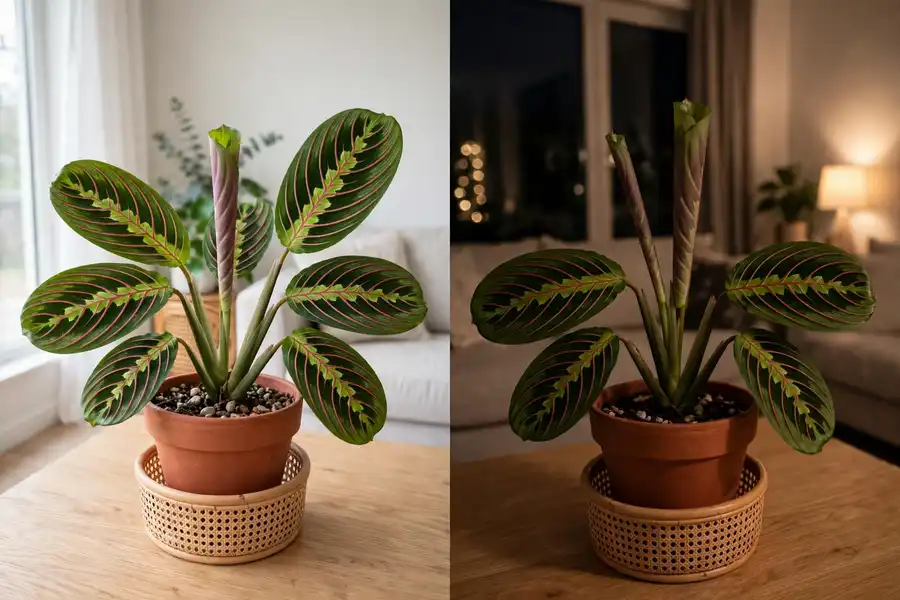
What are the types of prayer plant?
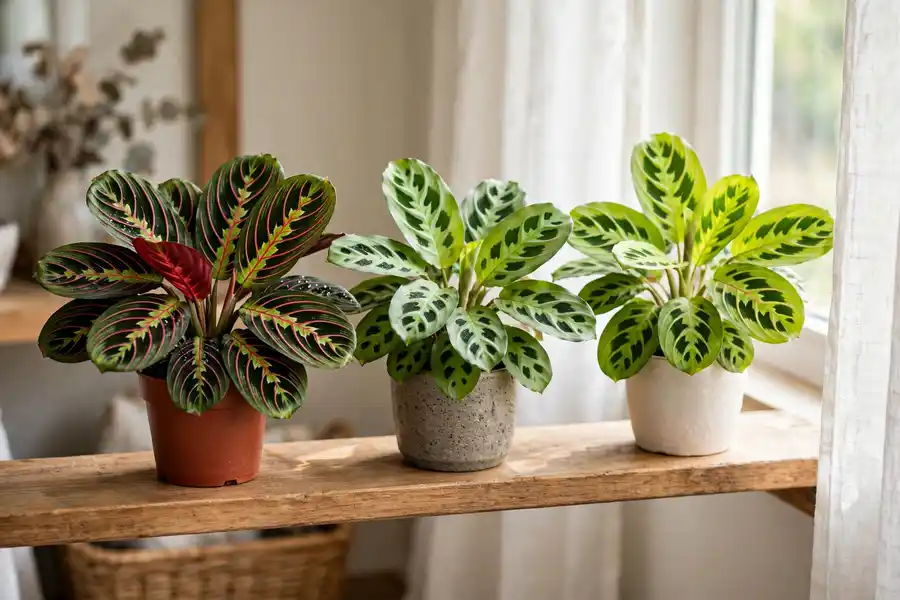
| Type | Look | Notes |
|---|---|---|
| Red prayer plant (M. leuconeura var. erythroneura, herringbone, 'Fascinator', tricolor) | Dark green leaves with red veins and a lighter center | The most popular type |
| Green prayer plant (var. kerchoveana, rabbit's foot, rabbit tracks) | Light green leaves with dark brown-green blotches | The plainest and easiest type |
| Lemon lime prayer plant | Bright lime and dark green leaves with red veins | A form of the same species |
| Black prayer plant ('Massangeana', silver band) | Dark leaves with a silver band | Sold under several names |
| Purple prayer plant | Purple undersides on many types | Not a separate species |
| Variegated types ('Beauty Kim', pink or cream marked) | Cream or pink marks | Names vary by seller |
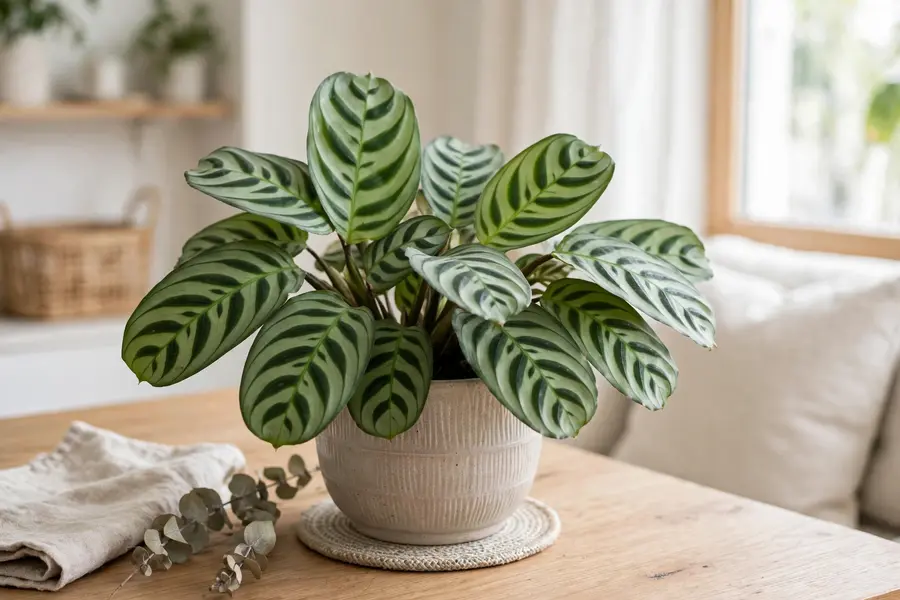
Look-alike relatives (same family, different genus):
| Plant | Notes |
|---|---|
| Fishbone prayer plant (Ctenanthe burle-marxii) | Zigzag stripes. Common in terrariums |
| Grey star (Ctenanthe setosa) | Gray-green. Taller |
| Never-never plant (Ctenanthe oppenheimiana) | Large, silver-green striped |
| Triostar (Stromanthe sanguinea) | Cream, green and pink leaves |
| Peacock plant (Calathea makoyana) | Feather-like pattern |
| Rattlesnake plant (Calathea lancifolia) | Wavy edges, dark spots |
| Calathea medallion, zebra, pinstripe, orbifolia, 'Freddie', 'Dottie' | Taller, clumping calatheas |
There is no true blue or white prayer plant. The "prayer lily plant" some people mean is a peace lily, which is toxic to pets. See our peace lily guide.
Is a prayer plant a calathea?
No, but they are close relatives. Both are in the Marantaceae family.
| Prayer plant (Maranta) | Calathea | |
|---|---|---|
| Growth | Low, spreading and trailing | Upright clump on tall stalks |
| Size | Usually under 1 ft | 1 to 3 ft |
| Leaves | Oval, smaller, with a clear center vein | Larger, often long or round |
| Care | Moderate | Often fussier |
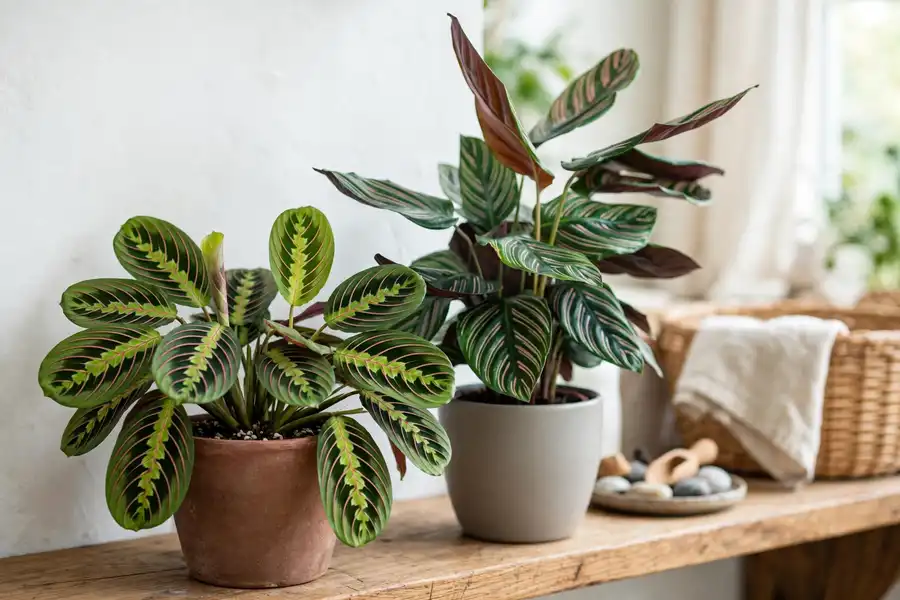
Care for both is similar. "Calathea prayer plant" and "peacock plant vs prayer plant" searches mean this same comparison.
How much light does a prayer plant need?
| Question | Answer |
|---|---|
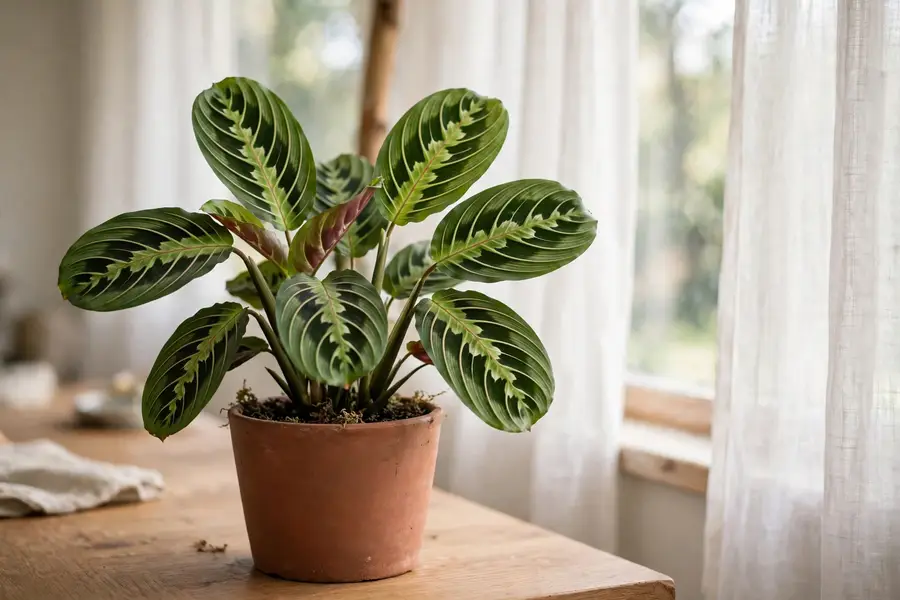
| Best light | Bright, indirect light |
| Best window | East or north window, or a few feet back from a south or west window behind a sheer curtain |
| Direct sun | Burns and fades the pattern |
| Low light | It survives, but growth is leggy and the colors dull |
| Grow light | Works well. Place it 12 to 24 inches away for 10 to 12 hours a day |
How often should you water a prayer plant?
Water when the top inch of soil feels dry, usually every 5 to 10 days. Water less in winter.
- Use filtered, distilled or rainwater, or tap water left out overnight. Prayer plants react to fluoride and minerals.
- Water until it drains from the holes.
- Empty the saucer.
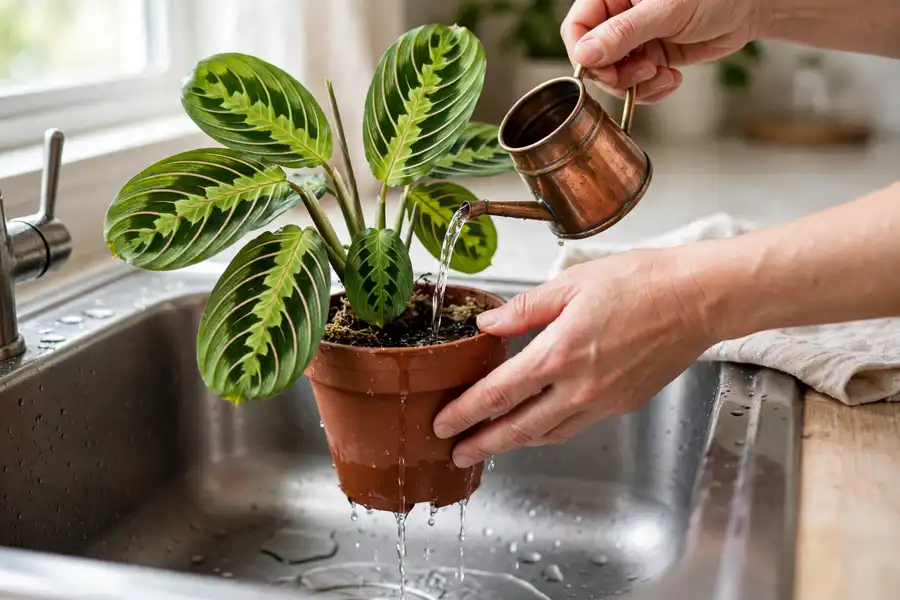
Aim for a moist soil reading, not wet or dry, if you use a moisture meter. Never let the pot sit in water.
| Overwatered | Underwatered | |
|---|---|---|
| Leaves | Yellow, limp, mushy stems | Curled, crispy, brown edges |
| Soil | Wet, may smell | Dry and pulling from the pot |
| Roots | Brown and mushy | Dry |
What humidity and temperature does it need?
- Humidity: 50 to 60 percent. Use a humidifier, group plants, or keep it in a bright bathroom or kitchen. Pebble trays help a little. Misting gives a short boost and can encourage leaf spots, so do not rely on it.
- Temperature: 65 to 80°F. Below 60°F causes damage. Keep it away from vents, heaters and cold drafts.
What soil and pot are best?
| Question | Answer |
|---|---|
| Soil mix | 2 parts peat-based potting mix, 1 part perlite, 1 part orchid bark or coco coir |
| Quick option | A premium houseplant mix with extra perlite |
| Pot | Shallow and wide with drainage, since roots stay near the surface |
| Size | 1 to 2 inches wider than the root ball. Not much bigger |
| Material | Plastic or glazed holds water. Terracotta dries faster |
| Repot | Every 1 to 2 years in spring, when roots show at the drain holes |
To repot: ease the plant out, loosen the roots, set it at the same depth in fresh mix and water. It grows from rhizomes and small tuberous roots, not from bulbs.
Should you fertilize a prayer plant?
Yes, lightly. Use a balanced liquid houseplant fertilizer at half strength once a month in spring and summer. Skip it in fall and winter. Too much fertilizer burns the tips and builds up salts. Flush the soil with water every few months.
How do you propagate a prayer plant?
Spring and summer are best. Division is the most reliable. This works for red, lemon lime and fishbone types too.
By division (easiest):
- Take the plant out of the pot at repotting time.
- Pull or cut the clump into sections, each with leaves and roots.
- Pot each in fresh mix and keep it moist.
By stem cutting (soil or water):
- Cut a stem 4 to 6 inches long, just below a node (the joint where a leaf meets the stem). Make sure it has 2 to 3 leaves.
- In water: put it in a jar with the node underwater and no leaves submerged. Place it in bright, indirect light and change the water weekly. Roots form in 2 to 4 weeks.
- In soil: dip the end in rooting hormone if you like, plant in moist mix, and cover with a clear bag for humidity.
- Pot up water cuttings when the roots are 1 to 2 inches long.
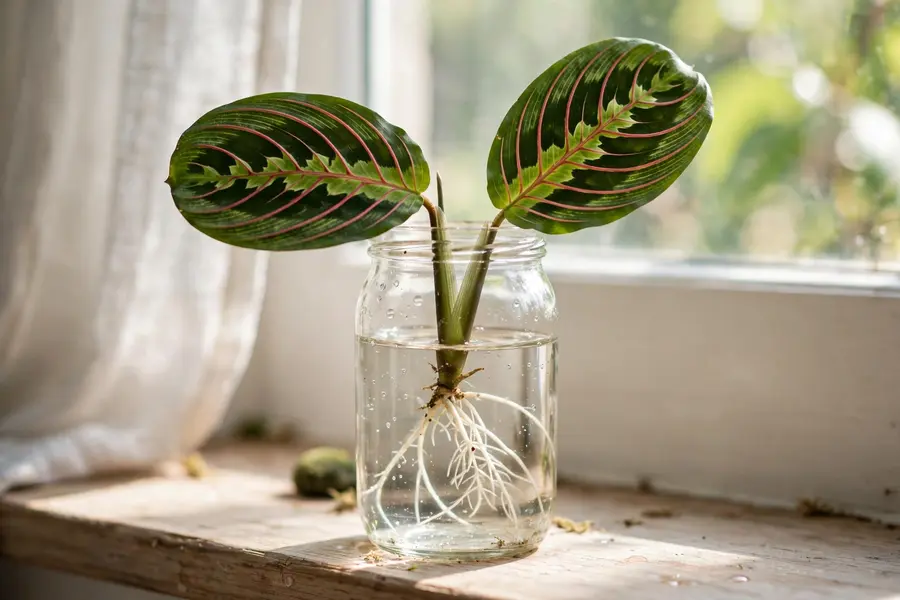
A prayer plant can live in water for a while, but it grows better in soil. A leaf alone will not root. Seeds are rarely used.
How do you prune a prayer plant?
Cut leggy or damaged stems back to just above a node in spring. New growth sprouts below the cut. Remove yellow leaves at the base. Do not remove more than a third at once. Pinching tips keeps the plant bushy, and trailing stems can go in a hanging basket. A trellis does not help, since it does not climb.
Why are my prayer plant's leaves curling, yellow or brown?
| Symptom | Likely cause | Fix |
|---|---|---|
| Curling or rolled up | Thirst, dry air, direct sun, cold, root-bound or spider mites | Check the soil, raise humidity, move out of sun |
| Yellow leaves | Overwatering (most common), low light, cold or nutrient shortage. One old lower leaf is normal | Let the soil dry, check roots, improve light |
| Brown tips and edges | Dry air, tap water minerals, fertilizer salts, underwatering | Use filtered water, raise humidity, flush the soil |
| Brown spots | Sunburn, fungal leaf spot, pests, overfertilizing | Move from sun, keep leaves dry, remove affected leaves |
| Drooping or wilting | Thirst, root rot, cold or shock | Check soil and roots |
| Crispy leaves | Very dry air or soil | Water well, add humidity |
| Leggy, falling over | Low light, or its natural trailing habit | Move to brighter light, prune, use a hanging basket |
| Holes in leaves | Insects or slugs | Inspect and treat |
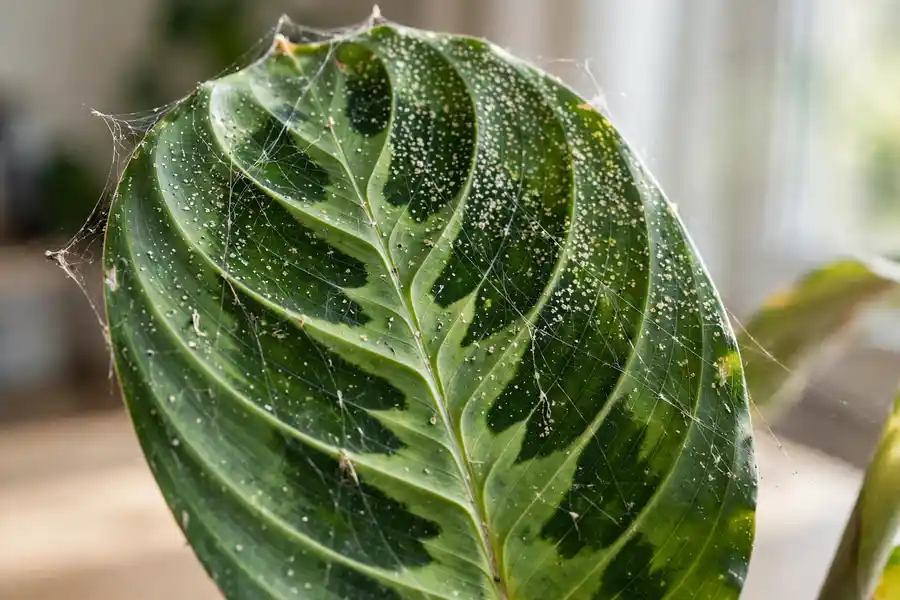
| Webbing and speckled leaves | Spider mites | Rinse the leaves, wipe them, use insecticidal soap weekly |
| Sticky leaves, white cottony spots | Mealybugs or aphids | Wipe with rubbing alcohol, then soap |
| Tiny flies around the pot | Fungus gnats from wet soil | Let the top dry out |
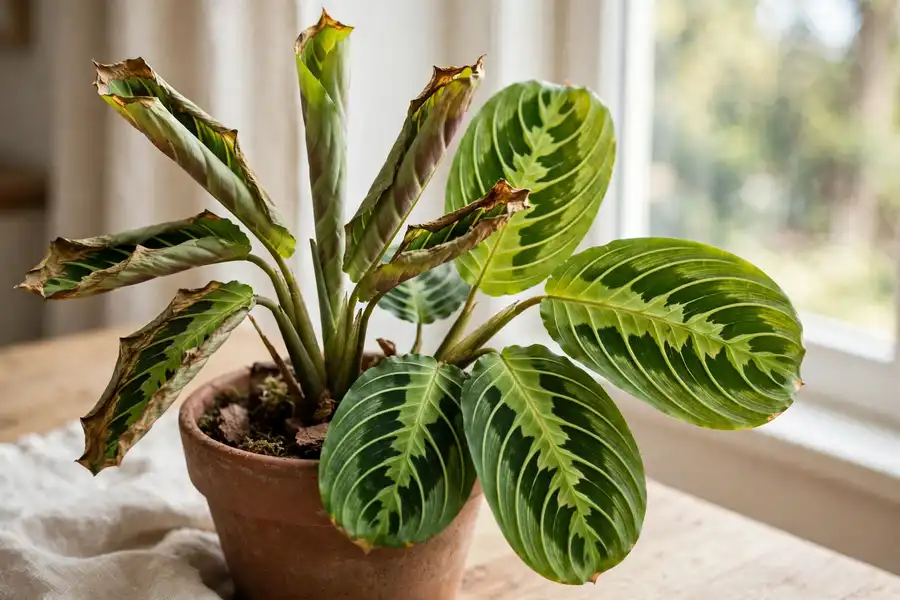
Root rot: soft brown, smelly roots and a collapsing plant. Cut off the rot, repot in fresh mix, water less and expect slow recovery. Prayer plants rarely get serious diseases other than rot and leaf spots.
How to revive a dying prayer plant:
- Pull it from the pot and check the roots. Firm white roots are healthy.
- Trim any dead or mushy parts and brown leaves.
- Repot in fresh, airy mix with drainage.
- Fix the cause: light, water type, humidity or watering.
- Wait. If every leaf dies but the roots live, cut it back to the soil and it can regrow from the rhizome.
Does a prayer plant flower?
Yes, rarely indoors. It makes small white or pale lilac flowers with purple marks on short spikes, mostly in summer on mature plants. The flowers are not showy and are neither good nor bad news. They usually show a mature, content plant. Snip the spike if you prefer more leaf growth.
Is a prayer plant toxic to cats and dogs?
No. The ASPCA lists prayer plant (Maranta leuconeura) as non-toxic to cats, dogs and horses, and calatheas are listed as non-toxic too. That covers red, lemon lime and fishbone types. Eating a lot can still upset a pet's stomach. The plant is not poisonous to people either, but do not eat it. Beware of the peace lily, which is toxic.
How big does a prayer plant get, and how long does it live?
It stays under about 1 foot tall, spreads 1 to 2 feet and trails over the pot edge with age. A well-grown, mature plant fills an 8 to 10 inch pot. Growth is moderate and fastest in spring and summer. With good care it lives for many years, and dividing it renews it.
Where can a prayer plant grow?
- Indoors: best, in bright indirect light with humidity.
- Outdoors: only in frost-free zones (about 11 to 12) in shade, or outside in summer once nights stay above 60°F.
- Terrarium: works well with fishbone and small types.
- Underwater (aquarium): it is not an aquatic plant and will rot.
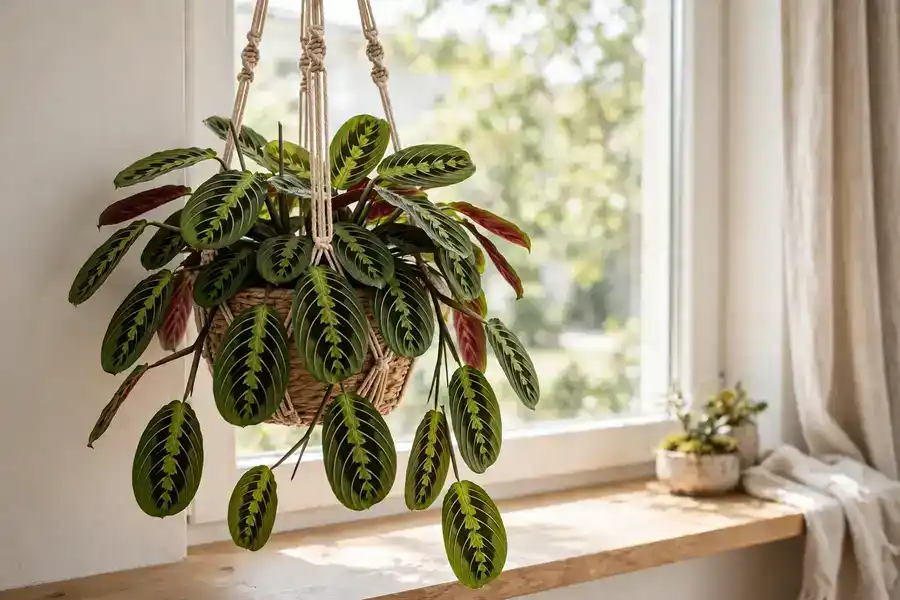
- Hanging basket: good for the trailing stems.
Does a prayer plant have benefits or meaning?
It adds color and movement to a room, and it is pet-safe. Claims that houseplants purify indoor air are weak at home scale, so do not expect that. Folk meanings link it to prayer, gratitude and devotion. Feng shui claims are not backed by evidence.
Quick answers to common questions
Why is it called a prayer plant?
Its leaves fold upward at night like hands in prayer.
How often should you water a prayer plant?
When the top inch of soil is dry, about every 5 to 10 days, with filtered or distilled water.
Why are my prayer plant leaves curling?
Usually thirst, dry air or direct sun. Check the soil first.
Is a prayer plant toxic to cats and dogs?
No. It is listed as non-toxic.
How do you propagate a prayer plant?
Divide it at repotting, or root a 4 to 6 inch stem cutting cut just below a node in water or soil.
Keep reading: peace lily, monstera plant, spider plant, pothos plant and more houseplant guides.
Is a prayer plant worth growing?
Yes, if you can give it humidity and filtered water. A prayer plant gives patterned leaves and daily movement, and it is safe around pets. Keep it out of direct sun, keep the soil lightly moist and you will have it for years.