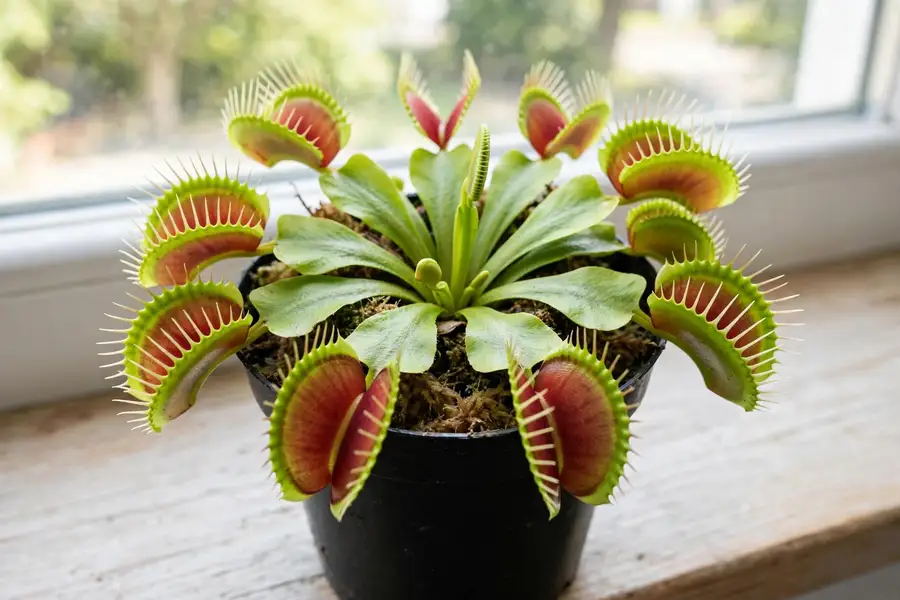
A Venus fly trap (Dionaea muscipula) is a small carnivorous plant that catches insects in hinged, toothed traps. It needs bright direct light, pure water (distilled, rain or reverse osmosis), nutrient-poor soil and a winter dormancy. It makes its own food by photosynthesis, so feeding is optional. Feed only live or rehydrated small insects, never human food. The plant is native only to a small area of North and South Carolina, and wild plants are protected.
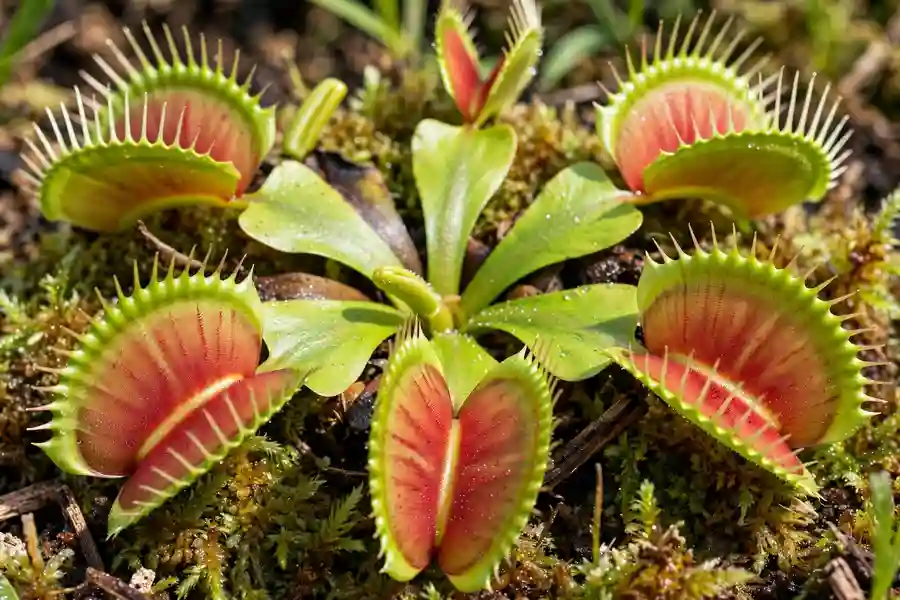
Venus fly trap at a glance
| Question | Answer |
|---|---|
| Scientific name | Dionaea muscipula (the only species) |
| Plant or animal? | A plant. It photosynthesizes and also digests insects |
| Native to | Coastal bogs of North and South Carolina |
| Light | Full sun: 4 to 6 hours of direct sun, or 12 to 14 hours under a strong full-spectrum grow light |
| Water | Distilled, rain or reverse osmosis water only. Keep the soil damp |
| Soil | Peat moss mixed with perlite or silica sand, or long-fiber sphagnum moss. No fertilizer |
| Temperature | Growing season 70 to 95°F. Winter dormancy 35 to 50°F |
| Humidity | Average is fine. Needs airflow |
| Feeding | Optional. One small insect per trap every 2 to 4 weeks in the growing season. None in winter |
| Repot | Every 1 to 2 years, in late winter or early spring |
| Size | A rosette 4 to 8 inches across, traps 1 to 2 inches |
| Lifespan | 20 years or more with good care |
| Pets | Not considered poisonous to cats or dogs |
What is a Venus fly trap and how does it work?
The Venus fly trap is a carnivorous plant in the sundew family (Droseraceae). It grows a rosette of leaves from an underground stem called a rhizome. Each leaf has a flat stalk (petiole) that photosynthesizes and a trap at the tip.
How the trap works:
- The inside of the trap is often red and the edges give off nectar, which attracts insects.
- Each lobe has three or four small trigger hairs.
- If an insect touches a hair twice within about 20 seconds, or touches two hairs, the trap snaps shut in a fraction of a second. Needing two touches stops it from closing on raindrops or debris.
- The toothed edges (cilia) lock together like bars.
- If the prey keeps moving, the trap seals tight and fills with digestive fluid. The plant absorbs nutrients, mainly nitrogen.
- Digestion takes about a week or more. The trap then reopens, and the empty shell of the insect blows away.
- Each trap can close and digest only a few times before it turns black and dies. The plant grows new ones.
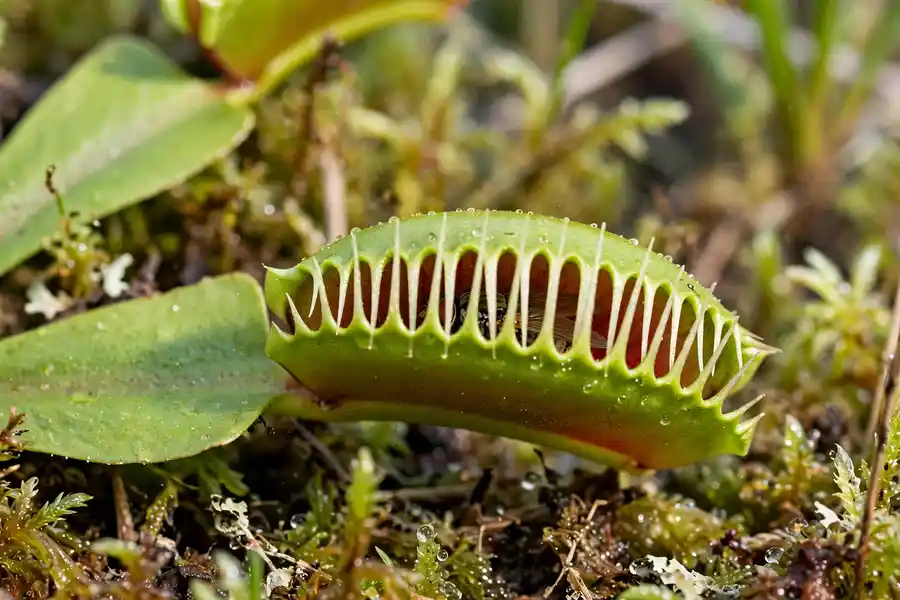
Parts of a Venus fly trap: rhizome, roots, leaf stalk, trap lobes, cilia (teeth), trigger hairs and the flower stalk.
Is a Venus fly trap a producer or a consumer? Both. It is a producer (it makes sugar by photosynthesis) that also eats insects as a nutrient supplement. It is not an animal.
Can a Venus fly trap hurt a human? No. The traps are too small and weak to harm people.
Where are Venus fly traps native?
Only in a small area of coastal North Carolina and South Carolina, within roughly 75 miles of Wilmington, NC, in wet pine savannas and bogs. They are sparse in the wild because of habitat loss and poaching. Taking wild plants is illegal in North Carolina. Buy nursery-grown plants only.
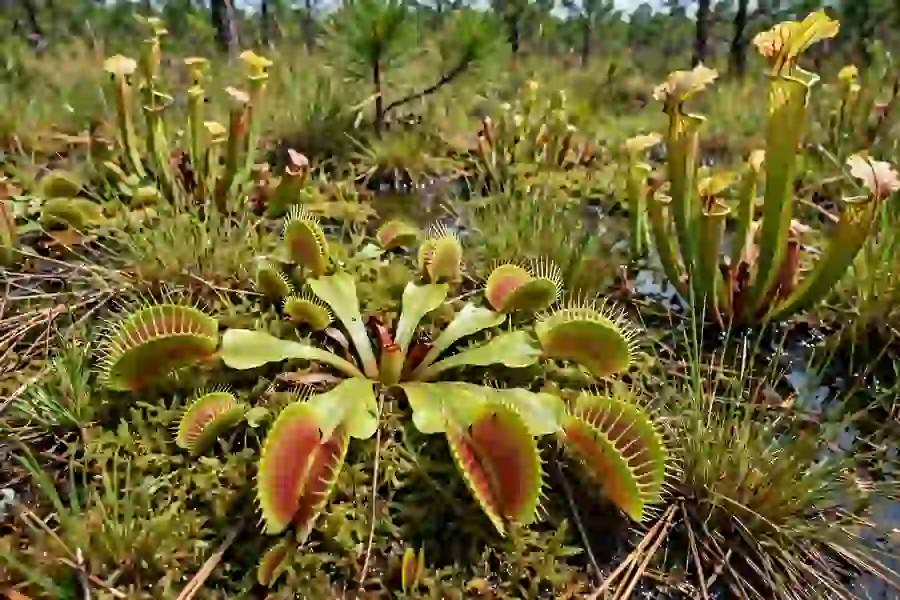
Other carnivorous plants that grow with it: sundews, pitcher plants (Sarracenia) and butterworts. The waterwheel plant (Aldrovanda) is its closest relative. Pitcher plants and flytraps have similar needs: sun, pure water and poor soil. Tropical pitcher plants (Nepenthes) are different.
How much light does a Venus fly trap need?
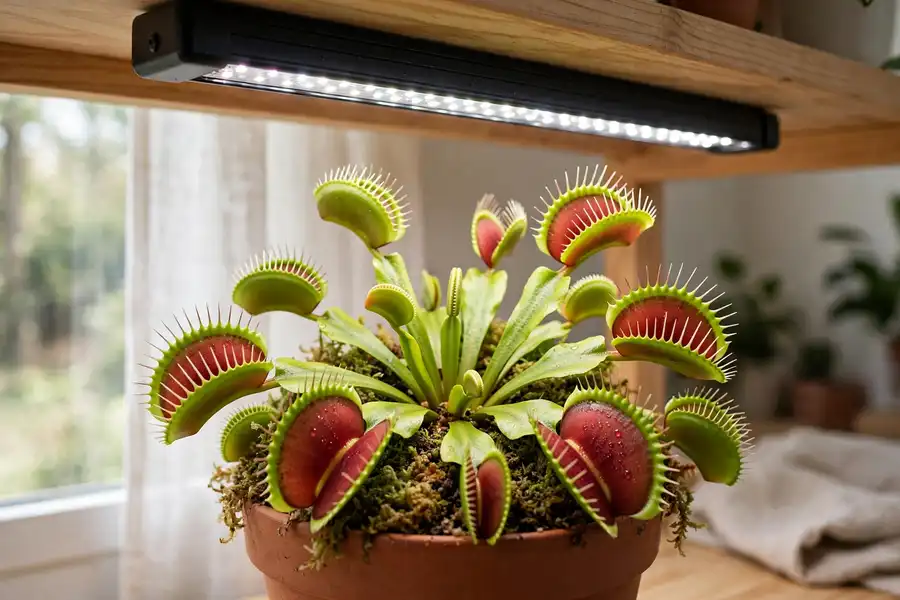
4 to 6 hours of direct sun a day, or a strong full-spectrum LED grow light for 12 to 14 hours, placed 6 to 12 inches away. A bright south window in a hot house can work with a grow light as backup. Low light gives weak, floppy growth and green traps. Strong light gives sturdier plants and red trap interiors. Outdoors, give full sun.
What water does a Venus fly trap need?
Only distilled water, rain water or reverse osmosis water. Tap water, spring water and bottled mineral water contain minerals that build up in the soil and kill the plant. Target total dissolved solids under about 50 parts per million.
- How often: keep the soil constantly damp. Stand the pot in a tray with 1/2 to 1 inch of water in the growing season, and refill it when dry. Often every 1 to 3 days in summer.
- In winter: keep the soil just damp, not sitting in water.
- Never use fertilizer or hard water.
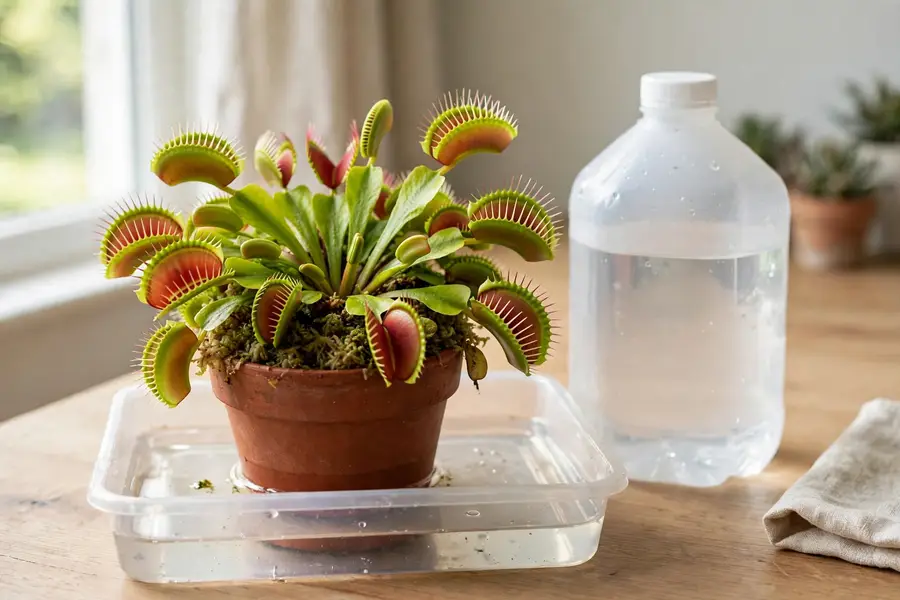
What soil and pot does a Venus fly trap need?
- Soil: nutrient-poor and acidic: a 1:1 mix of sphagnum peat moss and perlite, or peat and lime-free silica sand. Long-fiber sphagnum moss also works. Never use regular potting soil, compost or fertilizer.
- Pot: plastic or glazed ceramic with a drainage hole, at least 4 inches deep, so the roots have room. Unglazed terracotta leaches minerals. Choose a 3 to 4 inch pot for a small plant and a 5 to 6 inch pot for a mature one.
- Terrarium: a closed terrarium causes rot and mold. If you use one, it must be open, with strong light and airflow.
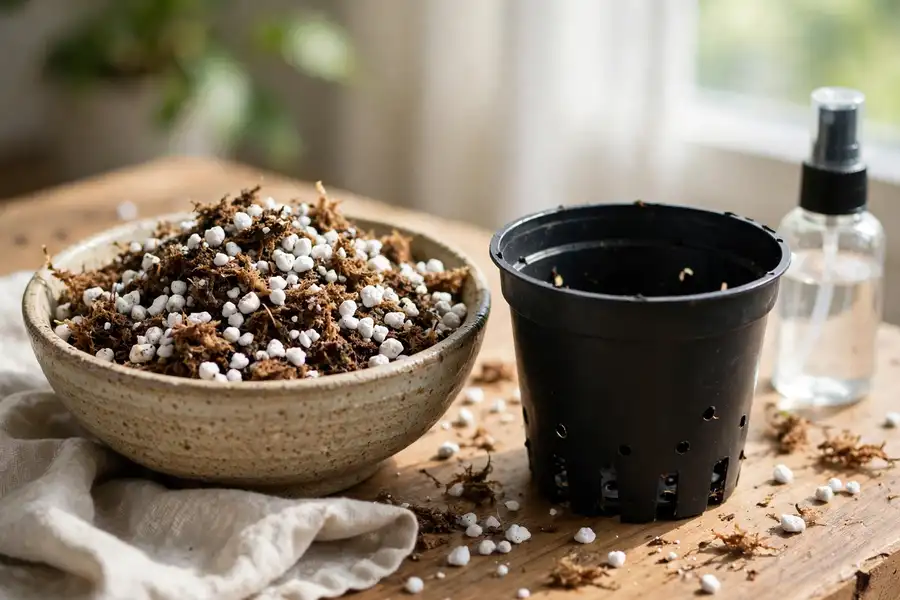
What do you feed a Venus fly trap?
Feeding is optional. A healthy plant lives on light alone, and feeding mainly adds growth.
What to feed: small live or freshly killed insects such as fruit flies, gnats, flies, ants, small spiders, crickets and small beetles. You can use rehydrated freeze-dried bloodworms or dried insects. Prey should be no more than about one third the size of the trap. Fruit flies are a good size.
What not to feed: hamburger, cheese or any human food, dead food that is large, or anything that does not move on its own. Rotting prey makes the trap turn black.
How to feed:
- Place a small insect in an open trap.
- If it does not move, gently squeeze the trap with tweezers to trigger it, then massage the trap for a few seconds to signal the plant to digest.
- Feed only one or two traps at a time.
- Feed every 2 to 4 weeks in the growing season, and wait until a trap has reopened before feeding it again.
- Do not feed in winter dormancy.
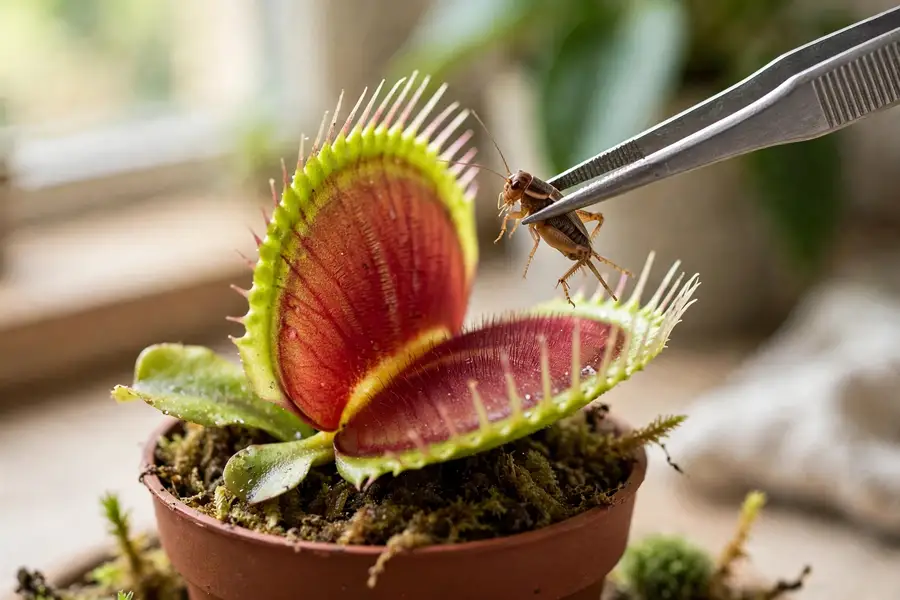
Can you overfeed a Venus fly trap? Yes. It causes rot and black traps. Does it eat dead bugs? Yes, if you rehydrate them and massage the trap. Does it catch fruit flies and gnats? Yes, but one plant will not clear an infestation.
If the trap closes with no food (false trigger), it reopens in a day or so but wastes energy. Do not poke it.
Does a Venus fly trap need winter dormancy?
Yes. From about November to February, the plant rests for 3 to 4 months. Skipping dormancy weakens it, and it may decline within a year or two.
- Temperature: cool, about 35 to 50°F.
- Light: still bright, but days are shorter. Growth slows, and traps are small and may turn black.
- Water: keep the soil damp.
- Feeding: none.
- How: outdoors in mild climates, or an unheated garage or cool windowsill. In warm climates, the refrigerator method works: wrap the roots in damp sphagnum moss, seal in a bag and store in the fridge for about 3 months.
- Wake-up: in late winter, put it back in bright light and warm temperatures and start feeding when new growth appears.
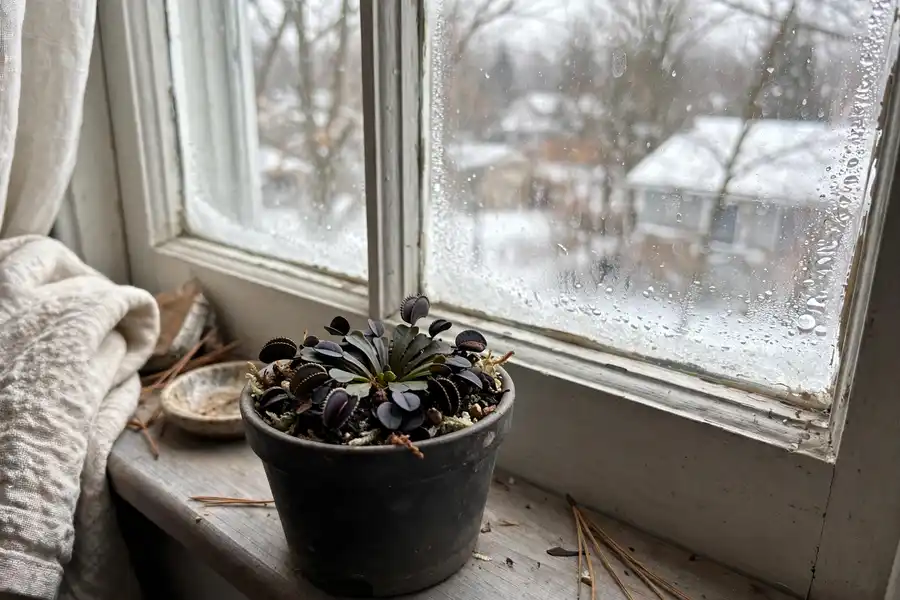
How do you repot a Venus fly trap?
Repot every 1 to 2 years in late winter or early spring, when dormancy ends.
- Gently remove the plant and rinse the old soil off with distilled water.
- Trim dead leaves and black roots.
- Plant the white rhizome in fresh peat-and-perlite mix, with the green leaves above the surface.
- Water with distilled water and place in bright light.
Can a Venus fly trap live outside?
In zones about 7 to 10, yes. Keep it in a bog garden or pot in full sun with pure water, and mulch in cold snaps. Elsewhere, put the pot outside in summer, where it will also catch its own prey, and bring it to a cool place in winter.
Does a Venus fly trap flower?
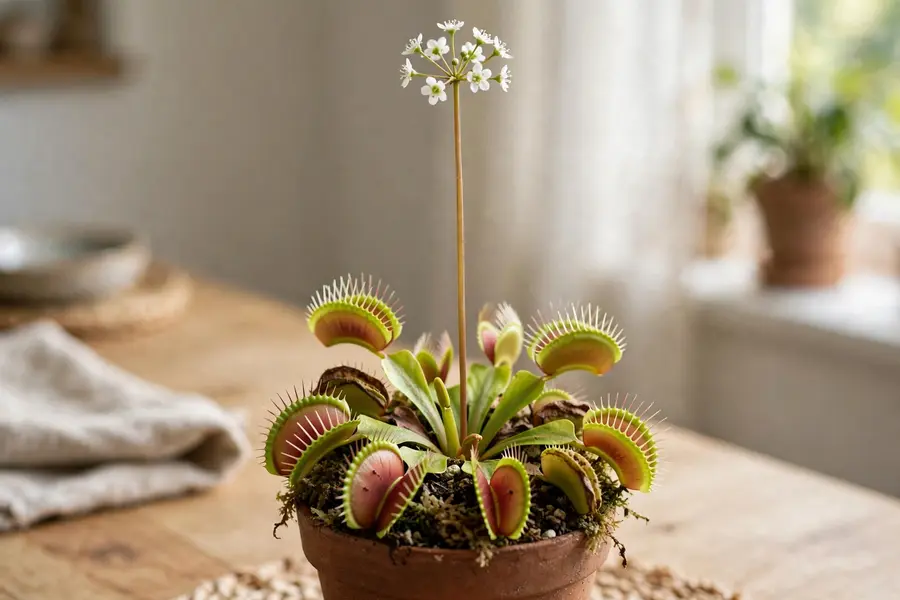
Yes, in spring (March to May). A tall stalk of small white flowers rises above the traps. The flowers use a lot of energy. For a weak or young plant, cut the stalk off when it is 2 to 3 inches tall to keep the plant strong. Leave it if you want seeds.
How do you propagate a Venus fly trap?
- Division: split rhizomes in spring when repotting. Each piece needs roots and leaves.
- Leaf pulling: pull a whole leaf with its white base and lay it on damp peat. It may grow a new plantlet in weeks to months.
- Seeds: sow fresh seed on the surface of damp peat and sand in bright light. Germination takes weeks. Plants take 3 to 5 years to mature.
- Flower stalk cuttings also work.
What are the types of Venus fly trap?
The species is one. The "types" are cultivars.
| Cultivar | Look |
|---|---|
| Typical (green/red) | Green outside and red inside in strong light |
| B52 | Very large traps, red inside |
| Akai Ryu (Red Dragon) | Deep red all over |
| Red Piranha | Red with long teeth |
| King Henry | Large, vigorous plant |
| Dente | Long, interlocking teeth |
| Alien, odd-shaped forms | Strange curled or fused traps |
| Jungle Giant, giant types | Bred for large traps |
Colors: green to deep red or maroon, depending on light. There is no real blue, pink or black Venus fly trap. Photos of blue ones are edited, and a "black" trap is dying. A "purple" one is usually deep red-purple under strong light.
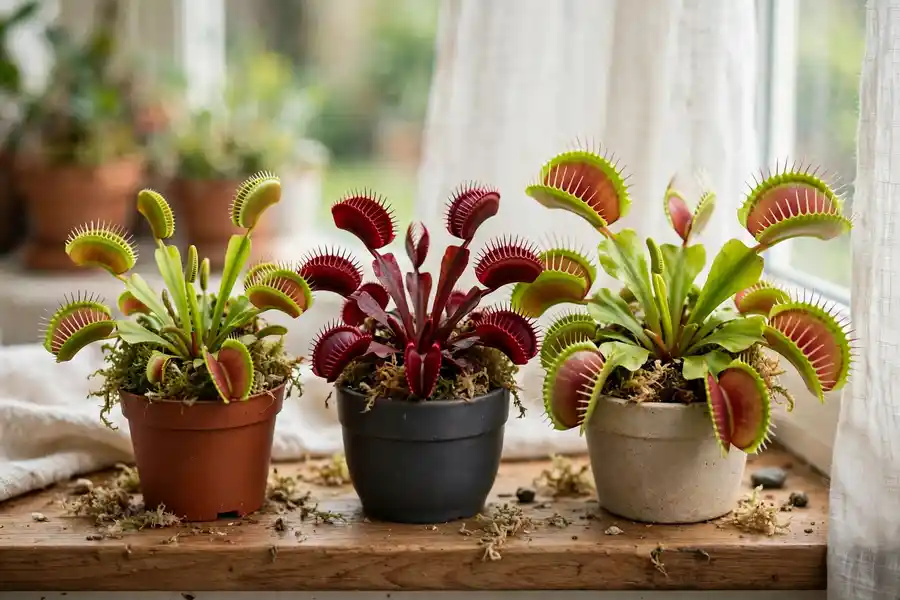
How big does a Venus fly trap get? A rosette 4 to 8 inches wide, with traps usually 1 to 1.5 inches. Large cultivars have traps up to about 2 inches. Claims of "giant" ones are mostly from big cultivars and good care.
Why is my Venus fly trap turning black?
| Cause | What to do |
|---|---|
| Normal aging of an old trap | Trim off the black trap with scissors |
| Winter dormancy | Normal. Trim dead leaves in spring |
| Overfeeding or prey too big, rotting inside | Do not feed. Feed less |
| Tap water or minerals, fertilizer | Flush the soil with distilled water. Never fertilize |
| Poor light or transplant shock | Give brighter light, wait |
| Root rot, soggy dead soil | Repot, improve drainage |
| Dead plant | Check the rhizome. White and firm is alive. Black and mushy is dead |
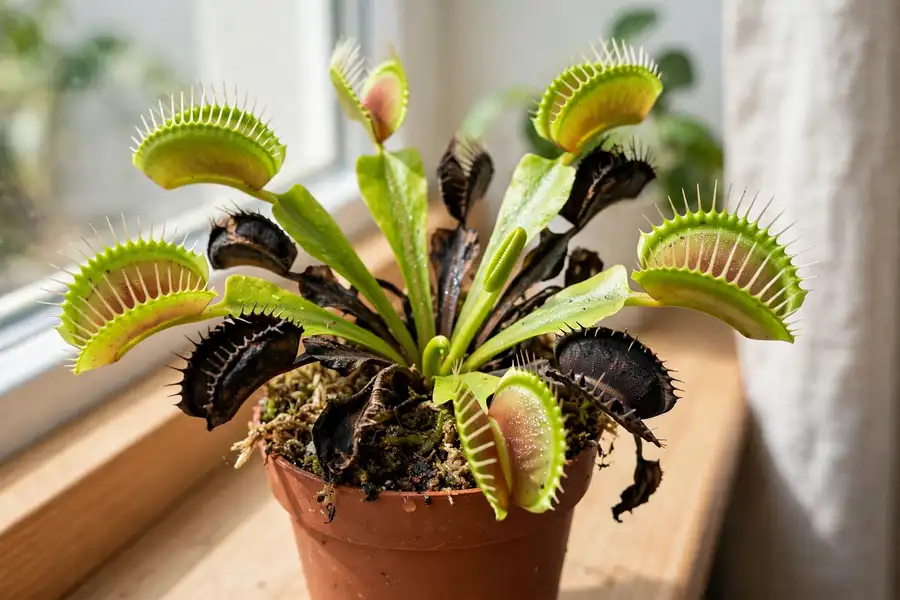
Yellow leaves: usually low light, hard water or stress. Drooping or floppy leaves: not enough light, heat stress, or recent repotting. Unhealthy or sick plants: check light, water quality and dormancy first. A healthy plant has stiff, upright traps.
Healthy vs unhealthy: healthy leaves are firm and upright, with green or red traps that snap shut. Unhealthy leaves are floppy, black or mushy.
How long does a Venus fly trap live?
With good care it can live 20 years or more, growing into a clump. Individual traps live a few weeks to months.
Is a Venus fly trap safe for cats and dogs?
It is not considered poisonous to cats or dogs. I could not confirm an official listing, so treat chewing as a risk for the plant, not the pet. Call a vet if your pet gets sick.
Venus fly trap facts
- Native only to a small part of the Carolinas.
- Needs two touches within about 20 seconds to close.
- Digests prey over about a week.
- Each trap closes only a few times in its life.
- Gets some nutrients from insects, but light provides its energy.
- Named for Venus, the Roman goddess of love. The genus name Dionaea refers to her mother, Dione. The species name muscipula means mousetrap in Latin.
- It rests every winter.
Quick answers to common questions
What do you feed a Venus fly trap?
Small live or rehydrated insects such as fruit flies, ants or small crickets, one per trap every 2 to 4 weeks in the growing season. Never human food.
What water does a Venus fly trap need?
Distilled, rain or reverse osmosis water only. Tap water kills it over time.
Why is my Venus fly trap turning black?
Old traps blacken naturally. Dormancy, overfeeding, tap water and low light are the other common causes.
Does a Venus fly trap need dormancy?
Yes, 3 to 4 months of cool, 35 to 50°F rest each winter.
Where are Venus fly traps native?
Coastal North and South Carolina, mostly around Wilmington, NC.
Keep reading: spider plant care, jade plant care, peace lily care, how to get rid of gnats and more houseplant guides.
Is a Venus fly trap worth growing?
Yes, if you can supply sun, pure water and a winter rest. A Venus fly trap is a long-lived curiosity that rewards the right conditions. Give it distilled water, poor soil and bright light, feed it sparingly, and let it rest each winter.