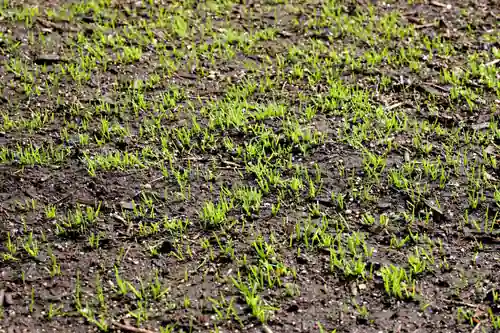
Mow low, open up the soil, spread seed so it touches bare dirt, then keep it damp until it fills in. The best time for most lawns is late summer to early fall. Seed that lands on thick thatch or dry ground rarely takes root, so the prep matters more than the seed. Expect sprouts in one to four weeks and a thicker lawn in a couple of months.
Reseeding a lawn at a glance
| Question | Short answer |
|---|---|
| Best time for cool-season grass | Late summer to early fall, when soil is about 50 to 65°F |
| Best time for warm-season grass | Late spring to early summer, once soil is warm |
| Key step | Seed-to-soil contact, from aerating or slit seeding |
| How much seed | Read the bag. Overseeding uses about half the new-lawn rate |
| Watering | Light, frequent watering until seedlings are up |
| Sprouts appear | About 1 to 4 weeks, depending on the grass |
| First mow | When seedlings are about 3 to 3.5 inches tall |
| Rough pro cost | About $150 to $900 for overseeding, more for a full lawn |
When is the best time to reseed a lawn?
Seed when the soil temperature suits your grass. For cool-season grasses such as Kentucky bluegrass, tall fescue and perennial ryegrass, that is when soil is about 50 to 65°F. In most northern lawns this means late summer to early fall. Warm-season grasses such as Bermuda and zoysia need warmer soil and are seeded in late spring to early summer.
How do you reseed a lawn in the fall?
Fall is the best season for cool-season lawns. The soil is still warm, the air is cooler, and there is less weed competition. In the north, that is roughly late August to mid-September, and in the transition zone early September to early October. A common rule is to finish about six weeks before the first hard frost, but check your local extension office for exact dates.
How do you reseed a lawn in the spring?
Spring works as a second choice. Seed cool-season lawns once the soil reaches about 50 to 65°F, usually March to mid-April in many areas. The drawbacks are more weeds, and young grass that has to survive summer heat. Do not use a crabgrass preventer if you plan to seed, because it stops grass seed from growing too.
Can you reseed a lawn in the summer?
Not cool-season grass. Summer heat and dry spells make seedlings struggle and fail. Warm-season grass is the exception, because it likes warm soil. For Bermuda, one state guide gives May 1 to June 15 as the best planting window. If it is past mid-August, it is usually too late to seed warm-season grass for that year.
What is the difference between reseeding and overseeding?
Overseeding adds seed to a lawn that is still alive, to thicken it. Reseeding is the broader word for sowing seed again, and it can mean spot repair on bare patches or starting over on a whole lawn. The steps are close, and the main difference is how much old grass you remove first.
| Job | What you do | When to choose it |
|---|---|---|
| Overseeding | Seed over thin, tired turf | Lawn is thin but mostly alive |
| Spot repair | Reseed bare patches only | A few dead or bare spots |
| Full renovation | Kill and remove the old lawn, then seed | Mostly dead, weedy or the wrong grass |
What do you need to reseed a lawn?
A few basic tools and materials. Most of them can be rented or borrowed.
- Grass seed that matches your region, light and traffic
- A lawn mower, and a bagging attachment or rake
- A dethatching rake or power dethatcher, if thatch is thick
- A core aerator or slit seeder
- A spreader
- Starter fertilizer
- A sprinkler and hose with a timer, if you have one
- Topsoil, compost or sand, for covering or leveling
A soil test is worth doing before you start. It shows whether the soil is too acidic or lacks nutrients, which can be why grass failed in the first place.
How to reseed a lawn, step by step
Prepare the surface, open the soil, seed, feed, water and wait. This sequence works for overseeding and for patches. Skip or change steps only when your lawn is in good shape.
- Mow low. Cut to about 1.5 to 2 inches, without scalping, and bag the clippings.
- Clear debris. Rake off leaves, sticks and dead grass.
- Dethatch if needed. A thatch layer thicker than about 1/2 inch can block water and seed from reaching the soil.
- Aerate or slit seed. Core aeration relieves compaction and leaves holes for seed. Do it when the soil is moist, not soggy.
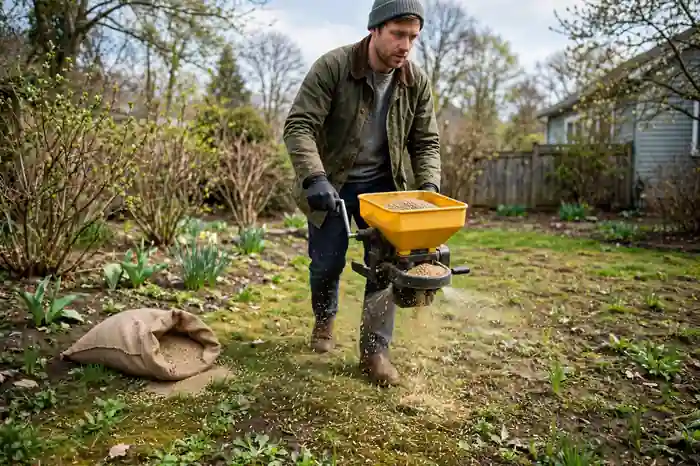
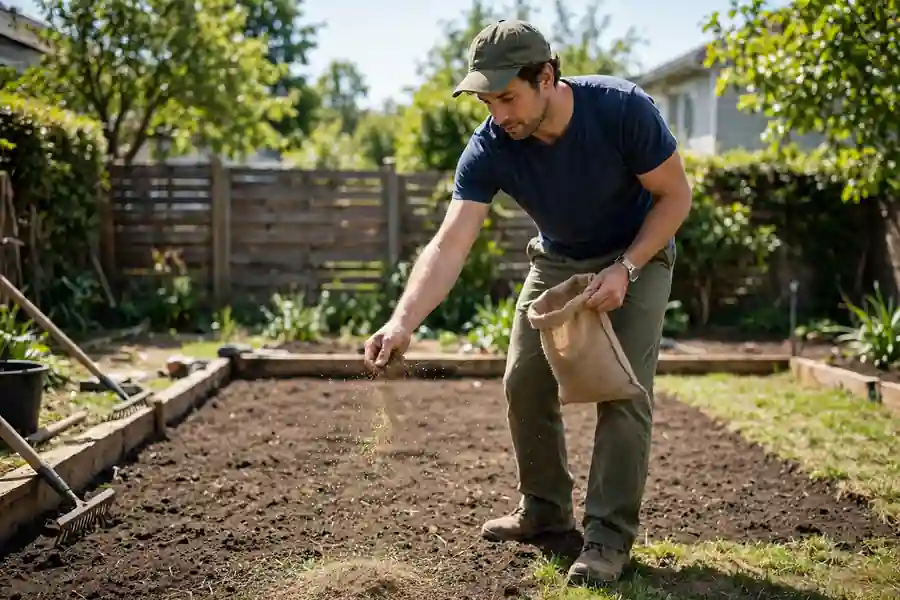
- Spread the seed. Use a spreader, and apply half the seed in one direction and half at a right angle, so coverage is even.
- Add starter fertilizer. Choose a product made for new seed, applied just before or after seeding. Check local rules, because some areas limit phosphorus.
- Water lightly. Keep the top layer damp until seedlings are up.
- Hold off on mowing. Wait until the grass is about 3 to 3.5 inches tall, then cut it to 2.5 to 3 inches with a sharp blade.
Why does seed-to-soil contact matter?
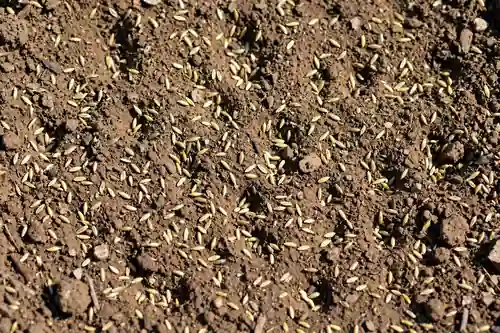
Seed that sits on top of thatch or hard ground does not root well. Grass seed needs to be in contact with moist soil to germinate and anchor. Aerating, slit seeding or lightly raking the surface puts the seed where it can grow. Do not bury it deeply, since a thin cover of about 1/4 inch of soil or sand is enough.
How much grass seed do you need?
Follow the bag, and use about half the new-lawn rate when overseeding. Rates vary by grass and by source, so treat the figures below as general ranges per 1,000 square feet.
| Grass | Overseeding | New lawn |
|---|---|---|
| Tall fescue | About 4 to 6 lb | About 6 to 9 lb |
| Kentucky bluegrass | About 1.5 to 3 lb | About 2 to 4 lb |
| Perennial ryegrass | About 4 to 8 lb | About 5 to 8 lb |
University turf guidance often lists lower rates than lawn-care retailers. Seeding too thick can crowd the seedlings and invite disease, so more is not better.
How do you water new grass seed?
Keep the seedbed damp with light, frequent watering. Seed dries out fast on the surface, and dry spells after germination can kill new sprouts. The goal is moist soil, not puddles.
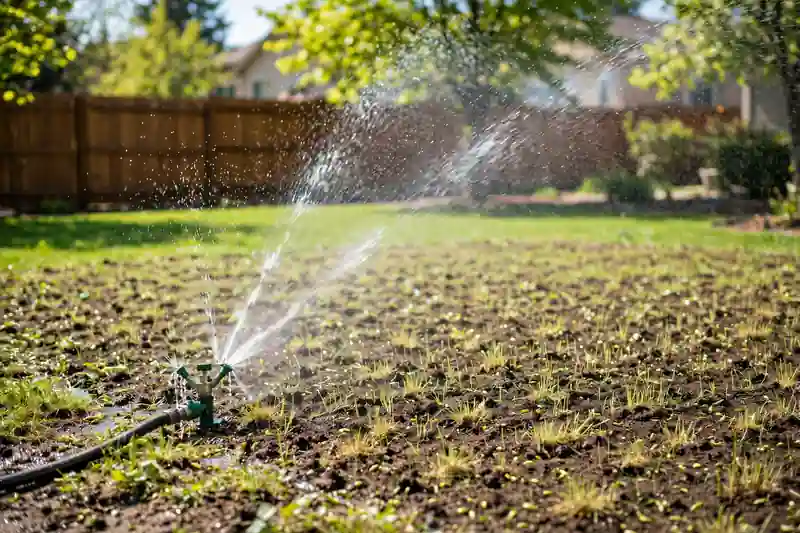
- Until sprouts appear: water lightly, a few times a day if it is hot or windy.
- Weeks 2 to 4: cut back on how often, and water a bit longer each time.
- Weeks 4 to 8: move toward deeper watering, less often.
- After that: about an inch of water a week, in the morning, including rain.
Most failed reseeding jobs come from too little water. Adjust for heat, wind and sandy soil, which dries out faster.
How long does grass seed take to grow?
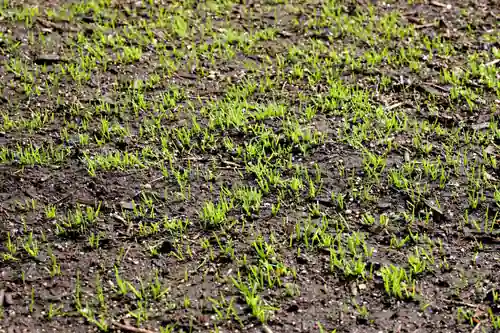
Anywhere from one to four weeks to sprout, depending on the grass. Perennial ryegrass is fastest, tall fescue is next, and Kentucky bluegrass is slowest. A lack of green in the first weeks is normal for bluegrass.
| Grass | Sprouts in | Notes |
|---|---|---|
| Perennial ryegrass | About 5 to 14 days | Fastest cool-season grass |
| Tall fescue | About 7 to 14 days | Good for sun and traffic |
| Kentucky bluegrass | About 14 to 30 days | Slow to start, spreads well |
Mow for the first time when the seedlings reach about 3 to 3.5 inches, which often takes three to six weeks. Remove no more than the top third of the blade, and use a sharp blade.
How do you reseed a patchy lawn?
Find out why it is patchy, fix that, and then reseed the bare spots. If the cause is still there, the new grass will die too. Common causes are listed below.
| Cause | Clue | Fix before seeding |
|---|---|---|
| Drought or heat | Gray-green, then brown, grass after dry weather | Water deeply, then reseed |
| Dog urine | Small round brown spots with a dark green ring | Rinse spots, train pets to another area |
| Grubs | Grass pulls up like a loose carpet | Treat the grubs, then reseed |
| Disease | Spreading patches in humid weather | Improve airflow and drainage, treat if needed |
| Shade | Thin grass under trees or buildings | Use shade-tolerant seed, or switch to ground cover |
| Compaction | Hard soil, water runs off | Core aerate |
| Chemical spill | A sharp-edged brown patch | Flush with water, then reseed once soil recovers |
Dormant grass looks dead but is alive, and the blades bend. To test, tug it. Dead grass comes up easily, while rooted grass holds.
To fix a bare patch, rake out the dead grass, loosen the top inch or two of soil, mix in a bit of compost or topsoil, spread seed, press it in lightly and water.
How do you reseed a dead lawn, or tear up a lawn and reseed?
Kill the old grass and weeds, clear the dead material, loosen the soil and seed. This is a full renovation, and it makes sense when most of the lawn is dead, full of weeds or the wrong type of grass. Do it in late summer or early fall for cool-season lawns.
- Skip mowing for a few days, and water so weeds and grass are actively growing.
- Spray a non-selective herbicide such as one with glyphosate, following the label. It works only on growing plants, and it can take up to two weeks to kill everything.
- Wait about a week before raking or aerating, so the herbicide can move to the roots. Check the label, because some glyphosate products include a pre-emergent that stops seed from growing.
- Mow very low, to about 1/2 inch, and rake off the dead material.
- Loosen the soil with a core aerator, a slit seeder or a tiller, and level low spots.
- Seed in two directions at the new-lawn rate.
- Cover lightly with about 1/4 inch of topsoil or sand, and add starter fertilizer.
- Water as described above.
How do you reseed a lawn with weeds or crabgrass?
Kill or pull the weeds first, avoid herbicides that stop seed, and seed in the fall. Many weed killers and crabgrass preventers stop grass seed from sprouting, so pick the timing carefully.
- Do not use weed-and-feed or a crabgrass preventer before you reseed.
- If you use glyphosate on a weedy lawn, wait about seven days before you work the soil, and check the product label.
- For a few weeds, pull or spot-treat them instead of spraying everything.
- After seeding, wait for about three mowings, or roughly 60 days, before you use a selective herbicide on young grass. Follow the label.
- Fall seeding gives the new grass a head start before crabgrass appears in spring.
How do you level and reseed a lawn?
Fill low spots with a thin layer of topsoil or a sand and soil mix, then seed. A thick layer smothers the grass beneath. Work in thin layers and let the grass grow through each one, rather than burying it all at once.
- Mow low and dethatch if needed.
- Spread a thin layer of topsoil, compost or a sand and soil mix over the low area.
- Rake it level, and work it down to the soil.
- Seed, and cover the seed lightly.
- Water as you would for any new seed.
How do you reseed a lawn by hand?
Use a hand-held broadcast spreader, or throw the seed in even sweeps. Divide the seed in half and spread the first half in one direction, then the second half at a right angle. Rake the area lightly so the seed touches soil, and water gently. For small patches, mix the seed with a bit of sand so you can see where it falls.
How much does it cost to reseed a lawn?
Doing it yourself costs a fraction of hiring a pro. Seed, starter fertilizer and a rented aerator are the main costs. A pro overseeding job often runs a few hundred dollars for a typical yard, and a full seeding of a quarter acre is about $1,200 in several cost guides.
| Service | Rough cost |
|---|---|
| Pro seeding, per square foot | About $0.07 to $0.23 |
| Hydroseeding, per square foot | About $0.08 to $0.21 |
| Slice seeding, per square foot | About $0.08 to $0.18 |
| Core aeration | About $75 to $200 |
| Overseeding a small or medium lawn | About $150 to $600 |
| Aeration plus overseeding | About $225 to $900 |
Prices vary by region and lawn size. Seed prices vary a lot by grass type and brand, so check bag prices locally.
What mistakes should you avoid?
Most failures come from poor timing, poor contact and poor watering.
- Seeding at the wrong time, especially cool-season grass in summer
- Skipping aeration or leaving thick thatch
- Putting down a crabgrass preventer first
- Letting the seedbed dry out
- Seeding too thickly
- Mowing too soon, or with a dull blade
- Reseeding without fixing the cause of the bare spots
Quick answers to common questions
When is the best time to reseed a lawn?
Late summer to early fall for cool-season grass, when soil is about 50 to 65°F. For warm-season grass, late spring to early summer.
How much grass seed do you need to reseed a lawn?
Follow the bag. Overseeding often uses about half the new-lawn rate, such as 4 to 6 pounds of tall fescue or 1.5 to 3 pounds of Kentucky bluegrass per 1,000 square feet.
How often should you water new grass seed?
Lightly, a few times a day, until sprouts appear. Then water less often and for longer as the seedlings fill in.
How long does grass seed take to grow?
About 1 to 4 weeks, with ryegrass fastest and Kentucky bluegrass slowest.
Can you reseed a lawn with weeds in it?
Yes, but control the weeds first, avoid products that block seed, and seed in the fall.
Keep reading: natural weed killer options and more lawn and garden guides.
Is it worth reseeding a lawn?
Yes, if you do it at the right time. To reseed a lawn well, prepare the soil, spread the right amount of seed, keep it damp and wait to mow until it is tall enough. Fix the cause of any bare spots, and a few hours of work in early fall can give you a thicker, greener lawn by spring.