To get rid of yellow jackets, you have to destroy the nest, because killing the ones you see does nothing about the hundreds behind them. A small nest in the open can be treated at dusk with the right gear. Nests in the ground near people, and any nest inside a wall, siding or attic, are jobs for a pest professional. Traps and home remedies only thin the numbers.
Yellow jackets are the stinging insect most likely to turn a backyard into a hazard. They defend their nest hard, can sting more than once, and show up at cookouts and soda cans in late summer. This guide covers ground nests, walls, siding, soffits, the house and the yard, and tells you where DIY stops being safe.
How to get rid of yellow jackets at a glance
| Situation | Best move |
|---|---|
| Nest in the ground, away from people | Treat at night with a labeled wasp dust, if you are not allergic |
| Nest in the ground by a door, path or play area | Call a pro |
| Nest in a wall, siding, soffit, attic or chimney | Call a pro. Do not plug the hole |
| Small nest in a shrub or tree | Soapy water or a labeled spray at dusk, or call a pro |
| Yellow jackets at a picnic or pool | Cover food and drinks, and set decoy traps far away |
| Nest you cannot find | Watch where workers fly, then follow the line |
| Anyone in the home is allergic to stings | Call a pro, always |
| Frost has already come | Leave the dead nest alone |
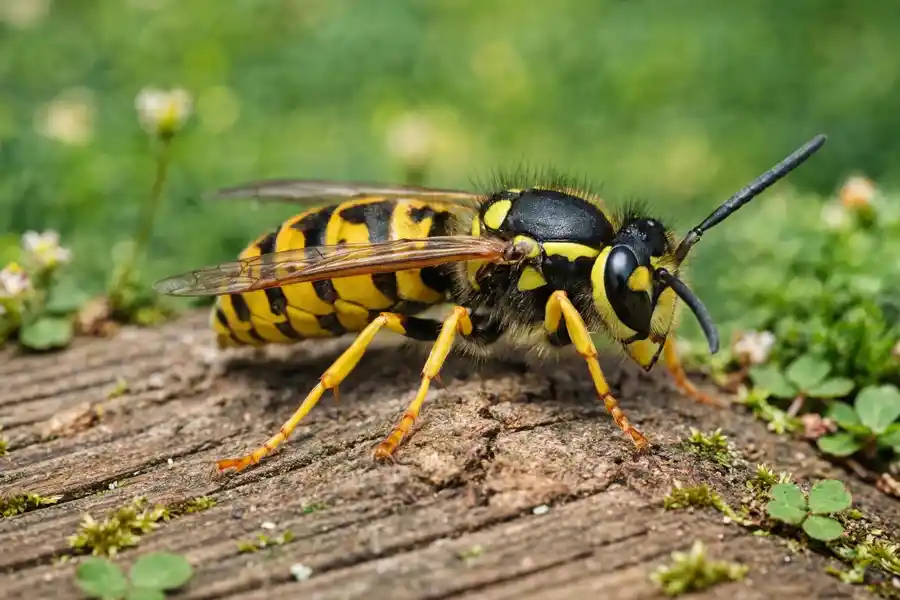
Is it really a yellow jacket?
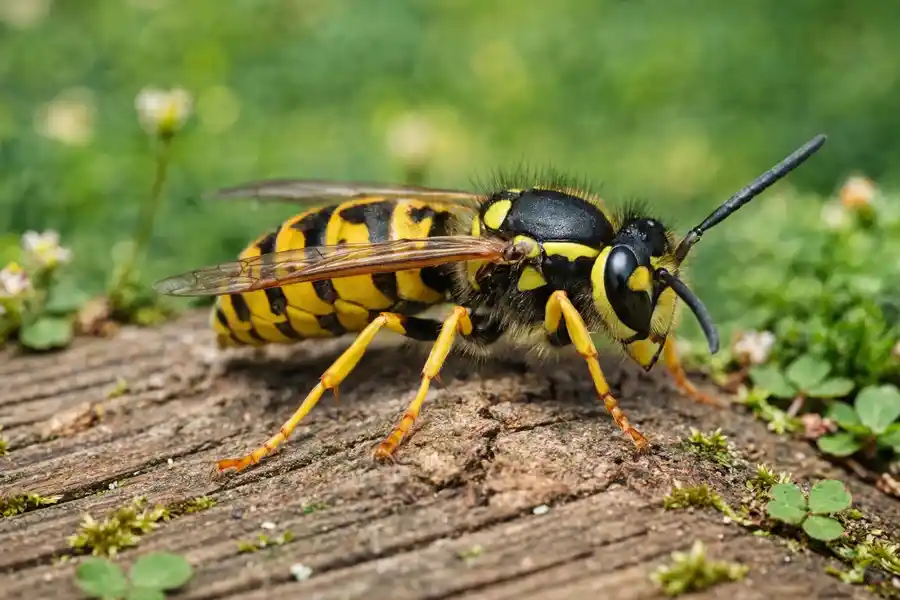
Yellow jackets are small, smooth and sharply marked with bright yellow and black bands. Bees are rounder and fuzzy, and paper wasps are longer, with dangling legs. Bald-faced hornets are black with a white face. Getting the animal right matters, because honey bees should be moved by a beekeeper, not killed.
Ground bees are another common mix-up. They are solitary, fuzzy bees that make small dirt mounds in lawns, and they rarely sting. A yellow jacket ground nest is a single hole with many wasps flying in and out of it, all day, in a steady stream. The same advice applies to the eastern, western, southern and German yellow jackets, though the German type often nests inside walls.
Should you kill yellow jackets at all?
Only when they nest where people live or play. Yellow jackets eat many pest insects and pollinate some flowers, so a nest far from the house does little harm and can be left alone. A nest by a doorway, a deck, a pool or a play area is different, because one disturbed nest can send dozens of wasps out at once.
Where do yellow jackets build their nests?
They nest in the ground, often in an old rodent burrow, and in sheltered gaps in buildings. Common spots are lawns, mulch beds, woodpiles, tree stumps, railroad ties, shrubs and bushes, large flower pots, garden beds, and the voids behind siding, soffits, eaves, brick walls, chimneys and attics. The visible hole is often not where the nest is, since the nest can sit a few feet away inside the wall or soil.
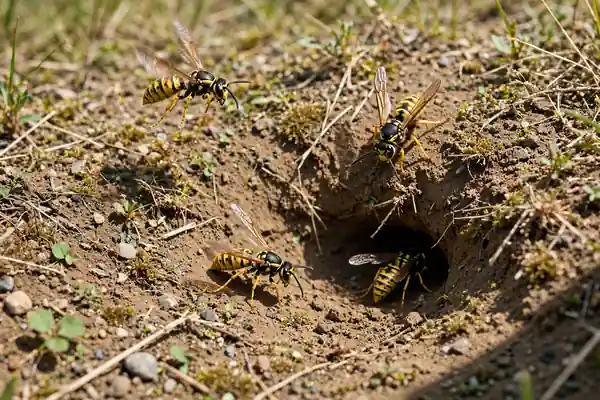
Old burrows matter here. If a mole, vole or chipmunk has dug under your yard, a queen may move in. The chipmunk guide explains how to deal with those burrows once the wasps are gone.
When are yellow jackets most dangerous?
Late summer and early fall. A nest starts in spring with one queen, grows through summer, and can hold from several hundred to a few thousand wasps by late summer. By then the workers are chasing sweets, which is why they swarm soda, fruit and picnics.
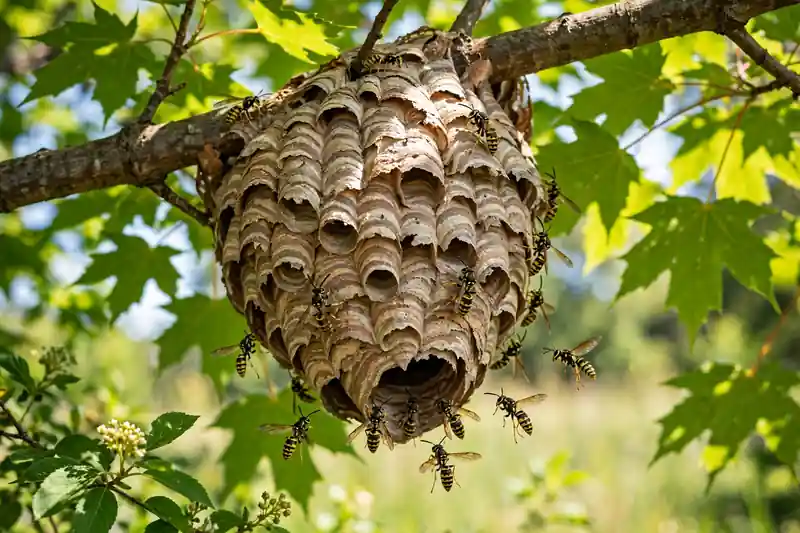
In most regions a hard frost kills the colony, and only the new queens survive, hidden in sheltered spots. Old nests are not reused. If frost has already come, a quiet nest can usually be left until spring, then knocked down or filled in.
How do you stay safe around a yellow jacket nest?
Keep your distance, move slowly and never swat. Yellow jackets release an alarm scent when disturbed, and swinging at them calls more. They can sting several times, and a nest can empty in seconds.
- Stay out of the flight path. Do not mow, trim or use a leaf blower near a nest.
- If they attack, walk away fast and shield your face. Get inside a house or car. Do not jump in water, since they wait.
- Wash a sting, put a cold pack on it, and take an antihistamine if your doctor has said that is fine.
- Know the emergency signs. Trouble breathing, swelling of the face or throat, widespread hives, dizziness or fainting need a call to emergency services right away. If the person has an epinephrine injector, use it and still get care.
- Know who is at risk. Anyone with a past strong reaction to stings should not go near a nest.
Should you handle a yellow jacket nest yourself?
Only if the nest is small, easy to reach and away from people, and no one at home is allergic. Extension sources note that yellow jackets defend nests aggressively, that disturbing one can bring many stings, and that using chemicals near an active nest is a job for a professional.
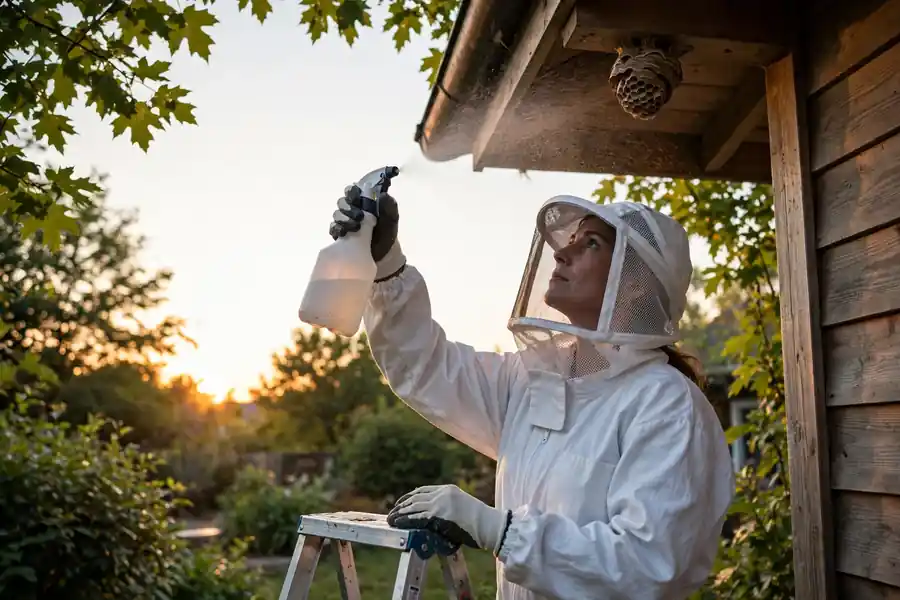
How do you get rid of yellow jackets in the ground?
Treat the nest entrance at night with a dust or spray labeled for wasps, from a safe distance, with all skin covered. Most wasps are inside after dark and less active. Use only what the label allows for ground nests, and follow every direction on it.
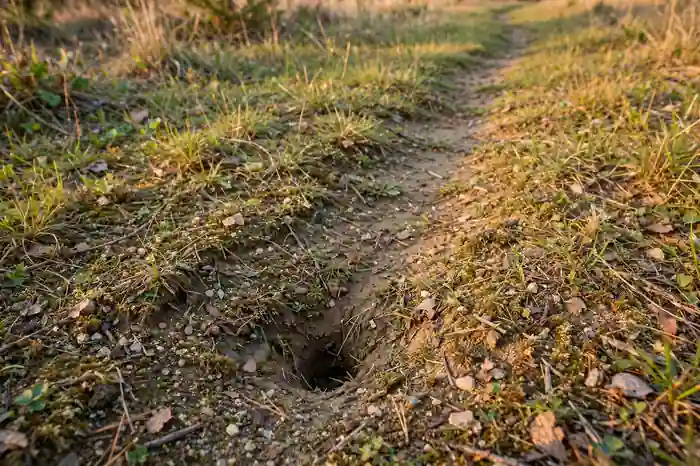
- Wait for full dark, when the foragers are home. Dusk or dawn can still have traffic, so darker is safer.
- Dress for it. Wear thick long sleeves and pants, gloves, boots, a hat and a veil. Tape the cuffs.
- Use a red light. Bright white light draws wasps. A flashlight with red film or a red bulb bothers them less.
- Apply as labeled. Dust the entrance so returning wasps carry it inside. Stay out of the area beyond what the label needs.
- Leave the hole open and walk away right away. Plugging it can drive wasps to chew another exit, sometimes into the house.
- Check again the next evening. A few days later, if traffic has stopped, fill the hole.
Do not pour gasoline or other fuels into a nest. It is a fire and fumes hazard, it contaminates the soil, and it is often illegal. Do not burn a nest or flood it, since both anger the wasps and rarely work.
How do you get rid of yellow jackets in a wall, siding, soffit or attic?
Call a pro. A wall nest can sit several feet from the hole you see, so a surface spray does little and may push wasps into the living space. A professional can find the cavity, dust or fog the void, and sometimes drill an access point.
Whatever you do, do not plug the entrance. Government guidance warns that wasps can chew through wood or follow wiring or pipes into a room, and sealing a live nest can send them inside. Seal the opening only once the nest is dead, and that means no activity for several days.
If you only see a few wasps indoors, they may be coming from a nest in a wall or attic. Look for a steady stream at one spot on the outside wall, a buzzing sound, or stains on the ceiling. Stray wasps inside can be removed with a trap or a labeled spray, but that is a stopgap.
- Siding, brick, stone and block walls: wasps enter at gaps, weep holes and cracks. A pro can treat the cavity.
- Soffits and eaves: a vent gap leads to a cavity. The same rule applies.
- Attic, ceiling, chimney or fireplace: inside spaces are hard to treat safely, and a flue can hold a nest. Call a pro, and keep the damper closed.
- Garage or basement: look for a nest inside a stored item, a crack in a wall or a gap in a sill.
How do you get rid of yellow jackets in a tree, bush or woodpile?
For a small nest you can reach, soapy water or a labeled spray at dusk can work. Extension guidance describes soapy water as useful on small aerial nests, applied at dusk or dawn. It is a close-range job with real sting risk, so use it only on a nest the size of a fist or less, and have a clear escape route.
Woodpiles, stumps, railroad ties and mulch can hold ground-style nests. Do not move a woodpile you suspect, since lifting it disturbs the nest. Treat it like a ground nest, or call a pro.
How do you find a yellow jacket nest you cannot see?
Watch the wasps. Late in the afternoon, sit at a distance and watch where workers fly in a straight line. A steady stream into one point shows the entrance. Wasps leaving with bits of food are heading home, and the direction they take is the direction of the nest. A bait of meat set out in the open can help show the flight line, since workers carry pieces away.
Do not follow them closely, and do not search at night with a bright light. If you cannot pin it down in a few days, a pro can find it quickly.
Do home remedies get rid of yellow jackets?
Mostly they do not. A few can help in a small way, and some are dangerous.
| Remedy | Verdict |
|---|---|
| Dish soap in water | Kills wasps it wets, such as on a small aerial nest. It does not reach a ground nest or a wall cavity |
| Soapy water trap | Catches some, but does not stop a nest |
| Vinegar, peppermint or other scents | Little proof they drive wasps off |
| Boric acid | Slow and unreliable on a nest |
| Fake paper nests | Mixed results. Yellow jackets do not hold territory the way some wasps do |
| Smoke or fire | Dangerous and angers the nest |
| Gasoline | Never. Fire hazard and illegal in many places |
What does dish soap do to yellow jackets? It coats their bodies and wings and they drown or suffocate. A soapy spray bottle works on a wasp you hit directly, and a sudsy mix of water and dish soap is the usual bait liquid in a trap. It is not a nest killer.
Do yellow jacket traps work?
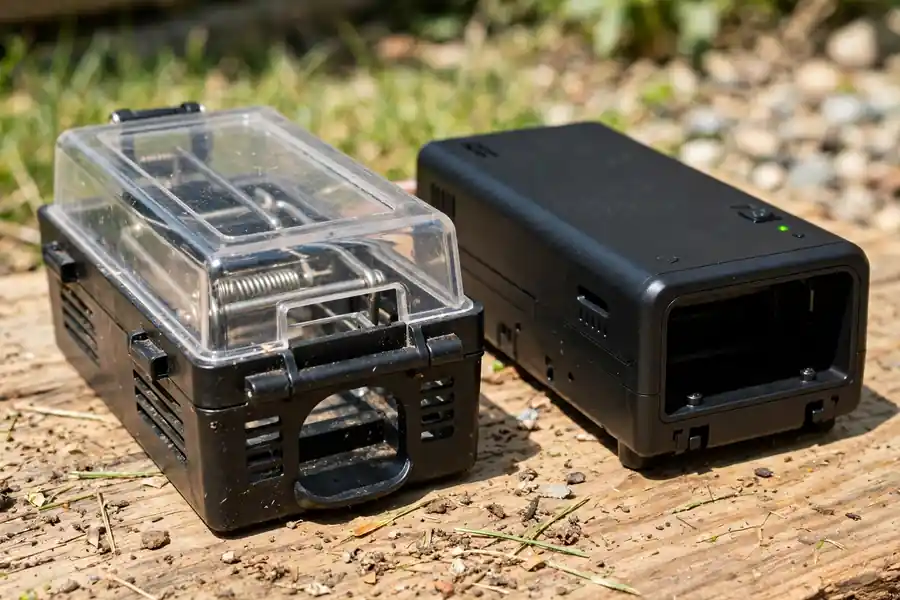
They can cut numbers near a seating area, but they do not eliminate a colony. Extension and university sources say traps work best in early spring, when each queen caught means one fewer nest. Late in summer, trapping did not reduce worker numbers in a field study.
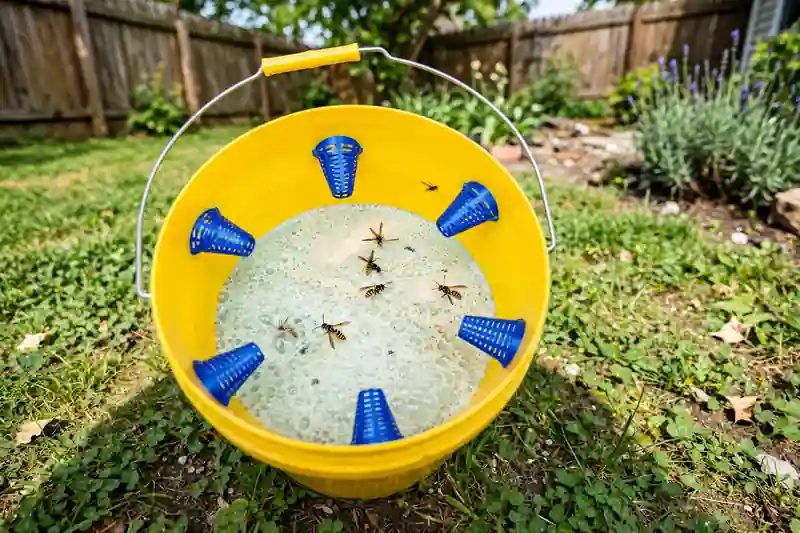
- Bait changes with the season. Yellow jackets want protein in early summer, so use fish or meat. By late summer they want sugar, so switch to a sweet lure. A sweet bait can also draw honey bees, so keep it far from flowers.
- Replace the bait often. Rotting meat repels them, so use fresh bait every few days. Commercial lures last longer, often weeks.
- Place traps away from people. Put them 20 feet or more from where you eat or sit, or they draw wasps to you.
- Skip traps near a known nest unless a pro advises, since they can pull in more wasps.
How do you keep yellow jackets away from your yard, pool or picnic?
Remove the food and water they come for. This helps more than any scent.
- Keep soda, juice, beer and fruit covered, and check a can before you sip. A wasp can crawl in.
- Use trash cans with tight lids, and rinse recycling.
- Pick up fallen fruit, and clean up pet food and spilled drinks.
- Cover pools and fill birdbaths away from seating, since wasps also come to drink.
- At a cookout, set a decoy trap well away from the table, with bait they like.
- While camping, seal food, and keep the site clean.
- Fill old rodent holes and seal gaps in siding, soffits and vents before spring.
Peppermint oil and other scented products are often sold as repellents. Evidence is thin, so treat them as a small help at best.
What kills yellow jackets instantly?
A direct hit with an aerosol wasp spray kills the wasps it touches within seconds, but no spray kills a whole nest in one go. Foaming and jet sprays reach farther, which keeps you at a safer distance. They still miss most of the colony, so use them to protect yourself, not as a nest treatment.
Can you get rid of yellow jackets without killing them?
Partly. Yellow jackets cannot be safely moved, because a nest cannot be relocated the way a honey bee swarm can, and a disturbed nest is dangerous. The humane options are to leave a nest that is far from people, to cut off what draws them in, and to block next year's nest sites.
- Leave it alone if it is out of the way. In most regions the colony dies at the first hard frost, and old nests are not reused.
- Remove the draw. Cover food and drinks, close trash lids and pick up fruit, so the wasps drift away from your seating area.
- Use barriers. Fill old burrows in spring, and seal gaps in siding, soffits and vents before a queen picks them.
- Keep it away from the house. A decoy trap far from the patio pulls foragers away, though it does kill the wasps that enter it.
- Check for honey bees first. A ball or comb of fuzzy golden bees belongs to a beekeeper, who can often remove it alive.
Can you get rid of yellow jackets permanently?
Not forever, but you can stop a repeat. Old nests are not reused, though a new queen can pick the same spot. Fill and seal old burrows, seal wall and soffit gaps, set traps in spring, and keep food and trash covered. Neighbors' nests can still send wasps over.
How much does it cost to get rid of yellow jackets?
A professional visit often runs a few hundred dollars, and more when the nest is deep in a wall or needs repeat visits. DIY dust or spray costs far less, but it carries the stinging risk. These are rough 2026 estimates, and prices vary by region, so ask for a written quote.
When should you call a pro?
Call if the nest is in a wall, siding, soffit, attic or chimney, if a ground nest is near people, if anyone at home is allergic, or if you cannot find it. Also call after a bad swarming. A professional has the gear to treat a nest safely and the skill to find where it really is.
Quick answers to common questions
What is the fastest way to get rid of yellow jackets?
Treat the nest entrance at night with a dust or spray labeled for wasps, from a safe distance with all skin covered. For walls and busy areas, call a pro.
What keeps yellow jackets away?
Covered food and drinks, lidded trash, no fallen fruit, and sealed holes. Scents and fake nests help little.
What does dish soap do to yellow jackets?
It coats and drowns the ones it touches, and it is the usual liquid in a trap. It does not kill a ground or wall nest.
How do you get rid of yellow jackets in a wall?
Call a pro, and do not plug the hole. They can treat the cavity, and you seal it after activity has stopped.
How do you find a yellow jacket nest you cannot see?
Watch the flight line in the late afternoon. A steady stream of wasps into one point marks the entrance.
Keep reading: how to get rid of ants, how to get rid of chipmunks and more pest control guides.
Is it worth getting rid of yellow jackets yourself?
Only for a small, reachable nest with no allergic person nearby. For anything in a wall, near a doorway or in the ground by a path, the right way to get rid of yellow jackets is to hire a licensed pro. A few hundred dollars costs far less than a swarm of stings, and a pro can stop them from nesting in the same spot next year.