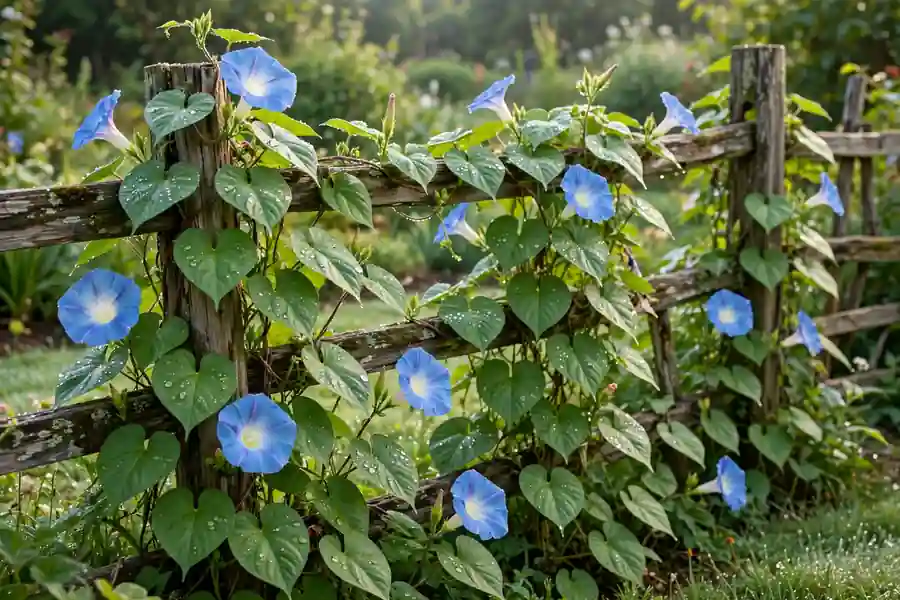
A morning glory is a fast-growing, twining vine with heart-shaped leaves and trumpet-shaped flowers in blue, purple, pink, white or red that open at dawn and fade by afternoon. It belongs to the genus Ipomoea (and a few close relatives) and is usually grown as an annual from seed sown after the last frost. It needs full sun, something to climb and poor to average soil, and it can climb 6 to 15 feet in a season. The seeds are poisonous, and in warm regions the plant can reseed so freely that it becomes a weed.
People search for "morning glory" for many reasons: to grow the flower, to identify a vine in their yard, to get rid of one, or to find out what the plant means. Some searches are really about other things that share the name, like a vegetable, a muffin or a movie. This guide covers the plant: what it is, its types and colors, how to plant and care for it, how to control it, whether it is poisonous and what it symbolizes.
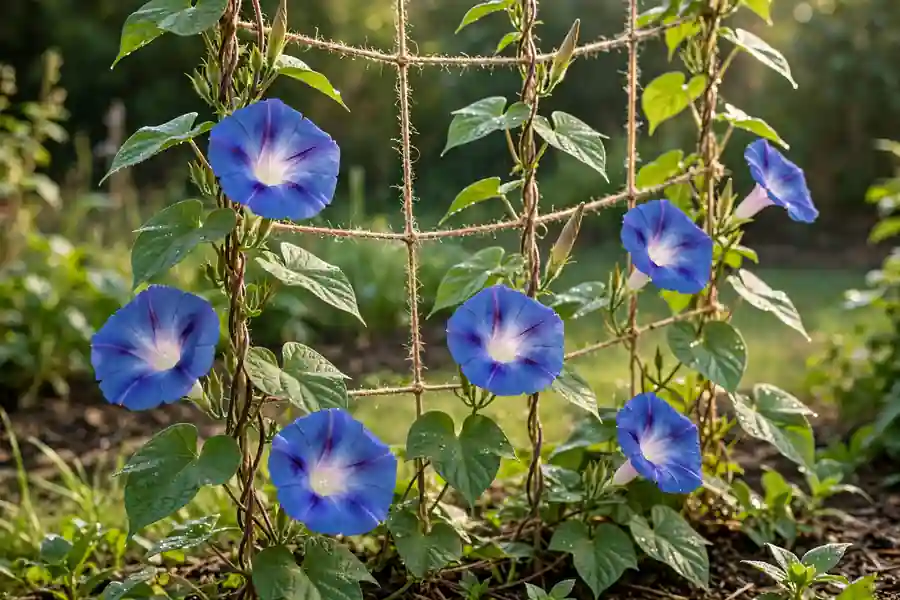
Morning glory at a glance
| Question | Short answer |
|---|---|
| Scientific name | Ipomoea (mainly Ipomoea purpurea, I. tricolor and I. nil) |
| Plant type | Twining vine, grown as an annual in most of the US |
| Flower | Trumpet-shaped, 2 to 4 inches across. Opens in the morning, fades by afternoon |
| Colors | Blue, purple, pink, red, white, magenta and striped or edged |
| Height | Usually 6 to 15 feet, with support |
| Light | Full sun, at least 6 hours |
| Soil | Average to poor, well-drained. Rich soil gives more leaves and fewer flowers |
| How to start | Seeds sown outdoors after the last frost, nicked or soaked first |
| Bloom time | Midsummer to first frost |
| Reseeding | Heavy. Can become weedy |
| Toxicity | Seeds are poisonous to people and pets. Do not eat the plant |
| Difficulty | Easy |
What is a morning glory?
Morning glory is the common name for many twining plants in the bindweed or morning glory family (Convolvulaceae). Most garden morning glories belong to the genus Ipomoea, which has hundreds of species, mostly tropical or subtropical. The genus also includes sweet potato, moonflower and water spinach.
The name comes from the flowers, which open at dawn and fade by afternoon. Each bloom lasts only a day, but the vine makes new buds every day, so it can flower for weeks.
What does a morning glory look like?
- Vines: thin, twining stems that wrap around anything they can reach, usually counterclockwise.
- Leaves: heart-shaped, 2 to 5 inches long, and in some types three-lobed or ivy-shaped.
- Flowers: funnel- or trumpet-shaped, often with a lighter or white throat, and a starry pattern when the flower is closed.
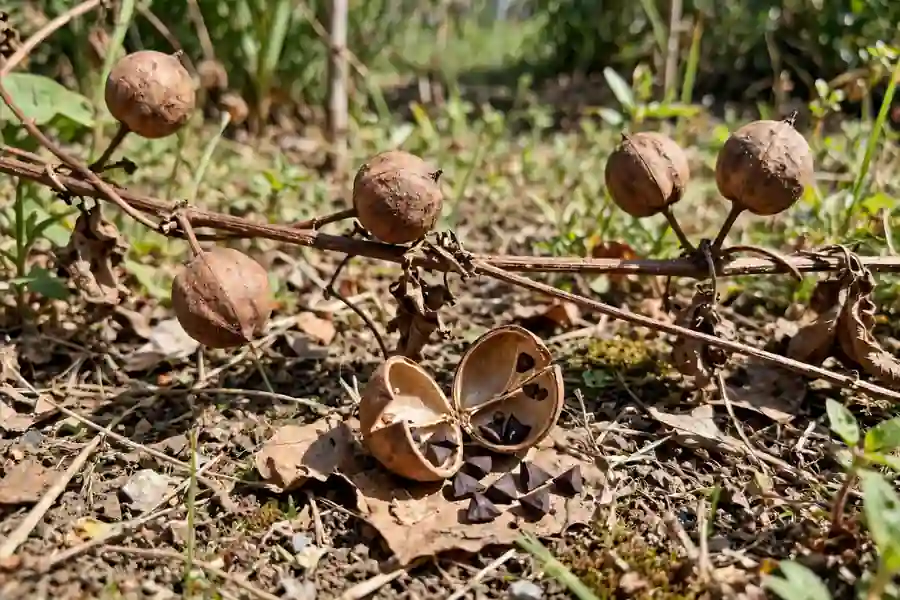
- Seed pods: round, papery capsules that hold three to four hard, dark, angular seeds each.
- Roots: fibrous in annual types. Some perennial species have large storage roots.
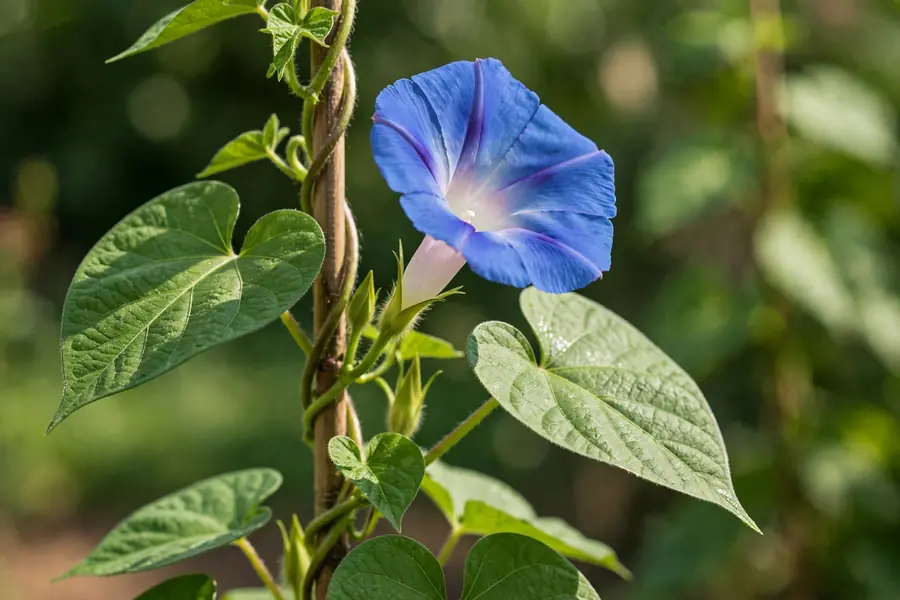
What is the scientific name of morning glory? The common garden types are Ipomoea purpurea (common morning glory), I. tricolor (including "Heavenly Blue"), I. nil (Japanese morning glory) and I. hederacea (ivyleaf morning glory).
What are the main types of morning glory?
| Type | What it is | Notes |
|---|---|---|
| Common morning glory (Ipomoea purpurea) | Purple, pink, blue or white flowers on a vigorous vine | Self-seeds heavily and can be weedy |
| Heavenly Blue (Ipomoea tricolor) | Sky-blue flowers with a white throat | A classic garden cultivar. Often called Mexican morning glory |
| Japanese morning glory (Ipomoea nil) | Larger flowers in many colors and patterns | Long popular in Japan, with many named varieties |
| Ivyleaf morning glory (Ipomoea hederacea) | Small flowers and lobed, ivy-like leaves | Often a weed in fields and gardens |
| Red morning glory (Ipomoea coccinea) | Small red or scarlet flowers with a yellow throat | Attracts hummingbirds |
| Moonflower (Ipomoea alba) | Large, fragrant white flowers that open at night | A tropical perennial grown as an annual, and a good partner for morning glories |
| Blue dawn flower (Ipomoea indica) | Blue to purple flowers on a perennial vine | A warm-climate perennial vine |
| Bush or dwarf morning glory (Convolvulus tricolor) | A short, bushy plant, 12 to 18 inches tall | Not a vine. Good for borders and pots |
| Blue daze and shaggy dwarf (Evolvulus) | Low plants with small blue flowers | Related, but a different genus |
| Beach morning glory (Ipomoea pes-caprae) | A creeping, salt-tolerant vine with pink flowers | Grows on tropical and subtropical beaches |
| Island or California morning glory (Calystegia) | A native western shrubby vine | A relative with white to pale pink flowers |
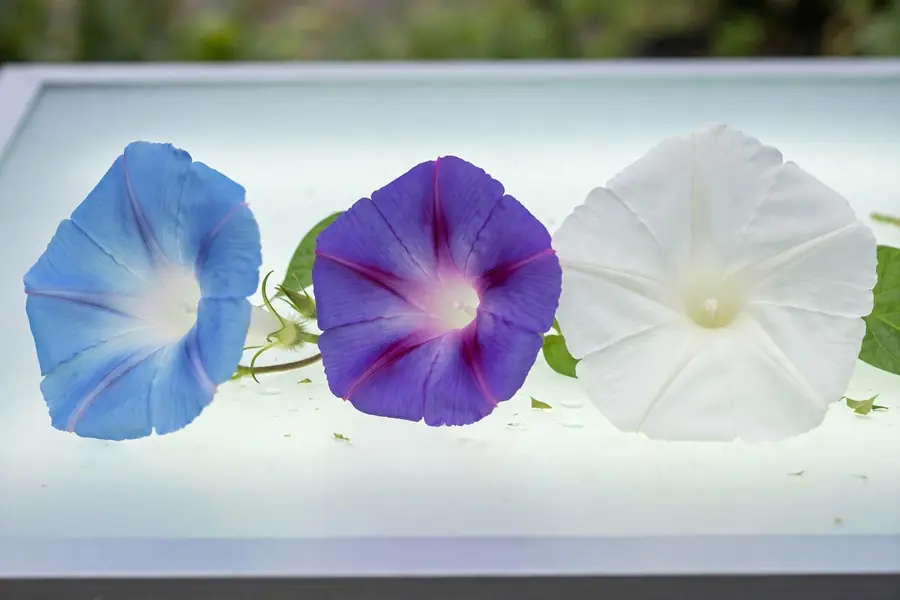
Popular named varieties include 'Heavenly Blue,' 'Grandpa Ott' (deep purple with a red star), 'Carnival of Venice' (striped red, white and blue), 'Flying Saucers' (marbled white and blue), 'Split Second,' 'Blue Picotee' and 'Black Knight' (very deep purple). Cultivar traits can vary between seed suppliers.
What is a dwarf morning glory? It is either a compact bush type (Convolvulus tricolor) or a trailing Evolvulus such as blue daze. Neither climbs like a true morning glory vine.
What is the difference between a morning glory and a moonflower? A moonflower is a close relative with large white, fragrant flowers that open in the evening and close the next morning. Morning glories do the opposite. Growing both on a trellis gives you flowers around the clock.
What colors do morning glories come in?
| Color | Examples | Notes |
|---|---|---|
| Blue | Heavenly Blue, Blue Picotee, Blue Star | The most famous morning glory color |
| Purple | Grandpa Ott, common morning glory | Often with a red or white star in the throat |
| Pink | Pink-flowered forms of common morning glory and Japanese types | Soft to hot pink |
| Red | Red morning glory, Scarlet O'Hara, Crimson Rambler | Bright, often smaller flowers |
| White | Pearly Gates, moonflower, white forms of common morning glory | Often fragrant at night, in the case of moonflower |
| Striped or edged | Carnival of Venice, Picotee types | White edges or stripes on a colored flower |
| Near black | Black Knight | Deep purple that looks black |
| Mixed | Seed mixes | Several colors from one packet |
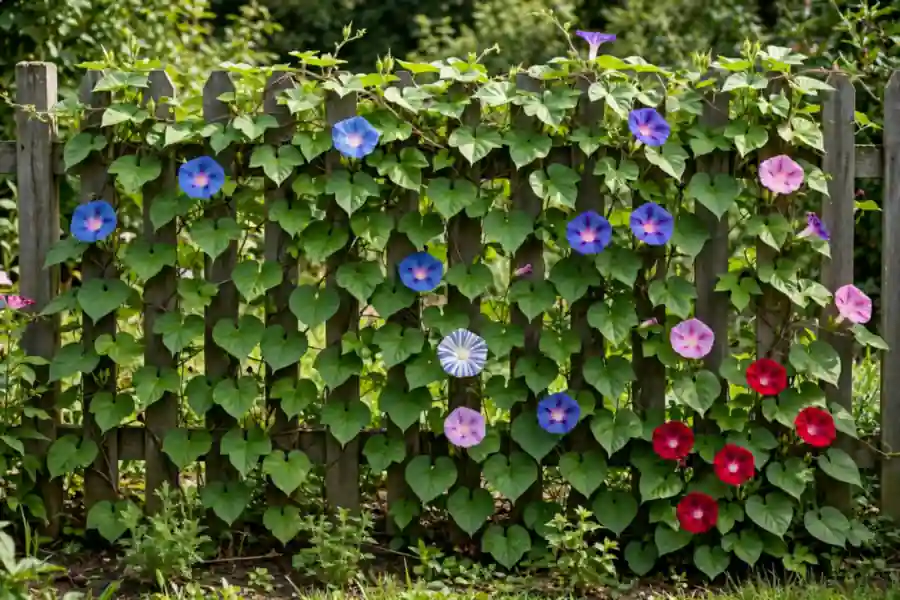
There is no true yellow morning glory among common garden types. Specialty seed lists also offer deep maroon and mixed-color varieties. Flower color can shift with pH and temperature, and many fade in strong afternoon sun.
When do morning glories bloom?
Morning glories bloom from midsummer until the first frost, usually about 2 to 3 months after sowing. They need warm weather and long days. If planted too early in cool soil, they will be slow to start.
- Each flower: opens at dawn and closes by midday or afternoon. Cool, cloudy days make flowers last longer.
- The vine: keeps making new flowers every morning for weeks.
Why is my morning glory not blooming?
| Reason | Fix |
|---|---|
| Too much nitrogen fertilizer | Stop feeding. Lots of leaves and few flowers is the sign |
| Rich soil | These plants bloom best in average to poor soil |
| Too much shade | Move to full sun, 6 or more hours |
| Planted too early or too cool | Wait for warm weather. Plants may bloom late summer |
| Transplant shock | Sow seeds directly where the plant will grow |
| Drought stress | Water deeply during dry spells |
| Too little time | Late-sown plants may need until late summer to flower |
How do you plant morning glory seeds?
When to plant: sow outdoors after the last frost, when the soil has warmed to at least the mid-60s°F. Cold soil slows or rots seeds. In short-season areas, start seeds indoors 3 to 4 weeks early.
How to plant:
- Choose a sunny spot with at least 6 hours of direct sun, next to a fence, trellis, arbor or other support.
- Prepare the seeds. The seed coat is very hard. Gently nick each seed with a file or nail clipper, or soak the seeds in water for 12 to 24 hours, until they swell.
- Loosen the soil and skip the rich compost and fertilizer. Average soil is fine.
- Sow seeds about 1/2 inch deep and 4 to 6 inches apart along the base of the support.
- Water well, then keep the soil lightly moist until seedlings appear, usually in 5 to 10 days.
- Thin seedlings to about 6 to 12 inches apart.
- Set up the support at planting time, so the vine has something to climb as soon as it starts.
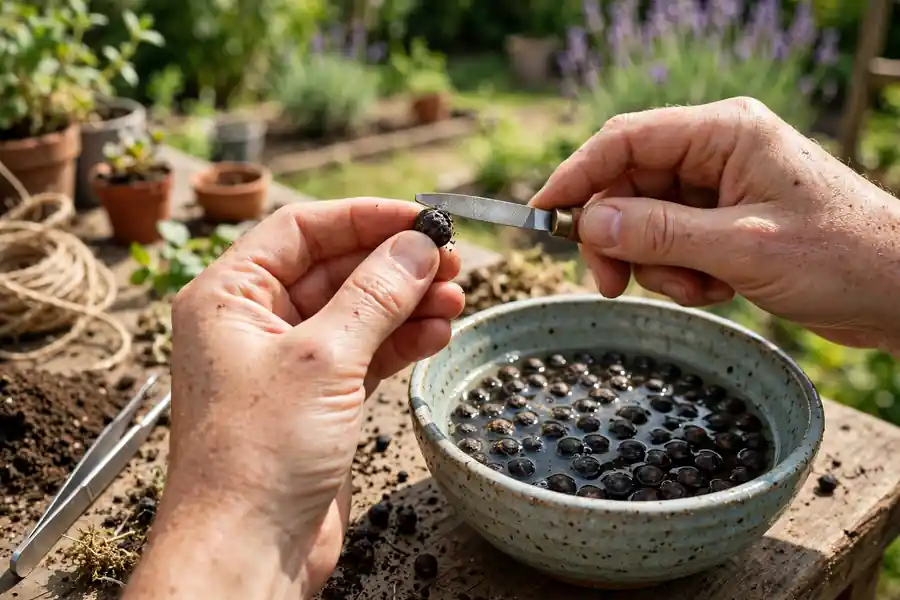
Can you start morning glories indoors? Yes, in biodegradable pots, because the roots dislike being disturbed. Harden off seedlings and plant them outside only after frost has passed.
What do morning glory seedlings look like? The first leaves are two rounded, butterfly-shaped seed leaves, followed by true heart-shaped leaves.
How do you grow and care for morning glories?
- Light: full sun. Plants in shade grow lots of leaves with few flowers.
- Soil: average to poor, well-drained. Skip fertilizer, or use a low-nitrogen one at most.
- Water: moderate. Water deeply once a week in dry weather, and more often in pots. Established vines tolerate some dryness.
- Support: vines need something to twine around. Strings, wires, a trellis, fence, arbor, obelisk or tomato cage all work.
- Deadheading: not required. Remove spent seed pods if you want to prevent reseeding.
- Pests: aphids, spider mites and leaf miners sometimes appear, and Japanese beetles may chew leaves. Rinse aphids off with water or use insecticidal soap.
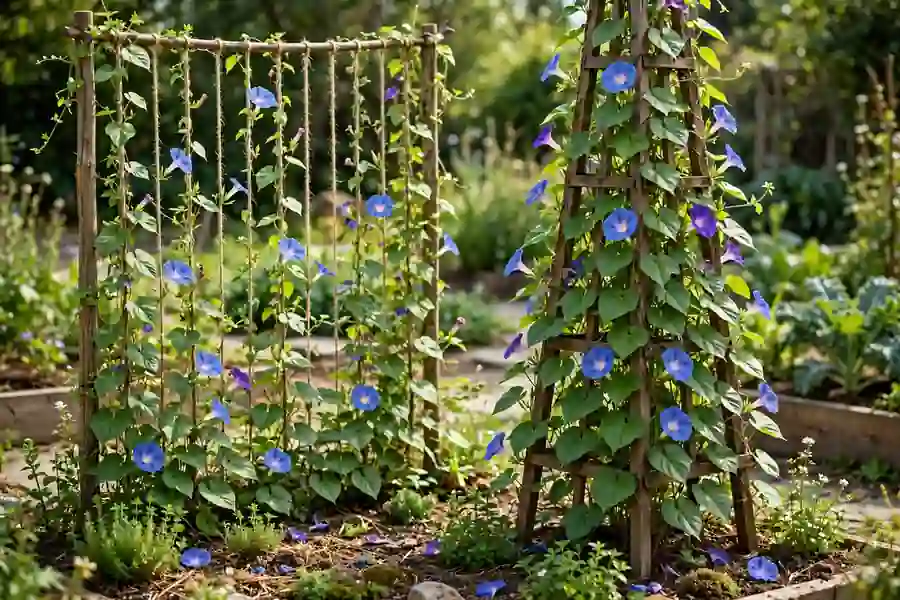
What is the best trellis for morning glories? Any sturdy support at least 6 to 8 feet tall. Strong strings running up to an eave, wire mesh on a fence, a bamboo teepee or an arbor all work. Morning glories do best on thin supports they can wrap around, such as strings and wire, not on wide boards.
Can you grow morning glory in pots and hanging baskets? Yes. Use a pot at least 12 inches wide with drainage, standard potting mix, and a small trellis or stakes. A hanging basket lets the vines trail. Container plants need more frequent watering.
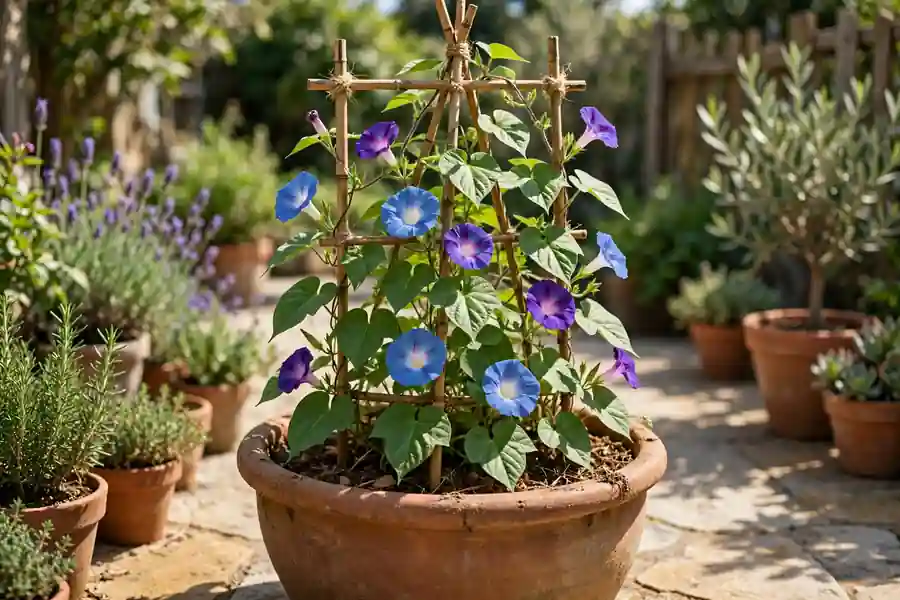
Which sun does a morning glory need? At least 6 hours of direct sun a day for the most flowers.
Is a morning glory an annual or perennial?
In most of the US, morning glory is grown as an annual: it grows, flowers, sets seed and dies at the first frost. Seeds drop and sprout the following spring, which can look like the plant "comes back."
- True perennials: some Ipomoea, such as blue dawn flower (Ipomoea indica) and a few native species, are perennial in warm zones, about 9 to 11.
- Tender perennials: moonflower is perennial only in frost-free climates.
Do morning glories come back every year? Usually through self-seeding, not the same plant. A few perennial types return from their roots in mild climates.
Is morning glory invasive or a weed?
It can be. Morning glories reseed very heavily, and the vines can smother nearby plants. In warm climates with long seasons and in fields, ivyleaf and common morning glory can become weeds. Some states list certain Ipomoea as invasive, so check local guidance before planting.
Morning glory vs bindweed: gardeners often confuse them.
| Feature | Morning glory (Ipomoea) | Field bindweed (Convolvulus arvensis) |
|---|---|---|
| Flowers | Large (2 to 4 inches), bright colors | Small (about 1 inch), white or pale pink |
| Leaves | Heart-shaped | Arrow-shaped |
| Life cycle | Annual from seed (in most cases) | Perennial with very deep roots |
| Spread | Self-seeds | Spreads by seed and by roots |
| How hard to remove | Easy to hand-pull when young | Very hard to eradicate |
If your "morning glory" is a vine with small white flowers and arrow-shaped leaves, it is likely bindweed and will need a longer fight.
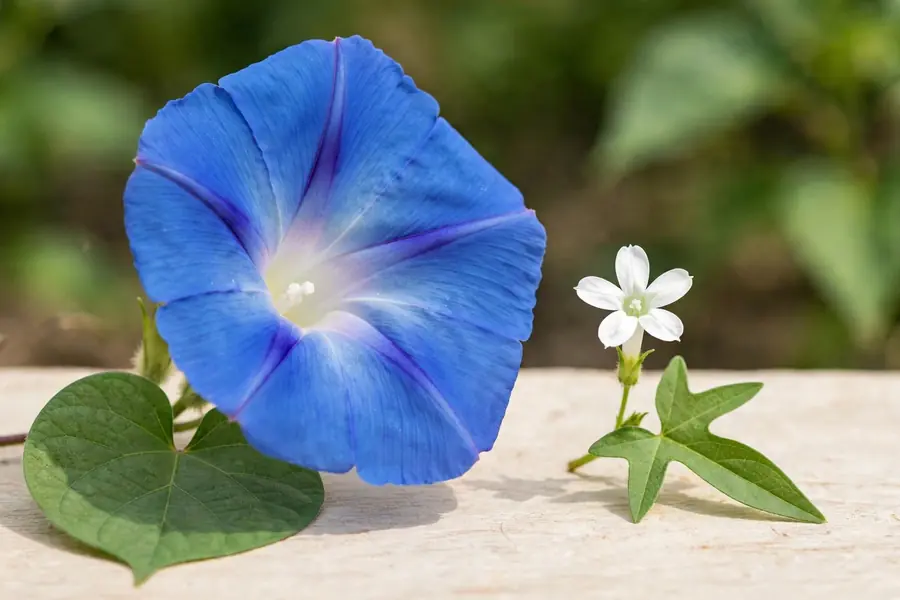
Is a morning glory a weed or a flower? Both, depending on where it grows. In a garden you plant on purpose, it is a flower. When it sprouts in a vegetable bed or fence line, it is a weed.
How do you get rid of morning glory?
Control depends on the plant's age and type.
- Pull seedlings early. Seedlings are easy to pull by hand or hoe. Do it before the vines twine.
- Cut and pull established vines. Cut at ground level and untangle the vine from plants and fences. Do not let cut vines touch soil and re-root.
- Remove seed pods before they open, so you do not get a new crop next year.
- Smother and mulch. A thick 3 to 4 inch layer of mulch, or cardboard under mulch, blocks seedlings.
- Dig out roots of perennial types and bindweed. Any root fragment left behind can regrow, so repeat every few weeks.
- Spot treat if needed. Vinegar-based products burn off top growth but do not kill deep roots. A broad-spectrum herbicide applied carefully to leaves can kill established vines, but it can also harm plants it touches, so follow the label. Our guide to natural weed killer explains what each home remedy can and cannot do.
- Repeat for a season or two. Seeds can stay in the soil for many years, so expect seedlings.
What kills morning glory? Consistent pulling and cutting, mulch, and spot treatment of regrowth. For the garden, keep the vines off fences and trees by pruning before they take over.
Are morning glories poisonous?
Yes, parts of them are, and the seeds are the main concern.
- People: morning glory seeds can cause nausea, vomiting, stomach upset and confusion, and some contain compounds that can cause hallucinations. They should never be eaten. Some commercial seeds are also treated with fungicide. Keep seed packets and pods away from children.
- Dogs and cats: the ASPCA lists morning glory (Ipomoea) as toxic to dogs, cats and horses. Eating the seeds or plants may cause vomiting, diarrhea and, in larger amounts, tremors or odd behavior. Some veterinary sources say serious poisoning is unlikely, but call your vet or the ASPCA Animal Poison Control Center at 888-426-4435 (a fee may apply) if your pet eats any part of the plant.
- Skin contact: touching the leaves and flowers is not usually harmful.
Can you eat morning glory? Do not eat ornamental morning glory flowers, leaves or seeds. A different Ipomoea species, water spinach, is a common cooked vegetable (see below).
Are morning glory seeds hallucinogenic? Some contain chemicals that can cause hallucinations along with serious sickness, which is why they are dangerous. This guide does not recommend or explain any use of the seeds. If someone swallows seeds and feels sick, call poison control.
What is the morning glory vegetable?
The "morning glory" served in many Asian restaurants is water spinach (Ipomoea aquatica), also called kangkong, ong choy, rau muống or Chinese morning glory. It is a different species from the garden flower. It has hollow stems and long, arrow-shaped leaves, and it is usually stir-fried with garlic or chili.
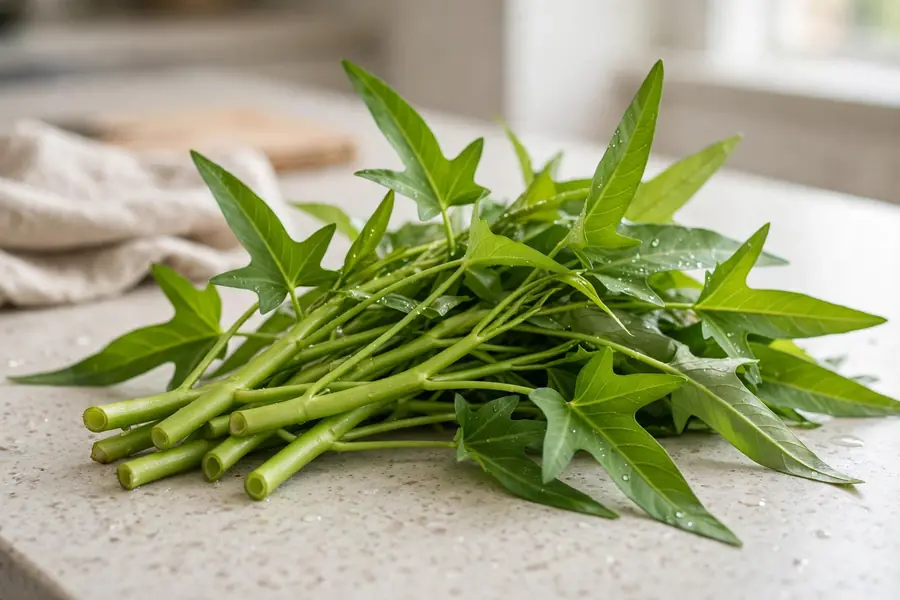
Water spinach grows in warm, wet conditions and spreads aggressively. In the US it is listed as a federal noxious weed, and growing or moving it is restricted or banned in some states. If you want to try growing it, check state and local rules first. Ordinary ornamental morning glory seeds will not give you a safe vegetable.
What does the morning glory mean?
Morning glory is a symbol of love, affection, renewal and the short, bright beauty of life, because each flower blooms for only a day. In flower language it has been linked to unrequited or faithful love and to mortality. In Japan, morning glory (asagao) is a summer symbol with a long cultivation history. In Chinese tradition it is tied to hope and rebirth. These meanings are traditions, not facts about the plant.
Color meanings usually follow general flower language: blue for calm and trust, purple for admiration, pink for affection and white for purity.
Is morning glory a birth flower? Yes. The morning glory, together with the aster, is the traditional September birth flower. Our guide to the November birth flower explains how birth flowers work in general.
Quick answers to common questions
What is a morning glory?
A twining vine in the genus Ipomoea with heart-shaped leaves and trumpet-shaped flowers that open at dawn and fade by afternoon. It is usually grown as an annual.
Are morning glories annuals or perennials?
In most of the US they are annuals that come back by self-seeding. A few types, such as blue dawn flower, are perennial in warm zones.
How do you grow morning glories from seed?
Sow seeds outdoors after the last frost in full sun, about 1/2 inch deep. Nick or soak the seeds first, and give the vines a trellis. Skip rich soil and fertilizer for more flowers.
Are morning glories invasive or poisonous?
They can reseed heavily and become weedy, especially in warm climates. The seeds and plants are poisonous to people and pets and should not be eaten.
How do you get rid of morning glory?
Pull seedlings early, cut and pull established vines, remove seed pods, mulch heavily and repeat. Perennial bindweed needs persistent digging and repeated cutting.
Keep reading: natural weed killer, lily flower, hibiscus flower, how to compost and more lawn and garden guides.
Is a morning glory worth growing?
Yes, if you give it a place to climb and keep an eye on the seed pods. A morning glory is one of the easiest and fastest flowering vines: it covers a trellis or fence in weeks, brings trumpet flowers in sky blue and purple and asks for little more than sun and a warm start. Skip the rich soil and fertilizer, remove spent pods if you do not want volunteers, keep the seeds away from children and pets, and you will be rewarded with fresh flowers each morning all summer.