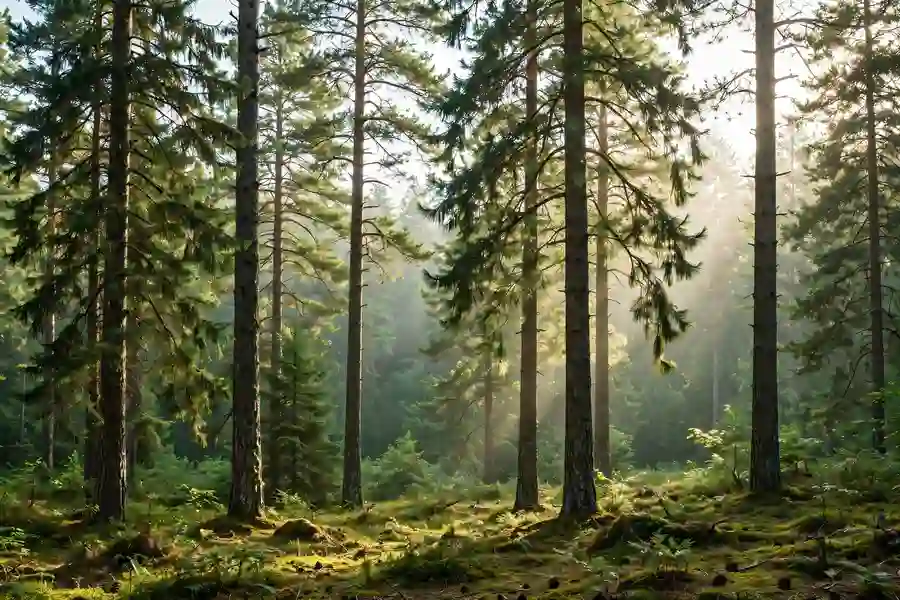
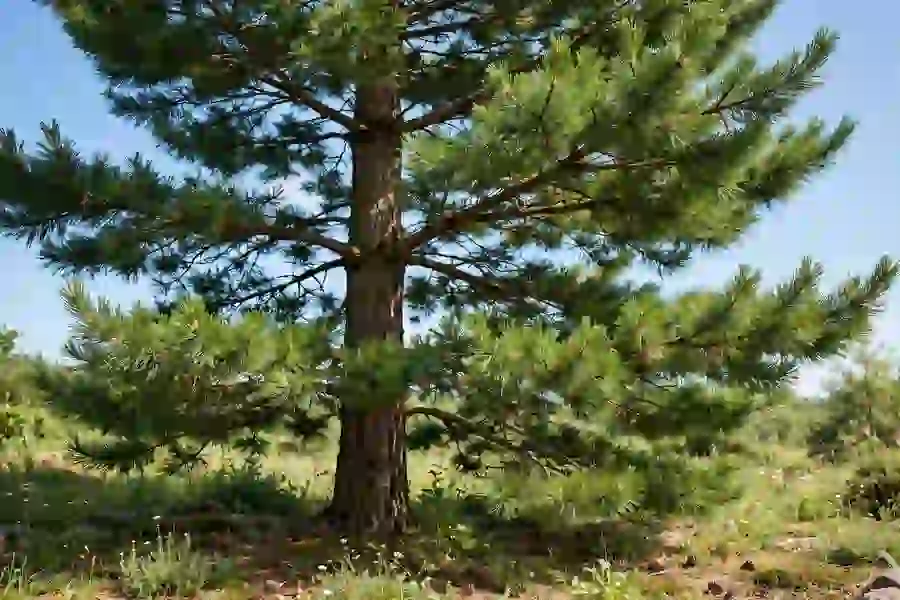
A pine tree is a cone-bearing evergreen in the genus Pinus (family Pinaceae), with long needles grown in bundles of 2, 3 or 5. There are roughly 110 to 126 species, depending on the source, and most are fast to moderate growers that want full sun and well-drained soil. To tell a pine from a spruce or fir, check the needles: pines bundle them, spruces have single, stiff, four-sided needles, and firs have flat, single needles.
Pine tree at a glance
| Question | Answer |
|---|---|
| Scientific name | Pinus (family Pinaceae). Example: Pinus strobus, eastern white pine |
| Species | About 110 to 126, mostly in the Northern Hemisphere |
| Needles | In bundles (fascicles) of 2, 3 or 5, wrapped at the base by a papery sheath |
| Fruit | Woody cones. The seeds sit under the scales |
| Sun | Full sun, 6 hours or more |
| Soil | Well-drained, slightly acidic. Many tolerate poor, sandy soil |
| Size | Dwarf types 3 to 10 ft. Large species 60 to 150 ft or more |
| Growth | Fast types about 2 ft or more a year. Slow types 6 inches a year or less |
| Pruning | Only the new growth ("candles") in late spring. Never cut into bare wood |
| Lifespan | 100 to 300 years is common. Bristlecone pines live for thousands |
What does a pine tree look like?
| Part | What to look for |
|---|---|
| Needles | Long, thin and in bundles of 2, 3 or 5, 1 to 18 inches long depending on species. They last 2 to 4 years or longer, and the oldest drop in fall |
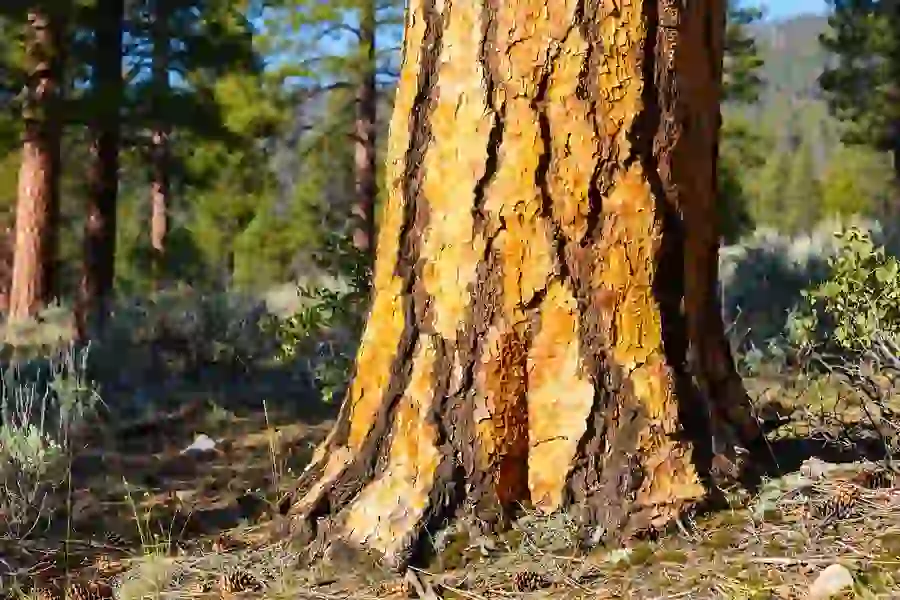
| Bark | Gray-brown and scaly or furrowed. Ponderosa bark has orange-yellow plates |
| Cones | Female cones are woody and take 2 to 3 years to mature. Male cones are small and shed yellow pollen in spring |
| Shape | Pyramid-shaped when young. Many become flat-topped or irregular with age |
| Branches | Whorls of branches, a new tier each year |
| Roots | A short taproot when young, then mostly wide, shallow roots. Most are in the top 1 to 3 feet of soil, spreading well past the branches |
| Resin | Sticky sap that seals wounds and repels insects |
| Fruit | Pines do not make berries. What looks like a berry is usually a juniper or yew |
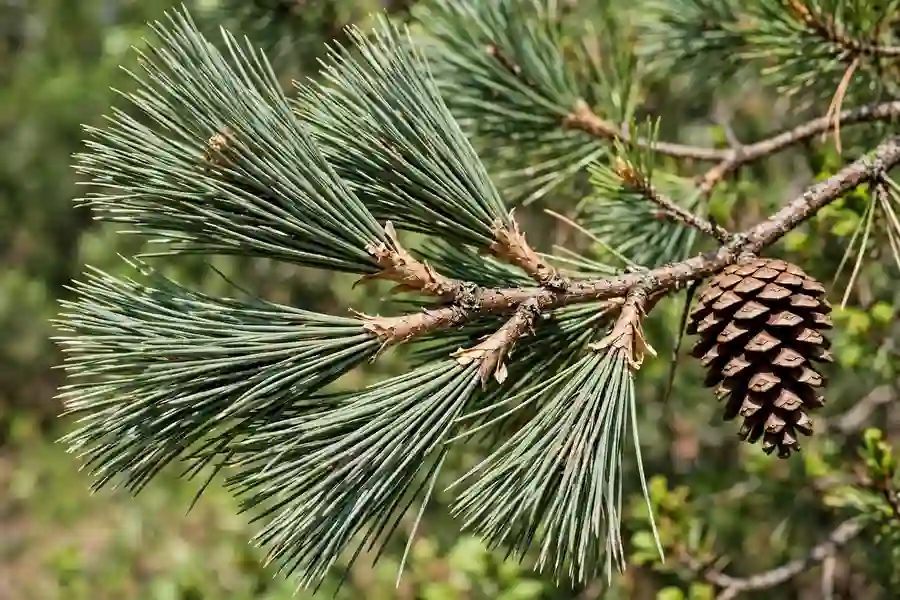
Adaptations: needles with a waxy coat save water, resin defends against insects and fungus, the cone shape sheds snow, wind carries the pollen and the winged seeds, and some cones open only after fire.
Life cycle: pollen blows from male cones in spring, the female cone takes 2 to 3 years to mature, the winged seeds drop and blow away, and a seedling can take 5 to 15 years or more to make its first cones.
What is the scientific name for a pine tree?
The genus is Pinus, in the family Pinaceae. The word for pine tree in Spanish is pino. There is no single species called "the pine." Each species has its own two-part Latin name.
| Common name | Scientific name |
|---|---|
| Eastern white pine | Pinus strobus |
| Loblolly pine | Pinus taeda |
| Longleaf pine | Pinus palustris |
| Slash pine | Pinus elliottii |
| Ponderosa pine | Pinus ponderosa |
| Scots (Scotch) pine | Pinus sylvestris |
| Red (Norway) pine | Pinus resinosa |
| Austrian (black) pine | Pinus nigra |
| Japanese black pine | Pinus thunbergii |
| Mugo pine | Pinus mugo |
| Italian stone pine | Pinus pinea |
| Bristlecone pine | Pinus longaeva |
What are the main types of pine trees?
Counting needles in a bundle is the quickest first step in identification. Then check needle length, cone size and where you live.
| Needles per bundle | Examples | Notes |
|---|---|---|
| 5 | Eastern white, western white, sugar, limber, whitebark, bristlecone | Soft, flexible needles. White pines |
| 3 | Loblolly, ponderosa, pitch, longleaf, slash (2 or 3) | Long needles. Yellow pines |
| 2 | Red, Scots, Austrian, Japanese black, jack, lodgepole, Virginia, shortleaf, mugo, pinyon | Shorter or stiffer needles |
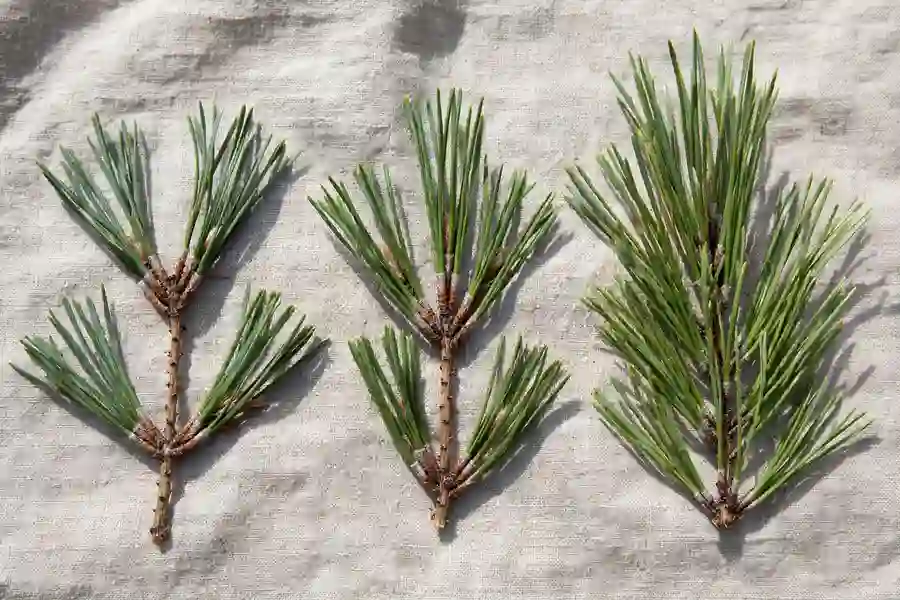
Check the needle count and length on several bundles, since a few vary. Pinyon pines have 2 needles, and one pinyon species has just 1.
| Pine | Where and what it is known for |
|---|---|
| Eastern white pine | Eastern North America. Soft needles in fives, 3 to 5 inches. Fast growing and tall. Maine is the "Pine Tree State" and it is the state tree of Maine and Michigan |
| Loblolly pine | Southeast. Needles in threes, 6 to 9 inches. Grows fast and is common in timber plantings |
| Longleaf pine | Southeast. The longest needles of any eastern pine, up to a foot or more. Slow "grass stage" as a seedling, fire-adapted |
| Slash pine | Southeast coast. Needles in twos and threes. Fast growing |
| Shortleaf pine | Southeast and Midwest. Short needles in twos and threes, small cones |
| Pitch pine | Northeast. Needles in threes, sprouts from the trunk after fire |
| Virginia pine | East. Short, twisted needles in twos. Grows on poor soil and is used for Christmas trees in the South |
| Red (Norway) pine | Northeast and Great Lakes. Needles in twos, 4 to 6 inches, that snap cleanly when bent. Reddish bark |
| Jack pine | Far north. Short, curved needles in twos, small cones that often open only after fire |
| Scots (Scotch) pine | Europe and Asia, widely planted. Twisted blue-green needles in twos and orange upper bark. Common Christmas tree |
| Austrian (black) pine | Europe. Stiff, dark needles in twos. Handles city conditions, but prone to Diplodia tip blight |
| Japanese black pine | Coastal Japan. Tolerates salt and wind. A bonsai favorite |
| Mugo pine | Mountains of Europe. A dwarf, shrubby pine often 3 to 6 feet tall, or taller in some forms |
| Ponderosa pine | Western US. Long needles in threes (or twos), orange-yellow bark that can smell like vanilla or butterscotch. Reaches 100 to 150 feet or more |
| Lodgepole pine | Western mountains. Straight trunk, needles in twos |
| Sugar pine | California and Oregon. Needles in fives, the longest cones of any pine, 10 to 20 inches or more |
| Torrey pine | Rare, on the southern California coast. Needles in fives and very long |
| Monterey pine | California coast, but widely planted in the Southern Hemisphere. Fast growing |
| Pinyon pine | Southwest. Needles in twos. Grown for edible pine nuts. Pinyon is the state tree of New Mexico |
| Italian stone (umbrella) pine | Mediterranean. Umbrella-shaped crown and large edible nuts |
| Aleppo and Eldarica (Afghan, Mondell) pine | Dry climates. Drought tolerant, common in the Southwest |
| Bosnian pine | Southern Europe. Hardy, slow and dark green |
| Korean and Chinese white pine | East Asia. Five-needle pines with edible nuts |
| Bristlecone pine | High mountains of the West. Twisted, slow and extremely long-lived |
| Whitebark and limber pine | High mountains. Five-needle pines. Whitebark pine is declining and is protected as threatened |
Common shapes: weeping pine (a drooping form of white pine and others), dwarf pine (mugo and dwarf white pine), tall pine and columnar types are cultivars, so check the label for mature size.
How are pine, spruce, fir, cedar and hemlock different?
| Tree | Needles | Cones | Other clues |
|---|---|---|---|
| Pine | Long, in bundles of 2, 3 or 5 | Woody, hang down | Scaly or furrowed bark, layered branches |
| Spruce | Single, stiff, sharp, four-sided (roll easily between your fingers) | Papery, hang down | Rough, scaly bark. Blue spruce is a spruce, not a pine |
| Fir | Single, flat, soft and blunt (will not roll) | Stand upright on the branch and fall apart | Smooth bark with resin blisters |
| Hemlock | Short, flat, single with two white lines underneath | Tiny, hang down | Drooping tip on the leader |
| Cedar (true cedar) | Needle tufts on short spurs | Barrel-shaped, upright | Many US "cedars" are junipers or arborvitae with scale-like leaves, not needles |
| Larch and tamarack | Needle tufts | Small | Lose their needles in fall (deciduous conifers) |
| Douglas fir | Single, flat needles | Cones with three-pointed bracts | Not a true fir |
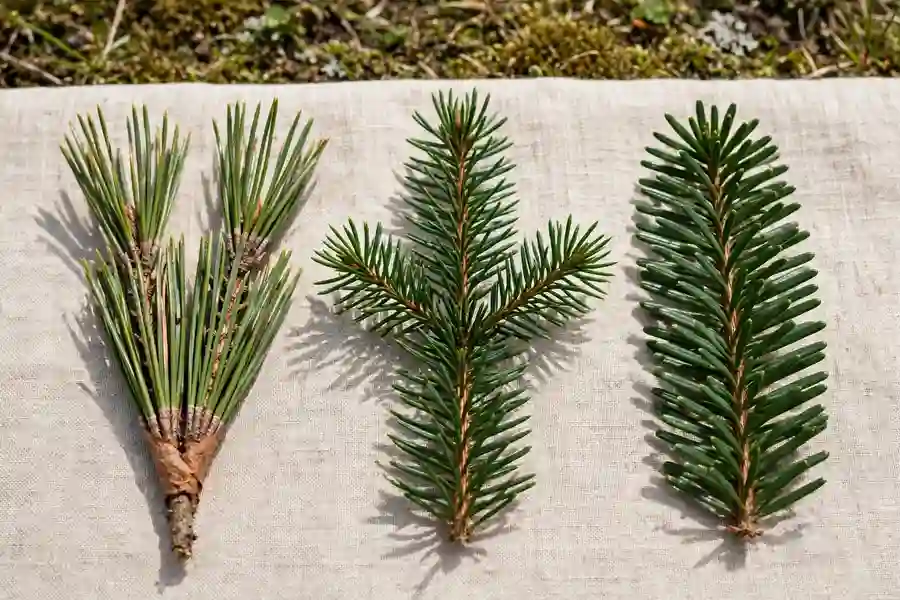
Is cedar a pine tree? No. Cedars are other conifers. A true cedar (Cedrus) is in the same family, but it is not a pine.
Is a Christmas tree a pine? Sometimes. Christmas trees are firs, spruces or pines, and Scotch, white and Virginia pines are common pine ones.
Is a spruce a pine? No. Both are conifers in the same family, but they are different genera.
Pine vs evergreen: "Evergreen" means a plant keeps its leaves year-round. Most pines are evergreens, but not all evergreens are pines (holly and magnolia are evergreen too). Not all conifers are evergreen: larches drop their needles.
How tall do pine trees get, and how fast do they grow?
| Group | Typical height | Growth |
|---|---|---|
| Dwarf and small (mugo, dwarf white, bonsai types) | 3 to 10 ft | Slow, about 6 inches a year or less |
| Medium (Japanese black, Virginia, pinyon, Scots) | 20 to 50 ft | Slow to moderate, 1 to 2 ft a year |
| Large (eastern white, loblolly, red, Austrian) | 50 to 100 ft | Fast, often 2 ft or more a year |
| Giants (ponderosa, sugar, Jeffrey) | 100 to 200 ft or more | Moderate to fast |
Sources differ on record heights, but the tallest pines are the sugar pine and the ponderosa pine, and both can top 200 feet in old forest.
Fastest growing pines: eastern white pine, loblolly, Monterey, slash and Virginia pine, in good soil with plenty of sun and water. Our fast growing trees guide compares other options.
How long to grow 10 feet: about 4 to 6 years for a fast pine from a young seedling, and 15 years or more for slow types.
Lifespan: most pines live 100 to 300 years. Bristlecone pines in the western US live thousands of years, and Methuselah, a bristlecone in California, is often cited at roughly 4,800 years.
Root depth: pine roots are mostly shallow and wide. Plant big pines well away from foundations, septic lines, driveways and walks. Shallow roots also make large pines easier to blow over when the soil is soaked.
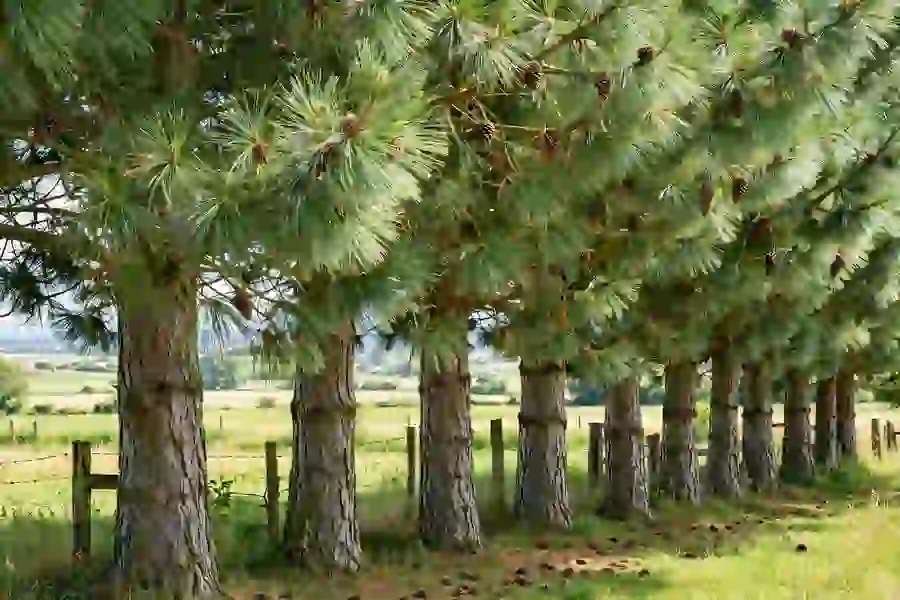
Where and how do you plant a pine tree?
When: early spring or early fall, when it is cool and the soil is moist. Bare-root seedlings go in early spring.
Where: full sun, space for the mature size, and well-drained soil. Most pines like slightly acidic soil, around pH 5.5 to 6.5. Avoid soggy spots, compacted soil and road-salt spray.
How:
- Dig a hole 2 to 3 times as wide as the root ball and no deeper.
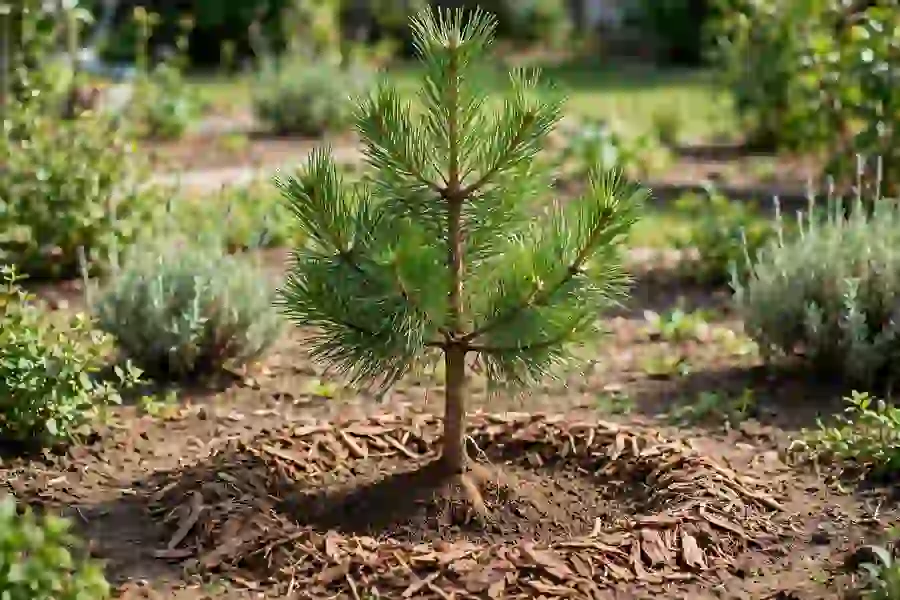
- Set the tree so the root flare (where the trunk widens) is at or just above soil level.
- Backfill with the same soil and water well.
- Mulch 2 to 4 inches deep, keeping it off the trunk.
- Skip fertilizer at planting.
Spacing: 10 to 15 feet apart for a windbreak or privacy screen of fast pines in staggered rows, wider for big trees. For a living screen, white pine and Scots pine are common choices. Check mature width on the tag.
Water: soak new trees weekly, about an inch of water, for the first year or two. Established pines are fairly drought tolerant. They do not need daily water.
Fertilizer and pine tree food: most pines grow fine without fertilizer. If needles are pale and short, test the soil, then use a slow-release evergreen fertilizer in early spring. Do not feed a stressed or dying tree.
Pines and shade plants: pines drop a lot of needles and compete for water. Plant hydrangeas, ferns, azaleas, rhododendrons and hostas under mature pines only with extra water and compost. The needle mulch changes soil acidity only slightly.
Can you grow a pine tree from a pine cone?
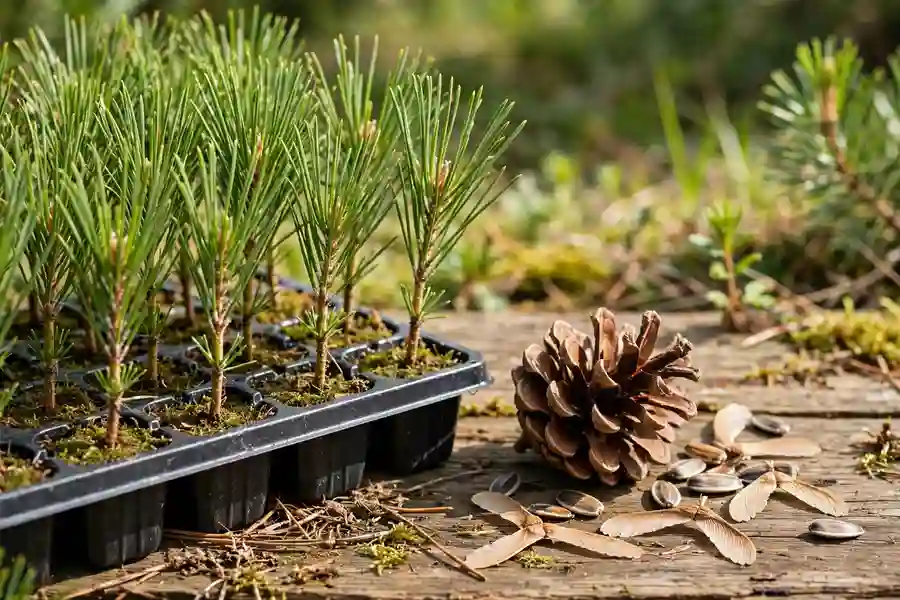
Yes, though the seed does the growing, not the cone. The seeds sit under the scales.
- Collect cones in fall when they begin to open, or dry closed cones in a warm, dry spot until the scales open.
- Shake out the winged seeds.
- Chill the seeds in damp sand or paper towel in the fridge, around 34 to 41°F. Many species need this cold stratification for about 1 to 3 months, depending on species.
- Sow them about 1/4 inch deep in pots of seed-starting mix in spring.
- Keep them moist in bright light. Seedlings grow slowly at first.
- Move them to larger pots after the first year. Plant them out when they are 1 to 3 years old.
Some cones, such as jack, lodgepole and pitch pines, open only after fire or heat. For those, warm the cones first.
Pine nuts and pine nut trees: pine nuts are the seeds of certain pines, including pinyon, Italian stone, Korean and Chinese white pine. Trees take many years (often 15 to 25 or more) to bear, so growing them for nuts is a long project.
When and how do you trim a pine tree?
Pines only grow from buds at the branch tips, and they will not resprout from bare old wood.
| Do | Do not |
|---|---|
| Cut dead, broken or diseased branches any time | Cut back to bare wood with no needles. It will not regrow |
| In late spring, when the new candles are growing, snap or cut off about one-half to two-thirds of each candle for a denser shape | Prune in late winter or early spring before the candles grow. It leaves dead stubs |
| Remove the lowest limbs to raise the crown on large trees | Cut off the central leader (the main top shoot) |
| Use clean, sharp tools | Remove more than about a quarter of the live branches in a year |
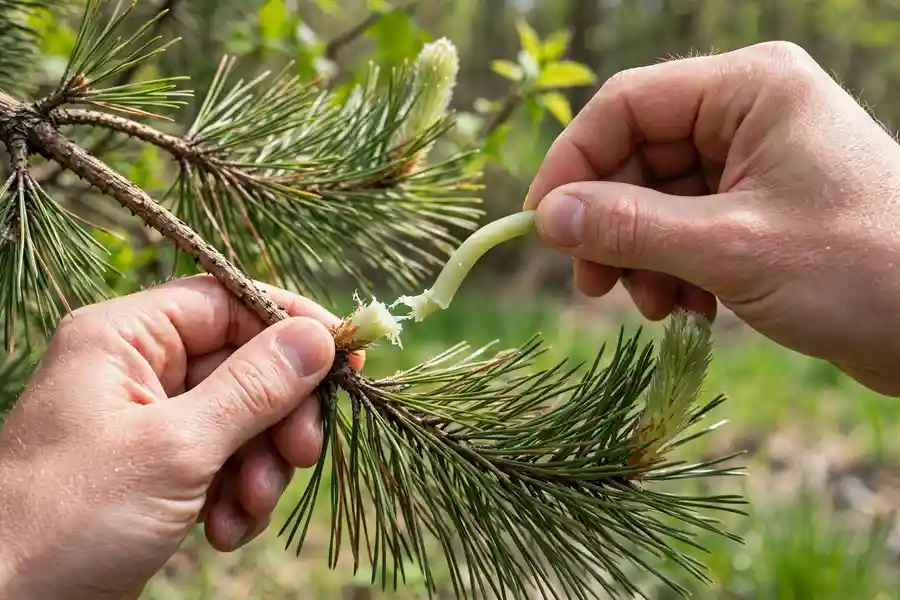
Can trimming a pine tree kill it? Yes, if you remove too much, top the tree or cut into the leafless wood. A pine that loses its leader will grow crooked or lopsided, and heavy cuts weaken it. In beetle country, make large cuts in winter, since fresh cuts in warm weather can attract bark beetles.
Before and after: a candle-pruned pine is denser and more compact, with the same branch tips, and an overpruned one is bare and thin.
Pine tree removal: a pine that is dead, leaning, cracked or near a house should come out. Use a certified arborist for big trees near buildings or power lines, because felling is dangerous. A stump can be ground out, and any herbicide use should follow the product label.
Why is my pine tree turning brown or dying?
| Symptom | Likely cause | What to do |
|---|---|---|
| Inner, older needles yellow and brown in fall | Normal needle drop. Pines shed their oldest needles in late summer and fall | Nothing. Tips should stay green |
| Browning from tips, dead tips | Drought, winter burn, road salt or Diplodia tip blight (worst on Austrian and ponderosa) | Water deeply, prune out dead tips in dry weather, call an extension office for diagnosis |
| Needles with brown spots or bands, lower branches thin | Needle cast and needle blights | Improve air flow, remove infected needles, fungicide in some cases |
| Whole tree browns fast in summer | Pine wilt (a nematode, mostly in Scots, Austrian and Japanese black pine). Usually fatal | Have it diagnosed and removed to stop the spread |
| Orange or yellow swellings and dead branch tips on white pine | White pine blister rust | Prune out cankers on branches, remove nearby currants and gooseberries if practical |
| Pitch tubes, tiny holes, sawdust, red-brown needles | Bark beetles (southern pine, Ips, mountain pine beetle) | Call an arborist right away. Preventive spraying is a professional job |
| Shoot ends turn into a crook and die | White pine weevil or shoot moths | Cut off damaged shoots in early summer, and pick a new leader |
| Groups of larvae eating needles | Pine sawfly | Pick off or spray the larvae with soap or a labeled insecticide |
| White foam on branches | Spittlebug. Harmless | Rinse with water |
| Sticky drips, black sooty film | Aphids or scale | Spray with water or insecticidal soap |
| Droopy tree | Drought, root problems, heavy snow or a natural weeping form | Check soil moisture and roots |
| Roots exposed, leaning | Wind throw, erosion | Call an arborist |
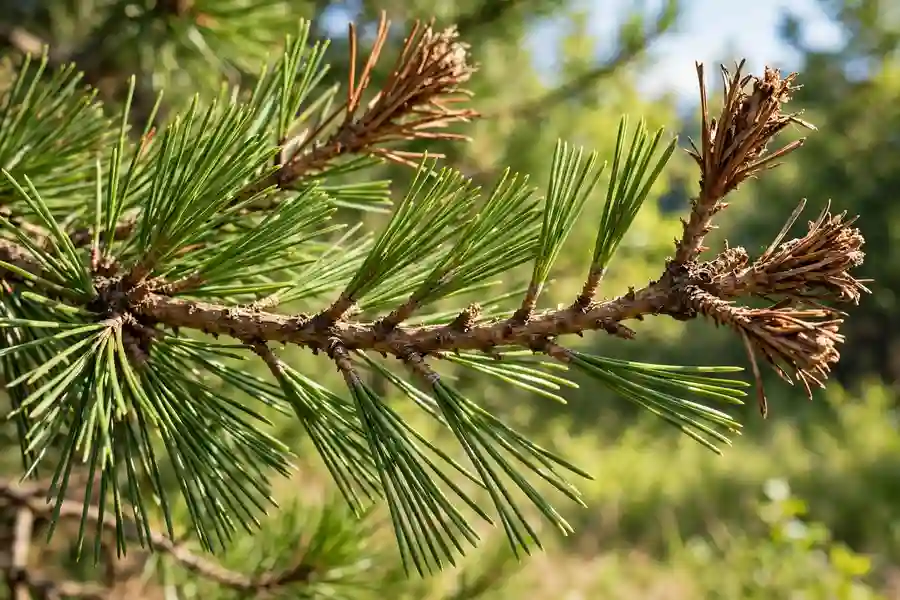
How to tell if a pine tree is dead:
- Scratch test: scrape a twig. Green under the bark means alive, and brown and dry means dead.
- Needles: all brown and brittle, and no new candles in spring.
- Bark: peeling, cracked or falling off, with fungus or conks at the base.
- Branches: brittle and snapping, starting at the top.
- Insects: pitch tubes or sawdust at the trunk.
Needles of a beetle-killed pine can stay green for weeks and fade to red-brown over weeks to a year. A pine that is brown from tip to base is almost always past saving. A pine with green buds and dripping resin may recover.
How to save a dying pine: find the cause first. Water deeply in drought, mulch, stop compaction and salt, and avoid fertilizing a stressed tree. Remove diseased tips. For beetles or wilt, hire an arborist, since early treatment matters.
Is pine sap, resin, pollen and needle tea safe?
- Pine sap (resin) is sticky. Remove it from skin, tools or a car with rubbing alcohol, then wash. Cooking oil also loosens it. Test on a hidden spot first. Resin is also the source of turpentine and rosin.
- Pine pollen is the yellow dust of spring, usually March to June depending on the region. The grains are large and waxy, so pine is a smaller allergy trigger than many trees, but it can still bother some people. Pollen shows up on cars and decks, and a rinse removes it.
- Pine smell: the scent comes from terpenes such as pinene in the resin and needles. Many cleaners and air fresheners copy it.
- Pine resin for teeth and gums: it has a long folk history, but there is no solid evidence that it helps, so see a dentist instead.
- Pine tree rash: touching sap or needles can cause contact dermatitis. Wash with soap and water and see a doctor if it is severe or spreading.
- Pine nuts and allergy: pine nuts are seeds, but the FDA counts them among the tree nuts for allergen labeling, and some people with tree nut allergy react to them. Ask an allergist. Rarely, some pine nuts can cause "pine mouth," a bitter taste for days.
- Pine needle tea is made from the needles of true pines. Never use yew or Norfolk Island pine, and avoid it in pregnancy. Ponderosa pine needles are linked to abortion in cattle. This is not medical advice.
- Pets: pine needles can upset the stomach and cause cuts. Keep pets away from chewing them and from anything sticky with sap.
What is a Norfolk Island pine, and how do you care for it?
A Norfolk Island pine (Araucaria heterophylla) is not a true pine. It is a tropical conifer from Norfolk Island in the Pacific, and a popular houseplant and living Christmas tree. Nicknames include star pine, Norfolk pine and indoor pine tree. People also confuse it with the Norway pine (which is red pine) and with the Norwegian pine.
| Need | Care |
|---|---|
| Light | Bright light, with some direct sun in a south or east window. Turn the pot a quarter turn weekly so it grows straight |
| Temperature | 60 to 75°F. Keep it above about 45°F |
| Water | When the top 1 to 2 inches are dry. Do not let the roots sit in water |
| Humidity | Moderate to high. Dry air browns the lower branches |
| Feeding | Diluted balanced fertilizer monthly in spring and summer |
| Repot | Every 2 to 4 years in spring. Use a draining mix |
| Pruning | Never cut the top. It will not regrow a new leader |
| Outdoors | Hardy only in the warmest zones (about 10 to 11). Brown lower branches do not grow back |
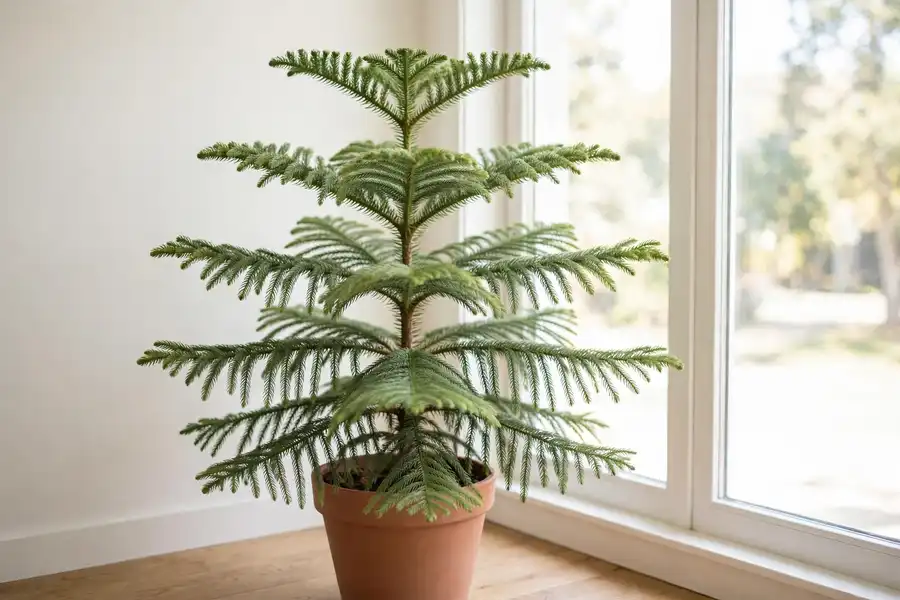
A related tree is the Cook pine (Araucaria columnaris). Neither is a true pine.
What else is called a "pine tree"?
| Name | What it is |
|---|---|
| Wollemi pine | Wollemia nobilis, a rare Australian conifer known from fossils and found in the wild in 1994. Fewer than 100 adult trees grow in the wild |
| Australian pine | Casuarina, a flowering tree that is invasive in Florida |
| Screw pine | Pandanus, a tropical plant |
| Umbrella pine | Italian stone pine, or the Japanese umbrella pine (Sciadopitys), a slow, unrelated conifer |
| Yew pine, fern pine, Buddhist pine | Podocarpus, used as hedges and screens |
| Monkey pine | Monkey puzzle tree (Araucaria araucana) |
| Cypress pine | Callitris, an Australian conifer |
| Pine apple | Pineapple, a ground-growing plant, not a tree |
| Pine oak or pin oak | Pin oak is an oak (Quercus palustris), not a pine. See our oak tree guide |
| Tamarack | A larch, not a pine |
What is pine wood and bark used for?
| Product | Use |
|---|---|
| Southern yellow pine lumber | Framing, decking and pressure-treated boards. It is a soft, strong wood |
| White pine | Trim, furniture, knotty pine paneling and millwork |
| Pine bark | Mulch and potting mixes. Nuggets break down slowly |
| Pine needles | Mulch and compost. See the how to compost guide |
| Pine resin | Turpentine, rosin and varnish |
| Firewood | Burns hot and fast and is sparky and resinous, so use seasoned wood |
Can you grow a pine tree in a pot or as a bonsai?
- Potted pines: dwarf types such as mugo grow in large containers outdoors for a few years. Water often and repot when roots circle.
- Bonsai: Japanese black, Japanese white, Scots and mugo pines are classic. Keep them outdoors in full sun, since they need winter dormancy. Pinch candles in spring, thin needles in summer and wire in fall or winter.
- Indoor pine tree: a true pine rarely survives indoors long, so people use Norfolk Island pine.
What does a pine tree symbolize?
Evergreen pines stand for endurance, long life and resilience in many cultures, and in Japan the pine is a symbol of longevity. The pine tree flag is a historic New England banner, now usually called the Appeal to Heaven flag, flown in the American Revolution.
Quick answers to common questions
What is the scientific name for a pine tree?
Pinus, in the family Pinaceae. Each species has its own name, such as Pinus strobus for eastern white pine.
How can you tell a pine tree from a spruce or fir?
Pines have long needles in bundles of 2, 3 or 5. Spruces have single, sharp, four-sided needles. Firs have single, flat, blunt needles.
How fast does a pine tree grow?
Fast types such as white pine and loblolly grow about 2 feet or more a year. Slow types like mugo grow about 6 inches.
Why is my pine tree turning brown?
Old inner needles browning in fall is normal. Tip browning usually means drought, salt, tip blight or beetles, and sudden browning can be pine wilt.
Can you grow a pine tree from a pine cone?
Yes, by planting the seeds inside it. Most need 1 to 3 months of cold first.
Keep reading: fast growing trees, oak tree, dogwood tree, magnolia tree and more lawn and garden guides.
Should you plant a pine tree?
Yes, if you have space and sun. A pine tree gives year-round green, a windbreak and privacy with little care. Choose a species that fits your climate and the mature size, keep it away from structures and watch the needles for early signs of trouble.