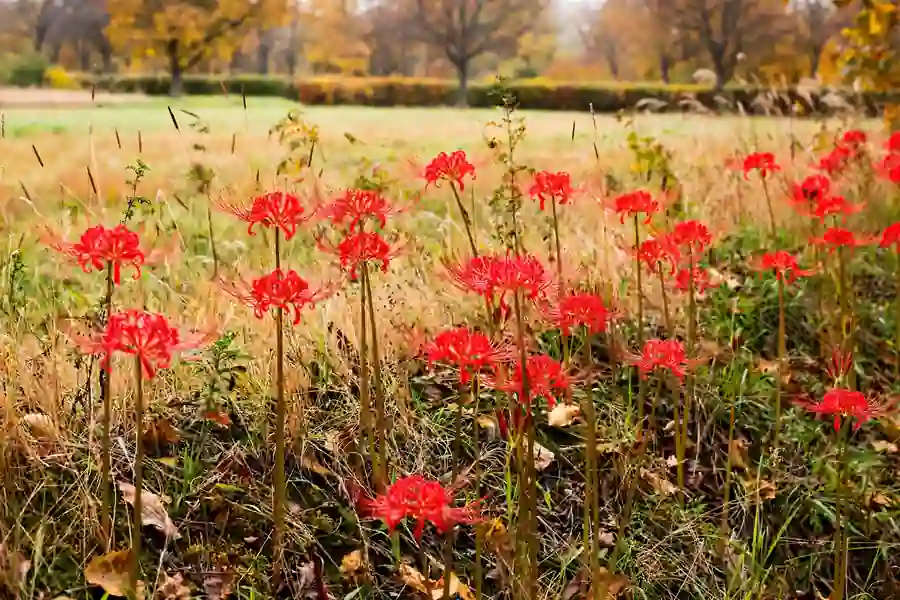
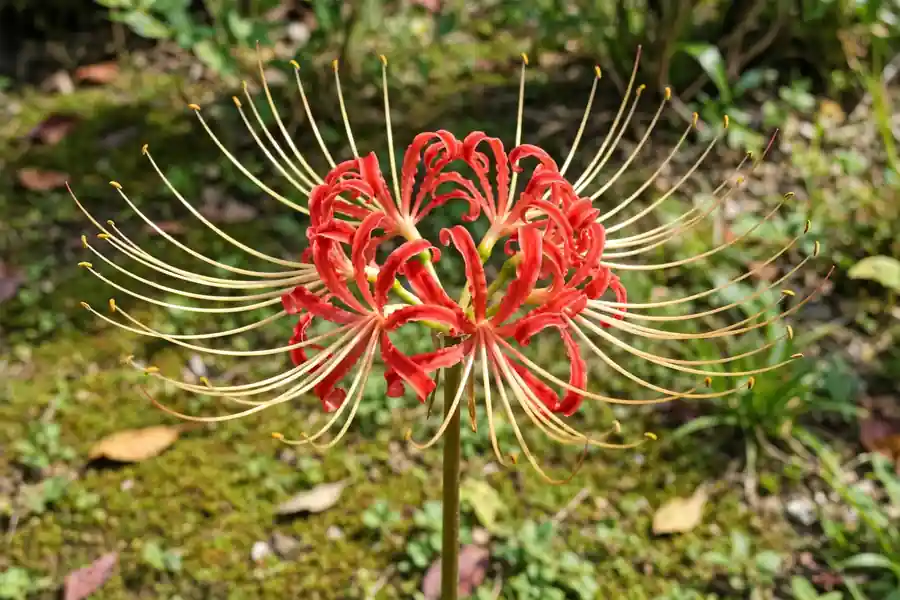
A spider lily is a bulb plant with a cluster of narrow, curled petals and long, curved stamens that make the flower look like a spider's legs. The best known is the red spider lily (Lycoris radiata), a late-summer and fall bloomer that sends up bare flower stalks before its leaves appear. Another group, the white spider lilies (Hymenocallis), has fragrant, spidery white flowers and likes moist soil. Spider lilies are not true lilies. They belong to the amaryllis family, grow from bulbs and are poisonous if eaten.
People look up spider lilies for different reasons: to grow them, to identify a red flower in a field, to learn what the flower means in Japanese folklore or to find out whether the "blue spider lily" is real. This guide covers all of that: the main types and colors, what the flower means, when it blooms, how to plant and care for the bulbs, how it spreads and whether it is safe for pets.
Spider lily at a glance
| Question | Short answer |
|---|---|
| What is it? | A bulb plant in the amaryllis family with spidery flowers |
| Is it a true lily? | No. True lilies are in the genus Lilium |
| Main groups | Red spider lily and relatives (Lycoris) and white spider lilies (Hymenocallis) |
| Red spider lily bloom time | Late summer to fall, often August to October |
| White spider lily bloom time | Summer |
| Flower look | Narrow, curled petals with long stamens that stick out |
| Colors | Red, pink, white, yellow, orange and lavender-pink. No true blue |
| Light | Full sun to light shade |
| Soil | Well-drained for Lycoris. Moist for most Hymenocallis |
| Hardiness | Red spider lily about zones 6 to 10. Hymenocallis varies by species |
| Planting time | Late summer to early fall, when Lycoris bulbs are dormant |
| Toxicity | The bulbs contain lycorine and are poisonous. Keep from pets and children |
| Difficulty | Easy once established |
What is a spider lily?
"Spider lily" is a common name for several bulb plants in the amaryllis family (Amaryllidaceae). It is not a true lily (Lilium). The two main groups are:
- Lycoris, native to East Asia (China, Japan and Korea). The red spider lily (Lycoris radiata) is the best known. Others include the golden spider lily (Lycoris aurea), the surprise lily or "naked lady" (Lycoris squamigera) and the electric blue spider lily (Lycoris sprengeri).
- Hymenocallis, native to the Americas. They have white, fragrant flowers and a cup-shaped ring between the stamens. Many grow in wet ground, such as swamps and riverbanks, in the southeastern US and farther south.
Other common names for the red spider lily are hurricane lily (it often blooms after late-summer storms), equinox flower, red magic lily and resurrection lily.
What does a spider lily look like?
- Flowers: a cluster (umbel) of 4 to 6 blooms on a bare stalk. Each has narrow petals that curl backward and long stamens that arch out beyond the petals.
- Stalk: 1 to 2 feet tall for red spider lily, with no leaves on it.
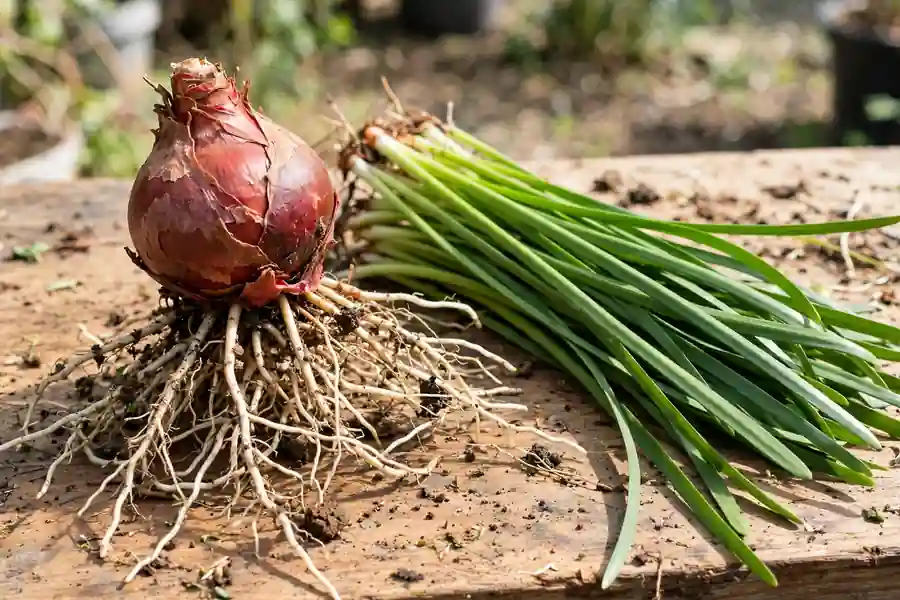
- Leaves: long, narrow and strap-like. On red spider lily they appear after the flowers fade, last through winter and die back by late spring.
- Bulb: a round bulb with a papery skin, like a small onion.
What are the main types of spider lily?
| Type | Latin name | Color | Bloom time | Notes |
|---|---|---|---|---|
| Red spider lily | Lycoris radiata | Red | Late summer to fall | The classic. Flowers come before leaves |
| Golden spider lily | Lycoris aurea | Yellow to gold | Late summer to fall | More tender than red, about zones 7 to 10 |
| Surprise lily, naked lady | Lycoris squamigera | Pink to lavender-pink | Midsummer | Hardier, about zones 5 or 6 to 9. Leaves come up in spring and vanish before the flowers |
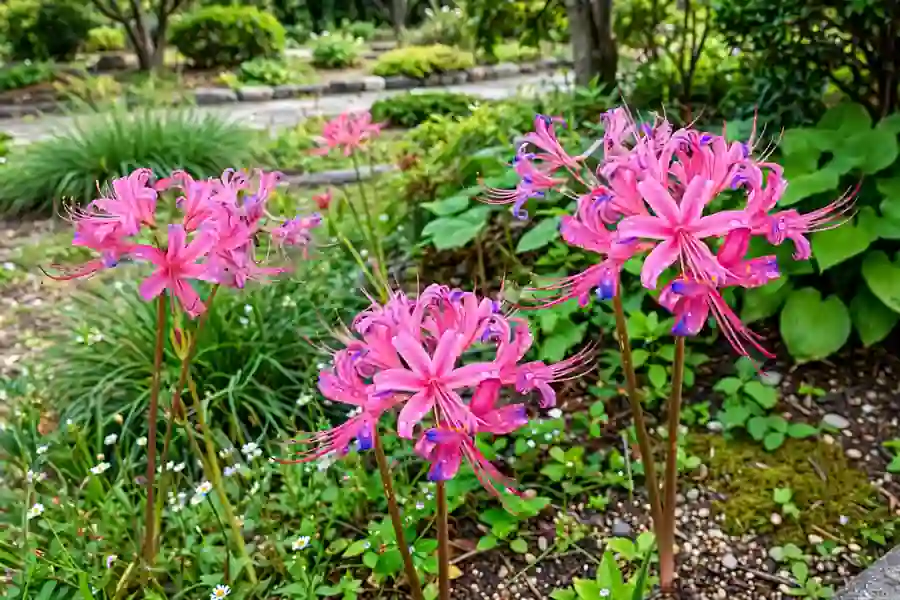
| Electric blue spider lily | Lycoris sprengeri | Pink with blue-violet tips | Midsummer | Not truly blue. The tips look blue or purple |
| White spider lily (Peruvian daffodil, beach spider lily) | Hymenocallis | White | Summer | Fragrant, spidery flowers. Many species like moist soil |
| Native spider lilies | Hymenocallis (such as Carolina, woodland and shoals species) | White | Summer | Wild forms of the southeastern US. Some are rare and protected |
| Black spider lily | Tacca chantrieri (bat flower) | Near-black | Warm months | A different tropical plant, not a spider lily, though sold under the name |
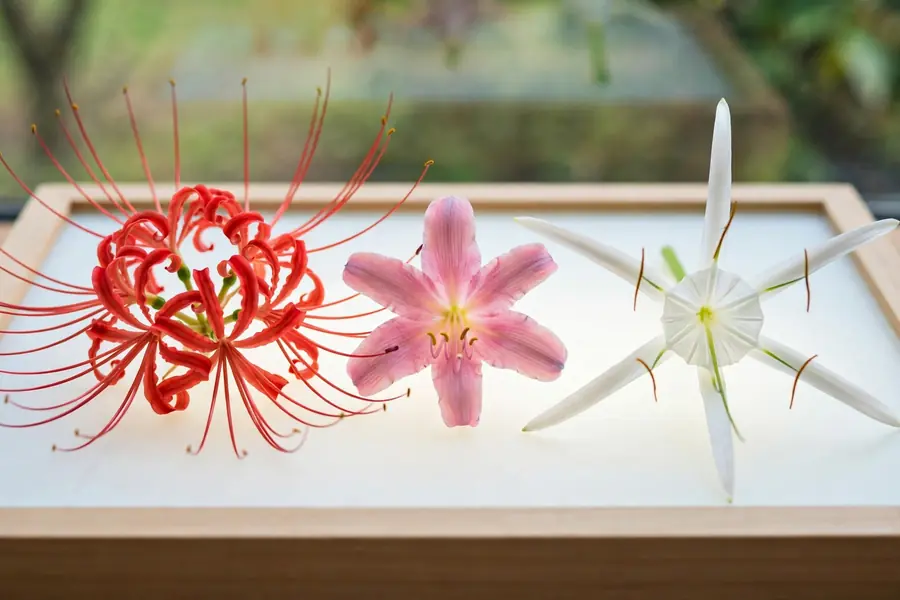
Hardiness zones and bloom dates vary by supplier and region, so check your bulb label. Hymenocallis species differ widely in cold hardiness, and tropical types need to be dug up or grown in pots in cold winters.
What colors do spider lilies come in?
| Color | Examples | Notes |
|---|---|---|
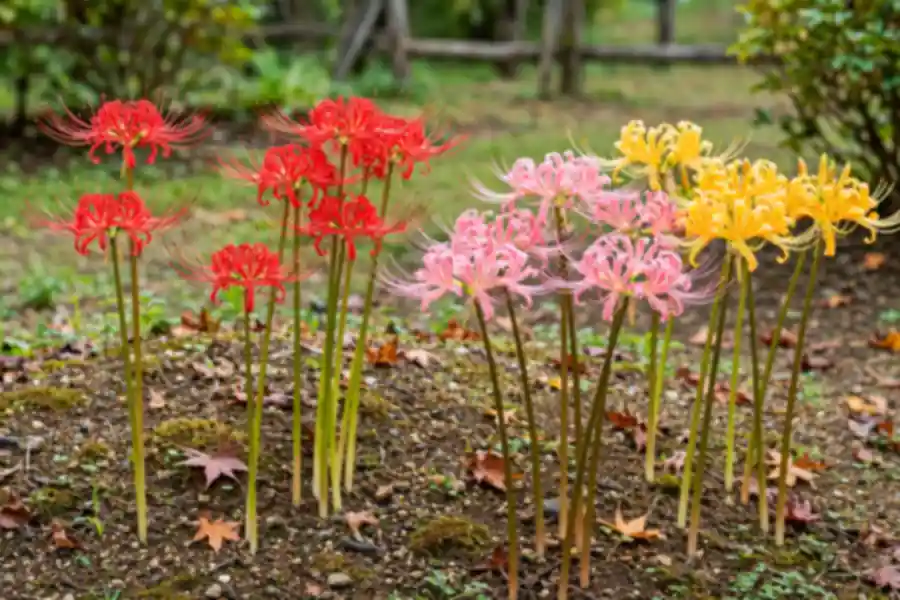
| Red | Red spider lily (Lycoris radiata) | The most common and best known |
| White | Hymenocallis, white forms of Lycoris such as Lycoris albiflora | Often fragrant |
| Pink | Surprise lily (Lycoris squamigera) and pink hybrids | Soft pink to lavender-pink |
| Yellow or gold | Golden spider lily (Lycoris aurea) | Needs a warmer climate |
| Orange | Orange-red Lycoris species and hybrids | Less common |
| Purple or lavender | Lycoris sprengeri and some hybrids | Usually pink with violet-blue tips |
| Green | Greenish throats in some Hymenocallis | Uncommon |
| Black | Not a Lycoris. The "black" plant is the tropical bat flower (Tacca) | A different plant |
Is the blue spider lily real?
No true blue spider lily exists. The "blue spider lily" is a famous flower from fiction, particularly anime and games, and it is not a real plant. Photos online that show glowing blue spider lilies are edited or digital art.
The closest real flower is Lycoris sprengeri, sold as electric blue spider lily. Its petals are pink with blue or violet tips, not blue throughout. Another way to get a blue look is with look-alike plants such as blue Agapanthus, which is not related.
What does the spider lily mean?
The red spider lily has a strong meaning in East Asian culture, especially in Japan, where it is called higanbana (the "equinox flower"). It blooms around the autumn equinox, during the Buddhist Higan holiday, when families visit graves.
Common meanings include:
- Farewell and separation: the flowers and leaves never appear at the same time, which inspired stories about lovers or spirits who cannot meet.
- Remembrance and the afterlife: it is planted near graves and rice paddy borders, and is linked to the idea of the "other shore" in Buddhism.
- Reunion and rebirth: in some traditions it guides souls or marks the passage between worlds.
- Death or bad luck: in parts of Japan the flower has a spooky reputation, with nicknames such as "death flower." This reflects the bulbs' poison and graveyard planting, not a real curse.
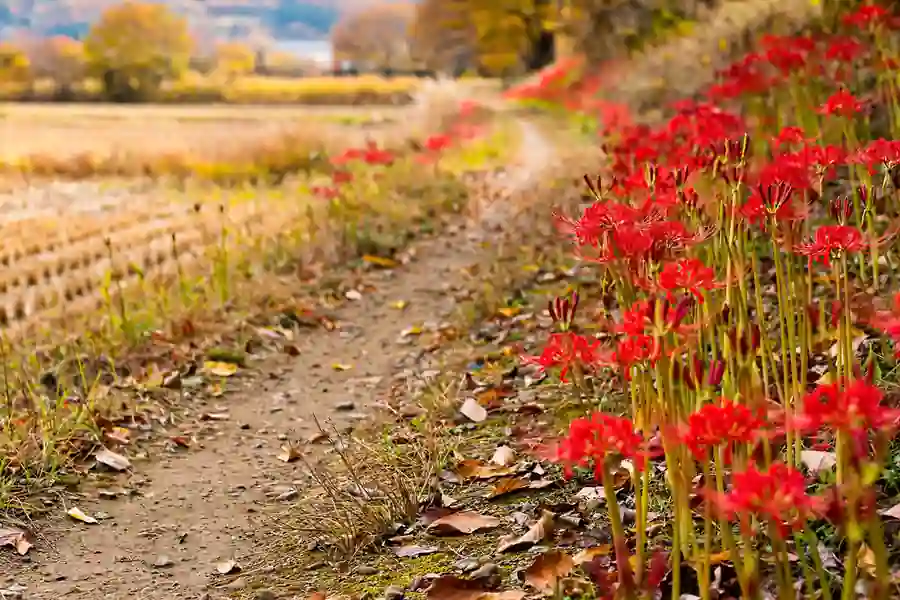
In flower language, red spider lily is often read as "never to meet again" or "lost memory." In Korea, related Lycoris are called "flowers of longing" for the same leaf-and-flower story.
Meaning by color is largely a modern flower-language idea, not a fixed tradition. White is often read as purity or a peaceful farewell, pink as gentle affection, yellow as nostalgia and red as passion and parting. The meanings differ among sources.
What does a spider lily tattoo mean? A spider lily tattoo usually follows the same meanings: remembrance, farewell, rebirth and the bond between life and death. Tattoo style and personal meaning vary, so choose a design with a meaning you understand.
Spiritual meaning: people connect spider lilies to transition, grief and renewal. These are cultural associations, not facts about the plant.
When do spider lilies bloom?
- Red spider lily: late summer to fall, usually August through October, a few days to a couple of weeks after rain in late summer. The bare flower stalks appear suddenly, and the leaves come later.
- Surprise lily: midsummer. Its leaves grow in spring, die back, then the flower stalk appears alone.
- Hymenocallis: summer, often in June to August, depending on species.
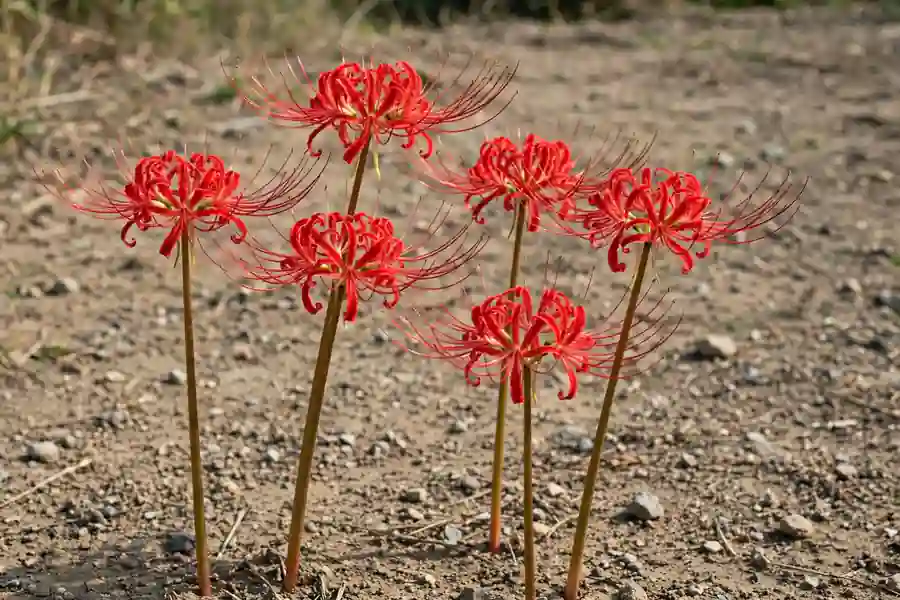
Why do spider lilies bloom before the leaves? Lycoris grow leaves in fall and winter, store energy in the bulb, then go dormant in summer. In late summer, the bulb sends up a flower stalk with no leaves. Because the flowers and leaves rarely overlap, the plant looks like it "appears from nowhere," which is why they are called naked ladies and surprise lilies.
How long do the flowers last? Each flower stalk stays in bloom for about one to two weeks, and a clump flowers over a couple of weeks.
Why is my spider lily not blooming?
| Reason | Fix |
|---|---|
| Newly planted bulbs | Bulbs often skip blooming for the first year while roots establish |
| Too much shade | Move to full sun to light shade |
| Leaves cut or mowed too early | Let winter and spring leaves die back naturally |
| Wet summer soil during dormancy | Plant in well-drained soil and avoid summer watering for Lycoris |
| Crowded bulbs | Divide after the leaves die back |
| Bulbs planted too deep | Replant at a modest depth |
| Too much nitrogen | Skip heavy fertilizer |
How do you plant spider lily bulbs?
When to plant: late summer to early fall, when red spider lily bulbs are dormant, or just as the flower stalks appear. Bulbs planted in late summer often skip blooming that year.
Where to plant:
- Full sun to light shade.
- Well-drained soil for Lycoris. Hymenocallis often prefers moist, rich soil.
- A spot where the winter leaves will not be smothered. Red spider lily leaves grow from fall to spring, so avoid beds covered in dense mulch or turf in winter.
How to plant:
- Loosen the soil and mix in a little compost. The compost guide explains how to make your own.
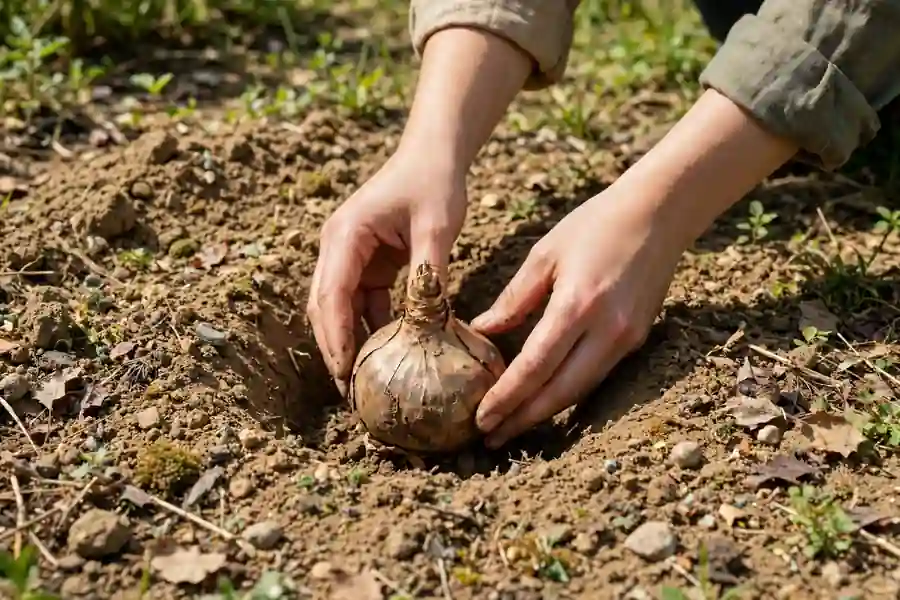
- Plant bulbs with the pointed end up. Sources disagree on exact depth. A common rule is to set the bulb about 2 to 3 times as deep as its height, with the neck near or just under the surface. Follow the supplier's label.
- Space bulbs 6 to 12 inches apart.
- Water once after planting, then keep the soil lightly moist while roots establish.
- Mark the spot, because the plant disappears in summer.
Can you grow spider lily in pots? Yes. Use a pot with drainage and a gritty mix, and keep red spider lily on the dry side in summer. Pots help in cold zones, because you can move them indoors.
Where do spider lilies grow best? Red spider lily thrives in the warm South and mid-Atlantic. In colder areas, mulch and a sheltered spot help, and zone 6 is generally the limit for Lycoris radiata. Hymenocallis are often found in warm, wet areas of the southeastern US, such as river edges.
How do you care for spider lilies?
- Water: Lycoris like regular water in fall through spring while the leaves grow, and dry conditions in summer dormancy. Hymenocallis like consistent moisture.
- Fertilizer: little needed. A light feeding of a balanced fertilizer in fall when leaves emerge is enough.
- Mulch: a thin layer is fine, but don't bury the bulb neck or the winter leaves.
- Leaves: leave them alone. They feed the bulb for next year's flowers. Cut them only after they turn yellow and collapse in spring.
- Flower stalks: remove them after they fade, if you like a tidy look.
- Winter protection: in the colder edge of the range, add a few inches of mulch over the bulbs and keep the leaves dry.
- Pests: spider lilies are rarely bothered by deer or rodents because the bulbs are toxic. Slugs may chew leaves in wet weather.
How do spider lilies spread, and can you grow them from seed?
Red spider lily spreads slowly by offset bulbs around the parent bulb. Most red spider lilies sold in the US are propagated from bulb divisions rather than seed, and many sources describe them as setting no viable seed. Because of that, plants called "red spider lily seeds" are not a reliable way to grow them. Buying bulbs from a reputable supplier is simpler.
How do you divide spider lilies? After several years, a clump gets crowded.
- Wait until the leaves die back in spring, or dig in late summer when the bulbs are dormant.
- Lift the clump and separate the offset bulbs.
- Replant right away at the same depth, 6 to 12 inches apart, and water in.
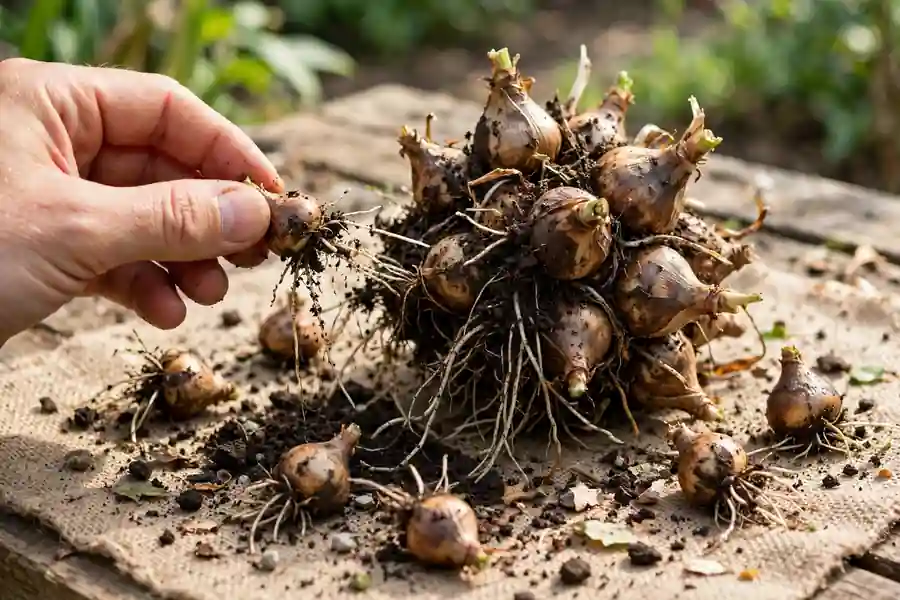
Hymenocallis can also be grown from seed, but offsets are faster.
Is a spider lily poisonous?
Yes. Spider lilies (Lycoris and related plants in the amaryllis family) contain lycorine, an alkaloid that is toxic if eaten. The bulb is the most poisonous part.
- People: eating the bulb can cause drooling, vomiting, diarrhea and abdominal pain. Don't eat any part of the plant, and keep the bulbs away from children. Wear gloves when handling many bulbs, since the sap can irritate sensitive skin.
- Dogs and cats: plants in this family are considered toxic to dogs and cats, with vomiting, drooling and diarrhea the common signs. Large amounts of bulb can cause more serious problems. Call your vet or the ASPCA Animal Poison Control Center at 888-426-4435 (a fee may apply) if a pet eats part of the plant.
I could not confirm an ASPCA listing for each individual species, so treat all spider lilies as toxic.
This poison is also why deer and rodents leave the plants alone, and why Japanese farmers planted red spider lily around rice paddies and graves.
What are the other plants called spider lily?
- Rocky shoals spider lily: a rare native Hymenocallis that grows in rocky river shoals in the Southeast. Do not dig wild plants. If you want one, buy nursery-grown stock.
- Beach spider lily: a tropical Hymenocallis with large, fragrant white flowers.
- Texas spider lily and woodland spider lily: native Hymenocallis species.
- Butterfly spider lily: a name used for some Hymenocallis cultivars.
- Giant spider lily: a large Crinum or Hymenocallis, depending on the seller. Check the Latin name.
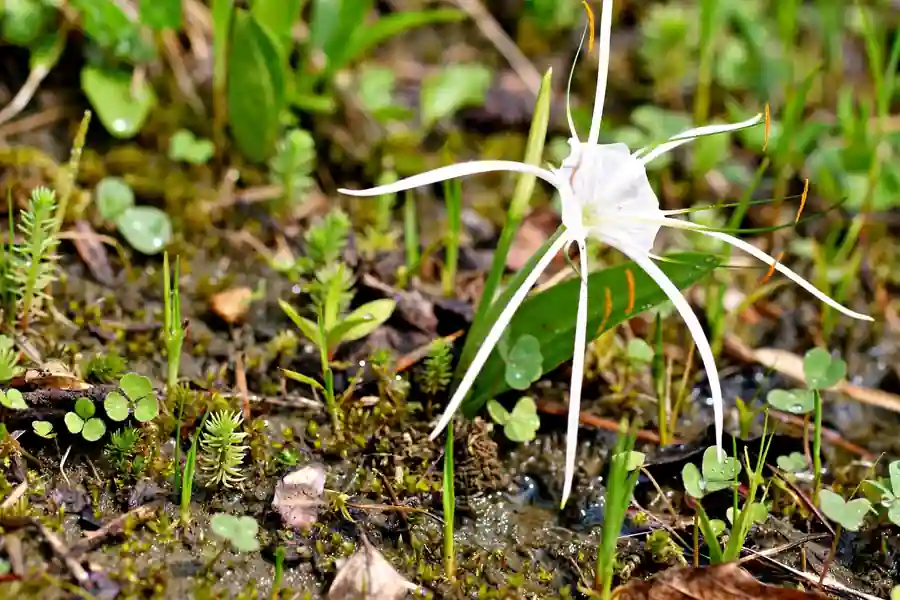
Spider lily vs lily: a true lily (Lilium) has scaly bulbs and flowers with six similar tepals, while spider lilies grow from papery-skinned bulbs and have distinctive curled petals and long stamens. Our guide to the lily flower covers true lilies in detail.
What flowers look like a spider lily? Crinum, Nerine (Guernsey lily), Amaryllis belladonna, and sometimes the tropical bat flower. Each is a bulb or tropical plant with a different set of needs.
Quick answers to common questions
What is a spider lily?
A bulb plant in the amaryllis family with spidery flowers. The best known are the red spider lily (Lycoris radiata) and the white spider lilies (Hymenocallis). They are not true lilies.
What does the red spider lily mean?
Farewell, separation, remembrance and rebirth. In Japan it is called higanbana and is linked to the autumn equinox, graves and the afterlife. Some people call it the death flower, but that is folklore.
Is the blue spider lily real?
No. The blue spider lily comes from fiction. The closest real plant is Lycoris sprengeri, which has pink petals with blue-violet tips.
When do spider lilies bloom?
Red spider lily blooms in late summer to fall, usually August through October, with bare stalks that appear before the leaves. Surprise lily blooms in midsummer, and white spider lilies bloom in summer.
Is a spider lily poisonous?
Yes. The bulbs contain lycorine and are toxic to people and pets. Keep them out of reach and call poison control if someone eats part of one.
Keep reading: lily flower, how to plant tulip bulbs, morning glory, how to compost and more lawn and garden guides.
Is a spider lily worth growing?
Yes. A spider lily rewards you with a surprising burst of color at the end of summer, when many gardens are fading. Plant the bulbs in well-drained soil in late summer or fall, leave the winter leaves alone, divide clumps every few years and keep the toxic bulbs away from pets and children. Pick the red spider lily for a dramatic fall show or a white Hymenocallis for a fragrant, moisture-loving summer flower, and you will enjoy your spider lily for many years.